In the late summer of 1944, red ball markers went up along narrow country roads in northern France. Army trucks followed them day and night, always in one direction. Their cargo beds held gasoline, ammunition and food.
A tank stops when its fuel runs out, however fast it is. That was the problem facing the US Army as it crossed France after the Normandy landings. Supply, transport and maintenance together are called logistics, and the Red Ball Express shows what World War II logistics looked like on the road.
The sections below look at why this truck route appeared and how it worked, who sat behind the wheel, and why the numbers differ from one source to the next.
When the advance outran supply
American, British and Canadian forces came ashore in Normandy on June 6, 1944, and then spent weeks fighting to widen the beachhead and get out of it. In the middle of July, France held over a million Allied troops, yet their foothold measured just 50 miles across and 20 miles deep.
Things changed with Operation Cobra, launched on July 25. US foot soldiers and tanks escaped the maze of Normandy hedgerows and reached open farmland in the middle of France. From then on, some Third Army units under George S. Patton Jr. frequently gained over 80 miles in a week, and by late August a large part of northern France, Paris included, was free.
Speed came at a price. In many cases, the leading units started to run ahead of the fuel, food and ammunition meant for them.
On June 14, 2004, the House debated a resolution honoring the Red Ball Express. In that debate, Representative Hunter of California spoke about the end of August 1944, when troops entered Paris. By his account, the US First and Third Armies were burning 800,000 gallons of gasoline a day, and their reserves were gone.
Why the railways and ports could not carry the load
France had railways, but they were in no shape to use. To deny the Germans the French rail network, Allied bombers had wrecked many bridges, steam locomotives and rail yards. That damage also kept the Allies from hauling their own supplies by train.
The ports were another problem. Most of what the growing armies needed, from fuel to rations to shells, was landed at Cherbourg in Normandy. From there, trucks carried it over narrow country roads to American supply dumps in a triangle formed by Chartres, La Loupe and Dreux.
Antwerp, the large port in Belgium, fell to British forces on September 4 with its port facilities nearly intact. But the Germans still held the Scheldt estuary, the waterway that leads from the North Sea to the port, so no ships could get in. Only after the river was cleared of mines did the first convoy enter the port, on November 28. Until then, wheels had to cover the long distance between the port and the front.
A one-way road marked with red balls
The answer American commanders came up with was a road set aside for trucks. Its name came from the red dots that US railways used to mark priority express trains. Red ball markers went up along the road as well.
The name of the organization behind it differs slightly by source. The House resolution text names the Army Motor Transportation Service, and the Defense Department news service article names the Army Transportation Corps. An article from The National WWII Museum names Brigadier General Ewart G. Plank as the officer who put the convoy system into action.
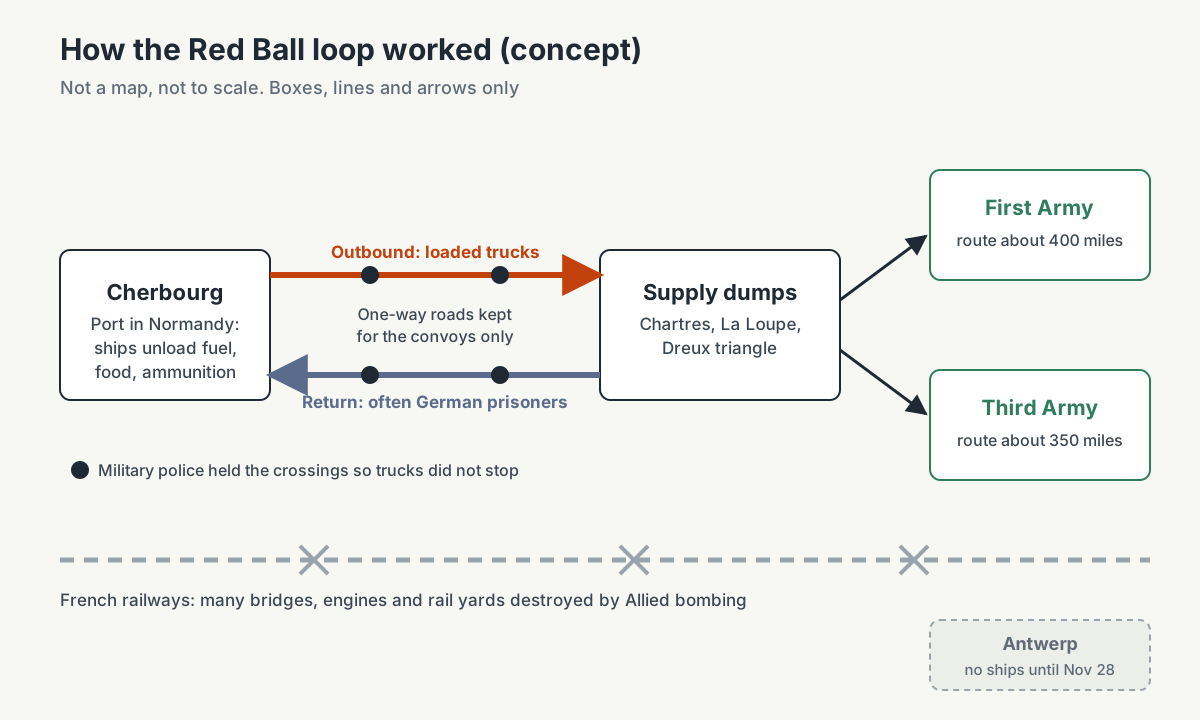
The route ran from Normandy to Paris and later to the front in France's northeastern borderland. Trucks followed one-way roads reserved for the convoys and kept circling the loop without a break. Military police stood at the crossings so that no truck had to stop for anything, and returning trucks often carried German prisoners.
The trucks never stopped, day or night, any day of the week. A 2019 Army article puts the haul at 400 miles to reach the First Army and 350 to reach the Third. At the busiest point, 140 truck companies lined the route, and a trip from Cherbourg to Chartres and back took 54 hours. Drivers often worked in pairs.
Plans and practice were not the same. The original plan called for jeep-led convoys moving at 25 miles per hour, with 60 yards between trucks. In practice, trucks often drove alone, pulled out of Cherbourg the moment their loads were on, and topped 60 miles per hour even with their lights blacked out.
The people who drove the trucks
Most of the drivers were African American soldiers. The House resolution states that in the war, many commanders judged African American soldiers unfit for combat and sent them to supply, support and service work instead. In his floor speech, Representative Hunter said they served in truck companies and quartermaster units segregated by race.
By the time the Red Ball ended, the number of African American soldiers in Europe stood at 210,209, according to the Defense Department news service article. Of these, 93,292 belonged to the Quartermaster Corps. Not every driver had been trained to drive a truck, but the emergency pushed them into the job. Most were under 24, and few had driven trucks before the war.
The road was dangerous. Crashes, exhaustion and enemy aircraft were only some of the dangers on the route. Soldiers piled sandbags in their cabs to soften mine blasts, and the trucks wore down fast, with engines running hot, motors burning out and tires going bald.
Drivers began to ignore speed and load limits and to push past their own exhaustion. The Army responded by putting relief drivers in the passenger seat. General Dwight D. Eisenhower gave the Red Ball Express a name of his own: the "lifeline."
Numbers that differ by source
The Red Ball story is well known, but its numbers do not settle on one value. The chart and list below copy each value as its source gives it.
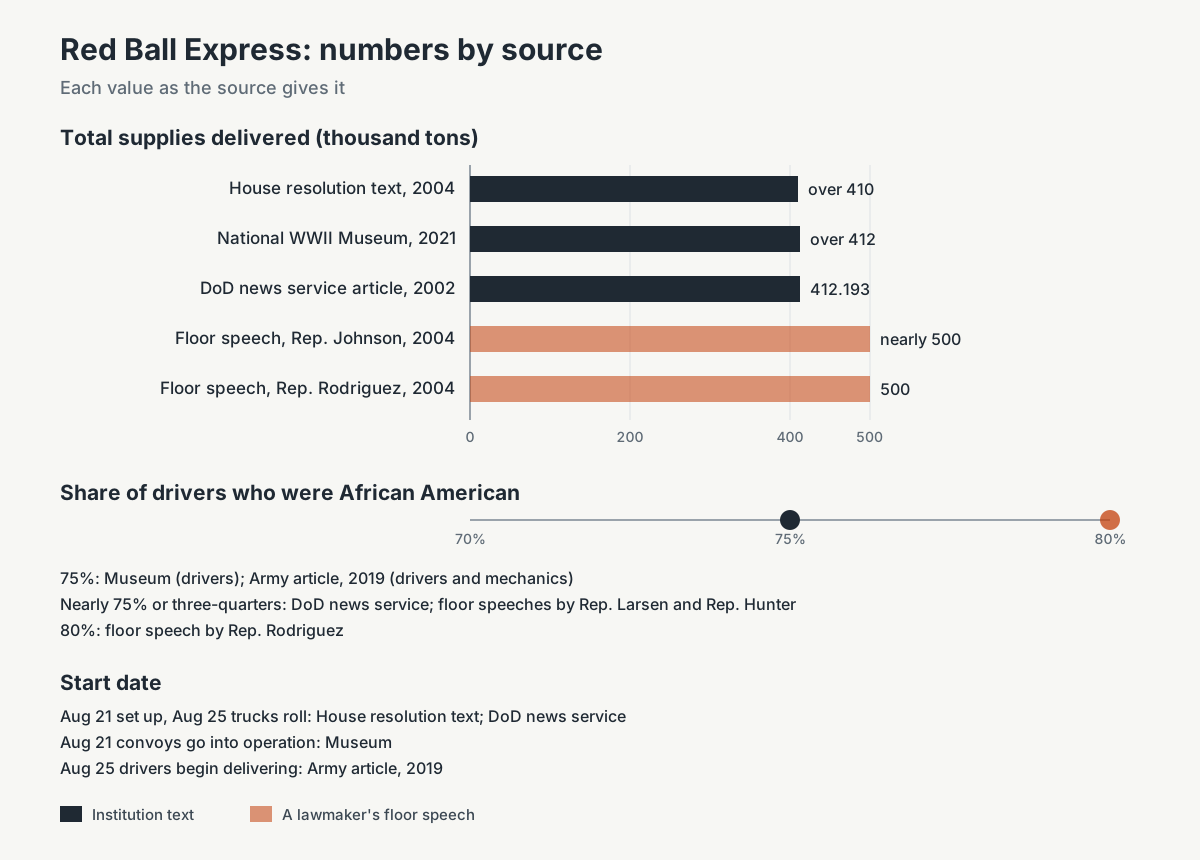
- Total tonnage: House resolution text, over 410,000 tons; the museum, over 412,000 tons; the Defense Department news service article, 412,193 tons. In floor speeches, Representative Eddie Bernice Johnson gave nearly 500,000 tons and Representative Rodriguez 500,000 tons.
- Start date: House resolution text and the Defense Department news service, set up August 21 and running from August 25. The museum, in operation from August 21. The 2019 Army article, delivering from August 25.
- The number 6,000: the museum, more than 6,000 trucks; the Army article, over 6,000 truck drivers; Representative Hunter's floor speech, nearly 6,000 vehicles at its height.
- Share of African American drivers: the museum, 75%; the Army article, 75% of drivers and mechanics; the Defense Department news service, nearly 75%; Representative Hunter, three-quarters; Representative Rodriguez, 80%.
The resolution text is what the House voted to pass, while a floor speech is one member's words in support of it. That is why the chart marks the two in different colors.
The end after 82 days
Several sources agree that the Red Ball Express ran for 82 days. According to the museum article, 900 vehicles on average were rolling at any moment, and they hauled an estimated 12,000 tons a day. The cargo reached 28 divisions.
Sources word the end date differently. It appears as mid-November in the Defense Department news service article, November 1944 in the House resolution, and the end of November in the museum article. Representative Rodriguez's speech gives the dates August 25 to November 16.
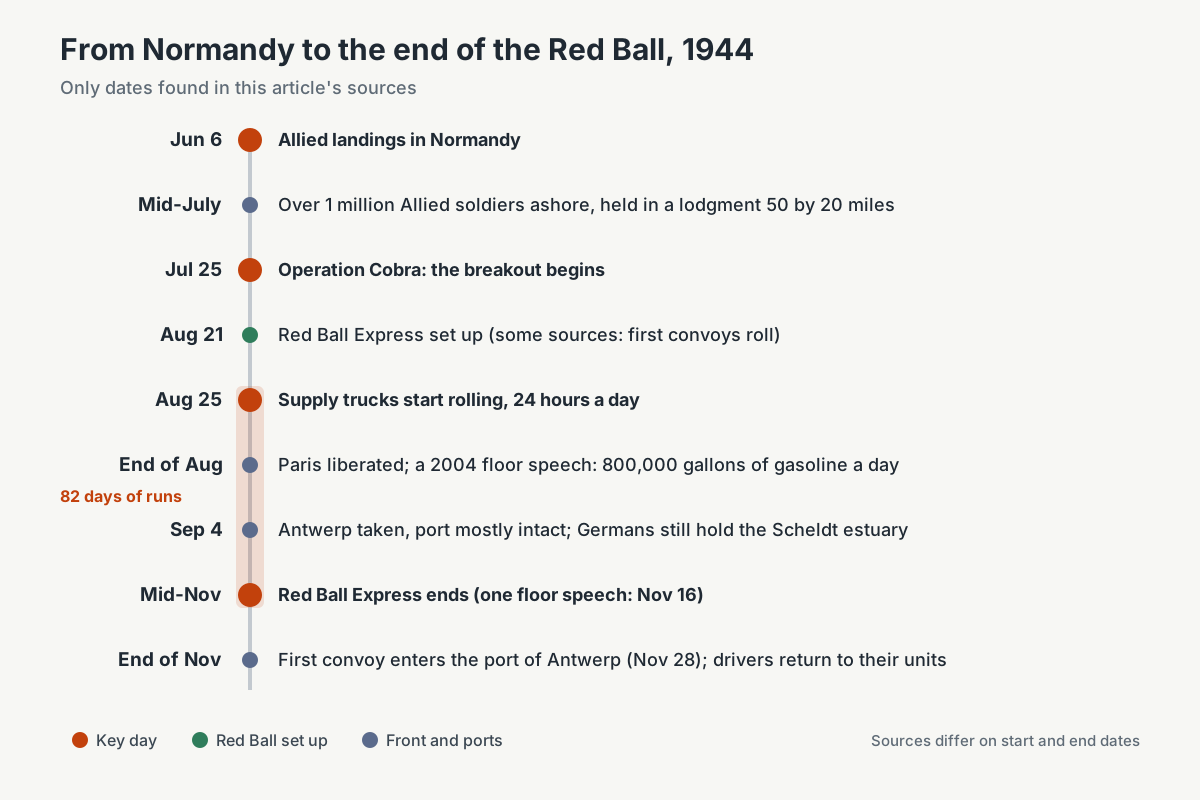
Once Antwerp was open to shipping, the Red Ball drivers went back to their own units. Because the Red Ball worked so well, several similar convoy systems were set up across France whenever the need arose.
What the Red Ball left behind
The museum article calls the 1944 US Army the world's most mechanized military, and notes that the German Army still leaned heavily on horses to move things. The Army publicized the drivers' work widely, and a 1952 movie took the same name. The movie is a story; the numbers and dates in this article come from institutional sources.
On June 14, 2004, the US House passed a resolution honoring the men of the Red Ball Express, with two-thirds voting in favor. In its words, they served despite humiliations and unequal treatment.
At the 75th anniversary in 2019, Lieutenant General Aundre F. Piggee, the Army's Deputy Chief of Staff for logistics (G-4), spoke about his father, Sergeant Roland Piggee, who had been a Red Ball driver. He said a future Red Ball might involve robots loading supplies, driverless trucks in convoys and unmanned aircraft delivering supplies. In his words, the challenge is to raise resupply throughput while cutting the number of drivers and the risk to convoys.
What to read next
- Military logistics: performance must be sustainable: what logistics covers, leading on to the "magazine depth" question for laser weapons.
- Turning points in military technology: what changed the course of technology in the same war.
- D-Day in Normandy: The Preparation and the Day Itself: the story just before the Red Ball.
- The Battle of the Bulge: Germany's Last Offensive in the Winter Forest: the period that followed the Red Ball.