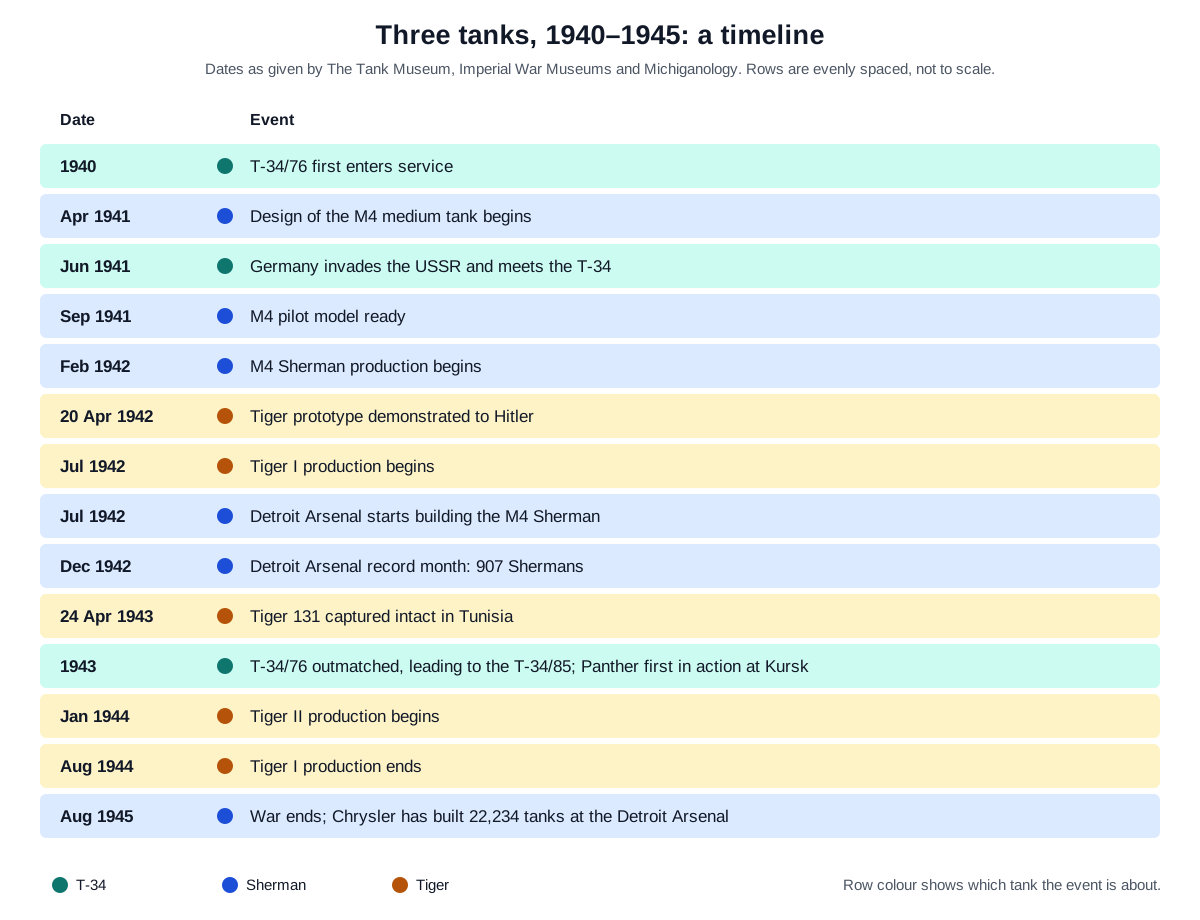
In April 1943, on a hill in Tunisia, British troops took a German tank almost intact. It was Tiger 131, the first complete Tiger I captured by the Western Allies. King George VI and Churchill came to see it, and the tank was shipped to London and put on show at Horse Guards Parade.
Four months earlier, in December 1942, 5,000 workers at the Detroit Arsenal in the United States set a record by building 907 Shermans in one month. The Soviet Union had put off upgrading the T-34 so that production would not be interrupted. Around 1943, when newer German tanks outmatched it, the Soviets built the T-34/85 with a new turret.
Three tanks from the same war took very different paths. Museum records show what ideas shaped each one, how they differed, and how the numbers and reputations vary between sources.
A war in which tanks took center stage
Britain was the first to use tanks on a mass scale, in the First World War. By the Second World War, though, it was the German forces that had built tanks more fully into the way they fought, and Germany held the initiative early on. Imperial War Museums (IWM) describes armored clashes in the Second World War on a scale never seen before or since. Tanks were part of turning-point battles such as El Alamein in 1942 and Kursk in 1943.
Later in the war the balance shifted. German forces had heavily armed tanks like the Tiger, but Allied industry put more tanks into the field. Allied tank designs and the way the Allies used armor improved as well. The differences between the three tanks make most sense against this background.
The T-34: the surprise of 1941
First fielded in 1940, the T-34/76 served the Soviet army as a medium tank. The Tank Museum in Bovington credits it with a strong balance of firepower, armor protection and mobility. Its 76.2 mm gun was a match for any tank then in service. Its thick, sloped armor was hard for the anti-tank weapons of that period to defeat.
When Germany invaded the Soviet Union in June 1941, its forces were caught off guard by how many Soviet tanks there were and how good they were. General von Kleist of the German army described the T-34/76 as "the finest tank in the world." According to The Tank Museum, Hitler ordered a copy of the T-34, and what came out of that order was the Panther, first in combat at Kursk in 1943.
The lead did not last. By 1943 newer German tanks had overtaken the T-34/76. Until then the Soviets had refused upgrades that would interrupt production and thin the stream of tanks reaching the front, but that was no longer possible.
The result was the T-34/85. A new, larger turret carried an 85 mm gun, thicker armor on the turret front, and room for three men. The rest of the tank stayed essentially the same.
The Sherman: built in numbers, easy to repair
Work on the M4 medium tank's design started in April 1941. The pilot vehicle followed that September, and series production started in February 1942. The engine, transmission and suspension followed the earlier M3 Grant. The difference was a turret on top of the hull that turned all the way around and held the main gun.
What the Sherman was meant to do is often misunderstood. IWM curator John Delaney explains that it was not designed from the start to fight other tanks. Its primary role was infantry support.
Above all, production came first. According to Delaney, Roosevelt wanted 45,000 tanks a year, which led to decisions that put ease, simplicity and speed of production ahead of battlefield survivability and firepower. Five main variants and their sub-variants came out of 10 main plants across the United States, but the same mechanical and electrical parts were used wherever possible. The front section, holding the gearbox, differential and final drives, was one unit that could be unbolted and swapped for another.
The car industry took on the job. In mid-1940 the U.S. government approached Chrysler's president, K.T. Keller, to ask whether his company could build tanks. Keller said "Yes," then asked, "Where can I see one?"
The Detroit Arsenal, a plant the government built for Chrysler to make tanks, started building Shermans in July 1942. By the end of the war in August 1945, it had turned out 22,234 tanks of all kinds, Shermans included.
The Sherman's reputation had a dark side. Its habit of catching fire earned it the nickname "Ronson," after a brand of lighter. Delaney explains that analysis found a penetrated Sherman caught fire in 60–80% of cases, and that the cause was where the ammunition was stowed.
The eventual fix was "wet stowage." Ammunition went into armored boxes set into the floor of the tank, with one more in the turret.
The gun aged as well. By 1943 the Sherman's dual-purpose 75 mm gun had fallen behind German weapons. An officer at Lulworth Camp in Britain proposed mounting Britain's 17-pounder, and the result was the Sherman Firefly. The Firefly worked well in action, but its armor was unchanged, so it stayed very vulnerable, and in IWM's account they were always in short supply.
The Tiger: thick armor and an 88 mm gun
The German Army wanted a heavy tank from before the war. Analysis of combat in France in 1940 then showed that future battlefields would need a stronger gun and thicker armor. Henschel and Porsche competed to build the new heavy tank, which was to carry an 88 mm turret made by Krupp.
On 20 April 1942, Hitler's birthday, a prototype Tiger was demonstrated to him. Trials that year showed problems with the Porsche tank: its engine and drive train were unreliable and used too much scarce copper. Henschel's design won the contract and, was refined through 1942 into the Tiger I.
The way it was built also differed from the American approach. Henschel assembled the Tiger I at its factory in Kassel, at the hub of a wide web of companies that made components and shipped them by rail. Krupp in Essen made the armor plate for hulls and turrets, and Maybach in Friedrichshafen made the engines. Instead of a modern production line, assembly ran in nine stages, and each tank took about 14 days in total.
When the Tiger I first appeared in battle in 1942, it frightened Allied tank crews. Its front armor was 100 mm thick and its main gun was an 88 mm. It also had problems: its reliability was poor, and fires started easily. The Tiger I first fought on the Eastern Front, then in North Africa and on every other major European front.
The Allies responded. By 1943 the powerful 17-pounder anti-tank gun was being rushed into service to counter the Tiger.
Side by side
Putting the three tanks in one table makes the contrasts easy to see. Each museum lists a different variant, though, so the values are not measured on the same basis. The table below copies the figures from The Tank Museum and the National WWII Museum in New Orleans, with each variant named.
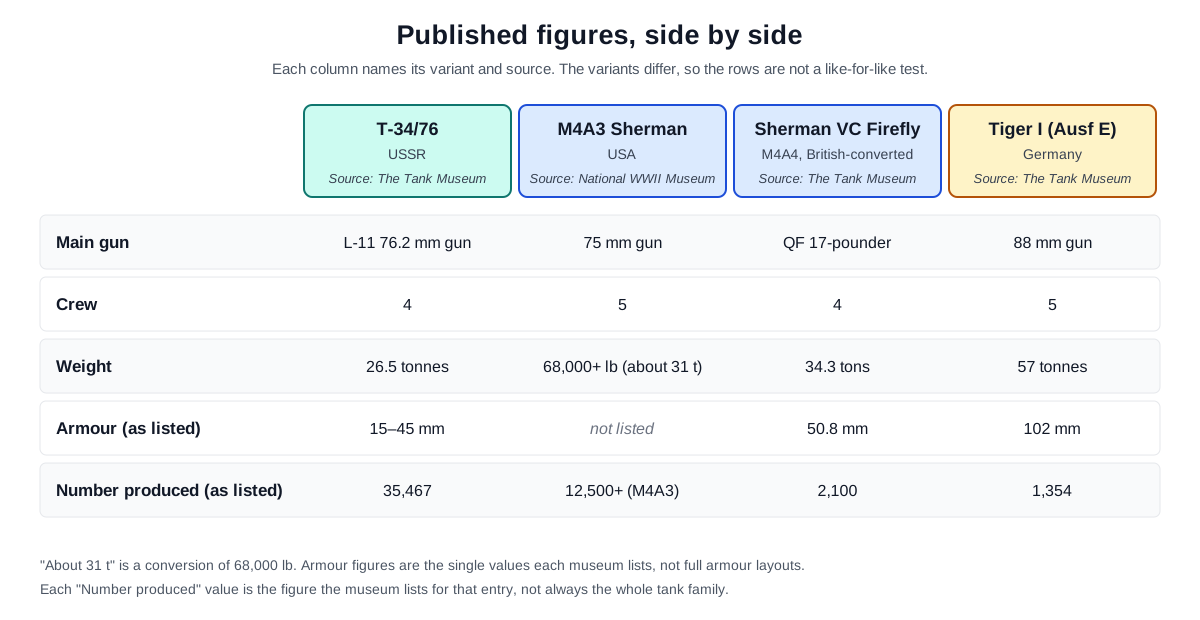
Weight alone shows a big gap. The T-34/76 weighed 26.5 t, the M4A3 Sherman more than 68,000 lb (about 31 t), and the Tiger I 57 t. That makes the Tiger I more than twice as heavy as the T-34/76. The T-34/76 had a crew of 4, while the M4A3 Sherman and the Tiger I each had 5.
How to read these differences depends on where you stand. Describing the Normandy campaign, IWM notes that German tanks and self-propelled guns were fewer but generally better armed. It adds that the Panther and Tiger were far better armored than the Sherman and Cromwell. Delaney sums up the Sherman as moderate in firepower, survivability and maneuverability, but much better in reliability, ease of production and ease of field maintenance.
Delaney likens comparing the Sherman with German heavy tanks to comparing a mass-produced family car with a Ferrari. On straight-line speed the Ferrari wins; on cost and speed of manufacture the family car wins. The comparison captures the difference in design goals. Unlike cars, though, tanks were weapons that faced each other on the battlefield, and the comparison leaves that out.
The National WWII Museum's description of the Sherman holds both sides too. Shermans were often outgunned by German tanks and fell far short of the Tiger, Panther and King Tiger. Yet they were easier to maintain and were often fixed right on the battlefield.
Numbers and myths
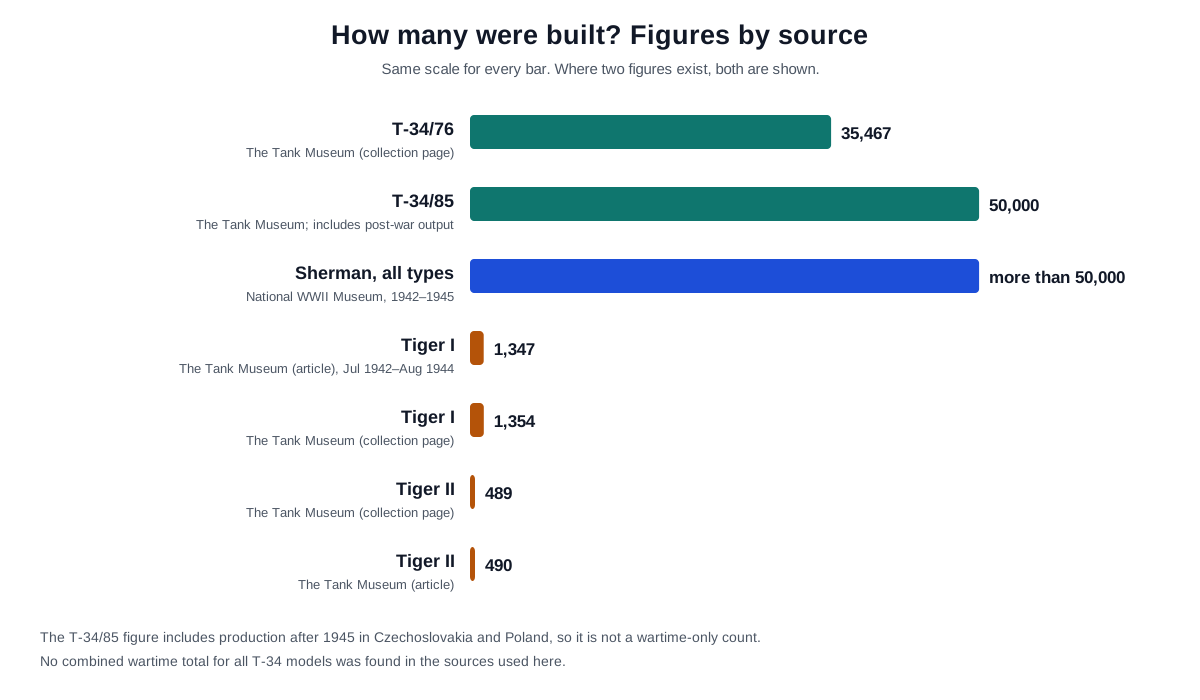
Sources also differ on how many were built. According to the National WWII Museum, the United States built over 50,000 Shermans between 1942 and 1945. The Tank Museum's collection pages list 35,467 for the T-34/76 and 50,000 for the T-34/85, but the T-34/85 figure includes tanks built after the war in Czechoslovakia and Poland. Poland alone built around 1,380 between 1951 and 1955.
The Tiger numbers are small by comparison. A Tank Museum article says 1,347 Tiger Is were built from July 1942 to August 1944, while the museum's collection page lists 1,354. For the Tiger II that followed, the article gives 490 and the collection page gives 489, built from January 1944 to March 1945.
Reputation and reality were also apart: The Tank Museum writes that the Tiger's reputation rests more on myth than fact. Allied tank crews feared meeting a Tiger, but in practice such a meeting was very unlikely. Too few Tigers ever reached the field to change the course of the war. The Panther, too, was produced slowly and was never numerous enough to make a serious difference on the Russian, Italian or north-west European fronts.
Alarmed by the Tiger's potential, the Allies were determined to get hold of one. Tiger 131 was the first complete example. It was captured on 24 April 1943 on Point 174, between Medjez el Bab and Montarnaud in Tunisia. The captors were the British 142nd Battalion, Royal Armoured Corps (RAC), and the 2nd Battalion, Sherwood Foresters.
What they left behind
All three tanks lasted well beyond the war. The T-34/85 spearheaded the Soviet advance across Eastern Europe into Germany, and after the war it served with more than 40 nations for decades. Delaney explains that Shermans stayed in service with the post-war French Army much longer than captured Panthers. He adds that the last frontline Sherman unit left service with the Chilean Army in 2003.
Museums kept the story too, starting in 1940, when Britain set up a Tank Mission in Washington led by Michael Dewar; the Lend-Lease Act followed in March 1941. The first Sherman delivered under Lend-Lease was named MICHAEL in Dewar's honor and shown on Horse Guards Parade in London. Today it is the oldest surviving Sherman, held by The Tank Museum. Tiger 131 has been in the museum's collection since 1951, and a plan made in the early 1990s returned it to running order in 2004.
Reading today's main battle tank (MBT) as a balance of firepower, protection and mobility continues in Main battle tanks: is it all about the gun?.
What to read next
- Main battle tanks: is it all about the gun?: post-war tanks read as a balance of firepower, protection and mobility.
- Composite and reactive armor: the blocks on a tank: what the blocks on a tank's surface are.
- The First Tanks and Cambrai: Machines Built to Cross Trenches: how the tank first appeared in the First World War.
- The Battle of Kursk: Record and Myth of a Huge Tank Battle: the big 1943 tank battle where the Panther first fought.