You need to see, yet the light has to be stopped. Laser safety eyewear has to meet both needs at once. The conditions in a booklet from Public Health England (PHE) say the same thing. Everything in the work area should stay visible, while optical radiation is held to acceptable levels.
Laser eyewear is not a lens that simply darkens everything. It is a filter that sharply cuts light at chosen wavelengths and lets as much of the rest through as it can. There are two main ways to cut the light: an absorptive filter that absorbs it, and a reflective filter that sends it back.
The sections below look at how each type works, how they differ, and when a filter alone falls short. How to read the wavelength and OD marked on eyewear is covered in the earlier article "Laser safety: classes and how to read eyewear labels". This article explains the principle. It does not replace safety training or the judgment of a laser safety officer.
What the eyewear reduces
The Laser Institute of America (LIA) has posted sample pages of ANSI Z136.1-2022, the US laser safety standard. In that sample, laser protective eyewear is built for a single wavelength, a set of wavelengths or a band, and must suit the laser in use. The means are special absorptive filter materials, reflective coatings, or both. The goal is to bring the possible exposure of the eye down to or below the maximum permissible exposure (MPE).
Reducing light is called attenuation. In the sample's glossary, it is the drop in power or energy as light passes through a medium that absorbs or scatters it. An eyewear filter is a medium made to cause a large attenuation only at chosen wavelengths.
How much it reduces is written as optical density (OD), a logarithmic measure. In a table from the US Army Public Health Center (APHC), OD 1 passes 10% of the light, OD 3 passes 0.1% and OD 6 passes 0.0001%. That does not make OD 6.0 always enough. APHC adds that it might still fall short of reducing a laser exposure to safe levels, and that the OD needed is always set for each laser.
Absorptive filters: a pigment takes in the light
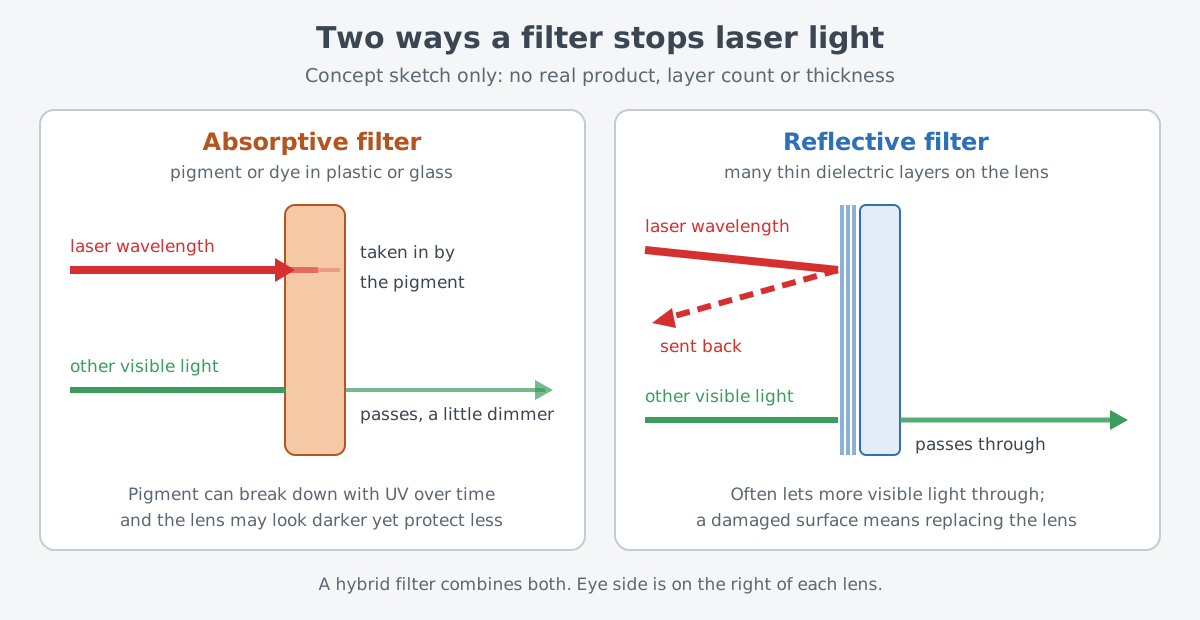
In the APHC guide, the most common laser eyewear uses absorption. The lens holds a pigment made to absorb the wavelengths that must be blocked. On the guide page of the eyewear maker NoIR, absorptive filters come in two materials: dye in a polymer, or glass.
Picture a sponge that soaks up one kind of liquid. Unlike a sponge, though, how much the pigment takes in changes a lot from one wavelength to the next. Absorption curves of eyewear are not linear, so blocking one wavelength range does not imply blocking the wavelengths next to it.
The pigment does not pick out only the wavelengths it is meant for. It can also absorb part of the visible light, so the world may look a little dimmer through an absorptive lens.
Where does the absorbed energy go? When laser light falls on an object, part of it is absorbed. That raises the temperature of the surface or interior and may change or deform the material. The University of Texas at Austin laser safety handbook gives this as a laser hazard, and it applies to any object hit by the light, not only eyewear.
Eyewear filters have their own requirement. The ANSI sample says a protective filter must show a damage threshold for a set exposure time, typically 10 seconds. The eyewear must also be used so that even the worst-case exposure stays below that threshold. The damage threshold of optical parts is explained under laser-induced damage threshold (LIDT).
Absorptive lenses also age. According to APHC, the pigment can break down over time, usually from UV light. The lens then looks darker to the eye, yet its protection may get weaker. Worn eyewear can turn brittle, so any that is cracked or darkened should be replaced.
Reflective filters: thin layers send light back
Reflective eyewear is also called dielectric-coated eyewear. The lens carries many thin films of dielectric material, and some wavelengths bounce off these films while others pass straight through. That is how the APHC guide pictures the reflective type. It is one kind of optical coating, a layer put on a lens face to change how it reflects and transmits light.
How can a thin film pick out colors? The rainbow colors on an oil slick or a sunlit soap bubble come from the same effect. Light bouncing off the upper and lower faces of the film overlaps and shows interference. Where the crests line up, the reflection grows, and where they miss, it fades, which is called thin-film interference.
Which color reflects strongly depends on the film thickness, the wavelength and the refractive index together. For light hitting the surface straight on, the ray from the bottom face travels about twice the film thickness farther than the ray from the top. How that extra path compares with the wavelength decides whether the two rays help or cancel each other.
Films can also be stacked. A standard high-reflectance laser mirror is a Bragg mirror, a stack of layers that alternate between high and low refractive index. Such a dielectric multilayer reflects strongly only over one range of wavelengths, and the reflection drops sharply at the edges. Keller's textbook Ultrafast Lasers calls this range the stop band.
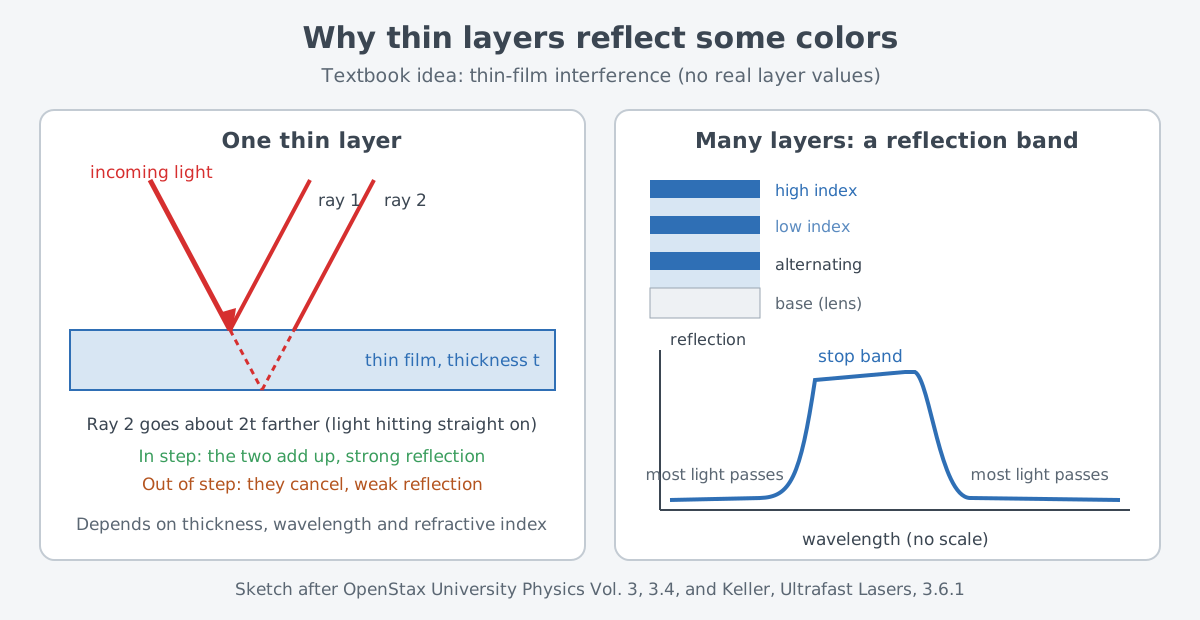
Reflective eyewear filters are built from stacked thin films in the same way. In the APHC guide, stacking films can cover a wide wavelength range, and reflective eyewear usually lets more visible light through than absorptive eyewear. On the other hand, some reflective eyewear protects only a very narrow range, so it has to be checked against the laser output.
The basics of interference are in "Interference and diffraction: how light adds up and spreads". Coatings inside laser equipment are in "Mirrors, lenses and coatings: optics for strong light".
Comparing the two
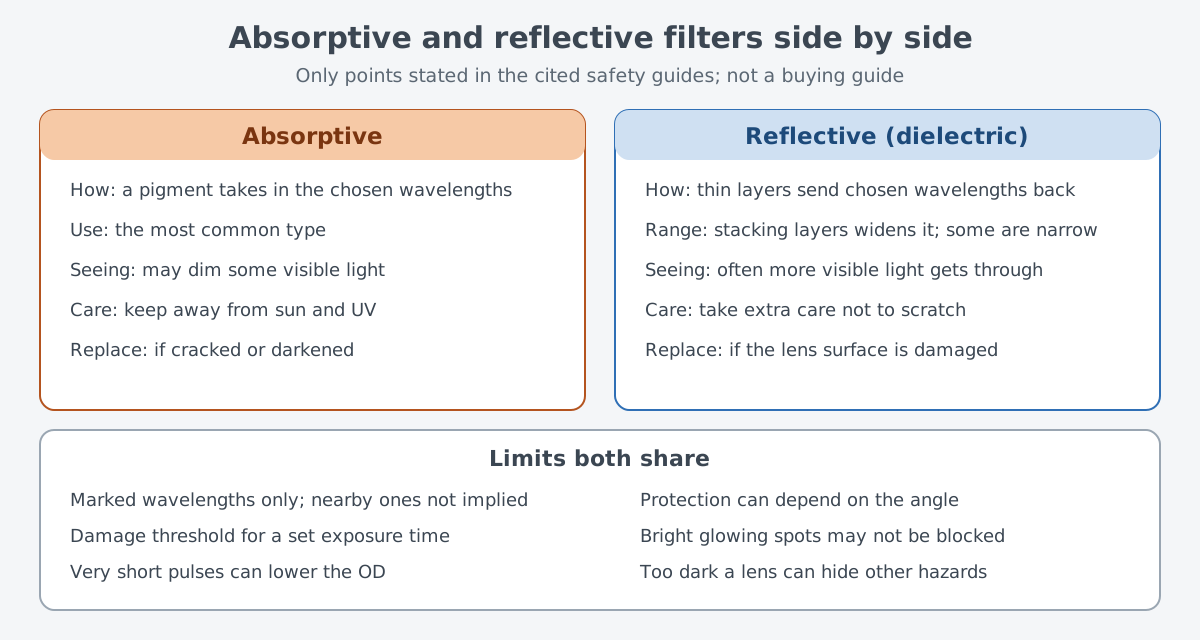
Start with visible light. Reflective eyewear usually has a higher visible light transmittance than absorptive eyewear. In NoIR's wording, visible light transmittance (VLT) means the share of visible light that gets through a filter, weighted by how sensitive the eye is in daylight. The PHE booklet also counts the brightness of the view through the filter, and the color of the surroundings, among the important features of eyewear.
Next comes care. Absorptive lenses should be stored away from the sun when possible, because the pigment is sensitive to UV. On reflective eyewear, the protective film is coated on the lens surface. APHC asks for reflective eyewear with a damaged lens surface to be replaced, and for extra care not to scratch it.
The third point is angle. The thin-film calculation above was for light hitting the surface straight on. The ANSI sample names the angle dependence of protection as one of the factors to weigh when choosing eyewear.
Makers compare the types this way. According to NoIR, a hybrid filter combines both technologies. In the company's account, polymer filters cost less, are easy to wear and resist impact best, while glass filters weigh more but can reach higher VLT and damage thresholds.
NoIR also claims that dielectric-coated and hybrid filters offer the highest VLT and the highest damage thresholds, because some energy is reflected rather than absorbed, at the highest cost. This is one company's account.
When the filter alone is not enough
Very short pulses need separate thought. Citing recent studies, the ANSI sample says existing filters often show nonlinear effects such as saturable absorption at ultrashort pulse durations. That covers polycarbonate, glass, interference and hybrid filters, at picosecond and femtosecond pulses, and the effects can lower the OD. Right after comes the line that laser users should ask eyewear makers for test data.
Wavelength needs a second look too. Some lasers emit several wavelengths at once or can be tuned to others. As APHC puts it, any optical device not marked with its protection level at the laser wavelength should be assumed to give no protection until checked.
Sometimes light other than the beam appears. A material hit by a laser can glow white-hot, and these spots are bright enough to cause serious photochemical injury to the eyes. The University of Texas at Austin handbook warns that laser eyewear may not protect against them.
NoIR's FAQ page has a related explanation. If the beam can still be seen through full-protection glasses, the protection level is too low or secondary light at another wavelength is being made. In any case, looking into the beam directly is not advised.
Blocking too much is a problem as well. Eyewear that blocks visible light can be hard to see through when the OD is high, and can hide other hazards such as things to trip over. APHC asks for eyewear that lets you see well enough to work safely and that does not hide colored indicators such as warning lights.
Because eyewear can be damaged and wear out, a safety program should include regular inspection. That is the advice of the Texas handbook.
Laser eye protection in the military
APHC is a public health agency of the US Army. Its Nonionizing Radiation Division (NRD) gives guidance on laser eyewear in system evaluation studies. If no study exists, the NRD is the contact, and for lasers that are not military-specific, the maker's advice applies.
Military personnel are to choose eye protection from the Approved Protective Eyewear List (APEL). Some glasses and goggles on that list can take swap-in laser protective filters. APHC also writes that when a laser's wavelength changes, the eyewear has to change with it. This fits the principle above that a filter is made for chosen wavelengths only.
Shape matters as much as the filter. Laser glasses should cover the front and the sides of the eyes and protect against direct exposure and reflections from a glancing angle. In APHC's view, goggles sit closer to the face than glasses and cover the sides of the eyes, which makes them the best choice for cutting exposure from reflections.
What to read next
- "Laser safety: classes and how to read eyewear labels": reads the wavelength and OD marked on eyewear with the conditions the official documents attach.
- "Interference and diffraction: how light adds up and spreads": a closer look at interference, the basis of reflective filters.
- "Mirrors, lenses and coatings: optics for strong light": coatings and damage thresholds inside laser equipment.
- "Q-switching and mode locking: two ways to make short pulses": how the very short pulses that can lower an eyewear OD are made.
- "Eye safety and international rules: the protocol on blinding laser weapons": how eye safety is handled in international rules for the military.