On December 5, 2022, in a building in Livermore, California, 192 laser beams converged on one spot. The target was no bigger than a pencil eraser. The fusion energy that came out of it was 3.15 MJ (megajoules), more than the 2.05 MJ of laser energy that went in.
Eight days later, the U.S. Department of Energy announced the result as "fusion ignition." It was a threshold no laboratory had crossed before.
Yet a single shot of this facility uses more than a hundred times that much electricity. Both statements are true. They simply compare different things.
2.05 MJ in, 3.15 MJ out
The experiment took place at the National Ignition Facility (NIF) at Lawrence Livermore National Laboratory (LLNL). In their December 13 announcement, the Department of Energy and the National Nuclear Security Administration (NNSA) said no controlled fusion experiment had ever reached this point before. It is also called scientific energy breakeven: the fusion produced more energy than the laser light that set it off.
LLNL's definition is short. Ignition means getting more energy out of fusion than the laser puts onto the NIF target. That day, 2.05 MJ went in and 3.15 MJ came out.
The ratio of fusion energy out to laser energy on the target is called the target gain, and that day it was about 1.5. If the energy units are unfamiliar, Power, energy and intensity: W, J and W/cm² is a good place to start.
A laser the size of a stadium
The NIF building is as big as a sports stadium, with room for three football fields. Inside, 192 laser beams are steered, amplified and focused onto a target no bigger than a pencil eraser, all within billionths of a second. The ultraviolet light delivered carries over 2 million joules, with 500 trillion watts at the peak.
The short time is the key. Squeeze the same energy into a very brief moment and the power in that moment, the peak power, becomes enormous. A laser that fires in short bursts like this is a pulsed laser. How it differs from a laser left on continuously is explained in Continuous-wave and pulsed lasers.
NIF's light starts out as invisible infrared. Special optics turn it into visible green light and then into invisible, high-energy ultraviolet. The change of color suits the light to the target. How infrared becomes green is covered in Nonlinear Crystals and Second-Harmonic Generation: Turning Infrared into Green.
Light becomes X-rays, and X-rays squeeze the fuel
NIF's ignition experiments use a method called indirect drive. The laser does not hit the fuel itself. Up to 192 beams pass into a hollow cylinder a centimeter or so across, called a hohlraum, and the cylinder wall gives off soft X-rays. Those X-rays strip away the outer surface of a capsule the size of a peppercorn that hangs inside.
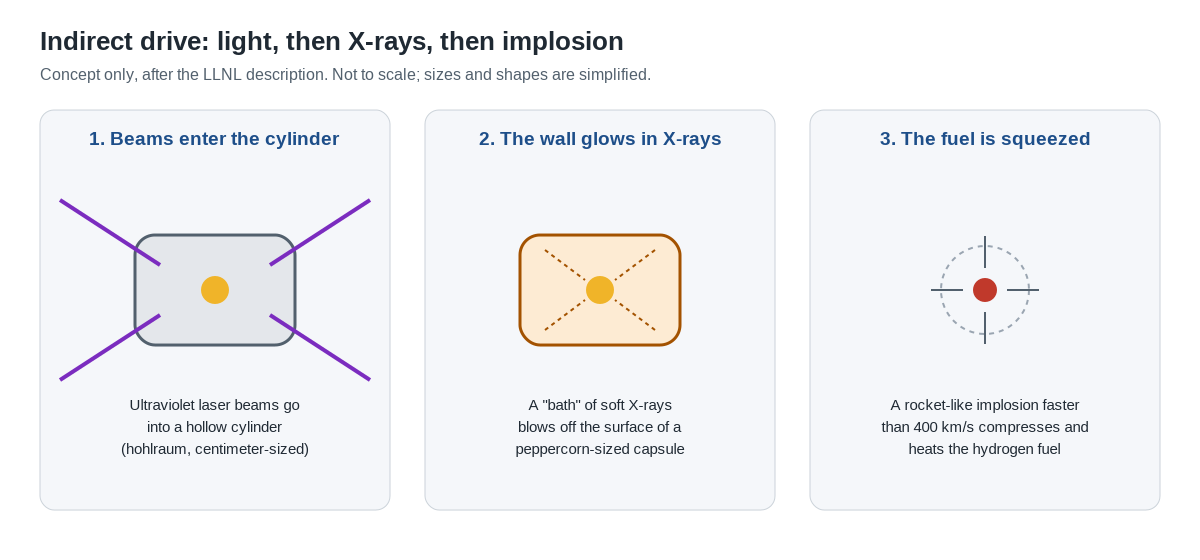
As the outer layer flies outward, the rest is pushed inward. It is the same idea as a rocket throwing gas backward to move forward. Unlike a rocket flying one way, though, the capsule is pushed toward its center from every direction at once.
This implosion, faster than 400 km/s, squeezes and heats the frozen hydrogen fuel inside, and fusion happens before the fuel can fly apart. Because the fuel is held in place by its own inertia, the method is called inertial confinement fusion (ICF).
The fuel is two isotopes of hydrogen, deuterium and tritium. At extreme temperature and pressure they join to form a helium nucleus, and some of their mass is released as energy. That runs in the opposite direction from today's nuclear power plants, which split heavy uranium (fission).
A threshold sixty years in the making
The idea of using lasers to cause fusion dates from the 1960s. A group led by physicist John Nuckolls proposed it, and it grew into inertial confinement fusion research. Nuckolls went on to lead LLNL as director from 1988 to 1994. The laboratory went on to build a series of ever more powerful lasers, and NIF came at the end of that line.
NIF began operating in 2009. Ignition experiments started in 2011, when the fusion energy produced was only a few kilojoules (kJ). A megajoule is a thousand kilojoules. By LLNL's account, it took 12 years of steady work and hundreds of shots to get there.
Why did it take so long? Ignition proved harder than first expected. Small parts, such as the thin membranes holding the capsule and the fill tube used to inject fuel, disturbed the implosion. Instabilities between laser and plasma, uneven X-rays inside the hohlraum and capsule material mixing into the fuel also held back the energy yield.
Not a one-off: the shots that followed
One success could be luck, so repeating it matters. LLNL's published list shows that on July 30, 2023, the same 2.05 MJ on target gave 3.88 MJ, and ignition shots kept coming after that.
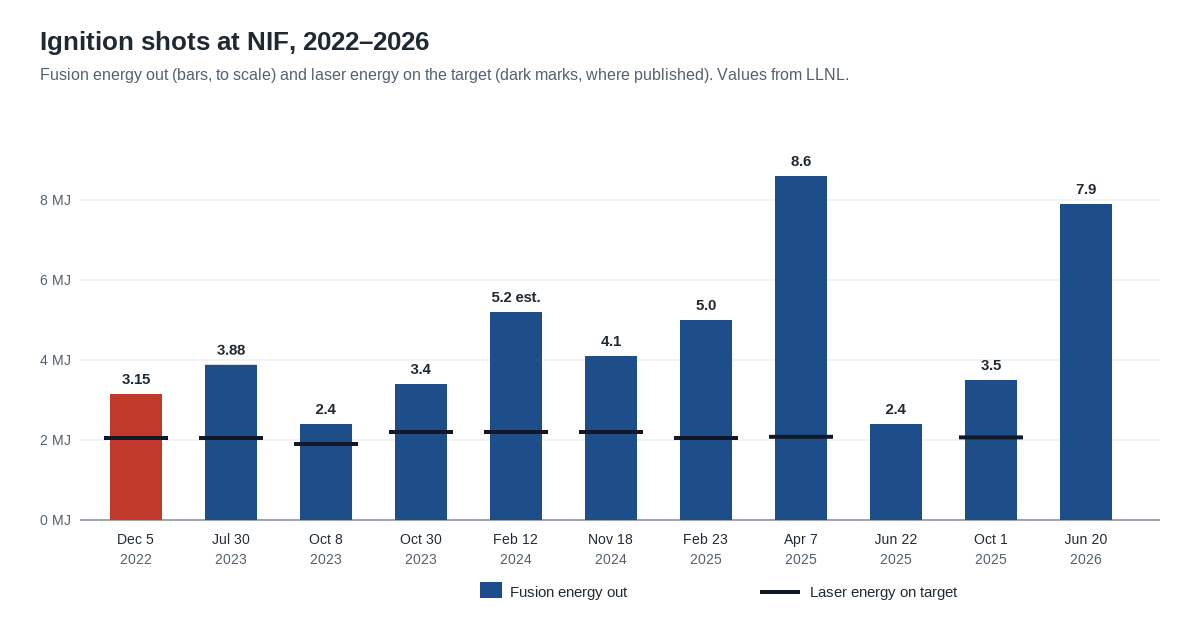
On April 7, 2025, a shot put 2.08 MJ on the target and yielded 8.6 MJ (±0.45 MJ measurement uncertainty). The target gain was 4.13. On June 20, 2026, the eleventh ignition was recorded at 7.9 MJ (±0.4 MJ), a target gain of about 3.8. In June 2025, a team led by Los Alamos National Laboratory also achieved ignition using NIF.
Not every shot beat the last one. The October 8, 2023 shot turned 1.9 MJ into 2.4 MJ, and the target gain on October 1, 2025, was 1.74. The values rise and fall from shot to shot.
Seen from the electricity meter
Ignition is defined against the laser energy on the target. The electricity needed to make that laser light is another matter. For each shot, NIF's power conditioning system spends 60 seconds charging 3,840 high-voltage capacitors with about 400 MJ of electrical energy, then lets it go in 400 microseconds. Nearly 330 MJ of that goes to the 7,680 flashlamps in the amplifiers.
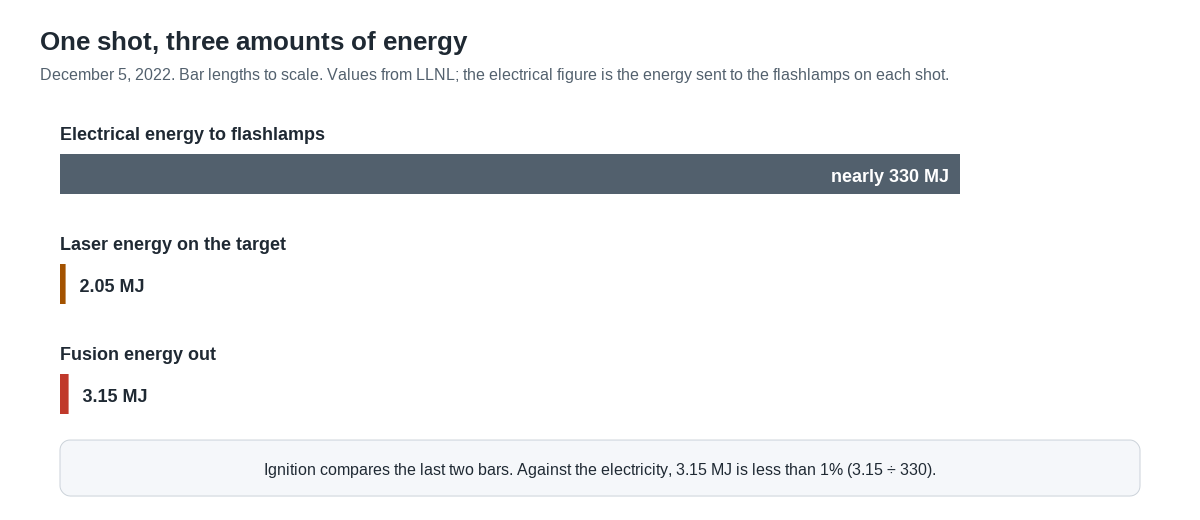
Set against those 330 MJ, the 3.15 MJ of December 2022 is less than 1%. Even the 2.05 MJ of laser energy that reached the target is a tiny share of 330 MJ. Why the share of electricity that becomes light matters leads on to Oscillators and amplifiers: making light, then growing it.
LLNL and the Department of Energy do not hide this gap. Their announcement says many advances in science and technology are still needed for simple, affordable inertial fusion energy that could power homes and businesses. The main goal of that day's experiment was not power generation either; it was the science of maintaining the nuclear weapons stockpile. December 2022 was the first time the physics was shown: a laser can squeeze fuel and get more energy out than it put in.
What to read next
- Continuous-wave and pulsed lasers: why a laser that fires in short bursts has such high peak power
- Oscillators and amplifiers: making light, then growing it: the structure that grows weak light into strong light, as NIF does
- Optical Coatings and Laser-Induced Damage Threshold: what strong light does to optical parts