A device that makes laser pulses stronger is called an amplifier. In the mid-1980s, researchers trying to make short pulses more intense ran into a strange wall. The more they amplified a pulse, the more that light damaged the amplifier itself.
Donna Strickland and Gérard Mourou, working at the University of Rochester in the United States, changed the order of things in 1985. They did not amplify the pulse right away. They first stretched it out in time, then amplified it, and finally squeezed it back. This method is chirped pulse amplification (CPA), and it won the 2018 Nobel Prize in Physics.
The energy is the same, so how can stretching and squeezing keep the amplifier safe? The key is the height of the pulse's top, its peak power.
The wall before 1985: pulses that break the amplifier
Pulse energy is the total energy carried by one pulse, and peak power is the power at the pulse's highest moment. The same energy delivered in a shorter time gives a higher peak. Stretch a pulse in time and its top comes down; compress it and the light packs into a small space, so its intensity rises sharply.
After the first laser appeared in 1960, pulses kept getting shorter. Progress in mode locking played a big part. Yet each pulse carried barely more photons in 1985 than it had in 1970.
Nanojoule (nJ) pulses from a mode-locked oscillator could be amplified to millijoules (mJ), a gain of six orders of magnitude. Going further damaged the amplifier material and the optical components.
The way around it was a wider beam. Spreading the beam over a larger area lowers the intensity the amplifier medium sees. The price was huge, costly laser installations that only national research institutes could build. These large lasers ran at very low repetition rates, as few as a few shots per day, to give the amplifiers time to cool.
The Nobel Committee for Physics, in its popular explainer, describes the mid-1980s as the point where "the end of the road had been reached." For short pulses, raising the light intensity without destroying the amplifying material was no longer practical.
Stretch, amplify, compress
CPA works in three steps. First, the ultrashort pulse is lengthened by several orders of magnitude in time. Its peak power drops by the same factor. Next, a laser material amplifies it without being damaged, and finally it is compressed back to its original duration to reach a very high peak power.
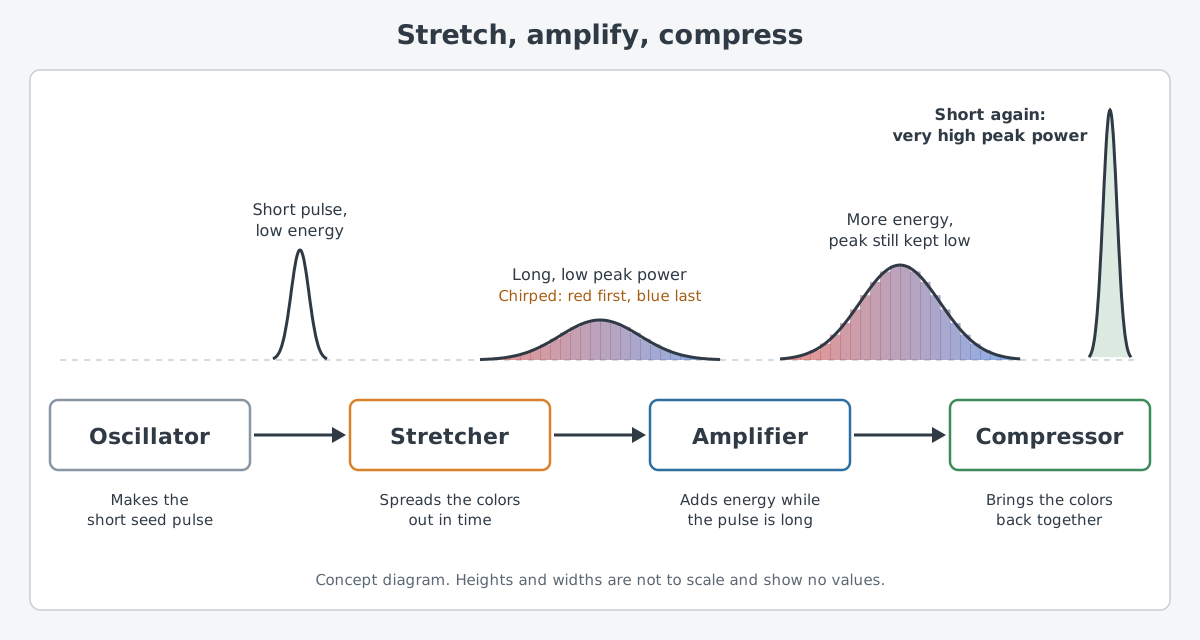
Picture a crowd waiting at a narrow bridge. If everyone crosses at once, the bridge cannot hold. Line people up and let them cross one after another, then gather them on the far side, and the bridge carries less weight while everyone still ends up together.
Real CPA differs from this picture in two ways. Light does not queue up like people. Instead, the different frequency components inside the pulse are spread out so they pass at different times. Also, the energy grows while the pulse crosses the amplifier, as if more people appeared on the bridge.
Keller's textbook sums it up: CPA lets peak power scale by many orders of magnitude. The idea had roots in radar technology. Still, carrying it over from long radio waves to much shorter light waves was hard, both in theory and in practice.
What a chirp is
A chirp means the instantaneous frequency of a pulse changes with time. If the frequency rises as time goes on, it is called an up-chirp. Such a pulse oscillates slowly and looks red at the front, then oscillates fast and looks blue at the back.
One short pulse holds many frequency components at once. When they all overlap and there is no chirp, the pulse is called transform-limited. It is the shortest pulse a given spectrum can make, and adding chirp makes the pulse longer.
So where does chirp come from? For light between 600 nm and 1.1 µm, transparent materials such as glass, sapphire and quartz show positive dispersion. Inside them red travels faster than blue, so an unchirped pulse picks up an up-chirp, with red ahead and blue behind.
This broadening is linear. If the frequency components that were shifted in time are moved back by the right amount, the broadened pulse can be shortened again. In CPA, stretching means adding a large chirp on purpose, and compression means removing it.
The stretcher and compressor are a matched pair
The classic tool for removing chirp is a pair of diffraction gratings. In the simplest grating-pair layout, long wavelengths travel a greater distance than short ones. This gives negative dispersion, so blue moves faster than red.
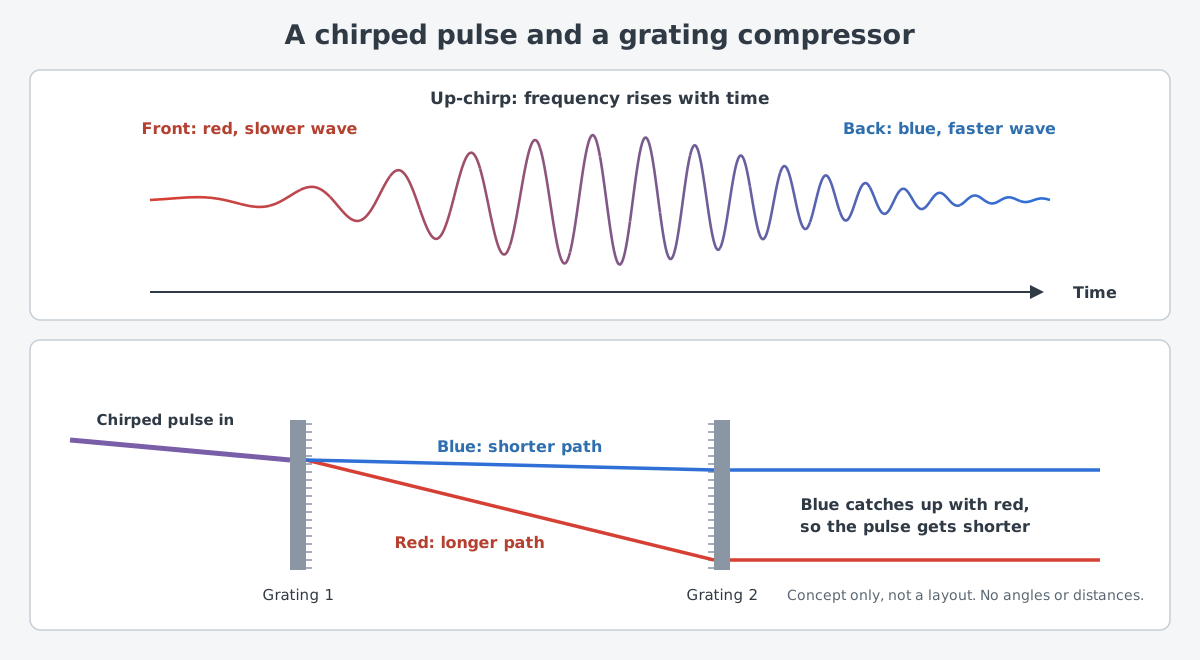
Send an up-chirped pulse into this grating pair and the red light that was ahead takes the long way and falls back, while the blue light that trailed catches up. This layout usually serves as the compressor, and the amount of dispersion is easy to tune by changing the distance between the two gratings. How a grating bends each color in a different direction is covered in "Diffraction Gratings: The Part That Merges Colors into One Beam."
The stretcher does the opposite job. CPA has to widen the pulse before amplification to prevent damage, so it needs a large, adjustable amount of positive dispersion. The compressor must remove exactly the chirp the stretcher added, or the pulse will not return to its starting length.
Matching the two was not easy from the start. Lining up the stages of the setup, and above all matching the stretcher to the compressor, was a major challenge that the two researchers also had to solve.
The first experiment, with 1.4 km of fiber
The first stretcher was an optical fiber, not gratings. A mode-locked Nd:YAG laser supplied a short nanojoule pulse with little energy, which went into a single-mode fiber and came out about 300 ps long. Inside the fiber, self-phase modulation together with group velocity dispersion gave the pulse a linear chirp. The fiber's dispersion was positive, so the red part moved ahead faster than the blue part.
The fiber has a story. The plan was to stretch the pulse with a 2.5 km fiber cable the lab had just bought, but light never reached the far end. Somewhere along its length the cable was broken, and after much effort the team settled for 1.4 km.
The stretched pulse was amplified in an Nd:glass regenerative amplifier, then compressed to 2 ps by a compressor made of two gratings. Going from about 300 ps to 2 ps cut the length to about one 150th. The amplified pulse carried 1 mJ.
Getting every part to work together took a few years. The paper appeared in December 1985 in the journal Optics Communications, volume 56, and it was the first scientific paper Strickland ever published. She had come to Rochester from Canada as a doctoral student, Mourou was her supervisor, and this paper became the foundation of her doctoral thesis.
From tabletop terawatts to petawatts
The CPA concept and further progress were presented in June 1986 at the Conference on Lasers and Electro-Optics (CLEO) in San Francisco and at a meeting in Snowmass, Colorado. Shortly after the first paper, CPA lasers with peak powers above 1 TW were built.
The first improvement came quickly. A pair of diffraction gratings took over the stretching job from the fiber. Amplification from the nanojoule level to the joule (J) level, nine orders of magnitude in energy per pulse, was then demonstrated.
Around this time the acronym T3 appeared, short for tabletop terawatt laser. The first Nd:glass systems typically delivered 1 J per pulse, with pulses lasting about 1 ps. Switching the gain medium to Ti:sapphire gave pulses shorter than 100 fs.
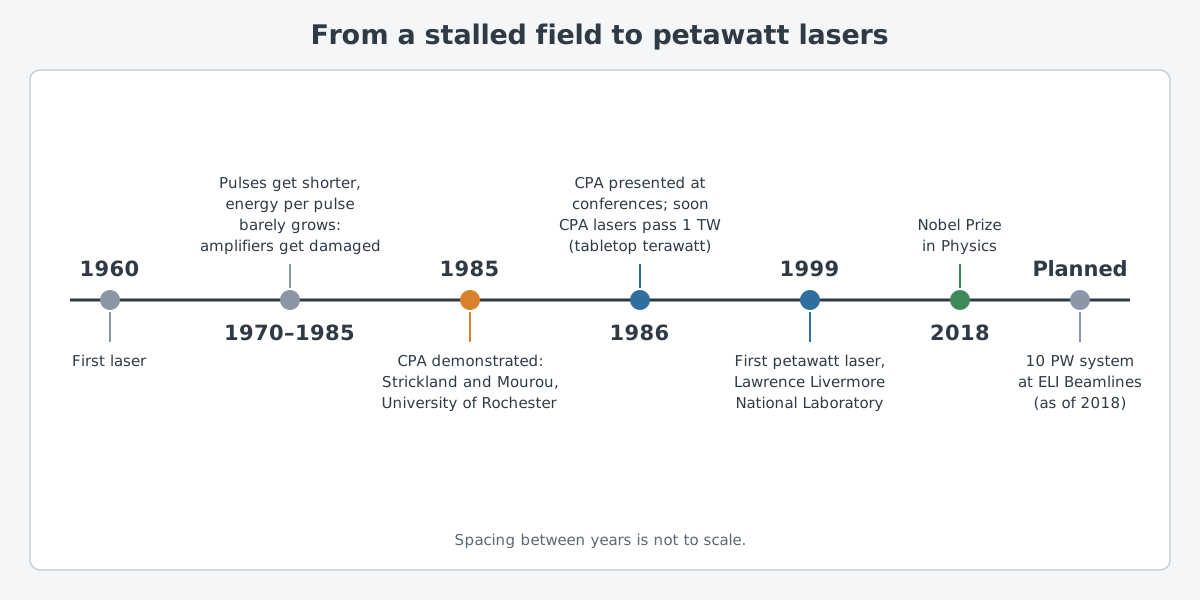
The next goal was the petawatt. It took a decade to go from vision to reality, and the first petawatt laser came in 1999 at Lawrence Livermore National Laboratory (LLNL) in the United States. A review written nearly two decades later listed more than 50 petawatt-class lasers that were operating, under construction or planned.
According to the 2018 Nobel document, ELI Beamlines in Prague, Czech Republic, was to include a 10 PW laser system, with focused intensities above 10²³ W/cm² anticipated. Such intensity values depend on how tightly the beam is focused, so they should be read as rough figures.
Also at ELI Beamlines is L3-HAPLS, a petawatt laser built on CPA that LLNL designed and built and delivered in June 2017. Its front end is a dual-CPA, high-contrast short-pulse system. The design goal is 1 PW at ten times per second (10 Hz). The first operating point LLNL reported was 16 J, a 27 fs pulse duration and 3.3 Hz, equal to a peak power of about 0.5 PW after the pulse compressor.
The Nobel Prize and what CPA is used for
The 2018 Nobel Prize in Physics was awarded "for groundbreaking inventions in the field of laser physics." One half went to Arthur Ashkin, who invented optical tweezers. The other half went jointly to Mourou and Strickland "for their method of generating high-intensity, ultra-short optical pulses."
At the time of the award, Mourou was affiliated with École Polytechnique in France and the University of Michigan in the United States. Strickland was with Canada's University of Waterloo. Each received a one-quarter share of the prize. CPA soon became the standard for the high-intensity lasers that followed.
CPA changed more than the record books. It led to lasers with high peak power from short pulses but only modest pulse energy, which made high repetition rates possible. Tabletop lasers that fit a university group's budget fired 10 pulses per second with the same peak power that huge fusion-research lasers delivered only a few times a day.
New fields grew out of these lasers, including strong-field physics, laser-plasma acceleration and attosecond science. At the BELLA facility of Lawrence Berkeley National Laboratory in the United States, a petawatt-class laser accelerates electrons to 4.2 GeV over 9 cm. Many challenges remain, though, before laser accelerators can be used in medicine.
CPA also reached industry and medicine. It made compact, easy-to-use, high-power ultrashort-pulse lasers possible, and femtosecond lasers are used in refractive surgery to correct myopia and astigmatism. A figure caption in the Nobel document describes a surgical CPA femtosecond laser. It uses low energies of about 120 nJ per pulse but fires more than 100,000 pulses per second (100 kHz).
The Nobel Committee notes that millions of eye operations are performed with such lasers every year. They also drill or cut very precise holes in many materials and help make stents that widen blood vessels. Why they leave less heat behind is explained in "Ultrashort-pulse laser processing: why less heat is left behind."
Open problems
The first problem is average power. Diode-pumped Yb-doped lasers raised the average power of ultrafast lasers sharply, and fiber, thin-disk and slab designs passed 1 kW. Such systems are usually multi-stage CPA. Pulses are picked from a low-power oscillator, stretched, sent through a chain of amplifiers and then compressed.
At hundreds of watts of average power, heat becomes a problem. Removing heat well without creating thermo-optic distortions is a key task for these systems.
The second problem is pulses getting longer again. External CPA amplification usually lengthens the pulse because of effective gain narrowing. That creates a need for ways to compress pulses again at high average power. In one example, an acousto-optic dispersive filter placed inside a CPA system compensated for gain narrowing and leftover phase errors and produced 17 fs pulses.
The third problem is the complexity of combining several amplifiers. Coherent beam combining (CBC) can raise energy and average power further, but it makes the whole system even more complex. In 2021, 16 CPA fiber amplifiers were combined to reach 1 kW average power with 120 fs pulses, 10 mJ pulse energy and a 100 kHz repetition rate.
What to read next
- "Q-switching and mode locking: two ways to make short pulses": mode locking makes the short seed pulses that go into CPA.
- "Ultrashort-pulse laser processing: why less heat is left behind": what CPA lasers do in industry.
- "Diffraction Gratings: The Part That Merges Colors into One Beam": how the key part of the compressor bends light.
- "Coherent beam combining: the principle, from published reviews": how light from several amplifiers is merged into one.