An aircraft with an empty cockpit is flying overhead. Where do its decisions come from? Perhaps from a pilot on the ground, perhaps from a computer inside the aircraft, perhaps from both, sharing the work.
"The link was lost," "it flew autonomously" and "it lost its position" sound alike, but they describe different things. Where does remote control end and autonomous flight begin? What does a published table of autonomy levels say and leave out, and why do communication and navigation have to be judged separately? The sources are public U.S. government documents.
Three jobs behind one drone
Under the U.S. Department of Defense definition, an unmanned aerial vehicle (UAV) is a powered aircraft that carries no human operator. It stays up through aerodynamic lift, it may fly itself or be flown by a remote pilot, and it can be expendable or recoverable. Cruise missiles, ballistic vehicles and artillery shells fall outside this definition.
A drone does not fly alone. Add a ground control station and data links to the aircraft and you have an unmanned aerial system (UAS). Such a system usually includes the ground station and a ground crew of remote pilots and sensor staff. It also has the links that carry data, and often more than one aircraft.
The work behind one drone can be split into three jobs.
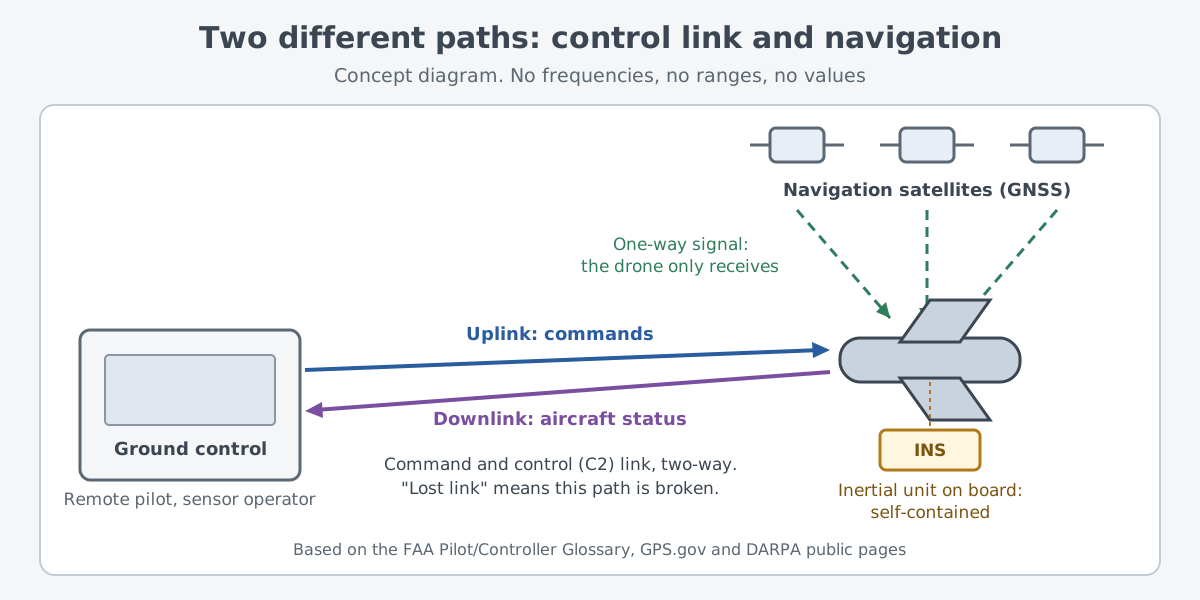
Who makes the decisions is a question of control. Where the aircraft is is a question of navigation. Whether it is talking with the ground is a question of communication.
From remote control to full autonomy
What does autonomy actually mean? One answer comes from ALFUS, a glossary of unmanned-system terms (version 2.0, 2008) edited at the National Institute of Standards and Technology (NIST). There, autonomy is a system's own ability to combine sensing, perceiving, analyzing, communicating, planning, deciding and acting, so that it reaches goals a human has given it.
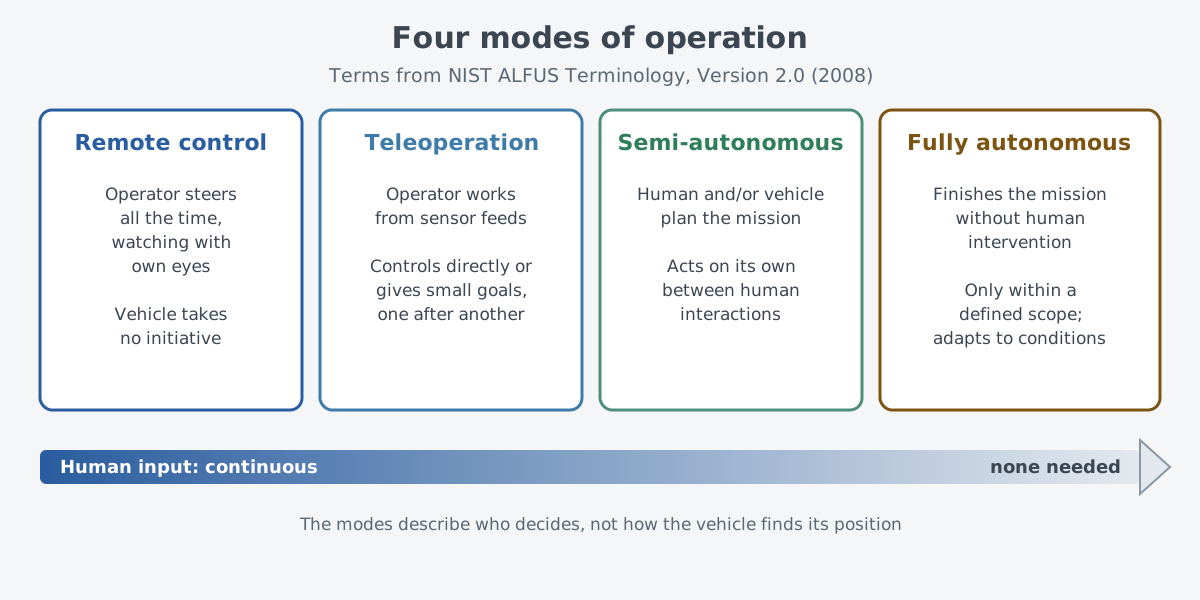
Autonomy is then graded by how independent of humans a system is, and operation is split into four modes. Ordered by how often a person has to step in, they look like this.
| Mode | What the human does | What the vehicle does |
|---|---|---|
| Remote control | Steers it continuously from outside, watching it directly | Takes no initiative of its own |
| Teleoperation | Works from outside using sensor feedback, either handling the controls directly or handing over small goals one after another | Follows the commands it gets |
| Semi-autonomous | Human and/or vehicle plan the mission; the human steps in at various levels | Acts on its own between those interactions |
| Fully autonomous | Does not step in | Finishes the job it was given, inside set limits, and adjusts to operating and environmental conditions |
A toy radio-controlled car makes the first row easy to picture. Let go of the controls and the car stops or wanders off. Real drones differ from the toy. In the semi-autonomous mode, people and the aircraft share the work, and even the definition of full autonomy carries the limit "within a defined scope."
The split shows up in names, too. Over the years drones have been called remotely piloted vehicles (RPVs), remotely piloted aircraft (RPAs) and other names. In a footnote to its 2012 drone report, the Congressional Research Service (CRS) says drones differ from RPVs in being built to fly on their own. So even the names were divided by who does the flying.
Putting a number on autonomy
There have also been attempts to rate autonomy with a single number. The 2012 CRS report notes that the Office of the Secretary of Defense (OSD) rates UAV autonomy from 1 to 10. It reproduces the Autonomous Capability Levels (ACL) table from the DoD UAS Roadmap 2005–2030.
Level 1, at the bottom, is remotely guided. Level 2 is real-time health checks and diagnosis, level 3 is adapting to failures and flight conditions, and level 4 is the aircraft replanning its own route. From level 5 the steps climb through group coordination, group tactical replanning, group tactical goals, distributed control and group strategic goals, up to level 10, fully autonomous swarms.
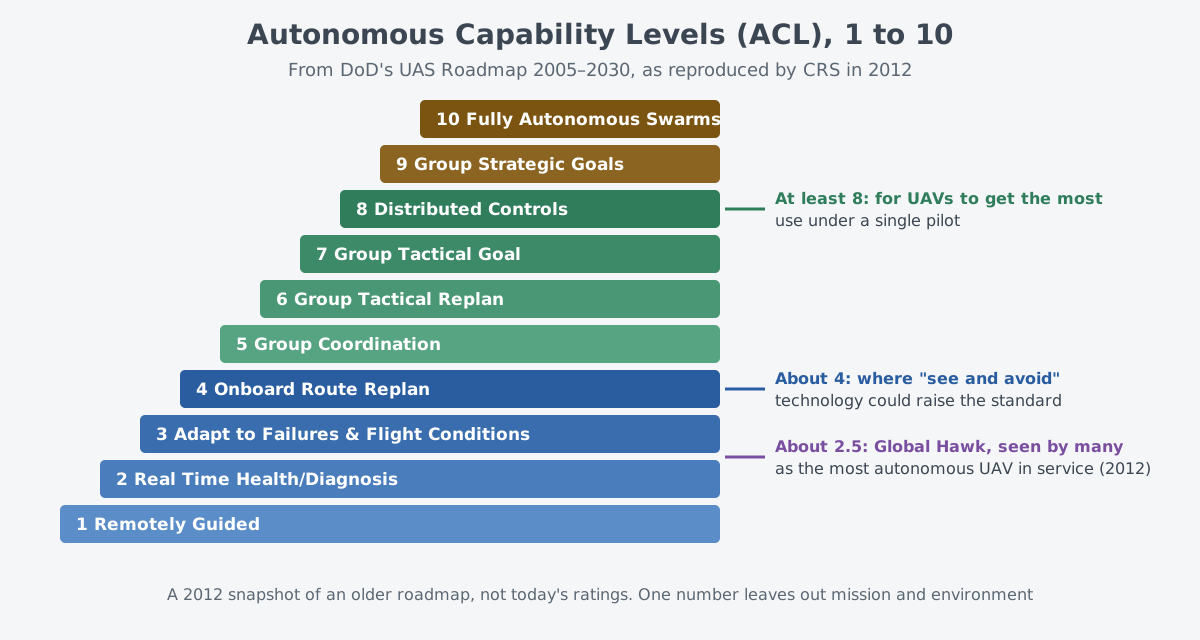
Where did real aircraft land on this scale? Global Hawk, which many then considered the most autonomous UAV in service, sat at an ACL of about 2.5. Global Hawk and ScanEagle had strong automated flight features, but in bad weather operators had to keep stepping in, so how autonomous their flight really was could be debated.
At the time, most unmanned aircraft systems needed two people on the ground at minimum: a pilot for the aircraft and a second person for the sensors. The goal was for one operator to handle several UAVs, and for UAVs to get the most use under a single pilot, the ACL had to reach at least 8. "See and avoid" technology, which would let an aircraft keep clear of approaching aircraft by itself, was described as a way to lift the standard ACL to 4.
Two cautions apply when reading the table. First, it is a 2005 roadmap reproduced in 2012, not a current rating. Second, one number leaves a lot out.
The NIST glossary looks at autonomous capability along three axes: the missions a system can do, the environments it does them in, and how independent of humans it can be. A task done in clear, empty sky and the same task done in bad weather over a crowded area weigh differently, even under the same level name.
What happens when the link drops
Remote control and teleoperation depend on communication. The Federal Aviation Administration (FAA) glossary defines a lost link as a break or loss of the control link, or a case where the pilot cannot control the aircraft. As a result, the unmanned aircraft carries out a predictable or planned maneuver.
The link has two parts. The uplink carries commands to the aircraft. The downlink sends the aircraft's status back so the pilot knows what is going on. If either one fails, the conversation between pilot and aircraft breaks.
That is why operators prepare for a broken link in advance. These preparations are called lost link procedures: mitigations that are preprogrammed or set ahead of time so the unmanned aircraft keeps operating safely after the link is lost. The "predictable or planned maneuver" in the definition above refers to exactly this.
How serious is a lost link? Apart from a few autonomous models, UAVs at the time needed a ground crew stepping in and steering all the time. A comparison with the F-16 makes the point. A piloted F-16 has a fairly high chance of flying on without contact from the ground, while a UAV cut off from its ground operators has a low chance.
Knowing where you are is a separate job
A broken control link does not mean the aircraft also loses track of where it is. Navigation reaches the aircraft by other paths.
Start with satellite navigation: the Global Positioning System (GPS) has a space segment built around a nominal set of 24 working satellites. Each one sends a one-way signal carrying its current position and the time. A receiver uses that information to work out its own three-dimensional position and the time. The receiver only listens and sends nothing back to the satellites, so this is a different path from the link to the ground station.
An inertial navigation system (INS) works from further inside. It measures the accelerations and rotations acting on the aircraft and calculates position and speed from them, so it is self-contained and needs no outside signal. The catch is that errors pile up while rotation data are integrated over time. Inertial and satellite navigation: knowing where you are explains the principle in detail.
Satellite navigation has a weak point as well. The Defense Advanced Research Projects Agency (DARPA) describes reliance on GPS as a serious weak spot for many DoD systems when the signal is degraded or missing. It ran a program to build small inertial sensors so that self-contained inertial navigation could guide precisely without GPS. The control link, satellite signals and onboard sensors each travel by a different path, so "the link was lost" and "it lost its position" have to be judged separately.
Autonomy and communication do meet in one place: the amount of data being sent. DoD told Congress that giving a UAV more autonomy would cut its bandwidth needs. The reasoning was that more data would be processed on board and less would be sent.
Yet sensor data transmission is what drives bandwidth demand, so it is not clear that autonomy will actually reduce it. One example cited is a single Global Hawk, already counted as an autonomous UAV, that needed 500 Mbps of bandwidth. An aircraft can fly itself and still need a wide data link to send back what its sensors collect.
Autonomy in flight, autonomy in weapons
When drone autonomy meets weapons, the question changes. The U.S. Department of Defense has a policy on autonomy in weapon systems, Department of Defense Directive (DODD) 3000.09. It was first issued in November 2012 and most recently updated in January 2023.
The directive's definitions rest on the role a human plays in choosing targets and deciding to engage them, not on how sophisticated the technology is. A system that, once activated, can pick and engage targets with no further human input is an autonomous weapon with the "human out of the loop." If operators can watch an engagement and stop it, the human is "on the loop." A semi-autonomous weapon that engages only targets a human has selected keeps the human "in the loop."
Here the line from earlier sections becomes clear. Unarmed platforms fall outside the directive. The autonomy levels above deal with how much an aircraft flies on its own; this directive deals with how people take part in decisions to use a weapon. Flying by itself and deciding by itself to use a weapon are different questions.
Communication still comes up. Lethal autonomous weapon systems are believed to allow military operations where communications are degraded or denied.
At the same time, the directive requires every system to be designed so that commanders and operators can exercise "appropriate levels of human judgment over the use of force." That does not mean steering the weapon by hand. It means people taking part, broadly, in deciding how, when, where and why to use a weapon. Manned-unmanned teaming: when a pilot's wingman is a drone shows how this question carries over when crewed and uncrewed aircraft work as a team.
Where this meets lasers: munitions a person guides
Lasers appear in the scope of 3000.09. Munitions that an operator guides by hand fall outside its scope, and the examples given are laser-guided and wire-guided munitions.
"Laser-guided" can sound like high technology first of all. Seen through this directive, though, a laser-guided munition is not an autonomous weapon but one a person guides. The directive's rule of sorting by the human's role, not by technical sophistication, shows up here as well. Precision-guided bombs: what gets added to a plain bomb explains what sets a laser-guided bomb apart from a plain one.
What to read next
- Inertial and satellite navigation: knowing where you are: the two navigation paths that work apart from the control link, from first principles.
- Drone swarms: is every group of drones a swarm?: how the "groups" near the top of the autonomy table showed up in a public test.
- Loitering munitions: between missile and drone: where human judgment remains when a drone becomes the munition.