Imagine designing a next-generation vehicle that must carry higher loads, in harsher conditions, for longer than today's aircraft. Could a laboratory recreate all of those loads? In 2012, NASA and Air Force researchers judged that a lab may not be able to recreate such extreme heat, mechanical and sound loads beyond the scale of one part.
This is where the phrase digital twin tends to come up. It brings to mind a copy of the real thing, living inside a computer, that can be tested ahead of time. Using public reports, this article looks at how a digital twin differs from an ordinary simulation and where the term came from. It then turns to where defense wants to use it and why it is still hard.
What a digital twin is
Even the meaning is not settled. A 2025 report from the U.S. National Institute of Standards and Technology (NIST) finds no agreed definition, and a 2024 U.S. National Academies report records speakers saying the same. Defining the term is still left to standards bodies.
The broadest definition is a simple one. A digital twin is any virtual, digital stand-in for something in the real world, whether a physical object or an idea someone has in mind. Taken this broadly, it even covers a static model such as the solid model of a part that aerospace designers make first.
The definition the Academies committee chose is narrower, with four parts. The twin copies how a real system is built, the setting it sits in and how it acts. It keeps taking in new data from the real object it pairs with, it can predict, and it helps people make decisions that create value.
Information flowing both ways, between the computer model and the real object, is the heart of this definition.
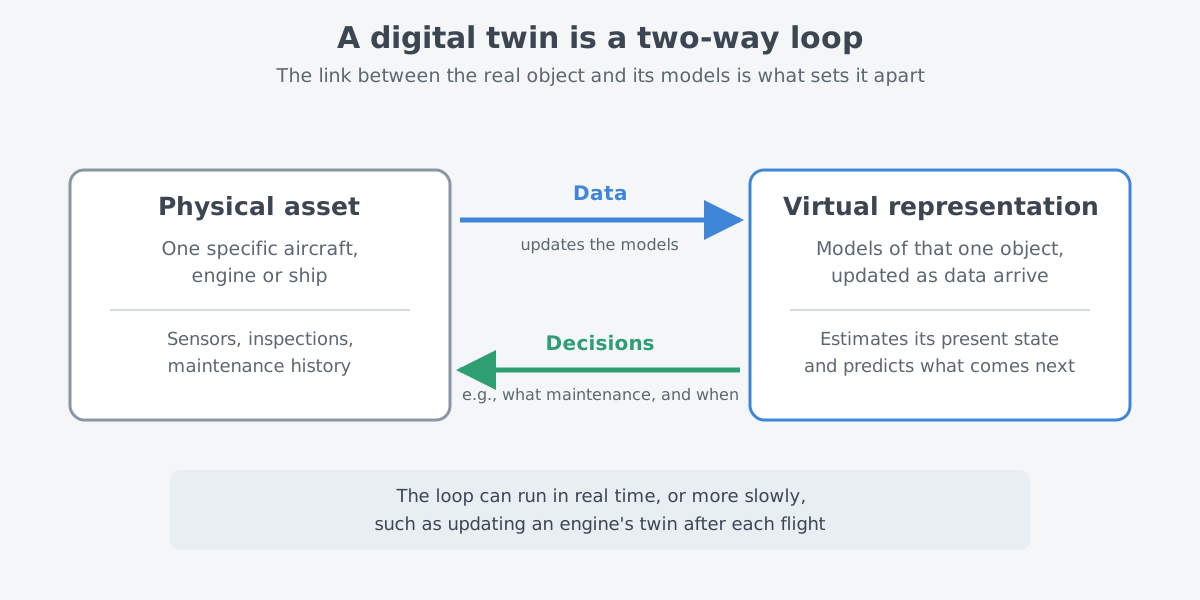
The name suggests a twin that lives through whatever the real object lives through. The reality is different. The copy in the computer does not wear out or tire on its own as time passes. It keeps up with the real object only when data from that object flow in.
How it differs from a simulation
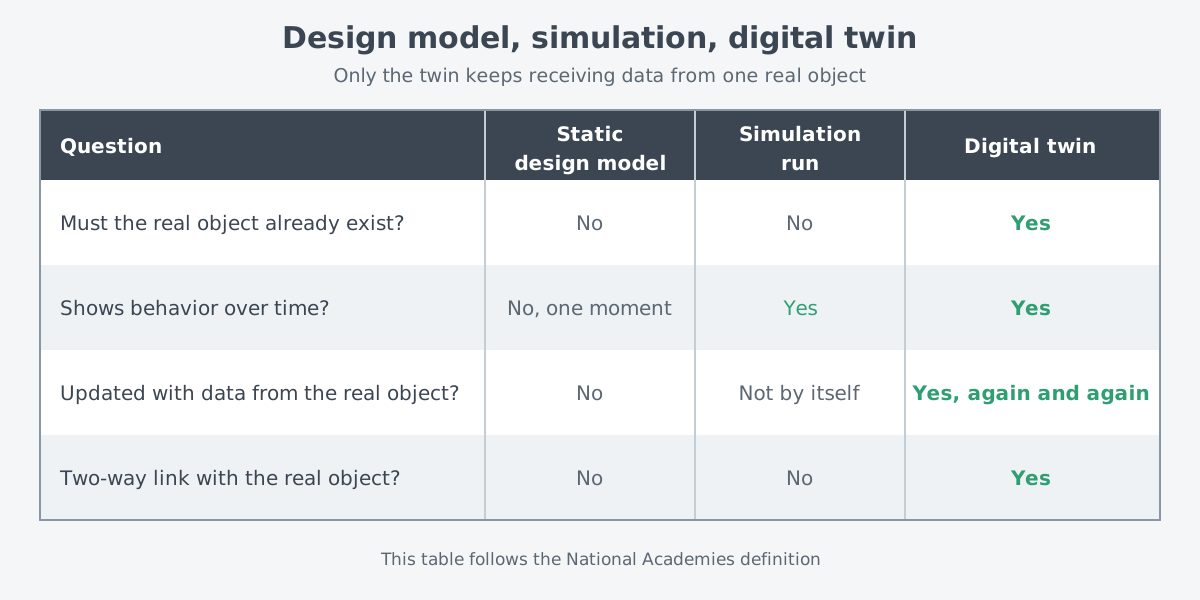
Simulation is an old tool. A digital twin goes a step beyond simulation and modeling. It ties models more tightly to observed data and to decisions.
The dividing point is real-time monitoring. Being able to watch an object in real time while revising its twin is where the technology goes past existing simulation and modeling. Watching the actual state of a real object is a different task at its root from imitating behavior with a calculation.
The loop does not have to be fast. It can run in real time, as with a self-driving vehicle or a wind farm. It can also be slow, such as updating an aircraft engine's twin after each flight for predictive maintenance. In an illustrative example of such an engine twin, the twin helps decide what maintenance to do and when.
Can equipment be tested virtually before it is built? Half of the answer is yes.
Studying an object through its model before building the real one is one of the technology's advantages. During first design, the real object may not exist yet.
The other half comes with conditions, though. A static model made before the object exists does not show how the object behaves; it suits only a look at one moment in time. For a twin that is updated again and again with real data, as in the National Academies definition, a real object has to exist first to send that data.
Why calculations and tests count as different kinds of evidence is covered in Simulation versus testing. A digital twin does not merge the two into one. It is closer to a way of linking them with data.
The term came from spacecraft and aircraft
The idea is older than the word. According to the National Academies report, the term "digital twin" appeared around 2010 during technology roadmap work at NASA. The roadmap reports were released in 2010 with an official publication date of 2012. The definition and idea build on product life-cycle management work by Grieves from 2005.
Much of the early research and development happened in aerospace engineering. The main aim was to apply digital twins to watching the structural health of airframes and aircraft engines, and to planning maintenance before failures.
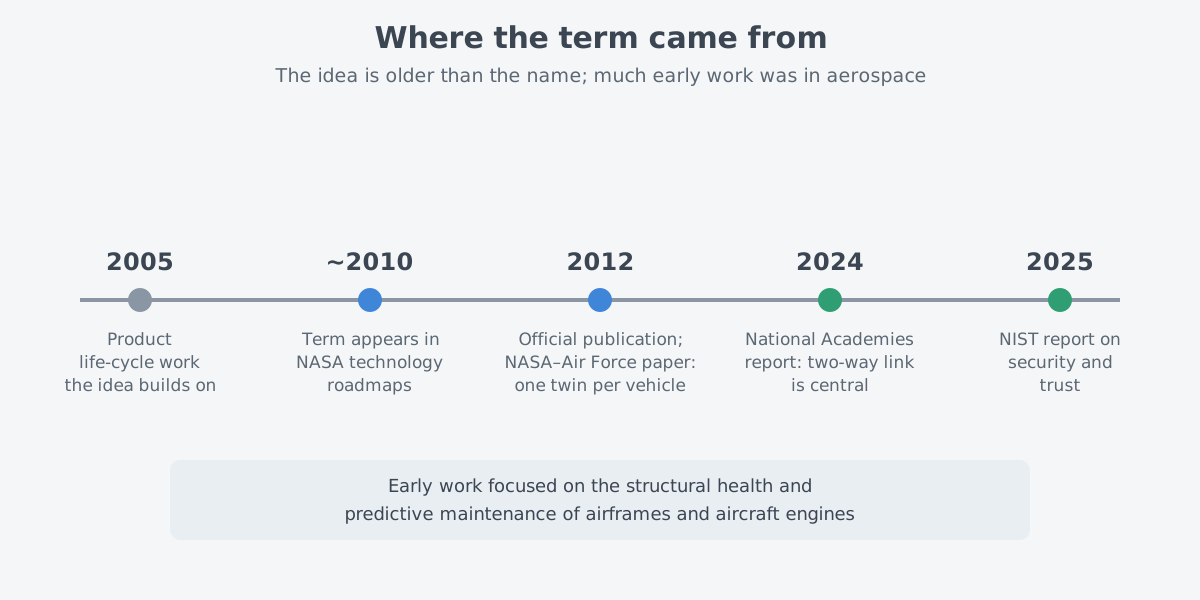
A 2012 conference paper by researchers at NASA Langley Research Center and the Air Force Office of Scientific Research (AFOSR) drew the idea in detail. It describes a simulation of a vehicle as it was actually built. That simulation combines the best physical models, sensor updates and the service history of the whole fleet so that it mirrors the life of its real, flying twin. In this picture, each twin is built for one particular vehicle, and it is also used to "fly" future missions in a computer during design and certification.
Why propose this? One reason was cost. The broad physical testing behind the success of past missions had become more and more expensive.
The authors also expected the full idea to need many decades to mature, so they proposed steps along the way. One was an Air Force Research Laboratory (AFRL) plan to use parts of an existing aircraft, the F-15, as a test platform for combining current technology and finding the gaps.
Where defense wants to use it
Aircraft maintenance is the first example. The National Academies summary of an engineering workshop describes the AFRL airframe digital twin program as focused on keeping the structure of military aircraft sound. Its first aim was to balance two needs: avoiding the unacceptable risk of a catastrophic structural failure, and cutting the time aircraft spend down for maintenance. Still, significant gaps remain before the U.S. Department of Defense can adopt the airframe twin.
Twins may also help plan tests. Using simulations first to pick which test conditions are worth running and where sensors should go could shrink physical test programs and calibrate twins better for real use. This direction came from the same workshop, and the point is not to drop testing but to choose where testing goes.
What about ships? One industry example is a twin that gives 2D and 3D views of a vessel or a virtual reality view. During operations, the twin could let the crew monitor every part of the ship, possibly removing the need for some physical inspections. For now that is a possibility, not a result.
Real programs find it hard. A June 2025 report by the Government Accountability Office (GAO), quoted by the Congressional Research Service (CRS), covers the U.S. Navy frigate program (FFG-62). When the report came out, program officials said their digital twin and digital thread planning would not appear in program documents until 2025. The difficulties named were getting data, what data environments cost, and hiring skilled staff.
What is still hard
The first problem is time. A real object wears over time, but the twin stays as it was unless new data come in. A metal part may develop hairline cracks that the twin does not show. So the two drift apart at some point and have to be brought back in line each time.
The second is checking that they really match. If the twin is a specification that can be run, it should give the same outputs as the real object for the same inputs. Only then can the two be called equivalent. A twin built after the real object exists may also be less faithful, since some of the object's inner details cannot be known.
The checking work has a name: verification, validation and uncertainty quantification (VVUQ). Validation is the part that asks how accurately a model represents the real world for the purpose it will be used for. The National Academies concluded that VVUQ is essential to building and running digital twins responsibly, and that trust requires VVUQ and monitoring to continue over time.
The third problem is cost and people. Many of today's most advanced digital twins are custom builds that need large resources and deep expertise. That overlaps with the data, cost and staffing problems the frigate program officials described.
The fourth is security. A digital twin gathers data and control signals from the many sensors on an object into one place. That makes calculation and control more efficient, but it also gathers sensitive data and control access into one place.
Reading on with the laser articles
Lasers are also studied with calculations before they are built. What simulations of gain, heat and beam propagation can and cannot stand in for is covered in Why lasers are studied by calculation first.
Reading the two articles side by side shows one dividing line. Whether a loop keeps revising the model with data from the real object is what separates the digital twin in this article from an ordinary calculation.
What to read next
- Simulation versus testing: why CG is not proof: why calculations and tests are different kinds of evidence.
- Why lasers are studied by calculation first: what calculation does before a laser is built.
- Predictive maintenance: spotting failures before they happen: picks up the maintenance side, where digital twins were first used most.
- Military logistics: performance must be sustainable: looks at the work that keeps equipment running.