AI that handles language grew up reading text piled up on the web. So where would a robot read how to hold a cup, fold a shirt, or get back up after a fall? No giant library records those hand and foot movements.
Robot foundation models are an attempt to fill that empty library. They pool data from many robots and many tasks into one large base model, and they make up for missing experience in virtual worlds inside a computer. Where does that data come from, and how do skills from a virtual world reach a real robot? The figures from company announcements run up to October 2026.
What "foundation model" means
In 2021, researchers at Stanford University wrote in a long report that AI was going through a major shift. More and more models were being built by learning from huge, wide-ranging datasets, and the same model could then be fitted to many different jobs. The name given to them was foundation models. The name was chosen to show that these models sit at the center of many things while still being incomplete on their own.
A long-standing dream in robotics is a "generalist" robot that can do many kinds of work in many different places. The Stanford report's robotics section sees robots, unlike language or images, as tied to the physical world, which creates basic challenges. The biggest one is getting enough data in a form that suits learning. Plentiful data, such as ordinary videos of people, is named as one candidate for closing that gap.
Robots have no web to read
Today's factory robots are narrow specialists. They are programmed to repeat one weld at one fixed point on a production line, again and again. It was normal to train a separate model for each task, each robot and each environment, and changing a single variable often meant starting again from scratch.
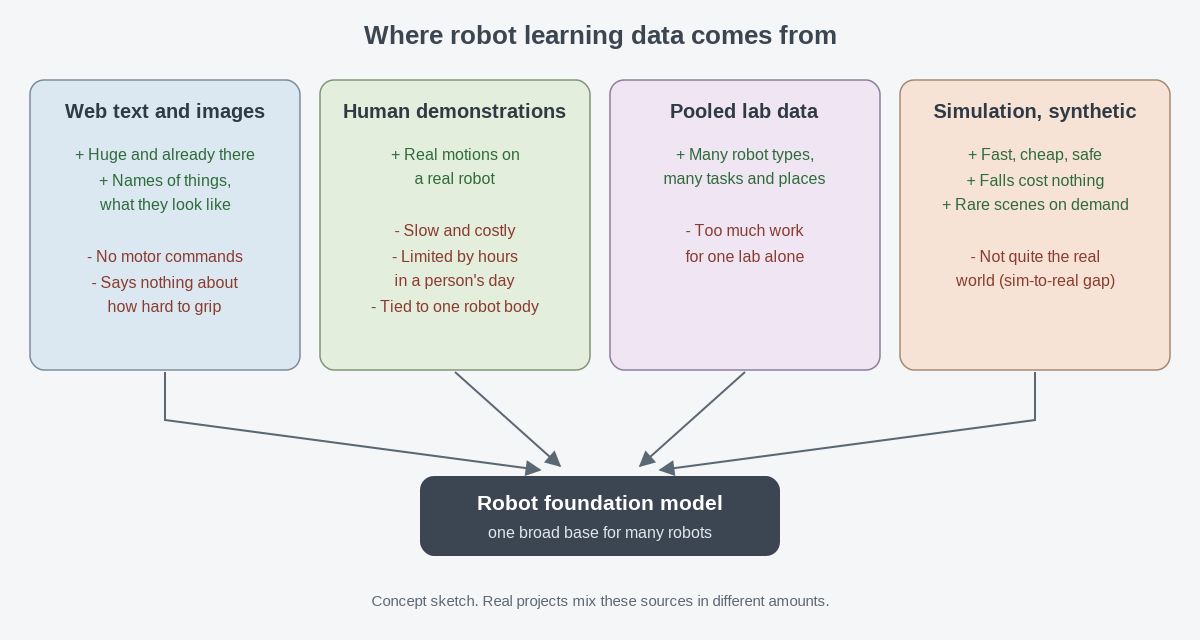
Language models mine documents from the web. Robots have no such treasure trove. Physical Intelligence, a company that builds robot models, explains that teaching a robot a new skill means collecting a lot of data with that particular robot for that particular use.
People can also drive a robot by hand to demonstrate a task. That leaves a record of real motions on a real robot, so the quality is good. But as NVIDIA puts it, a person can only demonstrate for so many hours, since a day has just 24 of them. Large, varied, high-quality data is vital for robot development, yet costly to capture.
It is a bit like learning to cook with no cookbook, only the chance to watch one chef's hands. In reality the robot is worse off. A person can watch someone else's hands and copy the motion. A robot with a different body shape used to need fresh data collected on that body.
Where the data comes from
The first path is to pool data from many labs. On October 3, 2023, Google DeepMind released the Open X-Embodiment dataset, built with 33 academic labs at more than 20 institutions from 22 types of robots. It covers more than 500 skills, 150,000 tasks and more than 1 million episodes. The reason for pooling was simple: collecting a dataset like this takes too many resources for any single lab.
DeepMind released results at the same time. In them, one model trained on data from many robot bodies did much better across many robots than models trained on a single body. In tests on five common robots at five labs, success rates were 50% higher on average than methods built separately for each robot.
The second path is for one company to collect data itself on several robots. When Physical Intelligence released its first general-purpose model, π0, on October 31, 2024, it said it had used dexterous task data from 8 different robots. The tasks included clearing dishes, packing items into envelopes, folding clothes, routing cables, assembling boxes and plugging in power plugs. The company described the full training mix, which also included open robot data, as the biggest collection of robot interaction data so far.
The third path is to inherit knowledge already learned from the web. π0 starts from a vision-language model that had already learned from web-scale images and text. The web teaches names and appearances of things, and robot data teaches how to pick them up.
But web images and text contain no motor commands. For dexterous tasks π0 has to issue motor commands as often as 50 times a second, and that skill comes from robot data. The fourth path is the virtual world in this article's title.
Falling over many times in a virtual world
Imagine teaching a four-legged robot to run. Practicing on a real robot means parts get damaged with every fall, and someone has to stand it back up. A 2019 paper in the journal Science Robotics made the same point. It said reinforcement learning for legged robots had mostly stayed in simulation because training with real robots, especially ones that must keep their own balance, is complicated and expensive.
Reinforcement learning needs little hand-crafted motion design and lets a control policy grow through trial and error. The paper's authors trained a neural network controller in a simulator and then moved it to ANYmal, a four-legged robot about the size of a medium dog. The robot ran faster than with earlier methods and got back up even after falling into awkward positions.
Imitation learning, in which a robot learns by copying human demonstrations, can also happen in a virtual world. Simulation frameworks such as NVIDIA's Isaac Lab use graphics processing units (GPUs) to run calculations in parallel. They train policies for humanoids, robot arms, autonomous mobile robots and other bodies, using either kind of learning. Testing in a virtual copy before building something is also the idea behind a digital twin, the subject of Digital twins: testing before building.
The gap between simulation and reality
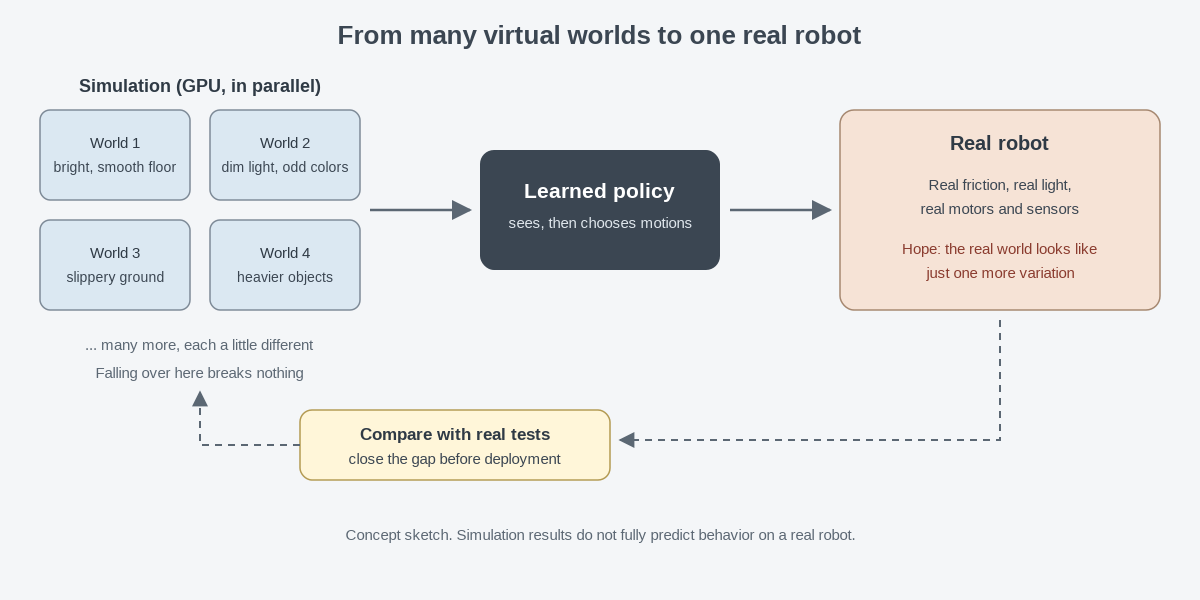
A virtual world is never exactly like reality. Floor friction, motor strength and the light reaching a camera all differ a little. This difference is called the sim-to-real gap.
So doing well in simulation does not fully tell you how a machine will act once it is in use. Simulated results need to be checked against real tests, and any gaps dealt with before deployment.
One idea for narrowing the gap is to shake up the conditions in the virtual world on purpose. A 2017 paper at the IROS robotics conference used domain randomization, which randomly changes the simulator's rendering settings, to train a real-world object detector on unrealistic simulated images alone. If the simulator varies enough, the real world may look to the model like just another variation. Later work extended the idea by generating random environments that grow harder automatically.
This method has a limit too. A property of the real world that is not on the list of things being shaken up cannot be learned, no matter how much shaking happens.
Others are working to make the physics calculation itself more accurate. In March 2025, NVIDIA announced Newton, a physics engine with open source code that it is building together with Disney Research and Google DeepMind. Its aim is to help robots learn complex tasks with more precision.
Multiplying human demonstrations with synthetic data
A virtual world is a practice field, but it is also a data factory. On March 18, 2025, NVIDIA announced Isaac GR00T N1, a model for humanoids, and called it the world's first "open, fully customizable" humanoid foundation model. Developers could download it from the day of the announcement. The part that produces actions was trained on human demonstration data plus a large amount of synthetic data made with NVIDIA's Omniverse platform.
In the same announcement, NVIDIA released a tool that takes a handful of human demonstrations and generates far more synthetic motion data from them. By the company's figures, it produced 780,000 synthetic trajectories in 11 hours. That equals 6,500 hours of human demonstrations, or nine months of nonstop work. Mixing synthetic data with real data made GR00T N1 perform 40% better than training on real data alone.
These are numbers the company measured on its own model. The announcement alone does not say on which tasks, or against what baseline, the 40% was measured. Releasing a model is also a different stage from robots running that model and doing real work at a site. The companies named as early users at the time were Agility Robotics, Boston Dynamics, Mentee Robotics and NEURA Robotics.
A broad base, then a little more teaching
Using a foundation model happens in two steps. First, a base model is pre-trained on broad data. Then it is post-trained on a small amount of data for a specific robot or a hard task.
π0 can be post-trained with carefully collected robot data so it can handle many tasks. It can also be asked in words to do a task, or tuned separately for a demanding use. GR00T N1 can likewise be adapted by developers to their own humanoid or task, using real data, synthetic data or both.
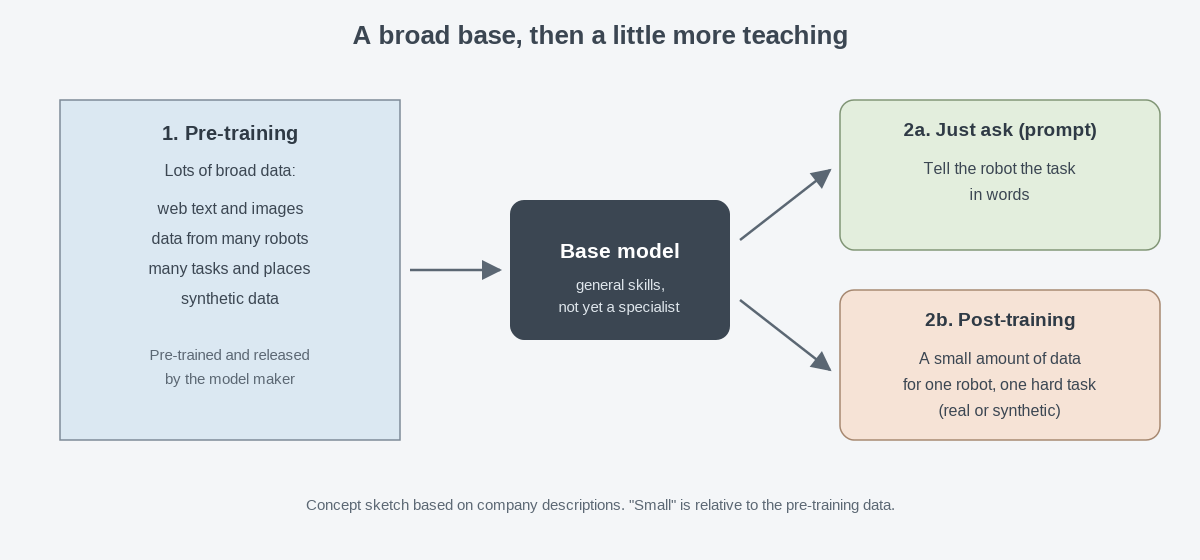
The goal is to get around the data shortage. If one general robot policy can do many skills and run many robots, each new robot or new use needs only a little data.
What is still hard
First, data is still expensive. Even GR00T N1, boosted with synthetic data, was trained on a mix that included real data. There is no guarantee that a model that does well in simulation will behave the same way in reality, so the step of comparing with real tests cannot be skipped.
Second, the companies themselves say it is early. Physical Intelligence called π0 just a small first step on the way to truly general-purpose robot models. A video of a robot folding laundry does not mean the same robot will soon do that work in every home and factory.
Third, robustness and safety weigh more once a model has a body. The Stanford report found that robot foundation models, while opening new uses, make robustness and safety matter more, including formal safety evaluation. Unlike AI whose mistakes stay on a screen, a robot's mistakes reach people and objects.
Fourth, performance numbers need careful reading. Figures in this article such as 50% and 40% were measured on tasks and baselines chosen by the companies that announced them. Whether the same result holds under other conditions has to be checked separately. And as robots decide more on their own, it matters more where people make which decisions.
What to read next
- What Is Physical AI: Artificial Intelligence with a Body: start with models that turn words into actions, and the difference between an announcement and a sale.
- How Humanoids Walk: Actuators and Balance Control: see how a gait learned in a virtual world moves a real body.
- Levels of Autonomy in Drones and Robots: Where the Human Sits: how much machines decide on their own, and where people stay.
- Simulation versus testing: why CG is not proof: how far to trust virtual results, seen through weapons development.
- Why lasers are studied by calculation first: why laser research also starts with calculation before experiments.