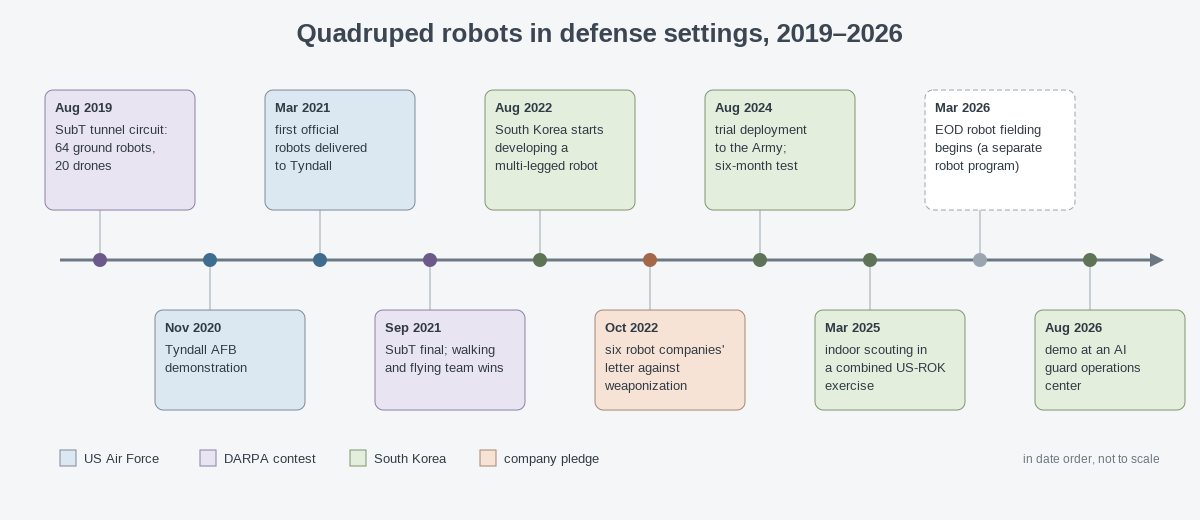
On November 10, 2020, a robot that walks on four legs stood before base leaders at Tyndall Air Force Base in Florida. It looked like a dog, but the Air Force story stated clearly that it was not meant to replace military working dogs. Its job was to walk through areas that people and vehicles would rather avoid.
In the years that followed, four-legged robots turned up in base patrols, an underground exploration contest, bomb disposal teams and South Korean military trials. These stories do not all carry the same weight. A demonstration, a trial deployment and a contract are different stages, and on the question of arming robots, the companies that build them have drawn a line themselves.
Which stage does each case belong to, and where does the question of arming them divide? The cases come from public records released up to October 2026.
Why legs instead of wheels
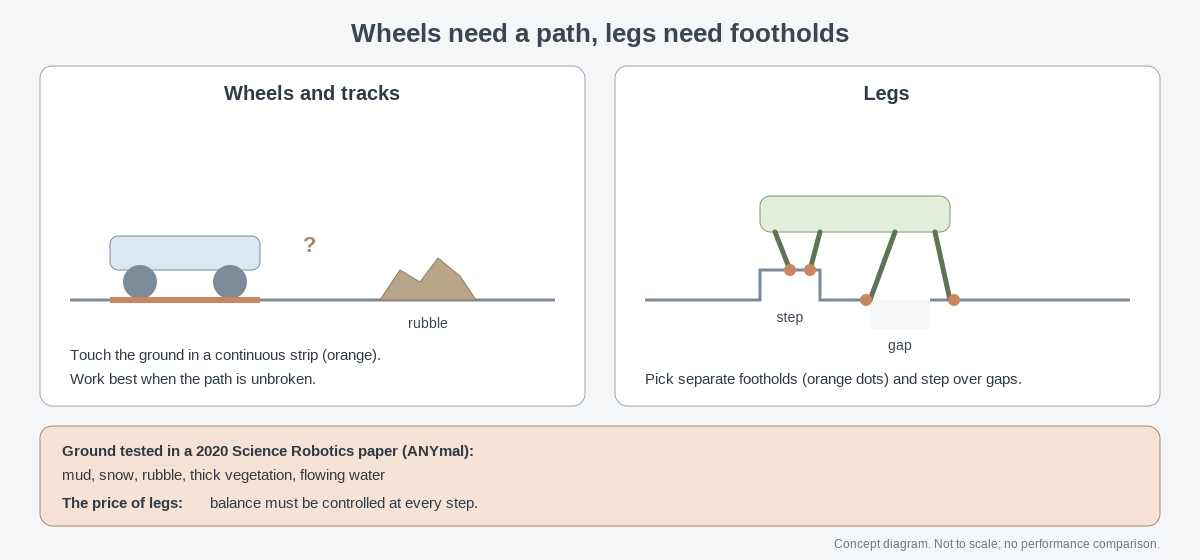
A wheel touches the ground in a continuous strip. Just as a tire track runs unbroken, a wheeled machine works best when its path is unbroken too. Legs work differently. They pick one foothold at a time, so they can step over a rock or a gap between those footholds.
Some of the hardest environments on Earth can be reached by four-legged animals but not yet by autonomous machines. A 2020 paper in Science Robotics opens with that observation and argues that legged walking can greatly widen the places where robots can work.
Legs come at a price: a legged robot has to keep its balance at every moment. Conventional legged controllers grew more and more complex, yet still could not match how widely and reliably animals walk. The team trained a controller by reinforcement learning in simulation and took two generations of the ANYmal quadruped into varied natural terrain. The controller stayed robust in conditions it never met in training, such as mud and snow, rubble, thick vegetation and flowing water.
Think of a hiker and a bicycle. On pavement the bicycle is faster, but on a slope scattered with boulders the hiker gets farther. The difference is that a robot does not pick its path by eye the way a person does, but balances each step through sensor signals and controller calculations. Unmanned ground vehicles (UGVs) that move on wheels and tracks are covered in Unmanned ground vehicles: robots for dangerous places.
Base patrol: helping guards and working dogs
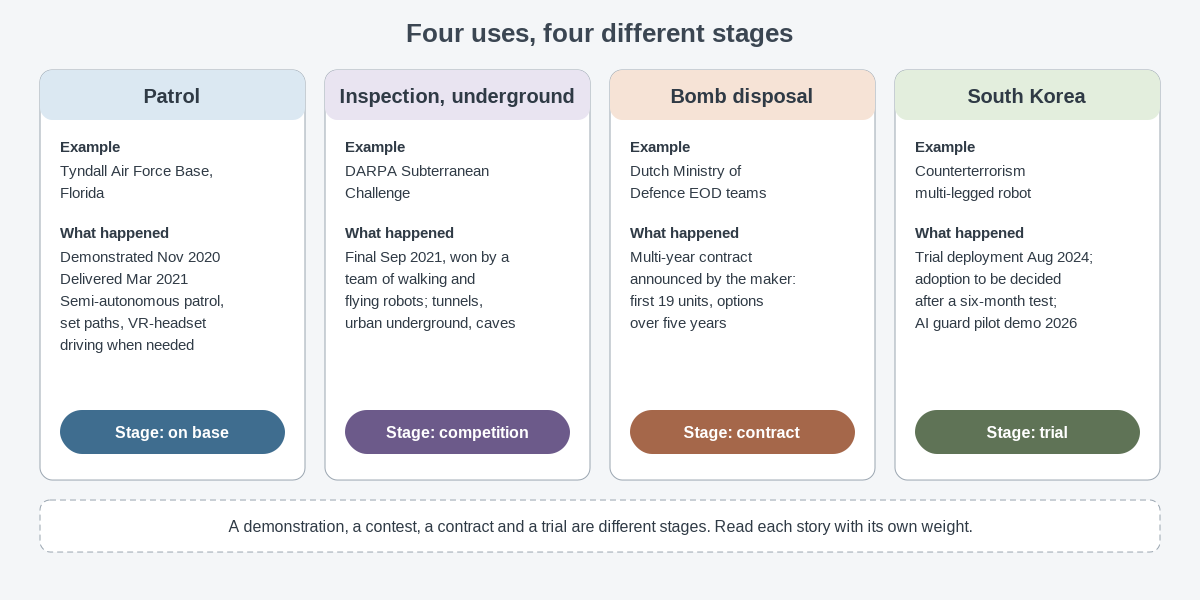
Air Force stories call the Tyndall robots "Quad-legged Unmanned Ground Vehicles (Q-UGVs)." The base and the 325th Security Forces Squadron had spent a year working with two companies, Immersive Wisdom and Ghost Robotics, on a virtual security operations center. They showed the results on November 10, 2020.
The patrols were semi-autonomous. Patrol paths are set in advance, and the noncommissioned officer in charge of the electronic security sensor system sets and watches them. When needed, operators can also drive a robot through a virtual reality headset from the base defense operations center. Driving a robot from a distance like this is called teleoperation.
The first official robots arrived at the base on March 22, 2021. Their purpose was to add one more layer of protection to the base, and each carries 14 sensors for 360-degree awareness. While the robots cover remote parts of the base, security staff can keep watching other critical areas.
Inspection and underground exploration
Looking into places people struggle to reach is another job given to four-legged robots. Spot, the quadruped from Boston Dynamics, is marketed as a robot that automates sensing and inspection. Its listed uses include checks in places that are electrically live, radioactive or otherwise dangerous.
Military interest went deeper underground. The US Defense Advanced Research Projects Agency (DARPA) ran the Subterranean Challenge (SubT). DARPA's program manager said the contest was designed mainly around the needs of warfighters and first responders. Search and rescue in many kinds of underground spaces was the inspiration.
The Tunnel Circuit, held in August 2019 in two Pittsburgh mines, drew 20 unmanned aerial vehicles and 64 ground robots. DARPA titled its release "Rolling, Walking, Flying, and Floating." Robots on wheels, robots on legs and robots in the air were tackling the same problem in one contest.
The final was held in September 2021 at the Mega Cavern in Louisville, Kentucky. The contest set out to advance and test mapping and navigation for real sites such as human-made tunnels, urban underground spaces and caves. The CERBERUS team, whose name stands for walking and flying robots exploring underground on their own, won the physical robot competition. The program manager said that in combat or disaster response, troops and first responders face rough terrain, unstable structures and limited communications.
Bomb disposal: going first instead of a person
In explosive ordnance disposal (EOD), the job Boston Dynamics highlights for Spot is reaching a suspicious object before a person does. The robot approaches a suspicious package or improvised explosive device first. Operators then watch the scene through the robot's cameras and sensors while keeping well back, and decide what to do next. If needed, a partner's disrupter can then be fitted to make the object safe.
How roadside improvised explosive devices changed military vehicles and gear is covered in IEDs and the MRAP: How a Roadside Threat Reshaped Vehicles.
Military contracts have followed. Boston Dynamics announced a multi-year contract with the Dutch Ministry of Defence to supply and support Spot for its EOD teams. The deal starts with 19 units, with options to add more over the next five years. The ministry also plans to look at using the robots elsewhere in its armed forces, beyond bomb disposal.
Another company post lists public safety jobs Spot already does: checking for dangerous gases, inspecting unexploded ordnance, looking into suspicious packages, search and rescue, and exploring underground or cramped spaces.
Trials in the South Korean military
In South Korea, a quadruped robot was developed through the Defense Acquisition Program Administration's (DAPA) rapid pilot program. On August 12, 2024, DAPA announced that a multi-legged robot for counterterrorism operations had been deployed to the Army on a trial basis on August 7. Development had started in August 2022.
Its stated performance is walking on four legs at 4 km/h or more and climbing vertical obstacles such as stairs of 20 cm or more. It carries day and night cameras for surveillance and reconnaissance, and it can take various equipment, including a remotely fired pistol, for combat tasks. A DAPA director said it was significant as the first robot able to carry out combat tasks to be deployed and run by the military.
The robot was still in testing. The military planned to check its performance and military usefulness for six months with the Army Special Warfare Command and one front-line division, and then decide whether to adopt it.
It has also appeared in exercises and demonstrations. On March 12, 2025, the Army's 25th Infantry Division brought multi-legged robots to a combined US-ROK exercise on removing weapons of mass destruction. Soldiers used one to scout the inside of a building.
On August 13, 2026, the defense minister watched demonstrations, including a multi-legged robot, at the 5th Infantry Division's AI guard operations center. He was also briefed on a pilot project to shift guard operations to an AI-based system.
A separate project involves another robot. On March 5, 2026, DAPA said it had begun fielding an explosive detection and disposal robot and called it the country's first robotic weapon system. In the exercise report, too, multi-legged robots and explosive detection and disposal robots appear as separate items.
The arming debate: company pledges and military trials
On October 6, 2022, six robot companies published an open letter titled "General Purpose Robots Should Not Be Weaponized." They were Boston Dynamics, Agility Robotics, ANYbotics, Clearpath Robotics, Open Robotics and Unitree. They pledged not to weaponize their highly mobile general-purpose robots or the software that runs them, and not to help others do so.
The pledge has limits on its scope. The letter states plainly that it does not object to the technology countries and their agencies already rely on for self-defense and law enforcement. The reasons the companies gave, and the limits that a company releasing open software admitted, are followed in The Debate over Military Physical AI: Company Policies and International Talks.
Meanwhile, some military quadrupeds are developed to be able to carry out combat tasks. South Korea's counterterrorism multi-legged robot, described above, is one example, and the government announcement says it can carry a remotely fired pistol. A pledge about companies' general-purpose robots and a robot developed as a military system do not sit on the same scale. Where people should make decisions as robots take on more of their own judgment is taken up in Autonomous weapons and human control.
What to read next
- Unmanned ground vehicles: robots for dangerous places: unmanned ground vehicles on wheels and tracks.
- IEDs and the MRAP: How a Roadside Threat Reshaped Vehicles: the background that made bomb disposal robots necessary.
- Autonomous weapons and human control: the question of human control behind the arming debate.
- What Is Physical AI: Artificial Intelligence with a Body: the big picture of machines that sense, decide and move.
- How Humanoids Walk: Actuators and Balance Control: a closer look at how legged robots keep their balance.
- Levels of Autonomy in Drones and Robots: Where the Human Sits: where semi-autonomous patrol and teleoperation fit among the levels of autonomy.
- The Debate over Military Physical AI: Company Policies and International Talks: the joint letter in this article, placed in the wider debate.