Early on 13 June 1944, people in London heard a sound they had never heard before. With a buzz like a motorbike, something that looked like a short-winged plane, half on fire, crossed the sky. A few minutes later the sound stopped, and then came the blast. Three months later a weapon appeared that fell without any sound at all.
The first was the V-1, the second the V-2. The V-1 flew low through the air on wings and a jet engine, while the V-2 rode a rocket to the edge of space and then fell back. The two families now called cruise missiles and ballistic missiles both saw combat for the first time here. This article follows, from public records, how the two weapons came about and were used, what happened to the people who built them, and what remained after the war.
When the "vengeance weapons" appeared
A week before the first V-1 fell, the Allies landed in Normandy. Over Germany, British and American bombers were raiding German cities almost at will. In this worsening strategic situation, Germany sent out its "revenge weapons" (Vergeltungswaffen). The aim was to frighten British civilians and break their morale, and Nazi propaganda hailed them as "wonder weapons" (Wunderwaffe) that might turn the tide of the war.
Why did a bomb without a pilot appeal? Vikki Hawkins, a curator at Imperial War Museums (IWM), explains that Germany was losing not only the bombing war but also the production war. A pilotless bomb was relatively simple to make and used cheaper materials than an aircraft. It also avoided spending scarce manpower over British skies.
The names were part of the propaganda too. "V-1" and "V-2" came from the Nazi Propaganda Ministry, and each weapon had another name. The V-1 was the Air Ministry's Fi 103, and the V-2 was German Army Ordnance's A-4 (Aggregat 4). Two different services built the two weapons separately.
The V-1: a winged jet bomb
The V-1 was an air force project. The engine maker Argus and the aircraft maker Fieseler built it together, and the name Fi 103 comes from Fieseler, which designed the airframe. The National Air and Space Museum (NASM) names rivalry with the army as one reason the air force pushed the flying bomb so hard. The army had just begun test launches of its A-4 rocket.
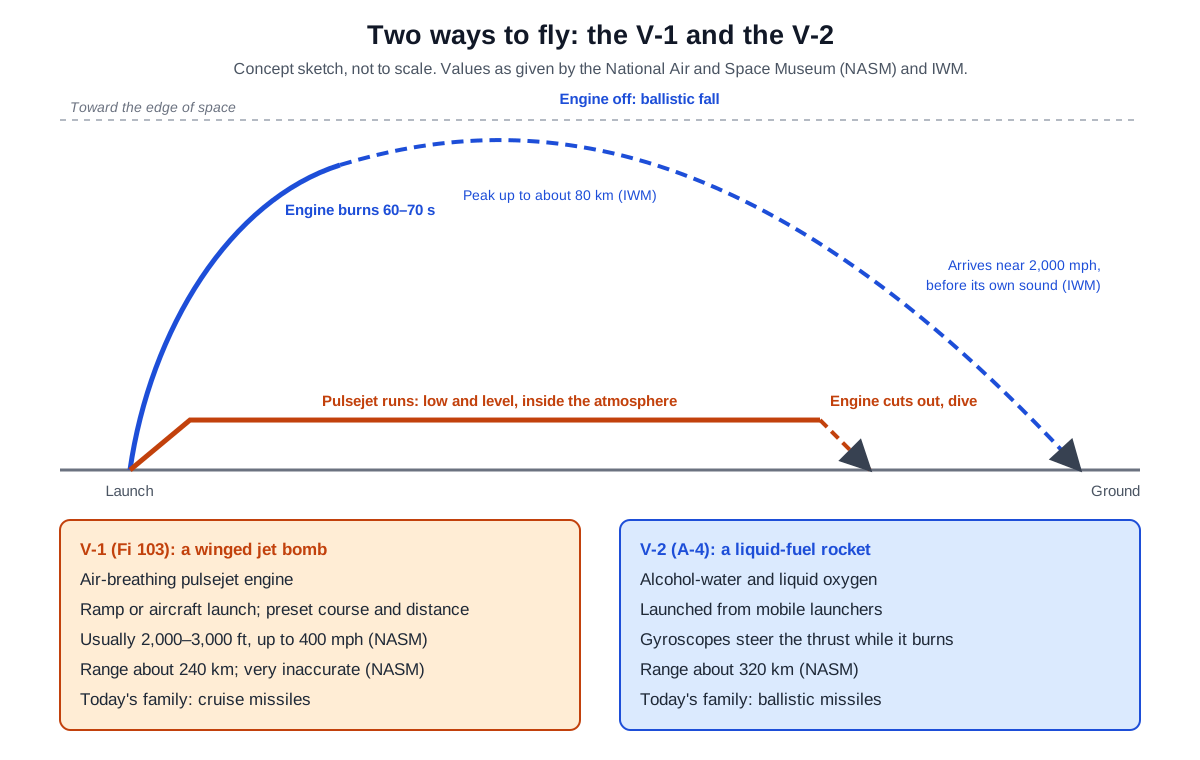
In shape it was close to a small aircraft. A tube-shaped engine called a pulsejet sat on top of the rear fuselage, and it drew in air to burn its fuel. It was simple but noisy. Because of that noise, people on the Allied side called the V-1 the "buzz bomb" and the "doodlebug."
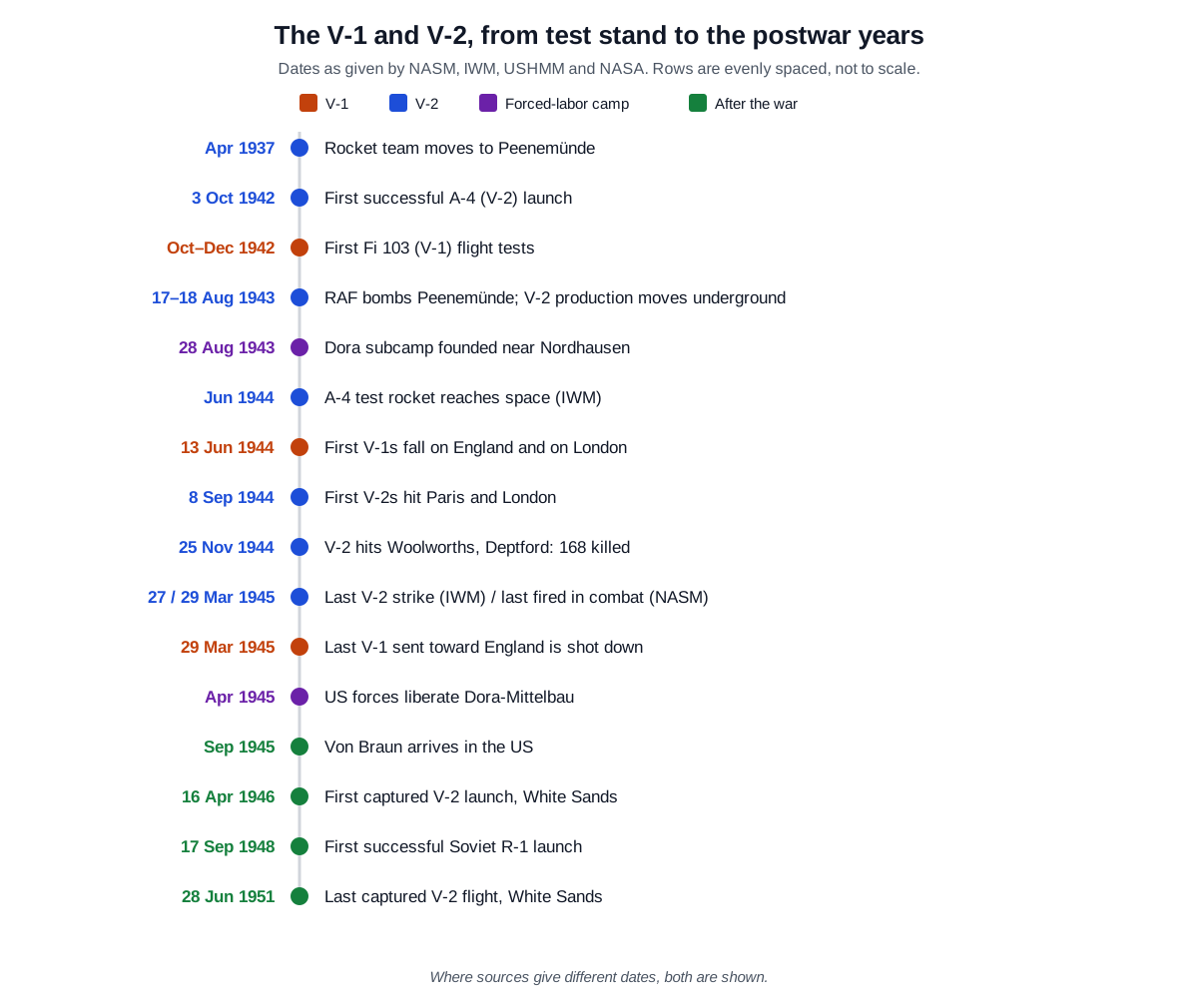
Testing began in 1942. That October an unpowered prototype made the first flight tests. In December came the first Fi 103 flight test, dropped from an aircraft, and the first ground launch from a ramp. In combat it was launched from ramps, and later also from bombers adapted to carry it.
The V-1 was not radio-controlled. A preset system held its heading with a magnetic compass, and a small propeller on the nose counted turns to measure distance. When the count was reached, a device in the tail sent the missile into a dive toward its target.
It usually flew for about half an hour at 2,000–3,000 ft and up to 400 mph. Its range was about 240 km, but it was very inaccurate.
People on the ground judged the danger by ear. A buzz meant a V-1 was on its way. When the buzz stopped, the fuel had been cut and the bomb was coming down. Harold Chisnell, a National Fire Service member in Twickenham, recalled that waiting without knowing when or where the sound would cut out was the worst thing for morale.
NASM calls the V-1 the world's first operational cruise missile. A winged weapon that flies through the air on an air-breathing jet engine belongs to the same family as today's cruise missiles. The V-1, though, had nothing that sought out its target. It only kept to a preset heading and distance.
The V-2: a rocket to the edge of space
The V-2 came out of the army's rocket program. After the First World War, rockets and space travel became very popular ideas in Germany. A common story says the army took an interest because the Treaty of Versailles did not restrict rockets. IWM curator Ian Kikuchi explains that, in reality, legality was not an important factor.
In April 1937, the rocket team of about 90 people moved to a large new secret research site at Peenemünde, on the island of Usedom on the Baltic coast. The program was led by Wernher von Braun, the technical director, and Walter Dornberger, its military head. Launches in June and August 1942 failed, and the first A-4 to fly successfully went up on 3 October.
Sources give different dates for the order to mass-produce it. NASM says Hitler ordered mass production on 22 November 1942. The IWM curator's video gives January 1943 for the large-scale production order and July of that year for top priority. Testing went on, and in June 1944 an A-4 test rocket became the first human-made object to reach space.
Most of the V-2's body was two large tanks. The upper tank held a mix of alcohol and water, the lower tank liquid oxygen, and the engine burned the two to produce thrust.
Behind the warhead sat a compartment with gyroscopes and an analog guidance computer. This equipment moved vanes inside the exhaust to change the direction of the thrust and correct the flight. The idea of steering with engine thrust is covered in the article on thrust vectoring.
The engine burned for 60 to 70 seconds and pushed the V-2 up to a maximum height of 80 km. After that it fell on a ballistic path with no engine, reaching almost 2,000 mph by impact. Because it was faster than sound, people in the target area heard the rocket coming only after the explosion. Its maximum range was about 320 km.
The first plan was to fire it from fortified bunkers on the French coast, but Allied bombers destroyed the bunkers. So the V-2 was fired from mobile batteries that could work from almost anywhere. NASM describes the V-2 as the first big liquid-fuel rocket and the first long-range ballistic missile, and as the forerunner of today's large rockets and space launchers. Falling on a ballistic path after the engine stops is exactly the flight that the name ballistic missile describes today.
1944–1945: London and Antwerp
At 4:18 a.m. on 13 June 1944, the first V-1 fell on Swanscombe in Kent, England. The first to hit London fell at 4:25 a.m. on Grove Road in Bow. That one bomb destroyed a railway bridge and nearby homes, killing 6 people, injuring 30 and leaving 200 homeless.
The defenders did not stand still. Because the V-1 flew straight and level, many were shot down before they reached their targets. Anti-aircraft guns brought down over 1,800 and fighters a similar number, while barrage balloons accounted for another 200.
What finally saved London from the V-1 was the Allied advance. Allied troops overran the Pas de Calais launch sites in late August 1944. For months afterward, V-1s could reach Britain only if they were launched from aircraft. Instead, the vital Allied port of Antwerp came into the firing line.
The V-2 appeared in September. On 7 September the first two rockets fired at Paris failed when their engines cut off early. At 8:30 a.m. on 8 September the first V-2 struck Paris, and at 6:43 p.m. the same day one hit Chiswick, a western suburb of London. Thanks to Austrian and Polish resistance groups, the Allies had known about the V-2 long before it appeared in their skies.
Knowing about it did not mean stopping it. Because of its speed and path, the V-2 could not be shot down by anti-aircraft guns or fighters. The Allies' only option was to capture the launch sites as they advanced through north-western Europe.
Every strike fell on people. At 12:25 p.m. on Saturday 25 November 1944, a V-2 landed on the Woolworths store on New Cross Road in Deptford. It was a month before Christmas and the shop was especially busy; 168 people were killed. Pat Grant, who lived nearby, remembered the eerie silence after the blast.
Antwerp was hit for longer. At the peak in December, more than a hundred V-2s a week fell on the port. The deadliest single attack was also in Antwerp, where 567 people died at a cinema.
The end came in March 1945. As the launch sites fell to Allied troops, the offensive stopped. IWM gives 27 March as the day of the last V-2 strike, and NASM gives 29 March as the last V-2 fired in combat. The last V-1 sent toward England was shot down by anti-aircraft guns on 29 March.
The people in the underground factory
On the night of 17–18 August 1943, the Royal Air Force bombed Peenemünde. The physical effect of the raid is still debated. Even so, it helped persuade the Nazi leadership to move V-2 production underground, out of reach of Allied bombers. Production moved to Mittelwerk, an underground plant at Nordhausen in Germany's Harz Mountains.
Concentration camp prisoners built that factory. On 28 August 1943, the SS trucked 107 prisoners from Buchenwald to tunnels in the southern Harz. That was the start of the Buchenwald subcamp called Dora. In October 1944 it became Mittelbau, a separate main camp that ran more than 30 subcamps.
The Holocaust Encyclopedia of the United States Holocaust Memorial Museum (USHMM) records the conditions in detail. Until spring 1944, most prisoners lived below ground in unstable tunnels, with no daylight or fresh air. Toilets were nothing more than oil drums sawn in half, and pneumonia, tuberculosis, typhoid and dysentery combined with 12-hour days of exhausting labor. Registered deaths rose from five in September 1943 to 669 in January 1944.
At that time the prisoners were all men. In order of size, the largest groups were Soviet, Polish, French, German, Belgian and Italian. Its death rate was above that of most other concentration camps. Those who became too weak or sick to work were shipped to Auschwitz-Birkenau or Mauthausen and killed there.
Prisoners resisted too. A resistance organization tried to slow production and sabotage the rockets. Prisoners suspected of sabotage were usually killed, and more than 200 were publicly hanged.
Seeing the camp only as a weapons factory leaves people out. Jens-Christian Wagner, a German historian, argues that much writing overstates Mittelbau's role as a weapons plant. Of about 40,000 prisoners in March 1945, fewer than 6,000 actually worked in production, and most were construction workers and miners. Even so, the factory turned out 600 to 700 rockets a month from September 1944, plus 6,000 of the much simpler flying bombs between November 1944 and March 1945.
In early April 1945, the Nazis began moving the prisoners out. Thousands died on death marches, and when US forces liberated the camp in April, only a few prisoners were left. Jan Imrich, a survivor, said in an IWM video that young people must be made to know what happened in those days.
The records also show who decided on this labor. NASM writes that Dornberger and Arthur Rudolph, the factory's chief engineer, were among those who decided to use concentration camp labor in the rocket program. In NASM's account, von Braun knew of these decisions and became more and more involved in managing camp labor over time. NASA's biography of him also names Mittelwerk as a forced labor factory.
Reading the numbers
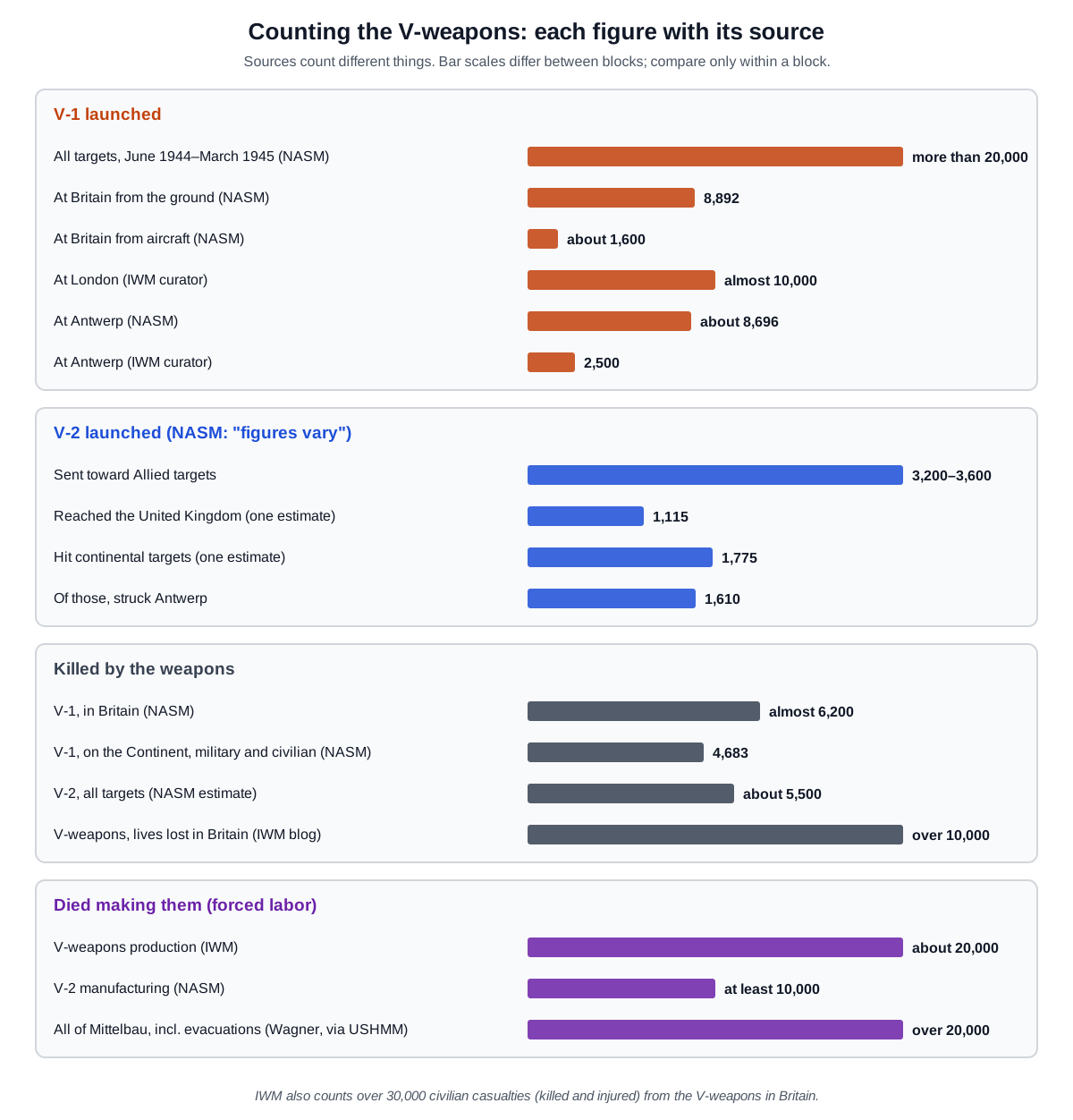
The numbers for the V-1 and V-2 differ from source to source. Sources differ on whether they count launches or impacts, and Britain alone or mainland Europe as well. So each figure below comes with its source.
Start with V-1 launches. NASM's summary says more than 20,000 were launched at Britain and mainland Europe from June 1944 to March 1945. The main NASM text counts 8,892 ground-launched and about 1,600 air-launched at Britain, and about 8,696 fired at Antwerp. The IWM curator's video gives almost 10,000 at London and 2,500 at Antwerp, so the Antwerp figures differ widely.
For the V-2, NASM first notes that figures vary, then says 3,200 to 3,600 were sent toward Allied targets. One estimate puts 1,115 of them in the United Kingdom and 1,775 on the Continent, with 1,610 of the latter landing on Antwerp.
Death tolls also differ. By NASM's count, the V-1 killed almost 6,200 people in Britain and 4,683 soldiers and civilians on the Continent. V-2 deaths are estimated at about 5,500, with 6,500 seriously wounded. IWM says the V-weapons caused over 30,000 civilian casualties in Britain, and an IWM research blog says over 10,000 lives were lost in Britain.
The people who died making the weapons belong in the count too. IWM says about 20,000 died making the V-weapons, more than the civilians the weapons killed. NASM says at least 10,000 died in the process of manufacturing the V-2 and attributes about half of the roughly 20,000 deaths at Mittelbau-Dora to the V-2 program. In Wagner's estimate, over 8,000 died during the evacuations alone, bringing the total Mittelbau toll to over 20,000.
The cost was huge as well. Kikuchi explains that the V-2 was Germany's largest arms project of the war, costing up to 2 billion Reichsmarks. He adds that the 3,000 tons of high explosive the V-2 carried over seven months could have been dropped by British heavy bombers in a single raid. In the end the V-2 was not accurate, not reliable, and not worth what it cost.
After the war
IWM concludes that the V-weapons campaign failed to change Germany's disastrous strategic situation. The psychological shock was great, but the destruction was less than in the Blitz of 1940–1941, and civilian morale held despite heavy losses. Winston Churchill described those months this way: "Suspense and strain were more prolonged. Dawn brought no relief and cloud no comfort."
When the war ended, the United States, Britain, France and the Soviet Union raced to take V-2 hardware, documents and technicians. As early as 15 November 1944, the US Army had signed a contract with General Electric to prepare captured V-2s for flight tests. That was a little over two months after the first V-2 launches. While US troops briefly held Mittelwerk in May 1945, parts for about 100 rockets were shipped to the United States.
People crossed the ocean too. Von Braun arrived in the United States in September 1945 under contract to the US Army. Under Operation Paperclip, 118 of his team came over according to NASM, and 120 according to NASA.
On 16 April 1946 the first captured V-2 in the United States was launched at White Sands in New Mexico. In all, V-2s made 67 flights at White Sands and at Cape Canaveral, Florida. A launch on 24 October 1946 filmed the Earth from 65 miles up, and the last captured V-2 flew on 28 June 1951.
Other countries used the V-2 as well. In October 1945, under Operation Backfire, Britain test-launched three V-2s with help from German technicians. France recruited Wolfgang Pilz and other former V-2 engineers, and they helped it build its first liquid-fuel missiles.
In October 1946 the Soviet Union forcibly deported thousands of German technicians and their families. It launched its first reassembled V-2 on 30 October 1947 and its first successful R-1 on 17 September 1948.
The V-1 crossed the ocean too. Before the war ended, the United States began copying the V-1 from wreckage parts supplied by Britain, and built more than 1,000 US versions called the JB-2. None saw combat, but they gave missile experience to the Army Air Forces and the Navy, and the Navy's version, the Loon, was later fired from submarines in the Pacific.
For a few postwar years the pulsejet powered low-cost missiles and target drones. These soon fell out of use, because they could not work at high altitudes and higher speeds.
The rocket line went much further. By the mid-1950s Soviet rockets belonged to a completely new generation, yet the Soviets had gained a lot from working with the V-2. Several countries launched modified V-2s for years, and that work paved the way for the next generation of nuclear-armed ballistic missiles. The rest of that story continues in the ICBM article.
Von Braun's team moved to Huntsville, Alabama, in 1950, and in 1969 a rocket he designed carried American astronauts to the Moon. An IWM video calls him one of history's most controversial figures. In 1984, after the Justice Department began a denaturalization hearing over his role as Mittelwerk's production manager, Rudolph left the United States rather than fight it. The history of the rockets and the history of the underground factory stayed tied together long after the war.
What to read next
- Cruise missiles: how they resemble aircraft: what the family that began with the V-1 looks like today.
- Ballistic missiles: why they climb high and come down: the physics of the ballistic flight the V-2 followed.
- Solid and liquid rockets: what the fuel form changes: the difference between the liquid fuel the V-2 used and solid fuel.
- ICBMs: what they share with space launch vehicles: how long-range ballistic missiles and launch vehicles relate after the V-2.
- Thrust vectoring: steering with the engine: today's version of the idea the V-2 used to steer with its exhaust.
- The Battle of Britain: An Air Defense Built on Radar and Control: the air defense that guarded London's skies four years earlier.
- A history of laser weapons: from chemical to electric lasers: another line of postwar weapons technology.