Ytterbium-doped fiber pumped at 976 nm is a picky eater. A 2024 SPIE abstract by nLIGHT researchers notes that its absorption band near 976 nm is narrower than 5 nm and drops off sharply around the peak. Yet the laser diode (LD) that supplies the pump light tends to shift its wavelength each time the chip warms up or cools down.
A small piece of glass called a volume Bragg grating (VBG) links the two. This article first looks at why a pump wavelength must not wander. It then shows how a pattern inside glass picks out one wavelength and sends it back, and how that returned light holds the diode's wavelength in place. It also covers what the method gives and what it costs, how it developed from the late 1990s, and a different path: gratings inside the chip.
When a pump's wavelength drifts
One reason a pump diode is useful is its narrow spectrum. A diode array has a much narrower spectrum than an ordinary flashlamp, so it can be tuned directly into an absorption line of a solid-state laser. Pump absorption becomes more efficient, and less heat is produced. Pump diodes: the part that turns electricity into light covers this in detail.
Things change when the tuned wavelength moves. In a solid-state laser with a narrow absorption line, a diode pump whose optical frequency is not stabilized can cause significant excess noise. The narrower the absorption band and the steeper its edges, the more the absorbed share changes when the pump wavelength slips even a little.
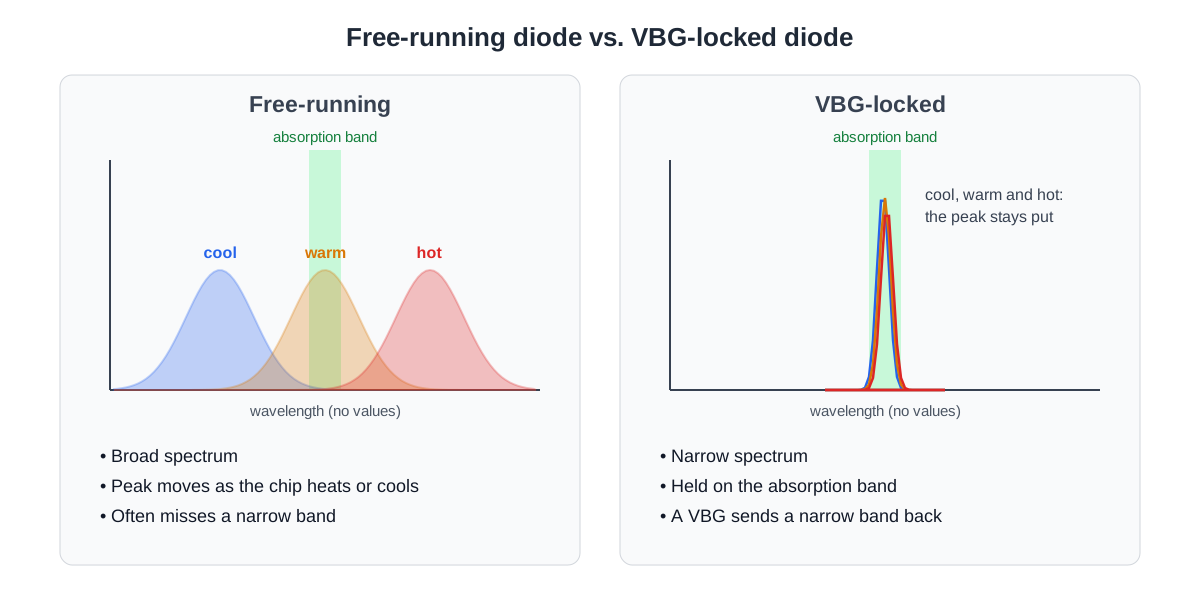
That is why the label "wavelength stabilized" shows up so often on pump diode products. The wavelength-stabilized products from nLIGHT are built so the spectrum stays put as temperature and current swing widely. The goal is to keep pump absorption high and even. Of the several ways to hold a wavelength, one long-used method places a VBG outside the chip.
Bragg reflection: layers that send back one color
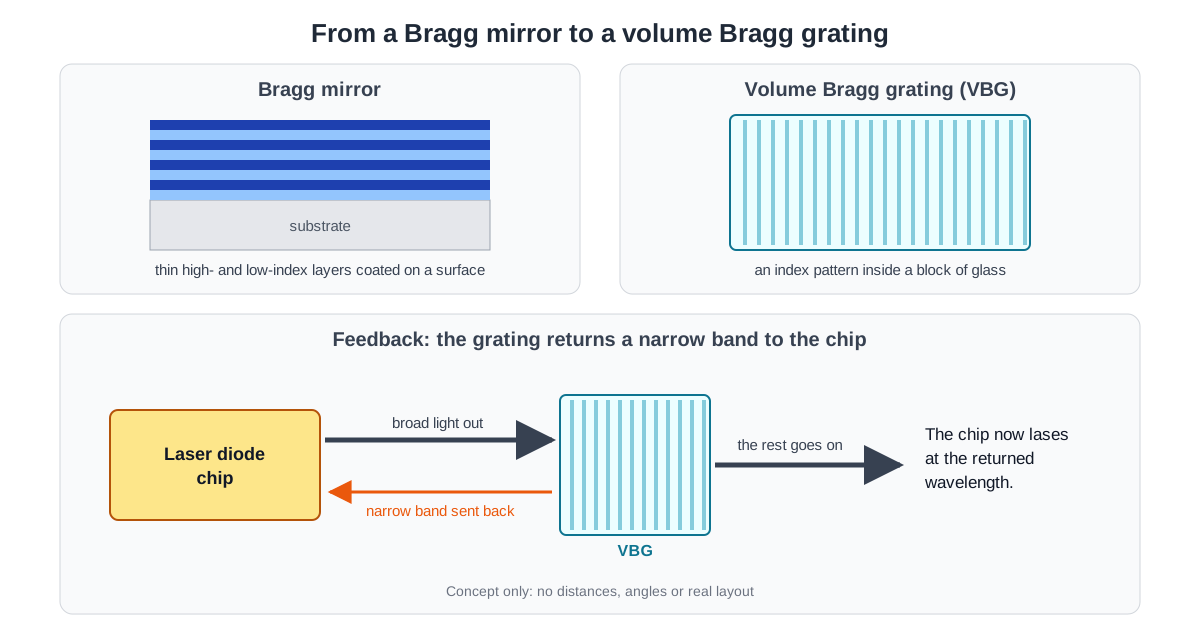
A VBG is easier to understand after a look at the Bragg mirror. The high-reflectance mirrors common in lasers are stacks of high-index and low-index layers coated in turn on a substrate. Such a mirror reflects most strongly at one wavelength, the Bragg wavelength.
Strong reflection is not limited to the Bragg wavelength alone. It covers a range of wavelengths around it, called the stop band, and the reflectivity drops sharply at its edges. The Bragg wavelength is set by the optical thickness of one pair of layers and equals twice that thickness.
Picture a column of people marching up a staircase. Only when each stride matches the step spacing does everyone move in the same rhythm. In reality the marchers are light waves, and the rhythm is set by the refractive index and spacing of the layers.
A pattern written inside a block of glass
A Bragg mirror is a set of thin layers coated on a surface. A VBG moves the same idea into the volume of a block of glass. It is still a medium whose refractive index changes periodically, but the pattern sits inside the glass rather than in a film on its surface.
A well-known material for writing this pattern is photo-thermo-refractive (PTR) glass. This silicate optical glass, made from many ingredients, changes its refractive index after exposure to ultraviolet light followed by heat treatment. The technology has its roots at the Center for Research and Education in Optics and Lasers (CREOL) at the University of Central Florida (UCF).
How the grating is angled and oriented inside the glass decides its job. Sorted by how they diffract light and how they sit in the plate, gratings come in reflecting, transmitting and chirped types. The type OptiGrate offers for diode wavelength locking is the reflecting one.
Locking the wavelength with returned light
What happens when a reflecting VBG sits in front of a diode? Of the light leaving the chip, only the part inside the grating's narrow reflection band returns to the chip. The chip then tends to lase at that returned wavelength, so the diode's wavelength is tied to the spot the grating sets.
In this way the grating forms one end of the optical resonator from outside the diode. A 2005 SPIE paper by UCF and OptiGrate researchers used VBGs in PTR glass as external resonator parts for powerful semiconductor laser diodes. With reflecting gratings, they kept the wavelength within 100 pm over temperature changes of up to 75 K, and they also narrowed and stabilized the spectra of diode bars. All of this came from passive elements alone.
OptiGrate says that using such gratings as laser output couplers narrowed and stabilized the spectrum without lowering the output power. "Diode laser wavelength locking" also appears among the uses of its reflecting product.
What it gives and what it costs
The gain is a narrower, steadier spectrum. A 2004 Optics Letters paper by researchers at PD-LD tested VBGs on multimode laser diodes and diode arrays of high power. The gratings made the spectral linewidth 8 times narrower and the emitted wavelength 30 times more stable. One listed use was stabilizing pump diodes for solid-state and metal-vapor lasers.
Company material points the same way. In a white paper, Coherent writes that VBG locking further reduces the effect of heat on the wavelength of its 976 nm pump diodes. In its tests, locking held across 20–50 °C without active temperature control. That suggests less need for temperature-control hardware, but it is a company describing its own product.
There are costs too. Feedback means sending light back into the chip, and too much of it causes trouble. In a 2024 SPIE abstract, Laserline researchers report no feedback-induced failures or degradation for up to 3,000 hours with their standard VBG setup. As expected, though, failures appeared when the feedback was increased.
Adding one more part is also a cost. nLIGHT researchers argue that an external VBG adds cost, mass and volume to the pump package. In their view, it is also less efficient for high-energy lasers (HEL). This comparison comes from the side that offers the in-chip approach, which is worth keeping in mind.
From late-1990s glass to today's pumps
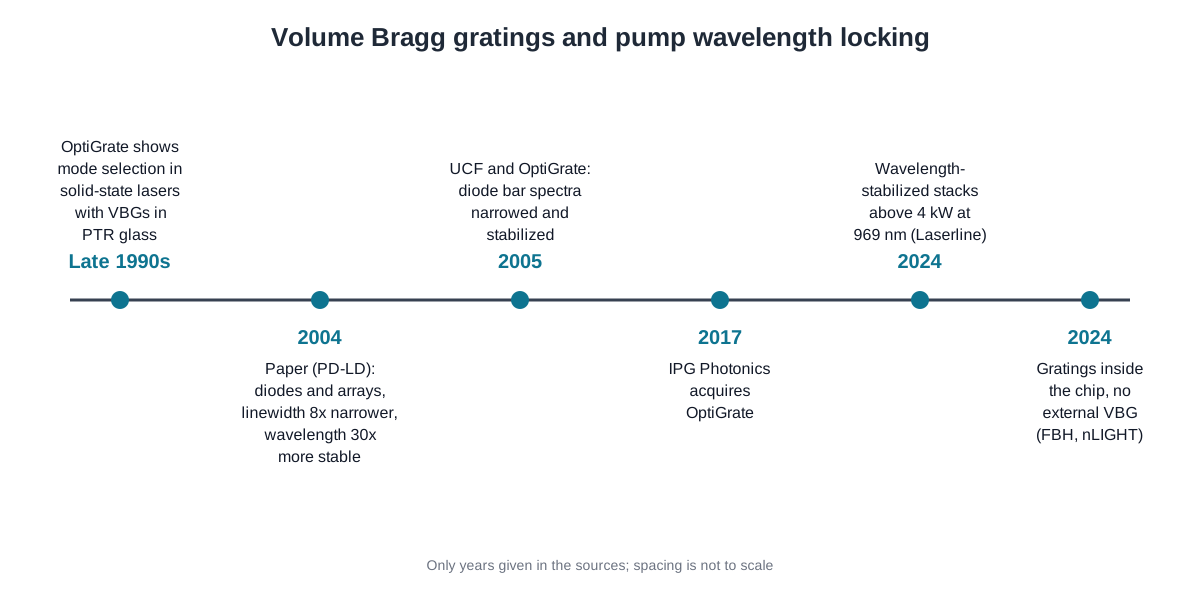
According to OptiGrate, selecting the longitudinal modes of solid-state lasers with VBGs in PTR glass was demonstrated at the company in the late 1990s. That demonstration aimed not at pump diodes but at keeping only the desired mode inside a laser resonator. In the 2000s, VBG use widened to holding diode wavelengths in place. The 2004 paper on multimode diodes and arrays and the 2005 work on diode bars date from that time.
VBGs found other uses as well. OptiGrate says that in 2008 four large-aperture VBG combiners merged the beams of five ytterbium fiber lasers running in continuous wave. The result was one beam close to the diffraction limit, carrying more than 750 W. This way of merging beams of different wavelengths into one continues in Diffraction Gratings: The Part That Merges Colors into One Beam.
In May 2017, fiber laser maker IPG Photonics acquired OptiGrate. OptiGrate had already been a supplier to IPG.
Recent pumps are far more powerful. In 2024 Laserline reported wavelength-stabilized diode stacks above 4 kW at 969 nm. In 2025 BWT researchers presented a 969 nm pump for Yb:YAG disk lasers built with a VBG. 969 nm sits on the zero-phonon-line absorption peak of Yb:YAG, so holding the wavelength there ties directly to absorption efficiency.
Gratings inside the chip, and laser weapons
The VBG is not the only option. Another path puts the grating inside the chip instead of outside it. In 2024 FBH researchers built prototype pump modules from diodes near 970 nm stabilized by gratings inside the chip, highlighting a simple setup with no need for an external VBG.
In the same year, nLIGHT researchers reported placing a wavelength-selective element inside the semiconductor chip so that it lases only at the desired wavelength. The abstract names ytterbium-doped fiber lasers and amplifiers as strong sources for HEL systems that join them by spectral or coherent beam combining. It calls pumping such fiber at 976 nm an imperative. "Instant-on," turning the beam on at once when it is needed, is a need the same abstract stresses above all.
nLIGHT also lists a wavelength-stabilized 976 nm product for directed energy in its defense lineup. Holding a pump wavelength in place is more than lab precision; it touches the efficiency, size and switch-on speed of laser weapons. Public sources do not show which path, external VBG or in-chip grating, will spread further, and for now both are being pursued.
Following One Laser Weapon: From Chip to Effector traces the whole path from the chip's light to the effector in one place.
What to read next
- Pump Modules: Putting Chip Light into One Fiber: the part that gathers the locked light into a fiber.
- Fiber Bragg Gratings: Mirrors Written Inside a Fiber: the same Bragg reflection written into a fiber core.
- High-power diode laser (pump LD) trends through a conference, 2022–2027: how wavelength stabilization grew in conference talks.