Most people picture the turtle ship the same way. A rounded back bristling with spikes, a dragon head at the bow puffing smoke, and a hull covered in iron plates. How much of that picture can be traced to records from the Imjin War itself?
No original turtle ship survives, so what is left falls into three groups. The first is a few short entries in the Annals of the Joseon Dynasty. The second is pictures and notes in a book published some 200 years after the war, and the third is the differing readings of scholars. Read one at a time instead of blended together, they show where the known ends and the unknown begins.
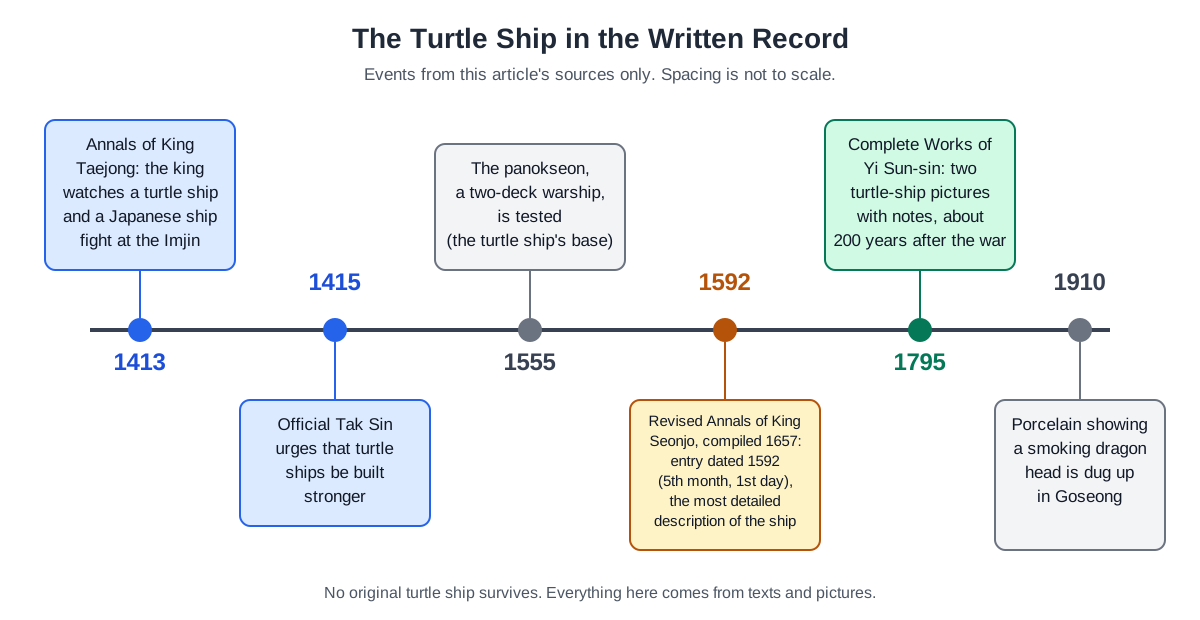
1413: a turtle ship at the Imjin crossing
The name "turtle ship" appears in records far older than the Imjin War. One is an entry in the Annals of King Taejong for the 5th day of the 2nd month of 1413 (Taejong's 13th year). As the king passed the Imjin river crossing, it says, he watched a turtle ship and a Japanese ship fight each other. The classical Chinese text begins "觀龜船," so gwiseon (龜船), the formal name of the turtle ship, was already in use.
Two years later, in 1415, the royal secretary Tak Sin (卓愼) submitted a list of points on the country's defenses. In the sixth point he called the turtle ship method "a good plan for deciding a battle." Even when it clashed with many enemies, he wrote, they could not harm it. He asked that turtle ships be built again, stronger and with more skill.
Why would anyone want a covered ship? From the Goryeo period on, Korean ships mostly fought by ramming enemy vessels or burning them with cannon. Pirates did the opposite: they came alongside, jumped aboard, and fought hand to hand. The Encyclopedia of Korean Culture explains, in its entry on the turtle ship, that the idea came from the need to keep enemies from climbing onto the ship.
The 1413 record says nothing about what that turtle ship looked like. The author of the entry suggests that Taejong's turtle ships never saw real fighting. They may have been dropped by a deliberate decision, made in light of the sharp fall in pirate raids from Sejong's reign on, among other things. Whether the turtle ships of the two eras were built the same way remains the key to the question of who first made the turtle ship.
The ship underneath: the panokseon
In the Imjin War, the main warship of the Joseon navy was the panokseon (板屋船). It was tested as a new warship in 1555 (the 10th year of King Myeongjong) and had two decks. The rowers worked between the two decks, out of the enemy's sight, while the fighting men stood on the broad, high upper deck. Around the upper deck ran a railing called a yeojang (女墻).
The turtle ship was a panokseon with its upper part rebuilt and a cover put over it. The fighting men, who stood in the open on a panokseon, went under the cover on a turtle ship.
In numbers, turtle ships were few. Apart from a handful of turtle ships, the navy's warships at the time were all panokseon. At the Battle of Okpo, Yi Sun-sin's first sortie, 28 panokseon took part (4 of them from Gyeongsang Right Province). Even at the highest point there were only some 180.
The author of the turtle-ship entry sees it as an outstanding and original ship, yet stresses that it did not appear out of nowhere one day. In that view, the shipbuilding tradition called baemui, carried over from Goryeo into Joseon, produced both the panokseon and the turtle ship.
The turtle ship in the Annals entry for 1592
The text that describes the Imjin War turtle ship in the most detail is an entry in the Revised Annals of King Seonjo. It is dated the 1st day of the 5th month of 1592, Seonjo's 25th year. But 1592 is only the entry's date; these annals were completed 65 years later, in 1657, the 8th year of King Hyojong. After the party in power changed, the earlier Annals of King Seonjo (1616) were revised and compiled again.
The entry reports Yi Sun-sin's victory over the Japanese off Geoje. At the end it adds that "before this," Yi had built a turtle ship on his own idea while overhauling his war equipment. The encyclopedia finds that no other record of the Imjin War describes the ship's look and size in more detail.
Here is the ship the entry describes. Planks were laid over the top of the ship like a turtle's back. On top, only narrow cross-shaped paths were left, just wide enough for the crew to pass, and the rest was lined with blades and spikes. In battle, the top was covered with straw mats or grass so the blades could not be seen, and anyone who jumped aboard would be stabbed.
At the front was a dragon head, and at the back a turtle tail with a gun opening beneath it. There were also six gun openings on each side, and all the men hid below them. According to the entry, the ship could fire in every direction and moved forward, back and sideways as fast as if it were flying.
Even the dragon head's mouth reads differently in translation. The original text says "口爲銃穴," that the mouth served as a chonghyeol (銃穴). The Korean translation on the Annals website renders it as a "cannon opening," while the encyclopedia's quotation renders it as a "gun opening." What the dragon head actually did is still an open question among scholars.
The entry ends with a claim of victory. The turtle ship moved freely among the enemy ships, it says, with no losses on the Korean side, breaking enemy ships wherever it went and always winning. The entry gives no size, and the encyclopedia, without naming its source, cites a remark that the ship was "about the size of a panokseon." The exact size of the panokseon is not known in detail either, and the encyclopedia adds a record of 125 rowers and archers aboard.
Someone else had a similar idea. During the Imjin War, Yi Deok-hong (李德弘) proposed building a gwigapseon (龜甲船), a "turtle-shell ship." He saw the Japanese army's strength in the lead balls of its matchlock muskets. The encyclopedia judges that the ship he described was quite similar to Yi Sun-sin's turtle ship.
Yi Bun (李芬) wrote an account of Yi Sun-sin's life, the Haengnok of Yi Sun-sin (李舜臣行錄). It also says a dragon head was made at the front with a gun opening in its mouth, and a turtle tail at the back. It adds that the ship was named the turtle ship because it was shaped like a turtle. The passage can be read in a translator's note to the 1415 entry on the Annals website.
Pictures from 200 years later: the Complete Works of Yi Sun-sin
Of the surviving records, one book describes the turtle ship's size and features in the most detail. It is the Complete Works of Yi Sun-sin (李忠武公全書), published in 1795 (the 19th year of King Jeongjo) on the king's order. Yun Haeng-im (尹行恁), a scholar-official of the royal library Gyujanggak, was in charge of compiling it. Its opening section of illustrations, the doseol (圖說), holds two turtle-ship pictures with notes.
The two pictures show the Tongjeyeong turtle ship and the Jeolla Left Navy turtle ship. The book says the Tongjeyeong ship came from the Imjin War turtle ship, but with some sizes increased or reduced. In other words, neither picture is a straight copy of the war-time ship.
The notes go into some detail. They give the length of the Tongjeyeong ship's bottom planking as 64 cheok 8 chon, for example, and say there were 10 oars on each side. They also say that sulfur and saltpeter were burned inside the turtle head at the bow, so that smoke poured like fog from its open mouth to confuse the enemy.
The two ships also look different. The Tongjeyeong ship has the yeojang railing around the panokseon deck removed, with a turtle cover laid straight onto the deck. The Jeolla Left Navy ship looks as if the cover were placed over a deck that kept its yeojang. It has 8 oars on each side, a demon's head carved below the turtle head, and a turtle-shell pattern on the cover.
Some ten-odd turtle-ship pictures survive in all, and the two in the Complete Works are the best known. Beyond these, in Japan, the Ehon Taikōki (繪本太閤記), an illustrated life of Toyotomi Hideyoshi, has a picture captioned "Yi Sun-sin built a turtle ship and drove off the Japanese army." Blue-and-white porcelain found in Goseong, South Gyeongsang Province, in 1910 shows a turtle ship with a smoking dragon head; it is now in the Korea Naval Academy Museum. Two pictures kept by the head family of Yi Sun-sin's descendants differ from the others: they show two masts and a raised command post on the ship's back.
What is still argued over
The turtle ship's structure and function are still much debated. The biggest reason is that no original ship can be examined. The two pictures in the Complete Works are the most detailed source. Yet they differ from each other in a fair number of ways, and both came about 200 years after the war.
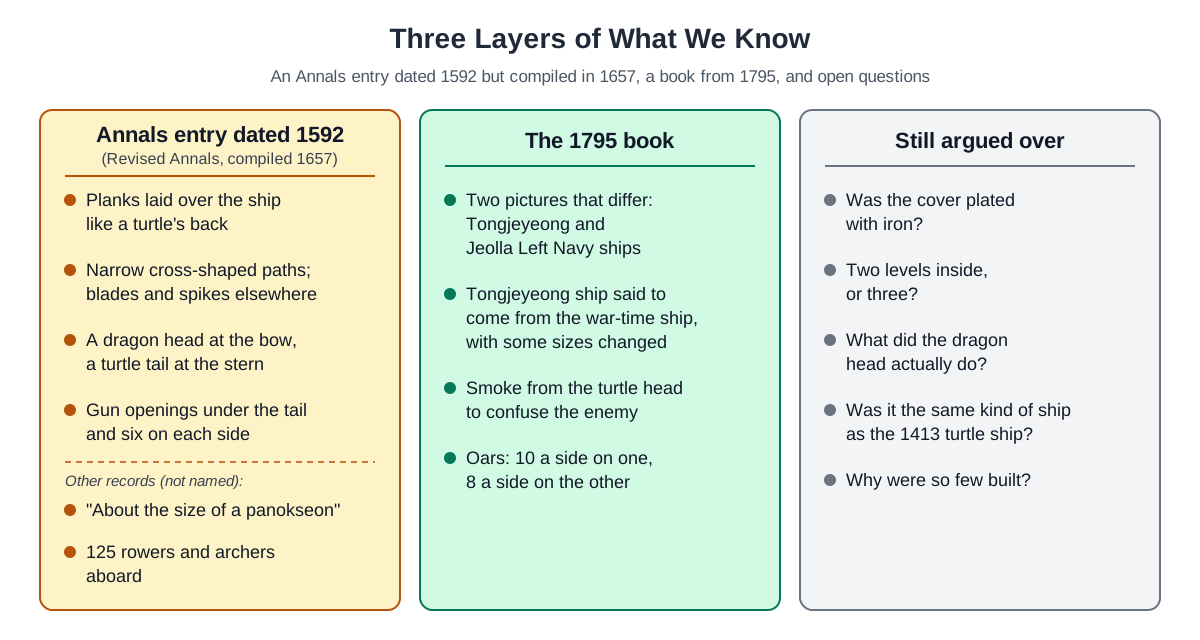
The first question is whether it was an ironclad, as Yu Gil-jun (兪吉濬) claimed in his book Seoyu Gyeonmun (西遊見聞). He called Yi Sun-sin's turtle ship "an iron-armored warship, the first of its kind built in the world," and many people later called it "the world's first ironclad." The encyclopedia entry sees the origin of this claim as unclear, resting on stories passed down by word of mouth and on Japanese written sources. Those Japanese sources were doubted early on, on the grounds that they had a hidden aim of blaming the defeat on the turtle ship.
That blades and spikes were set on the back is in the Annals entry. Whether the surface was covered with iron has not been confirmed. Some scholars doubt it, pointing out that iron plating would make the ship heavier and less nimble, and would corrode in seawater, making it inefficient.
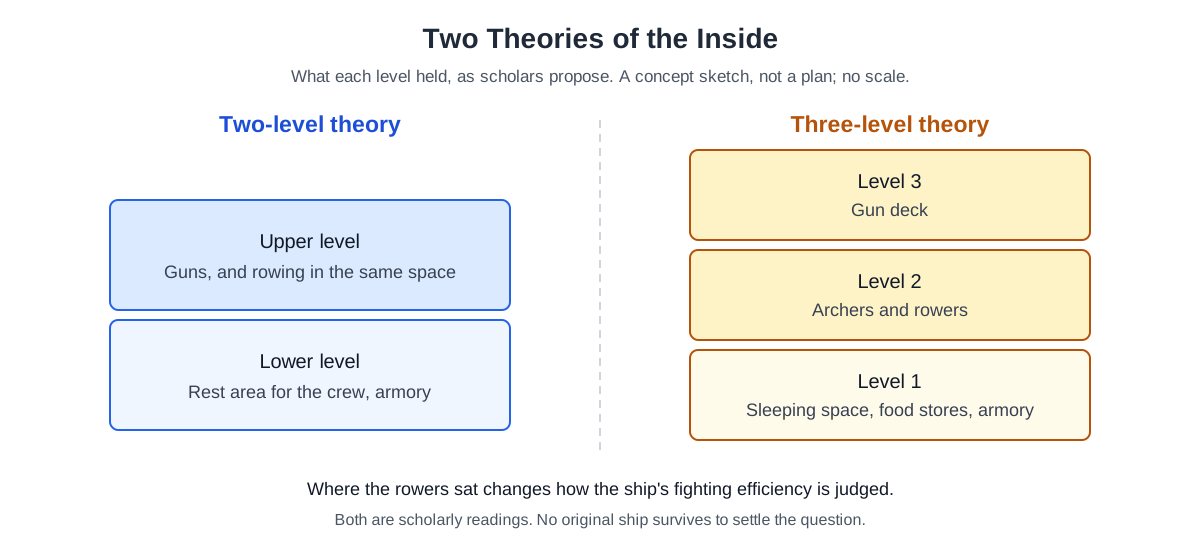
The second question is whether the inside had two levels or three. The two-level theory puts a crew rest area and an armory below, and guns and other fighting gear above, so rowing and firing shared one space. The three-level theory puts the crew's sleeping space, food stores and an armory on the first level, archers and rowers on the second, and a gun deck on the third. Because the rowers sit in different places, judgments of how efficient the ship was in battle also differ.
The third question is what the dragon head was for. In the Annals entry for 1592 the mouth was a chonghyeol; in the 1795 book the turtle head was where smoke came out. The encyclopedia mentions both: cannon fire or sulfur smoke from the dragon head. It also lists the function of the head at the bow as a question still to be answered.
The fourth question is how many there were. The size and number of turtle ships seem to have changed over time, and what is clear is that there were not very many. The entry's author argues that movement under the cover was restricted, making the ship awkward for chasing a fleeing enemy. For that job the panokseon, with its open upper deck, was more practical, so the number of turtle ships stayed small.
Most of the readings in this section were gathered by the author of a single encyclopedia entry, alongside the views of some other scholars. The entry also ends with a note that its content is the author's scholarly opinion and may differ from the official position of the Academy of Korean Studies. The Annals entry gives only the plank cover, blades and spikes, dragon head and turtle tail, gun openings on every side, and the ship moving among enemy vessels. That there were few of them is the judgment of the encyclopedia entries, not of the Annals entry.
What to read next
- Turning points in military technology: follows 20th-century weapons to see what each new technology changed and what new burdens it brought.
- The Imjin War at a Glance: Seven Years from 1592: a timeline of the whole war in which the turtle ship appeared.
- Yi Sun-sin and the Battle of Hansando, and The Battle of Myeongnyang: Thirteen Ships and the Uldolmok Strait: the sea battles that the panokseon and turtle ship fought, read through the records.