On the morning of 6 August 1945, the air raid alert in Hiroshima had already been called off. Only one plane had been seen. People were walking or cycling to work, and groups of women and children were working outdoors, clearing firebreaks against fire. At about 8:15 am Hiroshima time, the B-29 bomber Enola Gay released a single bomb.
That bomb traced back to a letter handed to the US president six years earlier. In between, the United States built a secret program with plants and laboratories across the country. This article uses public records to follow how the Manhattan Project worked and what was decided in July and August 1945. It also asks why the sources still disagree, even on how many people died in the two cities.
A letter and the fear of a race
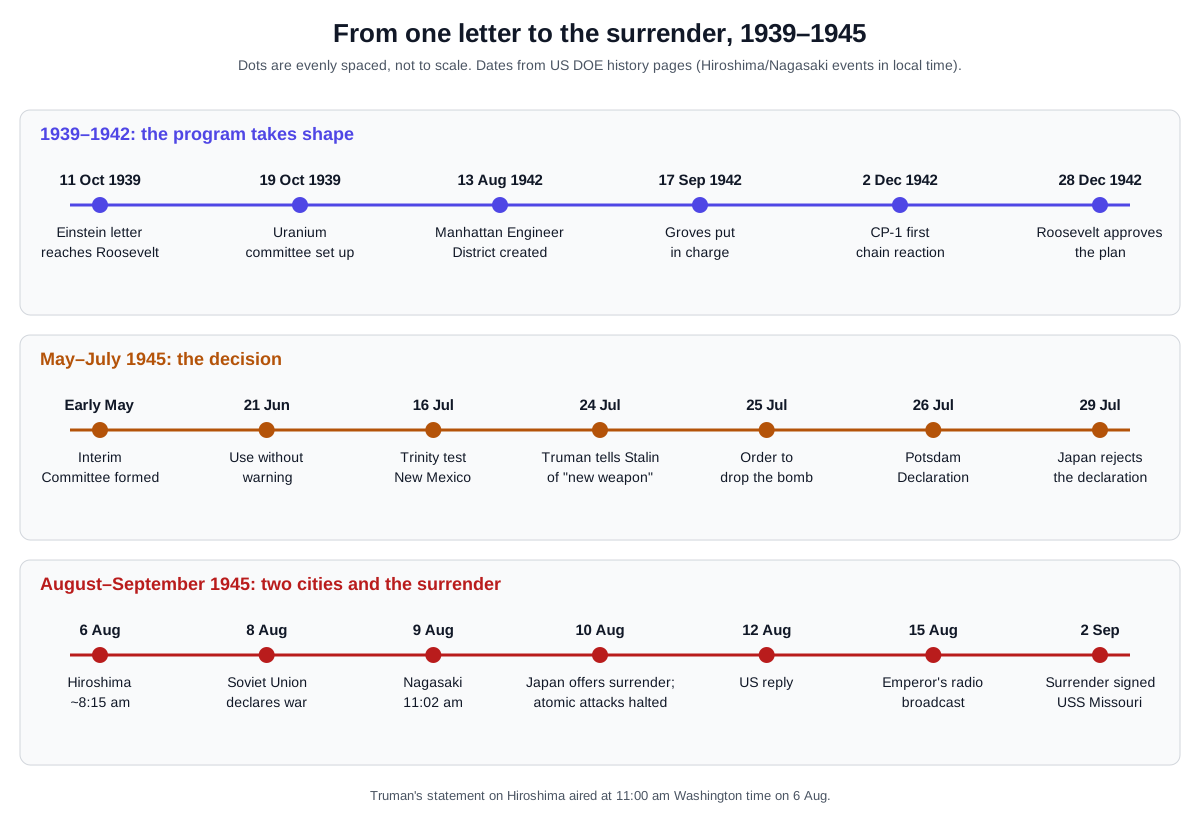
On 11 October 1939, the economist Alexander Sachs met President Franklin Roosevelt to brief him on a letter Albert Einstein had written that August. The letter warned that research on chain reactions in uranium might make "extremely powerful bombs" possible. Einstein believed the German government was backing such research, and he urged the US government to do the same.
The Hungarian-born physicist Leo Szilard helped draft the letter. He and fellow refugee scientists saw it as their duty to warn Americans that German scientists could get to the bomb first. On 19 October, Roosevelt replied that a committee of civilian and military members would now study uranium.
The history pages of the US Department of Energy (DOE) call this the first of many decisions that led to the Manhattan Project. The project began as a race to get the bomb before Nazi Germany did.
A science project run by the Army
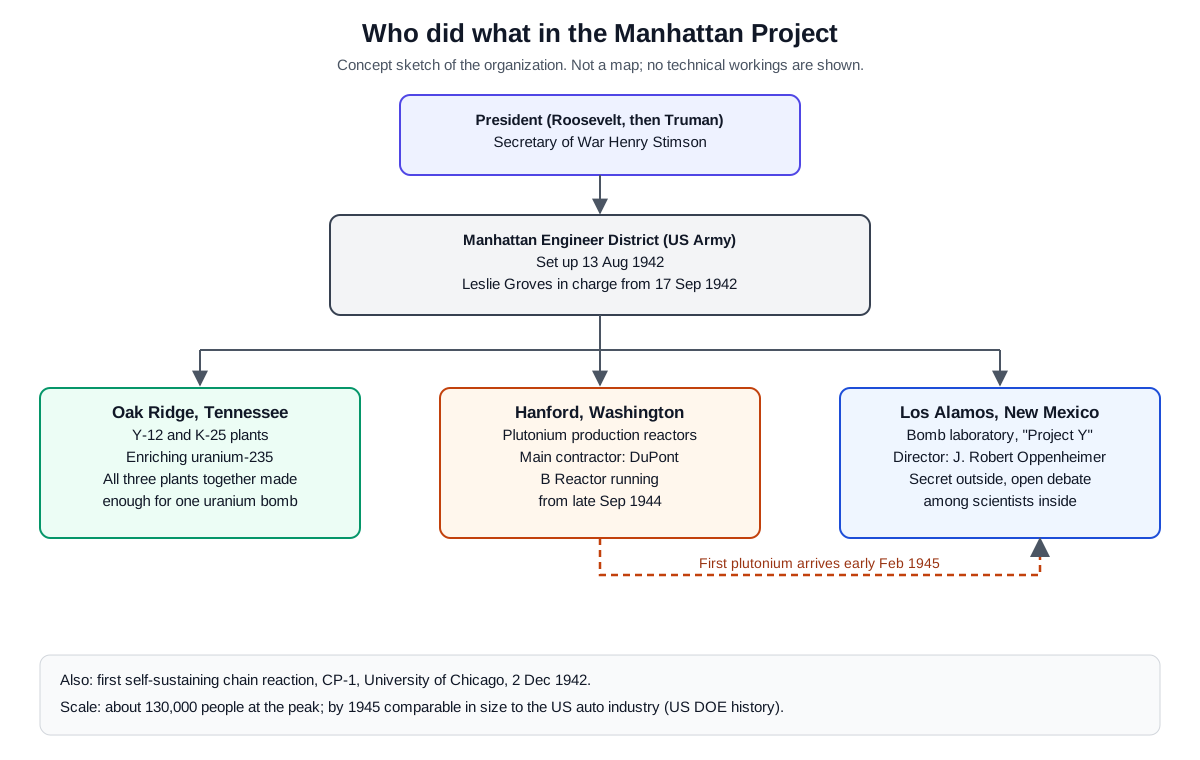
In the summer of 1942, the Army worried that the project's first cover name would draw too much attention. So on 13 August, a general order set up the Manhattan Engineer District (MED), which gave the "Manhattan Project" its name.
On 17 September, the Army put Colonel Leslie R. Groves in charge of the whole effort, and six days later he became a brigadier general. He was an engineer whose record included building the Pentagon. Groves had a clear rule: because of the war, scientists had to get from lab work to development and full production faster than anyone had before.
On 2 December 1942, a team under Enrico Fermi produced the first chain reaction that kept itself going (CP-1). The setting was a racket court beneath the stands of Stagg Field at the University of Chicago.
On 28 December, Roosevelt approved a plan that in the end became a government investment of more than $2 billion. In a report sent to the president, Vannevar Bush said bombs might be ready in the first half of 1945 but probably not sooner. By 1945, the project was about as large as the US auto industry. At the peak, about 130,000 people worked on it, from manual workers to Nobel laureates.
Oak Ridge, Hanford and Los Alamos
The Army coordinated work at many places across the United States. At the core were three secret communities. Today the three sites form one national historical park.
At Oak Ridge, Tennessee, the Y-12 and K-25 plants were built to collect uranium-235. Both plants took new, untested laboratory methods straight to large-scale production, and problems kept appearing. In the end, the two plants and a backup plant all had to work together to make the uranium for the one and only uranium bomb built during the war.
Hanford, Washington, was where plutonium was made. Groves made DuPont the main contractor and chose a site on the Columbia River. Construction began in mid-1943, and the first production reactor, the B Reactor, started running in late September 1944.
Los Alamos, in northern New Mexico, was the laboratory that designed the bombs, under the code name "Project Y." The site was an isolated boys' school on a mesa, and Groves chose J. Robert Oppenheimer to lead it.
Oppenheimer wanted the laboratory kept secret from the outside while scientists inside shared ideas freely. In early February 1945, the first plutonium from Hanford arrived there.
The secret was not complete. Since the fall of 1941, Soviet intelligence had been getting reports on the bomb project.
Trinity, 16 July 1945
There were two kinds of bomb. Most of the uranium bomb, "Little Boy," left for the Pacific on 14 July without its design ever having been fully tested. The plutonium bomb used a new design, so a test seemed vital.
Oppenheimer named the test "Trinity." The site was a remote bombing range in the New Mexico desert called the Jornada del Muerto, or "Journey of Death." At 5:30 am on Monday, 16 July 1945, the device went off and the nuclear age began.
The most common first reactions among those watching were surprise, joy and relief. Soon, more sober thoughts followed.
Kenneth Bainbridge, who ran the test, described it as a "foul and awesome display." Oppenheimer later recalled a line from the Hindu scripture the Bhagavad Gita: "Now I am become Death, the destroyer of worlds." The destructive power of atomic weapons haunted many of the scientists for the rest of their lives.
Whether, and how, to use it
With President Truman's approval, Secretary of War Henry L. Stimson set up an Interim Committee in early May 1945. Its job was to recommend how atomic weapons should be used in the war and what postwar atomic policy should be.
At its 31 May meeting, the physicist Ernest Lawrence suggested a demonstration to show the bomb's power first. The idea was turned down. The bomb might fail, Japan might bring American POWs to the target area, or the plane might be shot down.
There were dissenting voices. Scientists at the Metallurgical Laboratory in Chicago set up a committee under James Franck to give a "second opinion." Their Franck Report argued that bombing Japan without first showing the weapon in an empty area would make an arms race unavoidable. Only postwar international control, it said, could prevent one.
The committee's Scientific Panel, including Oppenheimer and Fermi, concluded that no technical demonstration would make Japan surrender. On 21 June, the Interim Committee agreed: the bomb was to be used at the earliest chance and without warning.
The target list at first included Kyoto. Stimson removed it as Japan's most treasured cultural center, and Nagasaki took its place.
On the evening of 24 July, at the Potsdam Conference, Truman raised the new weapon with Stalin. The records describe the talk a little differently. In the DOE history, Truman told Stalin only that the United States had a "new weapon of unusual destructive force." The State Department's Office of the Historian says he told Stalin the first atomic bomb had been successfully detonated on 16 July.
The next day, 25 July, the order to drop the bomb was issued. It called for an attack on Hiroshima, Kokura, Niigata or Nagasaki as soon after 3 August as the weather allowed, and no further approval was needed for later bombs.
On 26 July, the United States, Britain and China issued the Potsdam Declaration. It warned Japan of "prompt and utter destruction" if it did not surrender at once. The Soviet Union, not yet at war with Japan, did not sign.
The declaration said nothing about the atomic bomb and left the emperor's status unclear. On 29 July, Japan rejected it.
Hiroshima, 6 August
That morning, the Enola Gay left Tinian Island. The DOE history puts Hiroshima's population at almost 300,000 civilians plus about 43,000 soldiers. The City of Hiroshima estimates that about 350,000 people were in the city.
Among them were residents, soldiers and people from nearby towns sent in to pull down buildings. There were also people from Korea and Taiwan, then under Japanese rule, and from mainland China, some of them forced laborers. A handful of students from China and Southeast Asian countries and some American POWs were there too.
Within one mile of ground zero, almost no building was left standing. Out to three miles, nearly all buildings were damaged. Fewer than 10% of the city's buildings came through without any damage. Many small fires started at once and joined into one great firestorm, which burned over 4.4 square miles.
Several days later, survivors began to show the first signs of radiation sickness. Deaths from it were highest three to four weeks after the attack and only eased after seven to eight weeks. Long-term dangers such as cancer, along with the psychological harm, stayed with the survivors for the rest of their lives.
At 11:00 am on 6 August, Washington time, radio stations aired a statement in which Truman told Americans an "atomic bomb" had been dropped. Two days later, on 8 August, the Soviet Union entered the war against Japan and struck Japanese troops in Manchuria.
Nagasaki, 9 August, and the surrender
At 3:47 am on 9 August, the B-29 "Bock's Car" took off from Tinian. Its first target was the Kokura Arsenal. When the plane arrived, Kokura was hidden by smoke and haze, and with fuel running short, the crew turned to the second target, Nagasaki. Nagasaki was also under cloud, but the bomb exploded over the city at 11:02 am.
The DOE history says almost 200,000 people were under the bomb, while Nagasaki City puts its population at the time at about 240,000. The bomb went off between two Mitsubishi plants, and the hills and the city's layout shielded some districts. Even so, almost everything within half a mile of ground zero was destroyed.
The sources count damaged homes differently. The DOE history says that of 52,000 homes, 14,000 were wrecked and another 5,400 badly damaged. Nagasaki City puts the number of damaged houses by the end of December 1945 at 18,409, about 36% of all houses in the city.
In Tokyo, news of the Soviet entry and news of Nagasaki arrived almost at the same time. At an Imperial Council on the night of 9–10 August, the vote on surrender was tied 3 to 3, and the emperor himself decided for surrender. On 10 August, Japan offered to surrender on one condition: that the emperor stay as the nominal head of state. The same day, Groves reported that the next bomb would be ready after 17–18 August, but Truman ordered atomic attacks halted at once while surrender talks went on.
On 12 August, the United States said it would accept the surrender, with the emperor kept only in a purely ceremonial role. While the debate in Tokyo went on, conventional air raids resumed on 13 August, and thousands more Japanese civilians died. On 15 August, the emperor's surrender broadcast was heard across Japan. On 2 September, the formal surrender was signed on the deck of USS Missouri.
Reading the numbers, and the split verdicts
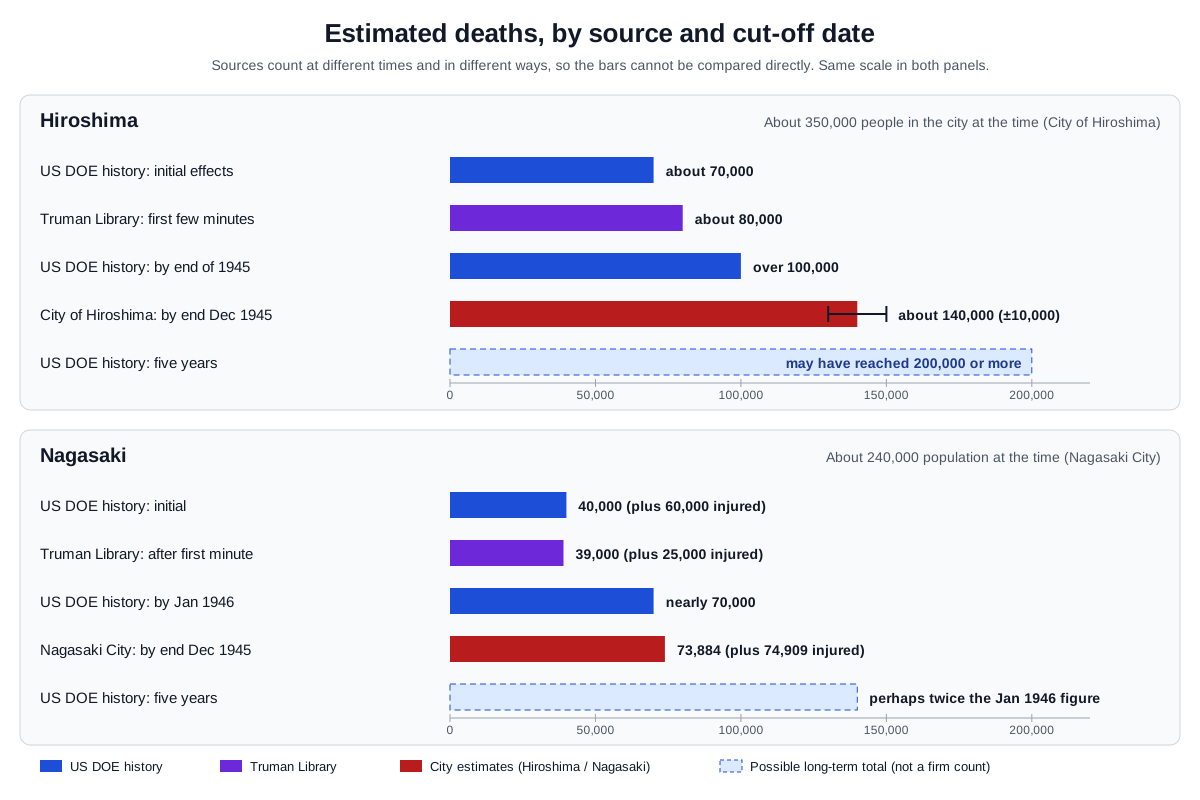
No one knows exactly how many people died in the two cities. Official US and Japanese sources both say so. One reason the numbers differ is the cut-off date each source uses.
For Hiroshima, the DOE history estimates about 70,000 deaths from the first blast, heat and radiation. They included about twenty American airmen who were prisoners in the city. The toll passed 100,000 by the end of 1945, and possibly 200,000 or more over five years. Teaching materials from the Truman Presidential Library give about 80,000 deaths in the first few minutes.
The City of Hiroshima and its Peace Memorial Museum use an official estimate of about 140,000 (±10,000). That figure runs to the end of December 1945, after acute radiation illness had mostly passed.
For Nagasaki, the DOE history estimates 40,000 dead and 60,000 injured at first, nearly 70,000 dead by January 1946, and possibly twice that within five years. The Truman Library gives 39,000 dead after the first minute. Citing a July 1950 report, Nagasaki City counts 73,884 dead and 74,909 injured by the end of December 1945.
Some estimates combine the two cities. The Norwegian Nobel Committee's 2024 press release puts the dead at about 120,000 inhabitants of Hiroshima and Nagasaki. About as many again, it adds, later died from burns and radiation injuries over the following months and years.
The decision to drop the bomb divides opinion even more.
The DOE history calls it probably the most disputed question in 20th-century American history and sets out two views. Many historians hold that the bombs were needed to end the war and saved Japanese and American lives by making unnecessary an invasion that could have killed hundreds of thousands. Others contend that Japan would have given up without them, and that Truman's circle used the bomb solely to frighten the Soviet Union.
The State Department's Office of the Historian likewise notes how historians have often read Truman's somewhat firm stance at Potsdam. In that reading, US negotiators believed nuclear capability would strengthen their bargaining power.
The same pages also lay out what the decision makers had in front of them. By reading intercepted Tokyo–Moscow messages, the United States knew Japan was seeking a conditional surrender. Other paths existed, such as a demonstration, waiting for the Soviet entry, or blockade with continued conventional bombing, but few planners thought they would work quickly.
According to the DOE history, more than ten weeks of fighting on Okinawa just before had left over 12,000 Americans and 100,000 Japanese dead. Perhaps 100,000 more Okinawan civilians died too.
The DOE history notes that Truman also hoped the bomb might strengthen the US hand in diplomacy after the war. Even so, it suggests, the prospect of avoiding another year of bloody war may in the end have weighed most in his decision. The Truman Library also notes that historians still debate the decision today.
What it left
According to the DOE history, the atomic bombs came at the end of a war that probably killed 60 million people worldwide between 1931 and 1945. Far more than two million Japanese, soldiers and civilians alike, died in the war, and perhaps 300,000 or more of them died because of the two atomic bombings.
What has lasted longest are the survivors' voices. For a long time, their fates were hidden and neglected. In 1956, local survivor groups and victims of Pacific nuclear tests formed Nihon Hidankyo, the Japan Confederation of A- and H-Bomb Sufferers Organisations.
The Norwegian Nobel Committee awarded it the 2024 Peace Prize. The committee said survivor testimony did much to build an international norm that sees any use of nuclear weapons as morally wrong, known as "the nuclear taboo." It also noted that, as of its 2024 announcement, no nuclear weapon had been used in war for nearly 80 years. The Hiroshima Peace Memorial Museum uses victims' belongings and survivors' testimony to carry the message "No More Hiroshimas."
One of the belongings records the museum shares is the story of Shizue Tsukamoto. She was 23, and that morning her workplace had told her to come in a little later, so she left home around 8 am. She was caught by the bomb at an intersection close to ground zero.
Her father learned on the 7th that she had reached Inokuchi Village and went to find her. She was so badly burned that he knew her only when he heard her voice. Despite her family's care, Shizue died on the 10th. Her mother, Hanayo, donated her belongings to the museum.
The US hold on the bomb was not expected to last. At the Interim Committee meeting of 31 May 1945, most of those present conceded that the American monopoly could not be kept for long.
The way the project was run also lasted. By joining science, government, universities, the military and industry in one organization, the Manhattan Project became the model for American "big science" in the late 20th century. When President Kennedy set the goal of landing on the Moon, it was this project he invoked.
On 10 November 2015, the three sites at Oak Ridge, Los Alamos and Hanford became the Manhattan Project National Historical Park. Plants and laboratories that were once secret are now places anyone can visit to look back on that time.
What to read next
- ICBMs: what they share with space launch vehicles: how the intercontinental ballistic missiles that appeared after the war share their basic workings with space launchers.
- Turning points in military technology: a timeline of technologies that changed warfare, from the proximity fuze of the same war to unmanned systems.
- A history of laser weapons: from chemical to electric lasers: how another new weapon technology, the laser weapon, moved from chemical lasers to electric ones.
- The Strategic Bombing Debate: Did Bombing Cities End the War?: the bombing of cities that went on right up to the atomic bombs, and how it has been judged.