At 9:30 am on 7 December 1950, US Air Force C-119 transports came in over Koto-ri, a small village in the mountains of northeast Korea. What swung down under parachutes into the perimeter was not a load of ammunition. It was a steel bridge, in sections weighing 2,500 pounds each.
The bridge south of Koto-ri had been blown. Only one road led down to the sea, and for troops who depended on a single road, a broken bridge meant a broken road.
The Battle of Chosin Reservoir was fought around the reservoir in northeast Korea from late November to mid-December 1950. The US 1st Marine Division, with Army and South Korean units, was surrounded by much larger Chinese forces. It fought its way back toward the sea along one mountain road. Why had they climbed so high into the mountains, and what did the cold, the air and a bridge dropped from the sky do during that withdrawal?
A war that was supposed to end by Christmas
After the landing at Inchon succeeded in September 1950, the Korean War looked as if it would soon end in victory for the United Nations forces. General Douglas MacArthur, the UN commander, expected the war to end, and Communist rule in North Korea to be gone, by Christmas that year.
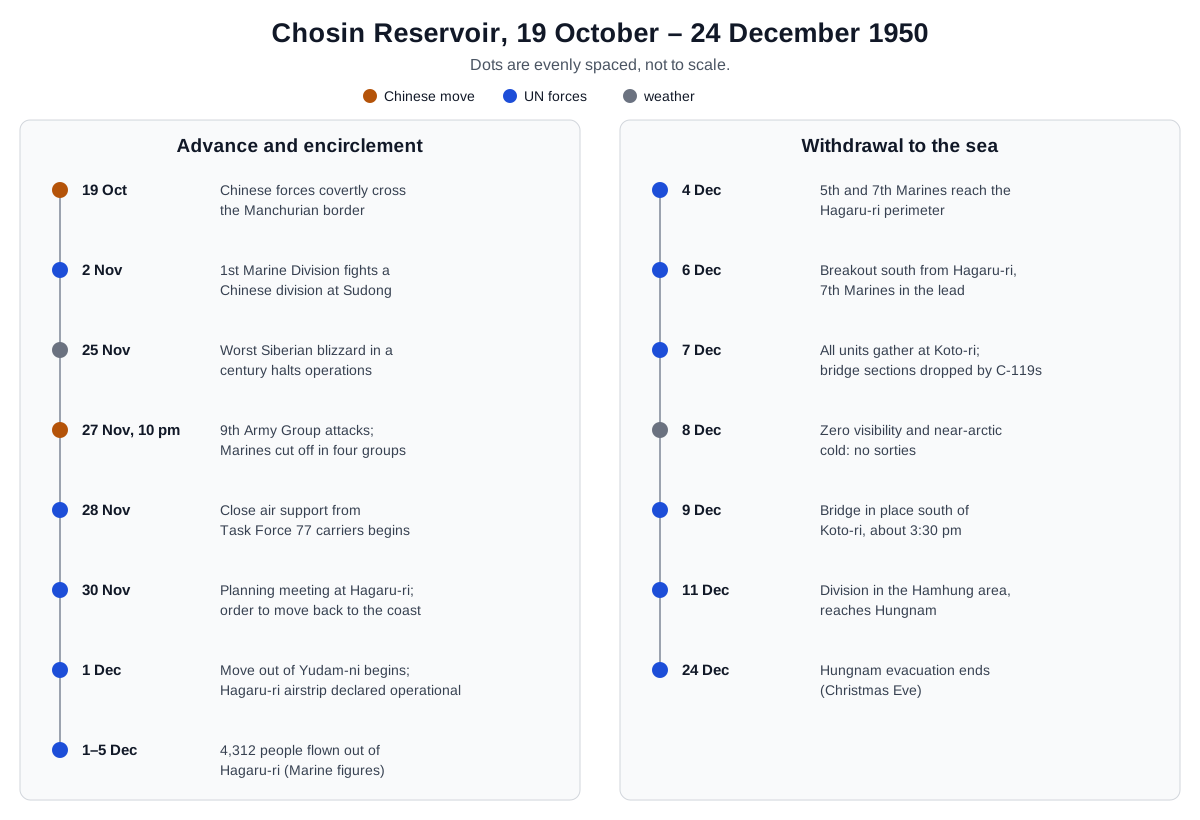
China was already moving. On 19 October, Chinese forces slipped across the Manchurian border into North Korea in secret. Six days later, the South Korean I Corps first ran into Chinese troops south of Chosin Reservoir. On 2 November the US 1st Marine Division clashed with a Chinese division at Sudong and caused it heavy losses.
The overview by the Naval History and Heritage Command (NHHC) estimates that about 100,000 Chinese troops had entered North Korea by mid-November. Counting the surviving North Korean units, the enemy facing UN forces numbered between 142,000 and 167,000.
The UN command saw things differently. The Korean encyclopedia's entry on the battle says MacArthur played down China's aims and troop strength until early November. Once MacArthur decided on a preemptive offensive, Major General Edward M. Almond of the US X Corps, which held the east, restarted the advance north toward the border.
X Corps included the US Army's 3rd and 7th Infantry Divisions, the 1st Marine Division, British Royal Marine Commandos and South Korean units. The corps pushed north from Hamhung toward the west side of the reservoir along an extremely narrow and difficult road. That road was the corps' main supply route (MSR), and it was very exposed to enemy attack. Ammunition, food and other logistics supplies came up this road.
Major General Oliver P. Smith, who led the 1st Marine Division, stayed cautious throughout the advance, stockpiling ammunition and supplies at every stage. He set up supply points and a crude airstrip along the route, and pressed for improvements to the MSR. Almond did not view these steps favorably, and friction grew between the two commanders.
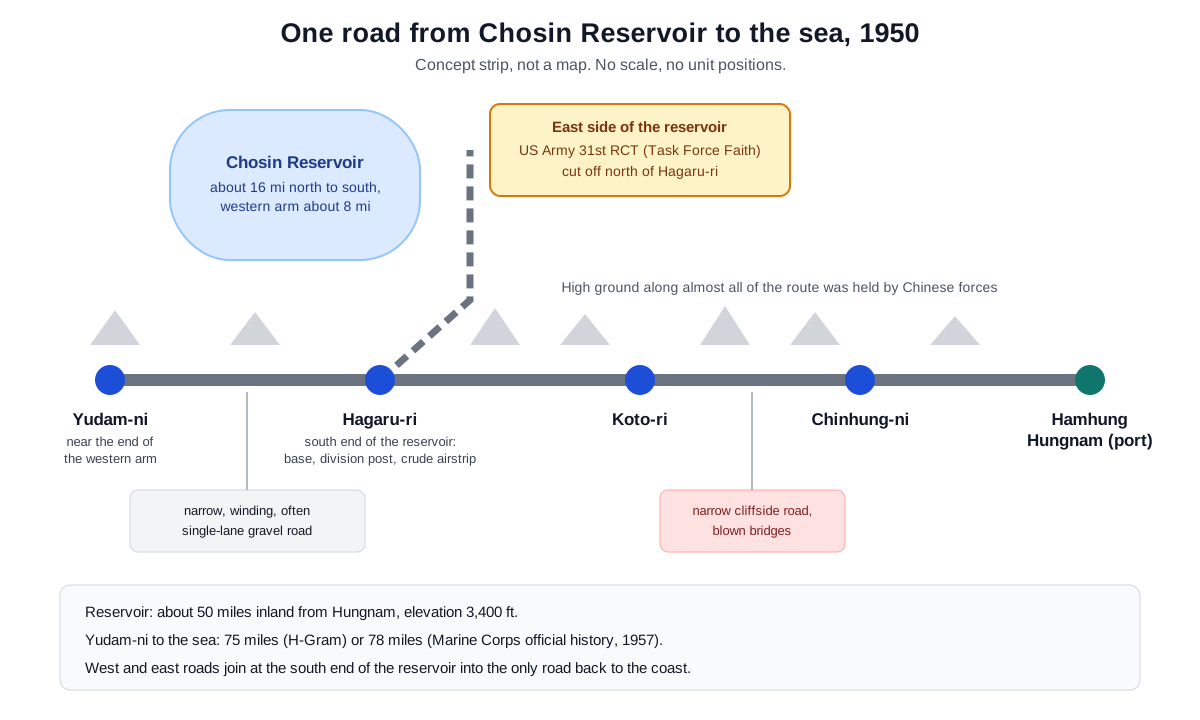
Chosin Reservoir sits 3,400 feet up, about 50 miles inland from the port of Hungnam. It runs about 16 miles from north to south, with a western arm about 8 miles long. Yudam-ni sits near the end of that western arm.
Yudam-ni was linked to Hagaru-ri, at the south end of the reservoir, by a narrow, twisting gravel road that was often just one lane wide. At Hagaru-ri the Marines had set up a forward base, the division command post and a crude airstrip. The Chinese held the high ground that overlooked almost the whole route.
The night of 27 November
The weather arrived before the fighting. On 25 November the worst Siberian blizzard in a century swept across the Korean peninsula and the sea, and all operations stopped. The cold proved as dangerous a foe as the Chinese.
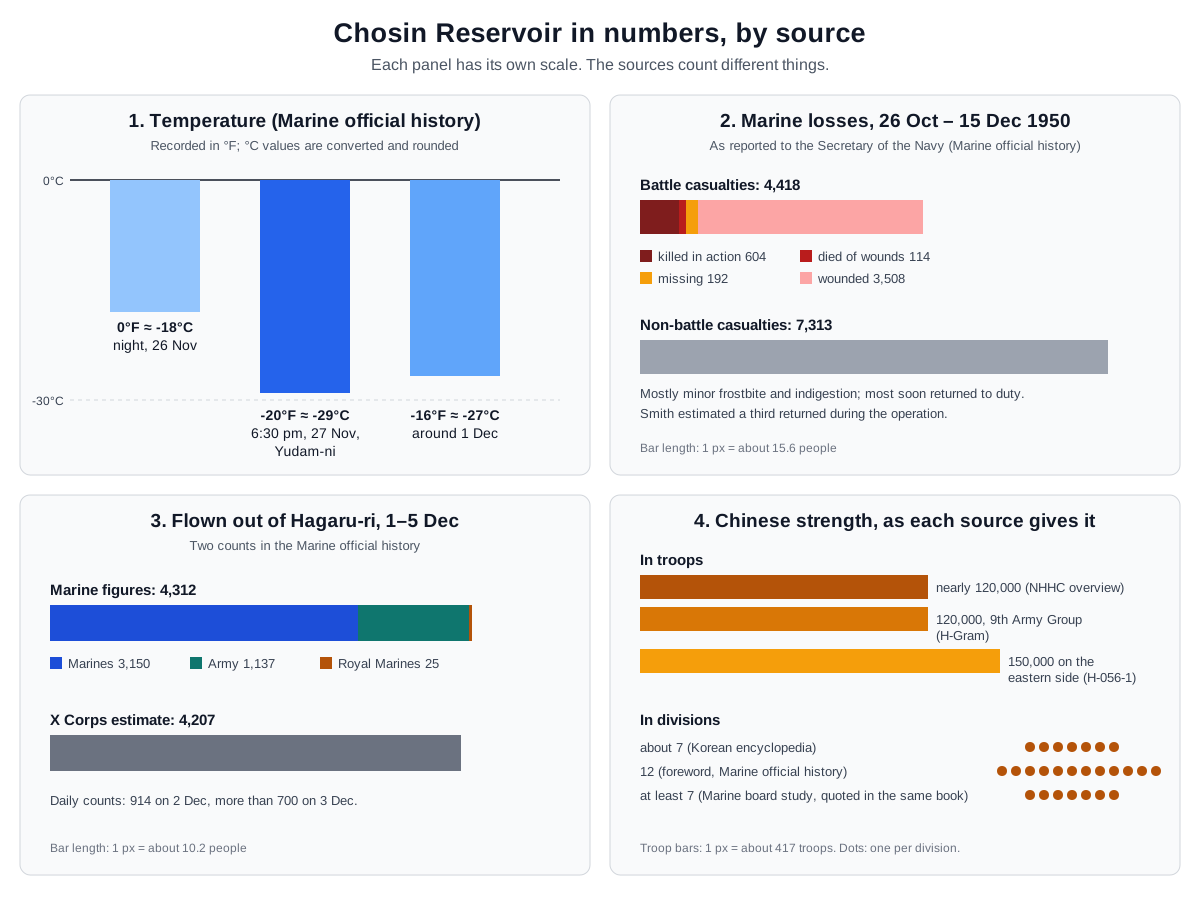
The temperatures of those days survive in Fahrenheit in the Marine Corps official history. On the night of 26 November the temperature suddenly fell to 0°F, and at 6:30 pm on the 27th it was −20°F at Yudam-ni. In Celsius those are about −18 °C and about −29 °C, close to minus thirty. H-Gram, a history series written by the NHHC director, says only that night temperatures often reached "25 degrees below zero," without giving a unit.
Marine units had reached Yudam-ni on the west side of the reservoir by 25 November and planned to attack farther west on the 27th. At 10 pm that night, the Chinese attacked to the sound of the bugles and gongs they used as battlefield signals. The 9th Army Group under General Song Shi-lun struck the Marines around Yudam-ni and the road west of the reservoir. At the same time it hit US Army positions on the east side.
The sources give different sizes for this offensive. The NHHC overview says "nearly 120,000" troops and H-Gram says "120,000," while the Korean encyclopedia describes a force of "about seven divisions" of the 9th Army Group. In the encyclopedia's account, the 9th Army Group commanded the 20th, 27th and 26th Corps.
The roads on the west and east sides of the reservoir joined into one at its southern end. That single road was the only way back to the coast.
After that night, the Marines were split into four groups, each cut off from the others. The 5th and 7th Marine Regiments were encircled at Yudam-ni by two Chinese divisions, and Marines farther south at Hagaru-ri and Koto-ri were also surrounded. On the east side of the reservoir, north of Hagaru-ri, the US Army's 31st Regimental Combat Team was trapped. It was widely known as Task Force Faith.
What tied these groups to one another, and to the sea 75 miles away, was one barely passable mountain road. The Chinese were on the heights above it.
One road to the sea
On 30 November, Almond held a planning meeting at Hagaru-ri and reviewed the plan to advance north. He then ordered every unit near the reservoir to move back to the operating base at Hamhung–Hungnam. The next day, 1 December, the US Joint Chiefs of Staff also directed MacArthur to withdraw X Corps.
On 1 December the 5th and 7th Marines left Yudam-ni and began fighting their way toward Hagaru-ri. In daylight they moved south down the road, leaning on close air support and artillery fire to suppress the Chinese on the heights beside it. The Marines lost about 100 casualties for every mile, and Chinese casualties were even higher.
On 4 December the two regiments entered the Hagaru-ri perimeter, still a coherent force. Almond authorized Smith to abandon equipment and fly out as many troops as possible. The Marines declined and instead flew in reinforcements. Only the wounded left by air.
On the east side of the reservoir, Task Force Faith was placed under the Marine division's command and tried to break out to Hagaru-ri. Four miles short of Hagaru-ri, repeated massive attacks broke the unit apart. Almost all of its officers and NCOs were killed, including its commander, Lieutenant Colonel Don Faith, and the survivors scattered as individuals, nearly all of them wounded.
On 6 December the breakout south from Hagaru-ri began, with the 7th Marine Regiment in the lead. Fighting never stopped along the flanks of the narrow road as Marine, Army and South Korean units pulled back. Hundreds of civilian refugees moved among the columns.
On 7 December the division gathered all its units at Koto-ri. The next stretch, from Koto-ri to Chinhung-ni, was probably the hardest part of the withdrawal, with an extremely narrow cliffside road and blown bridges. On 8 December, zero visibility and near-arctic cold on that stretch kept every aircraft on the ground. The same weather also slowed the pursuing Chinese, and many of them froze to death.
After passing Chinhung-ni, the whole 1st Marine Division was inside the Hamhung area on 11 December. That same day the division reached Hungnam, and the evacuation by ships of Task Force 90 began.
Cold, air power and a dropped bridge
The winter of 1950 in Korea was one of the coldest in the weather records up to that time. Below-freezing temperatures made it far harder to treat the wounded, stopped weapons from working and slowed wheeled vehicles almost to a halt. The Marine Corps official history records one officer pulling the trigger of his carbine, only for it to fail in the cold.
The reservoir froze as well. A Navy patrol squadron had planned to land flying boats on it to bring in supplies and carry out the wounded. The plan was dropped because the lake was frozen solid.
In the air, aircraft carriers played a large part. Close air support from the carriers of Task Force 77 began on 28 November. At first only two US Navy fleet carriers, Philippine Sea and Leyte, were available for operations around the reservoir. Princeton arrived on 5 December, and Valley Forge joined on 23 December.
Besides the Navy's carrier air wings, Marine squadrons operated from the escort carriers Badoeng Strait and Sicily. Airfields at Hamhung (Yonpo) and Wonsan were used too. The nearest US Air Force squadrons were 200 miles to the south, while the carriers stayed close to the coast. That closeness was a key factor in keeping the pace of operations high.
Conditions at sea were harsh. For the next week the carriers kept attacking in some of the worst weather ever met in combat, and accidents cost more than the enemy did. A pilot who came down at sea could survive only a few minutes in the freezing water, even in an immersion suit.
On 4 December, Ensign Jesse Brown was flying a mission in support of the Marines. He was the first African American to qualify as a naval aviator, and his Corsair, probably hit by ground fire, had to crash-land high in the mountains. Brown survived the landing but was pinned in the burning wreck.
His wingman, Lieutenant (junior grade) Thomas Hudner, deliberately landed nearby with his wheels up to try to pull him out. Marine helicopter pilot First Lieutenant Charles Ward also made a risky rescue attempt.
Neither man could free Brown from the cockpit, and he died of his injuries and hypothermia. His last words were "Tell Daisy how much I love her." Daisy was his wife.
Hudner was awarded the Medal of Honor on 13 April 1951, at a ceremony held by President Harry S. Truman. He met Daisy at the White House, and the two stayed in touch until she died in 2014.
The airstrip on the ground mattered as much as the road. When the half-built Hagaru-ri airstrip was declared "operational" on 1 December, four US Air Force C-47 transports landed with supplies. On 2 December, C-47 and R4D transports flew out 914 casualties, and more than 700 the next day.
By Marine figures, 4,312 people were flown out of Hagaru-ri in the first five days of December: 3,150 Marines, 1,137 Army soldiers and 25 Royal Marines. X Corps estimated 4,207 for the same period. At the most critical time, the only physical link between units split apart by the enemy was the OY observation planes and helicopters.
That left the blown bridge south of Koto-ri. Moving forces across an obstacle such as a ravine or river that has to be bridged is called gap crossing. Lieutenant Colonel Partridge, the engineer commander, asked for M-2 steel treadway bridge sections to be dropped from the air. To allow for damage, he requested eight sections, a 100% margin of safety.
At 9:30 am on 7 December, US Air Force C-119s dropped three of the 2,500-pound sections inside the Koto-ri perimeter. The other five came down by noon. One of them fell to the Chinese, and one was damaged.
On 9 December, at about 3:30 pm and three hours after work began, the bridge was in place. Soon a tractor pulling an earth-moving scraper smashed the plywood panel in the middle, and wheeled vehicles could no longer cross. Skilled bulldozer work respaced the treadways, and the first jeep crossed with its tires scraping both edges.
The numbers differ by source
The sources do not even agree on when the battle ended. The Korean encyclopedia treats it as the two weeks from 27 November to the arrival at Hamhung on 11 December. The NHHC overview groups everything up to the end of the Hungnam evacuation on 24 December as "battle, fighting retreat, evacuation." The Marine official history counts losses from 26 October to 15 December.
Chinese strength varies too. Besides the 120,000 figure above, H-056-1, a companion essay attached to H-Gram, puts the Chinese force that entered on the eastern side to face X Corps at 150,000.
The foreword of the 1957 Marine official history says the Marines fought through "twelve Chinese divisions" on a 78-mile mountain road. A Marine board study quoted in the body of the book says "at least seven" divisions. Even the distance from Yudam-ni to the sea differs: 75 miles in H-Gram, 78 miles in the foreword.
For Marine losses, the figures reported to the Secretary of the Navy survive. From 26 October to 15 December 1950 in northeast Korea, the Marines had 4,418 battle casualties: 604 killed in action, 114 died of wounds, 192 missing and 3,508 wounded.
Non-battle casualties were higher, at 7,313. Most were cases of minor frostbite and indigestion who soon returned to duty, and Smith estimated that a third of them came back during the operation itself.
Losses in the Army unit east of the reservoir appear as two figures. The main text of H-056-1 says 75% of the unit was lost. Its closing section says the 31st Regimental Combat Team suffered over 90% killed, wounded or captured.
Chinese losses are even less certain. The Marine official history estimated enemy losses for the same period at 37,500. Marine ground forces were credited with 15,000 killed and 7,500 wounded, and Marine aircraft with 10,000 killed and 5,000 wounded. The book adds right away that such figures as a rule cannot be relied on much.
The cold was an enemy of the Chinese, too. Captured Chinese documents quoted in the official history say more than 90% of the 26th Army suffered frostbite. The 27th Army reported 10,000 non-combat casualties alone from a strength of four divisions.
The documents said the soldiers were short of food and of houses to shelter in, and could not endure the bitter cold. In the 20th Army, 100 men died of tetanus because wounds were not properly cared for.
Even the count of Medals of Honor depends on what is counted. The Marines received 14, seven of them posthumously. In Task Force Faith, which served under the Marine division's control, two men, including Lieutenant Colonel Faith, received the medal posthumously. NHHC's page on Hudner says 17 Medals of Honor were awarded for the Battle of Chosin Reservoir.
What it left behind
The units that came down from Chosin boarded ships at Hungnam. The evacuation went on until Christmas Eve, and units of the US 7th Infantry Division were the last aboard.
In about two weeks, close to 200 ships of Task Force 90 carried 105,000 military personnel and 91,000 Korean civilians to the south. They also moved 17,500 tanks and other vehicles, plus 350,000 tons of supplies. Even so, at least 90,000 refugees were left behind at Hungnam.
Views differ on why the force left by sea and whether it should have. With the western front collapsing, MacArthur ordered the UN forces in the east to leave Hungnam by ship for the other side of Korea, as the main H-Gram text explains. It was an attempt to keep Seoul from falling to the Communists a second time. The decision was debated for years, and the NHHC director who wrote H-Gram judges that Hamhung and Hungnam could probably have been held, and that Seoul fell in January anyway.
The outcome on the Chinese side also has its interpretations. The Korean encyclopedia says the Chinese forces near the reservoir suffered heavy non-battle as well as battle losses and could not continue operations. The 9th Army Group headquarters withdrew to the rear for three months to rebuild its units.
The entry's author holds that the battle left the 9th Army Group unable to reinforce the 13th Army Group on the western front. In that view, this helped the US Eighth Army in the west get through its crisis.
The battle is also remembered in names and honors. The 1st Marine Division received the Presidential Unit Citation for the battle, and the cruiser USS Chosin, commissioned in 1991, was named for those who fought there.
Task Force Faith was at first left out of the citation. Later, Chinese documents came to light in which Chinese commanders credited the unit with breaking the force of their attacks there. In 2001 the US Navy approved the citation for it.
The cold also changed equipment. A study of the frostbite cases from Chosin led to the thermal boot being adopted as a preventive measure during the next two winters of the Korean War.
Behind the figures and the citations were the people on that mountain road that winter. They were Marines, Army and South Korean soldiers, British Royal Marines and refugees moving among the columns, and Chinese soldiers who froze to death in the same cold.
What to read next
- The Hungnam Evacuation: Refugees Taken Aboard: the two weeks in which troops from Chosin and refugees boarded ships at Hungnam.
- The Incheon Landing: Tides and Operation Chromite: the September 1950 landing that started the advance north.
- Armored bridging: tanks need bridges too: what military bridges are and how they reconnect a broken road.
- Military logistics: performance must be sustainable: how supply, movement and maintenance keep an army moving.
- Aircraft carriers: turning a ship into an airport: how a ship launches and recovers aircraft at sea.