Videos of four-legged robots climbing stairs at power plants and photographing gauges are now a common sight. Less known is what could be mounted on the same robot, and who could stop that. As more robots walk, see and find their own way, this question has moved into company policy documents and onto the agendas of international meetings.
Physical AI means AI with a body and the robots that carry it. When the military uses it, what have companies pledged, and where do government and UN documents draw their lines? The arguments on both sides are set side by side in the words of those documents. The company policies and UN pages were opened again in October 2026.
The same robot, different uses
When one technology serves both civilian and military ends, it is called dual-use. Robots are one such case. A robot that inspects a factory and a robot that scouts a dangerous area share legs, cameras and autonomous navigation software. What dual-use means and how its control developed is covered in Dual-Use Technology: When Civilian Tech Becomes Military Tech.
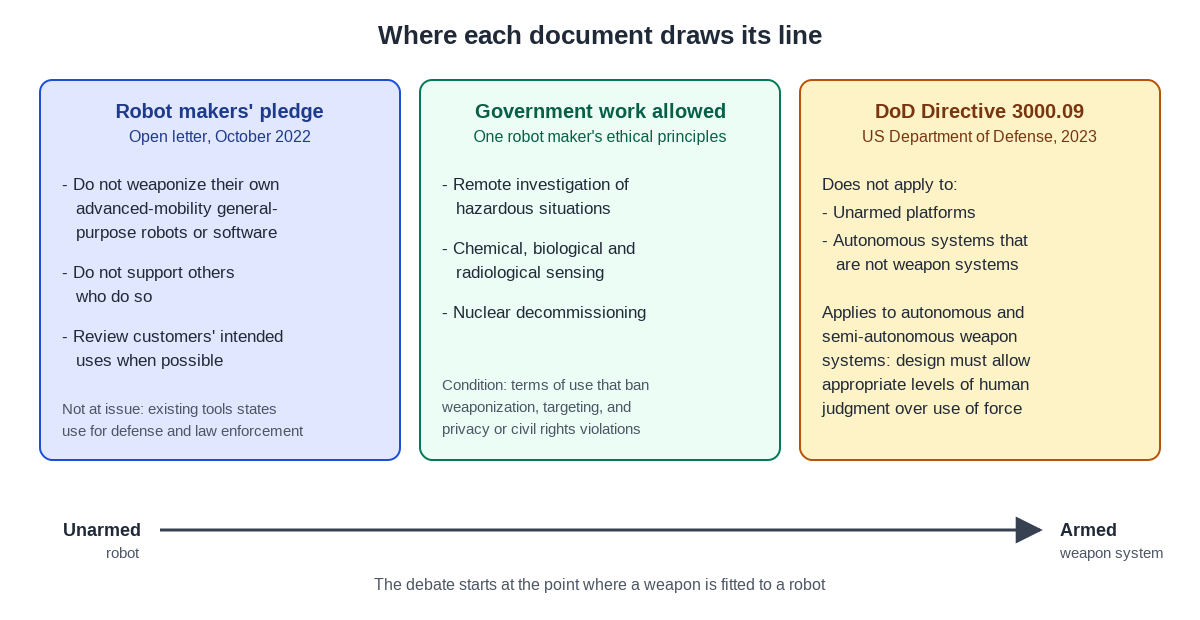
Government uses without weapons already exist. In government and public safety work, Boston Dynamics' four-legged robot Spot is used to look into hazardous situations remotely and calm them down. Other examples are adding sensors that pick up chemical, biological or radiological hazards, and cutting workers' radiation exposure while nuclear plants are taken apart.
Going into dangerous places in place of people is also something unmanned ground systems have long done. That story is in Unmanned ground vehicles: robots for dangerous places. The debate begins at the moment a weapon is mounted on such a robot.
The robot makers' open letter
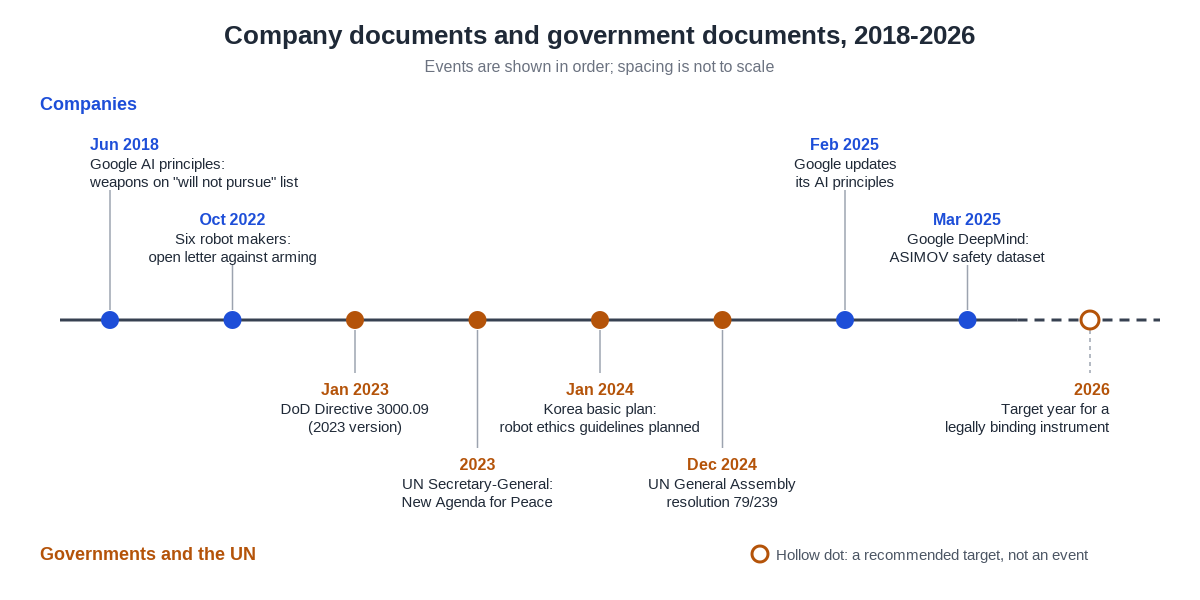
On October 6, 2022, six robot companies released an open letter titled "General Purpose Robots Should Not Be Weaponized." According to Open Robotics' blog, Agility Robotics, ANYbotics, Boston Dynamics, Clearpath Robotics, Open Robotics and Unitree wrote and signed it together.
The heart of the letter is the kind of risk involved. The letter looks at robots that can be run remotely or on their own, that the public can easily buy, and that can walk into homes and workplaces. Arming such robots creates new dangers and grave ethical questions. It also warns that armed uses would damage public trust in the technology.
The pledge is specific. The signers said they would not weaponize their own advanced-mobility general-purpose robots. The same went for the software behind those robots, and they would not help others do either. When possible, they would look at what customers intend to use the robots for, and they would look into technical features that could reduce the risks.
The pledge also has limits. The tools states and their agencies already use for self-defense and law enforcement are plainly left out of the letter's concerns. The trigger was growing concern after a small number of people had publicized makeshift attempts to arm commercial robots in the preceding months. Saying their own pledge was not enough, the signers asked policymakers to work with them on banning misuse.
Openly published software is a different matter. Open Robotics wrote that the permissive licenses on projects such as ROS and Gazebo make it hard, if not impossible, to stop its technology from being used in armed systems. It added that it would not directly help such efforts with its expertise or staff.
One company's principles: no weapons, but government work
Boston Dynamics, one of the signers, keeps a separate set of ethical principles on its website. One of them is a heading that rules out weaponizing its robots. Under it, the company will neither license nor team up with anyone seeking to turn its robots into weapons or self-directed targeting systems. If its products are put to harmful use, it will take steps to curb that.
The same principles do not rule out working with governments. Serving government agencies in charge of safety and security fits the company's mission, according to the principles. The condition is that the work follows its terms of use, which forbid arming the robots, using them for targeting, and breaking privacy or civil rights law. The remote investigation and hazard detection described above fall within that scope.
The principles also say where people fit. AI is advancing quickly, but in this view people alone are smart enough to cope with the full complexity of real workplaces. So the robots are meant to be designed from the start to draw on what people know, protect them, and relieve them of the heaviest work.
Two versions of an AI company's principles
The principles of companies that build the AI models that may become a robot's brain also enter this debate. When Google published its AI principles on June 7, 2018, it included a list of AI uses the company would not pursue. That list included weapons and other technologies whose main purpose is to cause injury to people or directly help do so.
Even the 2018 version did not cut off all work with the military. Google would not build AI for weapons, but it would go on working with governments and armed forces in other fields. The examples given were cybersecurity, training, recruiting, health care for veterans, and search and rescue.
On February 4, 2025, Google announced that it had revised its principles. The announcement said a global competition for AI leadership is under way in an increasingly complex geopolitical landscape. It argued that democracies should lead AI development, with like-minded companies, governments and groups building AI that protects people and supports national security. The new principles are built on three tenets: bold innovation, responsible development and deployment, and collaborative progress.
The current principles page has no list of applications Google will not pursue, and the word "weapon" does not appear on it. Instead, its section on responsible development speaks of suitable human oversight, careful checks and ways to gather feedback. These are meant to keep the work in line with international law and human rights principles that are broadly accepted. Putting the original texts side by side shows what changed between the two versions.
Safety research on the robot side has appeared too. Google DeepMind announced its robot models in March 2025. It said a "Robot Constitution," modeled on Isaac Asimov's Three Laws of Robotics, can steer a language model toward picking safer tasks for robots. It also released the ASIMOV dataset to measure the safety effects of robot actions.
Government documents draw the line at arming
Government documents draw the line somewhere else. US Defense Department Directive 3000.09 deals with autonomy in weapon systems, and it spells out what falls outside its scope. It does not apply to unarmed platforms, whether they are remotely operated or crewed, autonomous or semi-autonomous. Nor does it cover self-operating or partly self-operating systems that are not weapons.
Once a system is a weapon, things change. The same directive requires such weapon systems, whether autonomous or semi-autonomous, to be designed to let commanders and operators apply "appropriate levels of human judgment over the use of force." A patrol robot sits outside the directive, and it falls inside the moment a weapon is fitted.
The directive's categories and the human roles described as "in, on and out of the loop" are explained in detail in Autonomous weapons and human control.
Two tracks at the United Nations
Two tracks of talks continue at the United Nations. The first is about lethal autonomous weapon systems (LAWS). A group of governmental experts under the Convention on Certain Conventional Weapons (CCW) discusses the issue.
António Guterres, the UN Secretary-General, has described lethal autonomous weapons as "politically unacceptable and morally repugnant." He has called for an international legal ban. His 2023 New Agenda for Peace urged states to agree on a legally binding instrument by 2026. It would outlaw autonomous weapons that operate with no human control or supervision and cannot be used in line with international humanitarian law, and set rules for every other type.
The second track covers all military AI, not just weapons. On December 24, 2024, the UN General Assembly adopted resolution 79/239. It affirms that international law applies across the whole life cycle of AI in the military domain, and it states that it does not cover AI in the civilian domain.
The resolution asked the Secretary-General for a report to the 80th session of the General Assembly on states' views, focused on topics beyond lethal autonomous weapons. Views from industry, scientists, civil society and the International Committee of the Red Cross were also to go into an annex. In this way, the resolution names a place where companies that build robots and AI can feed into UN talks. Under that mandate the Secretary-General submitted a report (A/80/78), with the states' views behind it in an annex.
Korean government documents include a related plan. The Ministry of Trade, Industry and Energy confirmed the Fourth Basic Plan for Intelligent Robots in January 2024. The plan includes preparing robot ethics guidelines so that robots are developed and used in the right direction.
Both sides of the debate
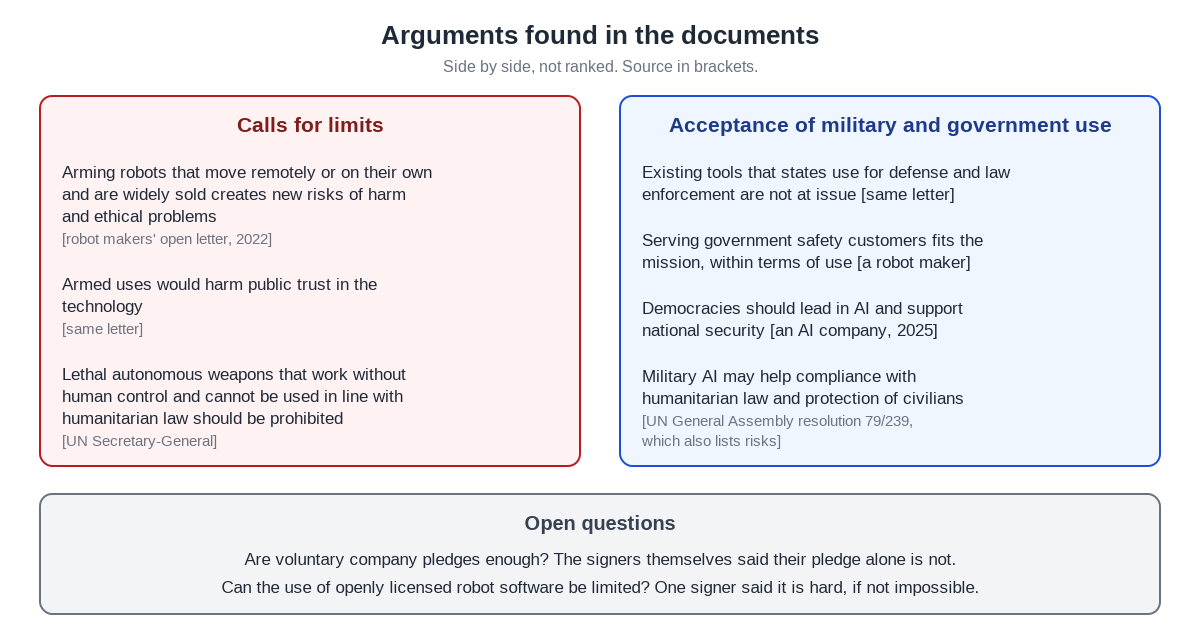
The case for limits rests on the documents above. The 2022 letter argues that arming robots that are widely sold and can reach people's surroundings creates new dangers and ethical problems, and damages trust in the technology. The UN Secretary-General's position is that lethal autonomous weapons working without human control, and unable to be used in line with international humanitarian law, should be banned.
The case for accepting military and government use rests on the same documents. The very same letter says it does not object to existing technologies for national defense, and Boston Dynamics sees helping government customers within its terms as part of its mission. Google's 2025 post said democracies should lead in AI and support national security. Resolution 79/239 lists opportunities, such as better respect for international humanitarian law and protecting civilians, alongside the risks.
The risks the resolution lists are concrete. They include an arms race, miscalculation, a lower threshold for conflict, and spread to non-state actors. Opportunities and risks written into the same document show what this debate looks like.
Some questions remain open. Company pledges are self-imposed, so they do not reach companies or individuals that never signed them. The signers themselves wrote that their pledge is not enough. Open Robotics also wrote that licenses can hardly limit how openly released robot software is used.
What to read next
- Autonomous weapons and human control: the US directive and the CCW talks in more detail.
- Dual-Use Technology: When Civilian Tech Becomes Military Tech: how technology moves between civilian and military use, and export controls.
- Unmanned ground vehicles: robots for dangerous places: what unmanned ground systems actually do.
- What Is Physical AI: Artificial Intelligence with a Body: the technology this debate is about.
- Levels of Autonomy in Drones and Robots: Where the Human Sits: ways of dividing up degrees of autonomy.