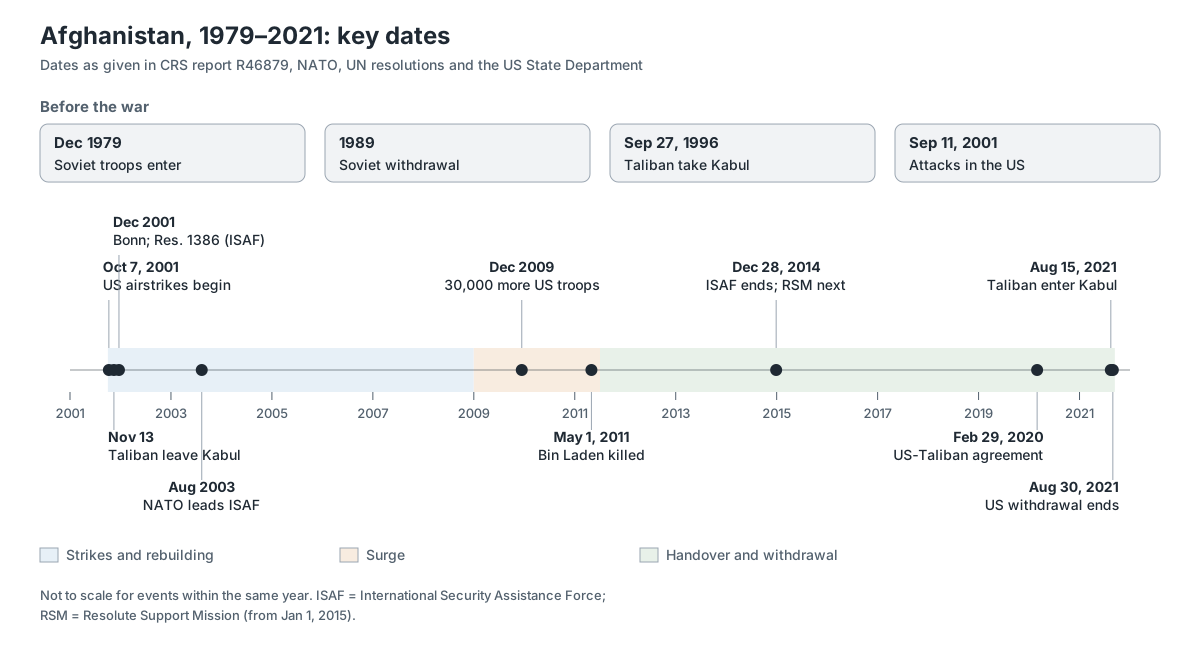
Early on August 15, 2021, Taliban fighters came into Kabul. Twenty years earlier, the same movement had abandoned the city a little more than a month after US airstrikes began. Fifteen days later, on August 30, the last US troops left Afghanistan.
How did a twenty-year war end in a place that looked so much like where it began? This article follows 2001 to 2021 stage by stage. It draws on Congressional Research Service (CRS) reports, NATO and UN records, and material from the US Defense Department, the Australian War Memorial and South Korea's foreign ministry. Troop and casualty figures are counted differently from one source to another, so each number is tied to the institution that published it.
Before 9/11: from the Soviet exit to the Taliban
In the last days of December 1979, thousands of Soviet troops moved into Afghanistan. After ten years of grinding insurgency, Soviet forces pulled out. The State Department's Office of the Historian puts the cost at millions of lives and billions of dollars.
Once Soviet troops left, US attention faded too. For security reasons, the US emptied its Kabul embassy in January 1989, and it did not reopen until 2001. After the Soviet-backed government fell in 1992, four years of civil war followed among the mujahideen, the groups that had fought the Soviets.
In that turmoil, in 1993–1994, clerics and students, mostly rural Pashtuns, formed the Taliban movement. A talib is a student of Islam, and Taliban is the plural. The movement seized Kandahar, in the south, in November 1994. On September 27, 1996, it took Kabul.
The Taliban controlled most of Afghanistan until 2001. Outside health care, women could not go to school or hold jobs away from home. In March 2001, the movement destroyed the giant sixth-century Buddhas of Bamyan and drew condemnation from around the world.
Also in 1996, Osama bin Laden relocated to Afghanistan from Sudan. The Taliban gave his organization, al-Qaeda, a safe haven for recruits and training camps. On August 7, 1998, al-Qaeda operatives bombed the US embassies in Kenya and Tanzania at the same time, killing more than 200 people. In October 1999, UN Security Council Resolution 1267 added sanctions on the Taliban.
Autumn 2001: the Taliban leave Kabul within weeks
On September 11, 2001, a series of terrorist attacks carried out by al-Qaeda operatives in the United States killed nearly 3,000 people. The next day, the UN Security Council adopted Resolution 1368. It recognized the right of individual or collective self-defense under the UN Charter and called the attacks a threat to international peace and security.
On the same day, NATO Allies agreed to invoke Article 5 of the Washington Treaty, the collective defense clause, if the attack proved to have been directed from abroad. It was a first for NATO. On October 2, the North Atlantic Council decided that the attacks were covered by Article 5.
President George W. Bush told the Taliban to turn over al-Qaeda's leaders. Taliban leaders refused, saying bin Laden was their guest. On September 18, Congress enacted an authorization for the use of military force (AUMF).
US military action began on October 7. It combined airstrikes on Taliban targets across the country with close air support for the Afghan forces fighting the Taliban in the north. Within two weeks, small numbers of US Army Special Forces, Central Intelligence Agency (CIA) paramilitary officers and some conventional ground troops were on the ground.
By November 13, the Taliban had left Kabul, and Afghan fighters known as the Northern Alliance soon took the city. US-backed Afghan forces then closed in on Kandahar in the south, where the Taliban movement was born. Many in the Taliban's ranks and leadership died or were taken prisoner, but others, including leader Mullah Omar, hid in remote rural areas or escaped to Pakistan.
The United States did not go alone. Australia invoked the ANZUS Treaty and began its military commitment on October 11, 2001. Two Royal Australian Air Force Boeing 707 aerial refueling aircraft from No. 33 Squadron also operated from Manas Air Base in Kyrgyzstan.
Bonn and ISAF: from Kabul to the whole country
In December 2001, Afghan delegates gathered by the United Nations in Bonn, Germany, chose Hamid Karzai to head an interim government. There appears to have been no effort to bring the Taliban into the talks. Karzai was then elected president in 2002 by an emergency loya jirga, Afghanistan's traditional consultative assembly.
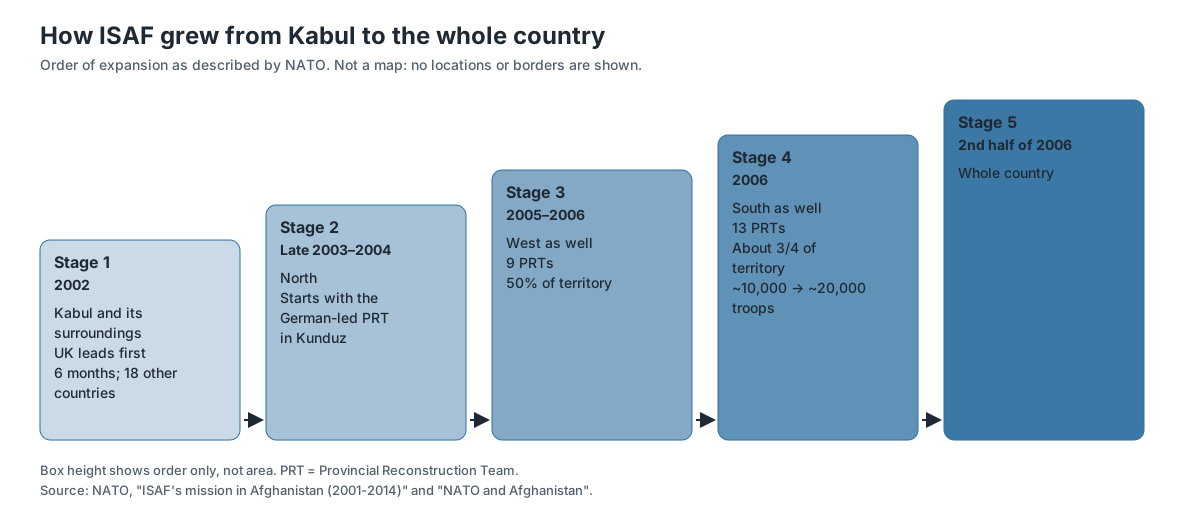
On December 20, the Security Council authorized the International Security Assistance Force (ISAF) in Resolution 1386. The decision was taken under Chapter VII of the UN Charter. The first mandate ran for six months: help the Afghan Interim Authority keep Kabul and its surroundings secure.
When the first ISAF troops arrived in January 2002, the United Kingdom held the command and 18 other countries sent forces and equipment. The United States declared an end to major combat operations on May 1, 2003, although Defense Secretary Donald Rumsfeld added that pockets of resistance remained. On August 11, 2003, NATO took the lead of ISAF, ending the six-month rotation of national commands, and in October the UN widened ISAF's mandate to cover the entire country.
ISAF did not spread across the country at once. It started in late 2003 by taking over the German-led Provincial Reconstruction Team (PRT) in Kunduz, in the north. At that point the other eight PRTs stayed under Operation Enduring Freedom, the US-led operation.
After moving into the north and west, ISAF led nine PRTs and provided security assistance in 50% of the territory. When it expanded south in 2006, it led 13 PRTs covering about three-quarters of the country, and its strength grew from about 10,000 to about 20,000 troops. By the second half of 2006, its area covered the whole country.
The insurgency returns, and the surge
Meanwhile, the Taliban regrouped. The Australian War Memorial's account says the fighting stalled without a result in mid-2002, while Washington turned its attention to Saddam Hussein's Iraq. Taliban leaders who had moved to the south and across the border to Pakistan had reorganized by 2003 and were fighting an insurgency against the government in Kabul.
The CRS report places the start a little later. By 2005, it says, scattered Taliban forces were gathering again in the Pashtun heartland of the east and south, and across the border in Pakistan. By 2007, much of the country was back in Taliban hands.
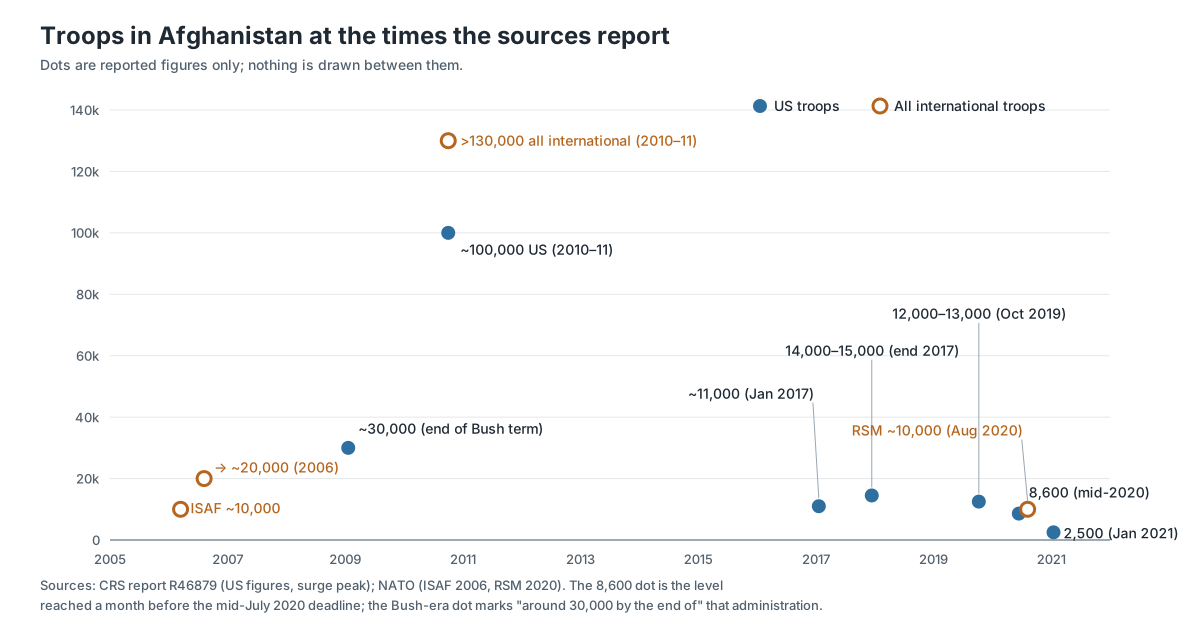
In 2007 and 2008, ISAF units pushing into the east and south found themselves fighting an insurgency that kept growing. By the time President Bush left office, US forces had grown to around 30,000. In February 2009, President Barack Obama announced 17,000 more troops.
In December 2009, after reviewing the military campaign for three months, he decided to send a further 30,000. He also promised to begin bringing US troops home from summer 2011, and NATO foreign ministers agreed to send 7,000 more soldiers. NATO's account records a new counter-insurgency effort that year and 40,000 extra troops.
With this surge, international forces peaked at more than 130,000 in 2010–2011, around 100,000 of them American. The surge can arguably be credited with weakening Taliban advances. Even so, by 2010 the Obama administration had concluded that military means alone would not settle the conflict. It aimed to wrap up combat operations by late 2014.
On May 1, 2011, bin Laden was killed in Pakistan by US Special Operations Forces. According to the Australian War Memorial, NATO leaders then started working out how to leave Afghanistan.
Handing over: the 2011–2014 transition
The handover began in 2011. Known in Dari and Pashtu as "Inteqal," it was a gradual transfer of security responsibility to Afghans. From 2011 onward, building up the capacity of Afghan forces became ISAF's central task.
The transition finished on time in December 2014. At a ceremony in Kabul on December 28, ISAF formally ended its mission, and Afghan forces took full responsibility for security across the country.
From January 1, 2015, the Resolute Support Mission (RSM) carried on, training, advising and assisting the Afghan National Defence and Security Forces (ANDSF). By August 2020, RSM numbered around 10,000 people drawn from 36 Allied and partner countries. US troops also ran counterterrorism operations alongside RSM, and the two missions together made up Operation Freedom's Sentinel.
The 2020 agreement and August 2021
When President Donald Trump took office in January 2017, about 11,000 US troops were reportedly in Afghanistan. By late 2017, extra forces had brought the total to 14,000–15,000. In mid-2018, Trump ordered formal, direct talks with the Taliban without the Afghan government, the first of their kind.
In October 2019, the top US commander in Afghanistan said US forces had dropped by 2,000 in a year, leaving 12,000–13,000. Then, on February 29, 2020, the United States and the Taliban signed the Agreement for Bringing Peace to Afghanistan.
In the text, the United States committed to withdraw, within 14 months of the announcement, all US, allied and coalition forces, along with non-diplomatic civilian staff and private security contractors. In the first 135 days, it would cut US forces to 8,600. In return, the Taliban promised that no group, al-Qaeda included, would be allowed to pose a threat to the United States and its allies.
The US withdrawal pledge did not require the Taliban to lower the level of violence against the Afghan government. The Afghan government was not even a party to the agreement. The text set March 10, 2020, as the start of talks among Afghans, but those talks did not open in Doha until September 12.
US forces reached 8,600 a month before the mid-July deadline in the agreement, and on January 15, 2021, they reached 2,500. On April 14, President Joe Biden announced a "final withdrawal" to begin on May 1 and finish by September 11. NATO Allies decided the same day to start withdrawing RSM forces by May 1. On July 8, Biden said the military mission would end on August 31.
The Taliban offensive began in early May. Wide stretches of the countryside fell first, and by one estimate the Taliban seized more than 100 of the country's 400 districts during May and June. On July 21, General Mark Milley, the Chairman of the Joint Chiefs of Staff, put the number of districts held by the Taliban at more than 200.
On August 6, the Taliban took a provincial capital for the first time. When half of the provincial capitals fell within the following week, many observers were surprised. On the morning of August 15, the Taliban entered Kabul, and on that day President Ashraf Ghani left the country.
On August 26, an Islamic State attack at Kabul airport killed 13 US service members and more than 100 Afghans and wounded 18 more US troops. The allied airlift from Kabul airport evacuated more than 120,000 people, including around 2,000 Afghans who had worked for NATO, with their families. The US withdrawal and evacuation ended on August 30.
Weapons and organization: what each side relied on
The war did not open with a massed ground advance. In autumn 2001, the United States relied on airstrikes and close air support from above. On the ground, it relied on small numbers of special forces and CIA officers working with Afghan forces such as the Northern Alliance. It was Afghan forces that retook Kabul.
Over the next twenty years, the weight shifted to building Afghan forces. Created in 2002, the Afghan National Army (ANA) began as an infantry-centered force. Step by step it added supporting branches: military police, intelligence, route clearance, combat support, medical care, aviation and logistics. The Afghan Air Force also added fixed-wing and rotary-wing aircraft.
In 2021, the question became what that army had been leaning on. One explanation experts give is that Afghan forces depended on US and international contractors to maintain their own air force and to provide intelligence and close air support. Those contractors left under the agreement. The ANDSF's official strength was reported at just under 300,000, but most observers judge that the real number was lower.
Among the weapons that harmed civilians were improvised explosive devices (IEDs). The UN Assistance Mission in Afghanistan (UNAMA) reported that civilian casualties in the last quarter of 2020, after peace talks began, were 45% higher than a year earlier. The rise came especially from IEDs and targeted killings. IEDs and the vehicles built to survive them are a topic of their own.
South Korea's deployments to Afghanistan
South Korea sent people to this war too. According to its foreign ministry, the first troops deployed in February 2002. The Dongui unit handled medical care and the Dasan unit handled engineering, with headquarters at Bagram and a detachment at Manas in Kyrgyzstan.
The two units gave medical and engineering support to the forces of 14 countries and also helped war refugees and local residents. The rotation that left on August 27, 2003, had 77 people from the Dongui unit and 138 from the Dasan unit, 215 in all. This first deployment ended with a withdrawal in December 2007, when about 220 people were serving.
In June 2008, a reconstruction project began inside the US base at Bagram, running a hospital. On December 8, 2009, South Korea's cabinet approved sending up to 350 troops to Parwan Province. Their main task was protecting the Provincial Reconstruction Team, and the deployment was set for July 1, 2010, to December 31, 2012.
The Korean PRT began work in Parwan in July 2010. It brought together foreign ministry officials, the Ashena Unit (Oshino in Korean), police officers, the Korea International Cooperation Agency (KOICA), and hospital and vocational training staff. About 2,500 people took part over four years. In December 2012, it handed its base at Charikar over to the Afghan government.
The Korean PRT formally ended its four-year mission at a ceremony on June 23, 2014. The foreign ministry described the withdrawal as part of the full pullout of national PRTs as the ISAF mission came to an end.
What twenty years left behind
By the Defense Department's count, 2,219 US service members died in Afghanistan from October 7, 2001, through the end of 2014, and 20,093 were wounded in action. After 2014, Operation Freedom's Sentinel added 109 deaths and 620 wounded. Across both periods, US military deaths total 2,328.
Close to one-third of coalition deaths were from NATO members and partner countries other than the United States. Of the 130,000 troops in Afghanistan in 2011, roughly 40,000 came from those countries. NATO's two pages give the number of ISAF contributors differently, as 50 and as 51 countries.
UNAMA has documented civilian harm systematically since 2009. 2020 was the seventh year in a row in which it recorded more than 3,000 civilians killed. Civilian casualties that year came to 8,820, with 3,035 killed and 5,785 injured.
The financial cost also depends on what is counted. From September 2001 through March 2021, the Defense Department obligated $837.3 billion, in current dollars, to fight the war and fund reconstruction in Afghanistan. Its yearly obligations peaked at $98 billion in fiscal year 2012.
Reconstruction funding tallied by the Special Inspector General for Afghanistan Reconstruction (SIGAR) came to about $145 billion. Brown University's Costs of War project, which adds interest on war borrowing and veterans' medical care, estimated $2.26 trillion.
There is no single answer to why the government's forces collapsed so fast. Experts point to high casualty and attrition rates and to corruption deep enough that soldiers went without pay or food. They also point to leaders who were unprepared because they did not believe the United States would really leave. Others cite a political choice to hold vulnerable rural outposts that left forces overstretched, and reports that more and more soldiers took Taliban payments to surrender after the 2020 agreement.
Some argue that the centralized army the United States built did not fit Afghanistan's circumstances, and that the United States put the number of troops ahead of their quality. The CRS report lists these explanations side by side instead of reducing them to one.
Views on the withdrawal decision also differ. Some argue that a small force of several thousand troops could have stayed to help reach a peace deal among Afghans. Biden argued that such a force could not have deterred the Taliban and that a renewed buildup would eventually have been needed. Others hold that even if a minimal presence had been possible, it would not have been worth more US resources and lives.
NATO notes that over the two decades, no terrorist attack launched from Afghanistan struck Allied territory. Its own assessment also recommended that it consider how to strengthen its ability to carry out large evacuations at short notice. Since the Taliban returned, girls have been barred from secondary school, and a mass exodus of refugees has come with a growing humanitarian crisis.
What to read next
- "The Soviet-Afghan War: Ten Years of Intervention": 1979 to 1989, the story before this one.
- "The Iraq War, 2003: Three Weeks to Baghdad": where US attention turned in mid-2002.
- "IEDs and the MRAP: How a Roadside Threat Reshaped Vehicles": improvised explosive devices and the vehicles built to survive them.
- Precision-guided bombs: what gets added to a plain bomb: how the bombs used in airstrikes and close air support find their targets.
- Aerial refueling: sharing fuel in the air: what the Australian tankers were there to do.
- Military logistics: performance must be sustainable: background for why maintenance became a question once the contractors left.