On 14 October 1962, a US U-2 spy plane took several photographs over Cuba. They clearly showed ballistic missile sites under construction. The pictures reached the White House the next day, and for nearly two weeks after that the world stood at the edge of nuclear war.
The US State Department's Office of the Historian calls the crisis the point in the Cold War when Washington and Moscow came nearest to a nuclear clash. People often speak of "thirteen days." Kennedy held his first meeting on the crisis on 16 October, and Khrushchev announced on 28 October that the missiles would go. Counting both of those days, that makes thirteen.
Why Cuba, of all places? What words and letters went back and forth in those thirteen days, and what was learned only decades later? This article follows the released meeting transcripts, the letters, and the US Navy's operational records.
From the Bay of Pigs to a secret agreement
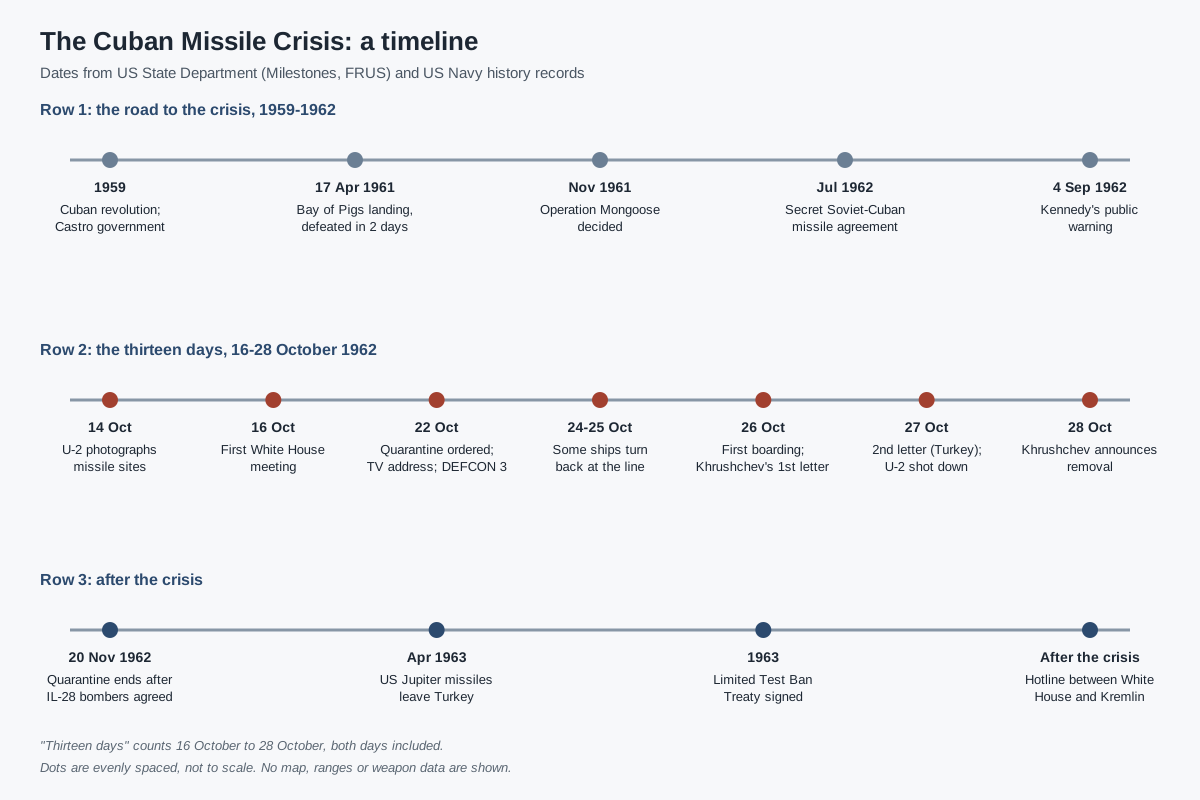
In 1959 a left-wing revolution in Cuba drove out President Fulgencio Batista and set up a government under Fidel Castro. The new government took over American economic assets on the island and moved close to the Soviet Union. An island just off the US coast had become a new front of the superpower rivalry.
Eisenhower, still president in March 1960, ordered the Central Intelligence Agency (CIA) to draw up an invasion plan. The CIA trained and paid for a force of Cuban exiles known as Brigade 2506. The brigade landed at the Bay of Pigs on 17 April 1961 and was defeated within 2 days by Cuban forces under Castro's direct command.
The failure only made Castro's government stronger. In November 1961 the United States settled on a new covert program, Operation Mongoose, meant to do what the Bay of Pigs had not: remove the Castro regime from power. Some of its planned actions were carried out in 1962, but the military intervention never happened.
That spring and summer, intelligence reports pointed to growing Soviet arms shipments to Cuba. In the State Department's account, Khrushchev reached a secret agreement with Castro in July 1962 to station Soviet nuclear missiles on the island as a deterrent against another invasion. Work on the sites began in late summer, and routine US surveillance flights found a general arms buildup that included IL-28 bombers. On 4 September, Kennedy publicly warned against bringing offensive weapons into Cuba.
The photographs of October 14 and the first meeting
The building went on despite the warning. The U-2 photographs of 14 October showed sites under construction for medium-range ballistic missiles (MRBMs) and intermediate-range ballistic missiles (IRBMs). After processing, they were presented at the White House the next day.
The first meeting at the White House began at 11:50 a.m. on 16 October. The released transcript opens with the analysis of the photographs. Secretary of State Dean Rusk said the United States had to start a chain of events that would eliminate the base, and he laid out two paths. One was a quick strike; the other was to build up the crisis until the other side had to think very seriously about giving in.
The advisers were split. Some, the whole Joint Chiefs of Staff among them, wanted to bomb the missile sites and then invade the island. Others preferred firm warnings to Havana and Moscow. Kennedy chose a middle course.
A line at sea: a quarantine, not a blockade
On 22 October, Kennedy ordered a naval "quarantine" of Cuba. Why not call it a blockade? A blockade assumes a state of war, so the word "quarantine" set the action apart from one in legal terms. It also made it easier for the United States to win backing from the Organization of American States (OAS).
The same day, Kennedy wrote to Khrushchev that the United States would not allow offensive weapons to be delivered to Cuba. He demanded that the bases already built or under construction be taken apart. This letter was the first of many direct and indirect messages between the two governments during the crisis.
That evening he spoke on television. Any nuclear missile launched from Cuba at any nation in the Western Hemisphere, he said, would count as a Soviet attack on the United States. The answer would be a full retaliatory response against the Soviet Union. The Joint Chiefs raised the readiness level to DEFCON 3.
On 24 October, Khrushchev answered that the US "blockade" was an "act of aggression" and that Soviet vessels heading for Cuba would be ordered to sail on. Yet on 24–25 October some ships turned back at the quarantine line. Ships that were stopped carried no offensive weapons and were allowed through. On the morning of 26 October, a boarding party from two US Navy destroyers went aboard the Lebanese freighter Marucla in the first quarantine search.
The quarantine was a big operation. US destroyers and frigates stayed on station for a month, resupplied at sea. By mid-November, as the last week of the quarantine began, Navy support forces had supplied 85,000 people aboard 183 ships, according to the Naval History and Heritage Command (NHHC).
Meanwhile, reconnaissance flights showed the missile sites in Cuba getting close to being ready for use. US forces went to DEFCON 2, a level meaning that a war involving the Strategic Air Command was close at hand.
The grimmest Saturday
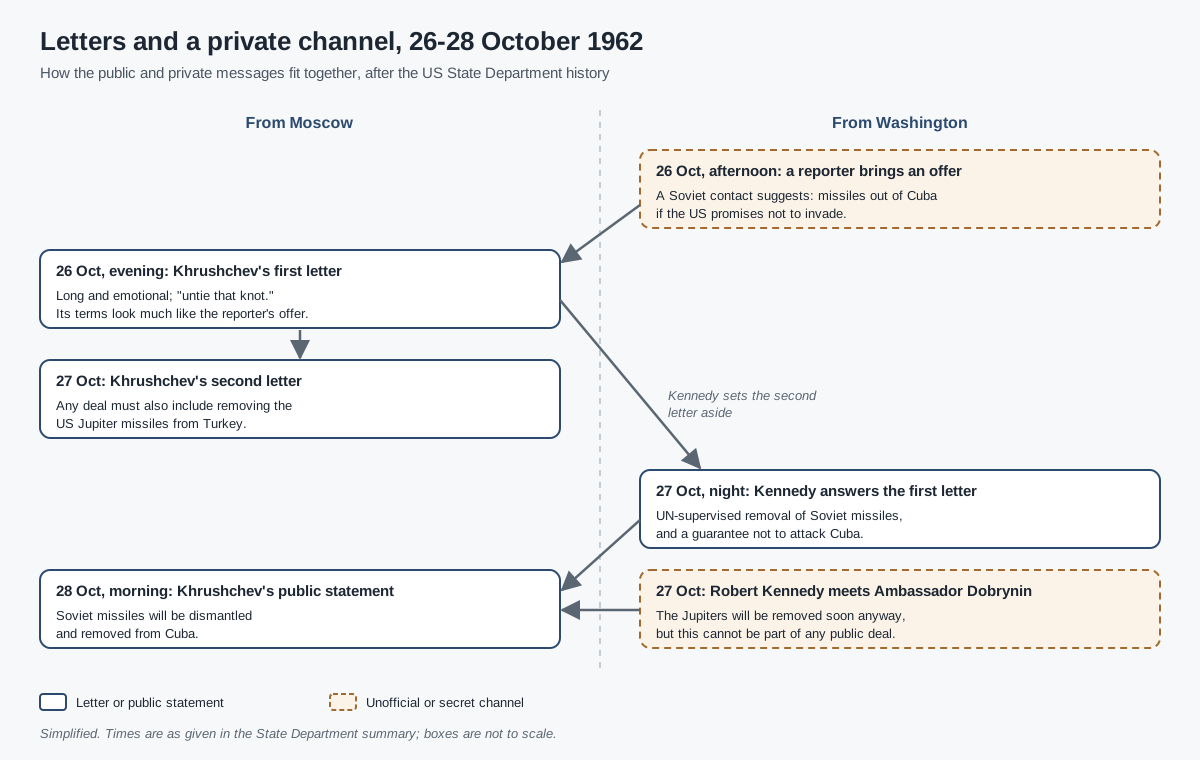
On 26 October, Kennedy told his advisers that only a US attack on Cuba seemed likely to remove the missiles. Still, he wanted to give diplomacy a little more time. That afternoon, ABC News reporter John Scali brought word to the White House. A Soviet agent had approached him and suggested a deal: Soviet missiles would leave Cuba in return for a US promise not to invade.
That evening a letter from Khrushchev arrived. It was long and emotional, raising the specter of nuclear disaster, and its proposal looked very much like the one Scali had passed on. "Let us not only relax the forces pulling on the ends of the rope," he wrote, "let us take measures to untie that knot."
The hope did not last. On 27 October, Khrushchev sent a second letter saying any deal must include removing the US Jupiter missiles from Turkey. The same day, a US U-2 was shot down over Cuba and its pilot was killed.
At a 1992 Navy history colloquium, Walter S. Poole called it the grimmest day of the crisis. That day the Joint Chiefs advised the White House that, without clear proof the offensive weapons were being taken apart, air strikes should come by Monday morning, 29 October. An invasion would follow seven days later.
Kennedy decided to set the second letter aside and answer the first. That night he proposed steps to remove the Soviet missiles under United Nations supervision, along with a US pledge not to attack Cuba. Ignoring the second letter was a risky move.
Then Attorney General Robert Kennedy met in secret with the Soviet ambassador, Anatoly Dobrynin. He said the United States planned to remove the Jupiter missiles from Turkey soon anyway, but it had to stay out of any public settlement. The next morning, 28 October, Khrushchev announced publicly that the Soviet missiles in Cuba would be taken apart and shipped out.
In a letter to Kennedy that day, Khrushchev said he had given a new order. The weapons Kennedy called offensive were to be dismantled, crated and sent back to the Soviet Union. He added that the Soviet Union had armed Cuba because Cuba was under constant threat of invasion.
The hardware in the crisis: missiles, photographs, submarines
Several Cold War weapon technologies were tangled up in this crisis, with missiles at the center. "Medium-range" and "intermediate-range" are names that sort ballistic missiles by range, and the ballistic missile article explains the categories. According to a 1992 talk by Raymond Garthoff, the nuclear-armed medium-range missiles in Cuba could be launched only with Khrushchev's explicit permission, whatever happened. Soviet forces there were under strict orders to fight only if the United States attacked.
Photographs drove the decisions. The U-2 pictures opened the crisis, and Navy photo and patrol aircraft played a large part in watching Soviet offensive weapons arrive and in monitoring their withdrawal by sea. The path from an aerial photograph to intelligence continues in the reconnaissance satellite article.
The U-2 was brought down by a surface-to-air missile, a kind of weapon the surface-to-air missile article explains. On 27 October, after Castro ordered his own anti-aircraft guns to fire at low-flying US reconnaissance planes, the Soviet command switched on its air defense radars. When a U-2 came into range, local Soviet air defense commanders ordered a missile unit to shoot it down. Khrushchev had not authorized this and at first assumed the Cubans had fired.
There was tension under the sea as well. The Navy intercepted not only merchant ships bound for Cuba but Soviet submarines in the area too. On 26 October, submarines were seen in the quarantine area after intense surveillance forced them to the surface, and three Soviet "F" class long-range conventional submarines were identified.
What was not known then, and views that differ
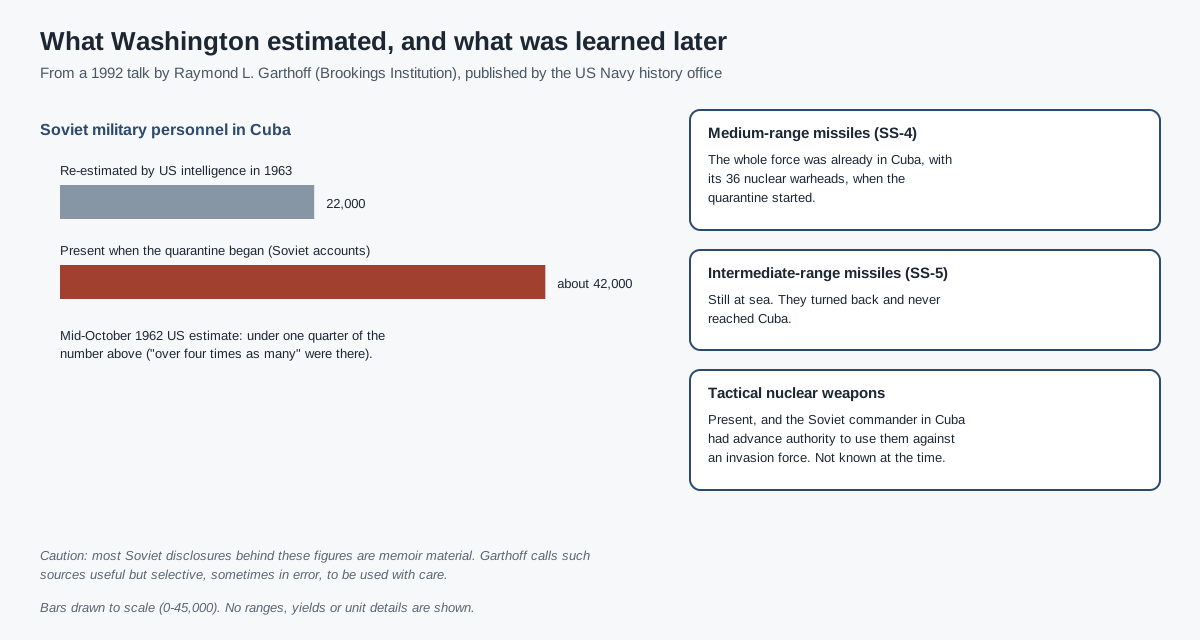
At an NHHC colloquium on 18 June 1992, Raymond L. Garthoff of the Brookings Institution summed up what had come out of the Soviet side after the Cold War. When the quarantine began, about 42,000 Soviet military personnel were in Cuba. That was more than four times the mid-October US intelligence estimate and nearly twice the 22,000 estimated after the fact in 1963.
The nuclear story is heavier still. When the United States found the missiles and started the quarantine, the medium-range force (SS-4) was already in Cuba with its 36 nuclear warheads. All of the intermediate-range missiles (SS-5) were still at sea and turned back without ever reaching Cuba. There were also tactical nuclear weapons, and the Soviet commander in Cuba had been given authority in advance to use them if American troops landed.
These numbers come with a caveat. Garthoff himself noted that most Soviet disclosures are memoir material, useful but selective, sometimes misleading or wrong, and to be used with care.
Why did Khrushchev send the missiles? The State Department history says it was to deter any future invasion, and Khrushchev's letter of 28 October also says Cuba was under constant threat of invasion. The NHHC summary page says Khrushchev was trying to fix a balance of strategic power that he saw as tilted toward the United States.
Garthoff sees three considerations at work together. First, a reverse "missile gap" exposed growing US strategic superiority. Second, Cuba and the Soviet Union believed the United States would invade Cuba after the Bay of Pigs. Third, the United States was tightening a ring of air and missile forces around the Soviet Union, including the IRBMs in Turkey.
He added that which of these weighed most is a question that will probably never be answered.
Accounts also differ on what ended the crisis. In the NHHC summary, Khrushchev came to see that his missiles and bombers could not stand up to the Navy's Polaris submarines and the Air Force's nuclear forces on land. It says Kennedy did not press his advantage, so the Soviet leader could back away peacefully. The State Department account puts more weight on the letters, the secret channel, and two leaderships that struggled to read each other's intentions.
What the crisis left behind
Khrushchev's announcement ended the crisis, but the quarantine did not lift at once. Once the Soviets agreed to take their IL-28 bombers out of Cuba, the United States ended the quarantine on 20 November 1962. The Jupiter missiles left Turkey in April 1963.
The State Department history judges that the crisis strengthened Kennedy's image at home and abroad and may have eased the poor world opinion left by the Bay of Pigs. Two other important results followed.
The first was about communication. Despite all the letters, and perhaps because of them, the two leaders and their advisers had trouble all through the crisis grasping what the other side really meant to do. To keep that from happening again, a direct telephone link was set up between the White House and the Kremlin, and it became known as the "Hotline."
The second was about nuclear testing. Having come to the edge of nuclear war, both countries began to rethink the nuclear arms race. The fast escalation of the crisis pushed US and Soviet leaders to seek a test ban agreement more actively. The Limited Test Ban Treaty, signed in 1963 by Britain, the United States and the Soviet Union, outlawed every nuclear test in the air, in outer space and under water.
What to read next
- Ballistic missiles: why they climb high and come down: what the labels "medium-range" and "intermediate-range" separate.
- Surface-to-air missiles: ground systems that guard the sky: how the kind of weapon that hit the U-2 on 27 October works.
- Reconnaissance satellites: information from orbit: how pictures from above become intelligence.
- Destroyers and frigates: why warships have different names: what kind of warships held the quarantine line.
- The Cold War Arms Race: From Bombers to Missiles to Satellites: the larger contest before and after the crisis.