An arrow has feathers at its tail, and a dart has small wings at the back. Missiles and rockets often carry small fins at the tail end too. What are those little fins actually doing?
They do two jobs. When the fins are fixed, they hold the body on a straight path. When the fins move, they turn the body toward a new direction. This article explains both jobs with NASA's public teaching material, then looks at where the moving surfaces go and what a rocket uses to steer once there is no air.
Like the feathers on an arrow: fins that keep it straight
Anything in flight turns around its center of gravity (CG). The CG is the point where the weight of all the parts can be treated as acting together.
The push of the air is handled the same way. Aerodynamic forces come from pressure differences around the surface, and they act on every part of the body. They can be treated as acting at a single point, and this point is the center of pressure (CP).
When a rocket tilts a little away from its flight path, the body and fins produce a sideways force, or lift. For small tilts, the drag stays about the same. What matters is where that lift is applied.
If the CP sits behind the CG, the lift and drag on the tilted body move the nose back toward the direction of flight. This is what engineers mean by a restoring force, and they consider such a rocket stable.
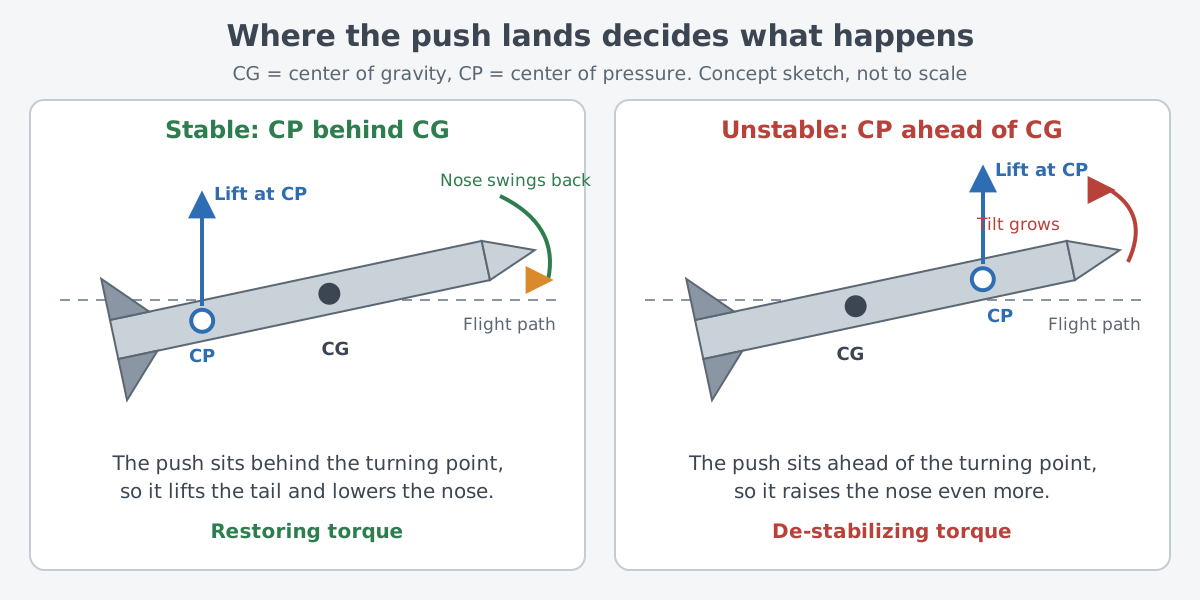
What if the CP sits ahead of the CG? The lift and drag keep their directions, but the turning effect they create is reversed. Any small push on the nose produces forces that make the push bigger. That is why NASA gives a CP located behind the CG as the condition for a stable rocket.
Picturing the feathers on an arrow helps make sense of this. But NASA's explanation is about model rockets, not about how arrows fly.
Full-size rockets are a different case as well. Modern large rockets usually do not rely on aerodynamics for stability; they pivot their exhaust nozzles to get both stability and control. This is why Delta, Titan and Atlas boosters fly without fins.
Move a fin and the body turns
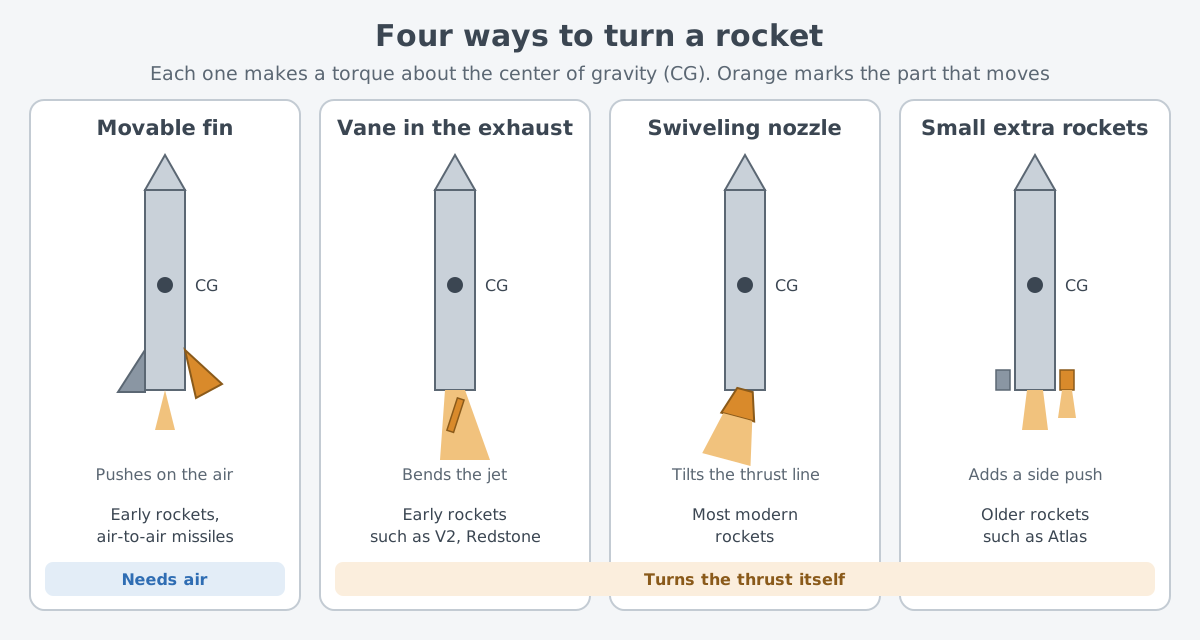
Fixed fins hold the body steady; moving fins turn it. There are several ways to steer a rocket, but they all make a torque about the center of gravity, and that torque rotates the body. On early rockets and on current air-to-air missiles, steering is usually done by fins near the tail that can move.
A movable fin changes how much aerodynamic force acts on the body. That force is applied at the CP, and the CP and the CG usually sit in different places. Because the two points are apart, a torque appears about the CG.
A rocket's guidance system has two jobs: keeping the rocket stable in flight and steering it during maneuvers.
Why does tilting a fin change the force? The angle between a wing and the oncoming air is the angle of attack (AoA), and it strongly affects how much lift a wing makes. For thin airfoils, lift rises in direct proportion to the angle of attack while the angle stays small, within ±10°.
Push the angle too far and things change. The airflow separates from the wing surface, and the wing suddenly loses lift. This is a stall. Getting force by tilting a control surface works only within a limited range.
The upright tail of an airplane is a good example. The vertical stabilizer in front is a fixed wing section that keeps the aircraft flying straight. The rudder behind it is hinged, so it changes how much force the tail surface makes. Both use a symmetric airfoil, so a straight rudder gives no side force, and deflecting it one way or the other gives a force to the left or right.
Three axes: pitch, yaw and roll
A body can turn in three ways. Pitch is the nose moving up and down, yaw is the nose moving side to side, and roll is the wing tips moving up and down. On an airplane, the elevators make pitch, the rudder makes yaw and the ailerons make roll. No aircraft before the Wright brothers' 1902 glider had demonstrated active control in all three axes.
Whichever surface is used, its aerodynamic force acts at some distance from the center of gravity. That creates a torque about the three axes. The explanation is written for airplanes, but turning the body with a torque about the CG is the same idea used to explain rocket control.
Roll is produced a little differently. The ailerons on the two wings usually move in opposite directions: when the right one goes up, the left one goes down. Changing the deflection at the back of an airfoil changes the lift it makes. If the forces on both sides and their distances from the CG are equal, no torque is left over; if not, the leftover torque rolls the aircraft about its CG.
Where the moving surfaces go: front, middle or rear
There is no single answer to where the moving surfaces belong. A 1966 report from NASA's Langley Research Center, "Recent Results on the Aerodynamics of Winged Missiles," studied three missiles with cross-shaped (cruciform) wings in wind tunnels. The three were canard control, which moves small surfaces at the front; tail control; and wing control, which moves the whole middle wing.
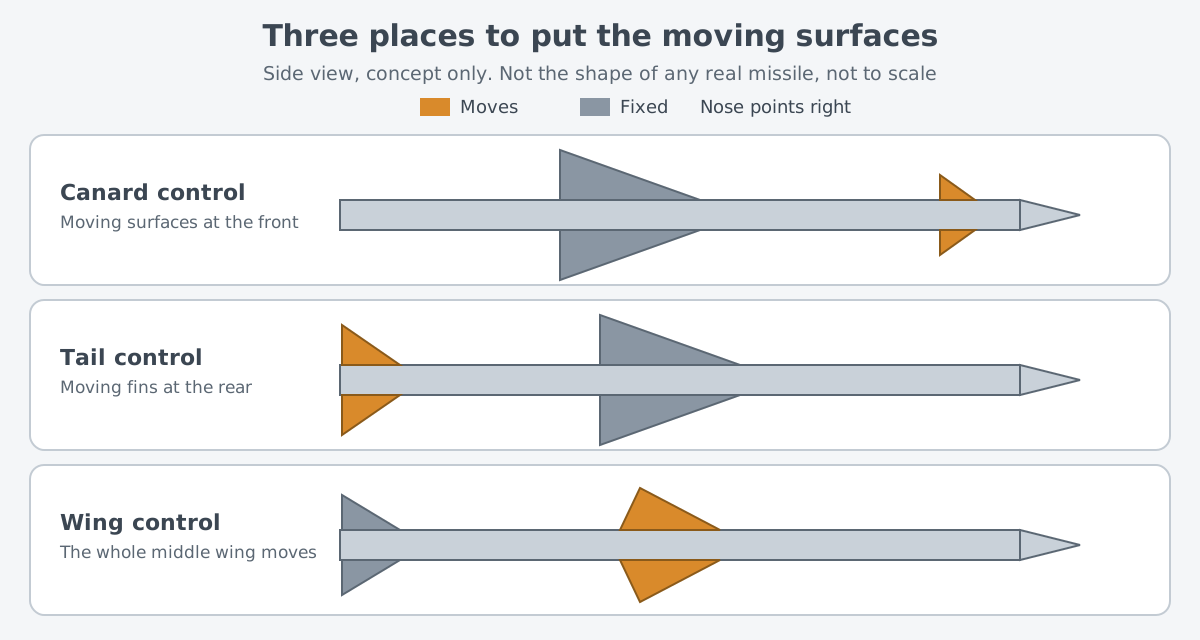
The report says the three layouts were not part of a systematic comparison. They were chosen as three very different arrangements that could come from considerations beyond aerodynamics alone. So these results cannot rank them, but it does show some general traits that come with each layout.
With the canard layout, tilting the control surface adds only a small amount of lift, but the change is in the helpful direction, as is typical of canards. With tail control, tilting the tail to trim the pitch costs some lift, which the report treats as built into aft tail controls. Pitch control with the moving wing relies on a fairly large gain in lift from the wing combined with a short moment arm.
Front-mounted control surfaces were also found on early airplanes. Every Wright brothers' aircraft had its elevator at the front, while modern aircraft usually place it at the rear on the horizontal stabilizer. If a gust lifts the nose, the front elevator's angle of attack grows, its lift grows, and the nose rises even more. The front elevator gave the Wrights' 1903 and 1904 flyers serious trouble in pitch, and the brothers solved them only with the 1905 redesign.
The canard layout for missiles was already being flight-tested in 1950. NACA research memorandum RM L50I27, dated November 1950, was part of a guided missile research program. It reported flight tests of a canard missile layout with delta wings at Wallops Island, Virginia, covering longitudinal stability, control effectiveness, drag and the hinge moments on the control surfaces.
A 1978 NASA wind tunnel report tested a missile model with cross-shaped wings, steered by canards. It compared a tail with fixed fins against a tail whose fins could spin freely. With the free-spinning tail, the canards gave normal roll control at low angles of attack, without the roll control acting in reverse.
Tail-mounted controls have a long history too. The Smithsonian National Air and Space Museum holds a German Fritz X (Ruhrstahl X-1), an armor-piercing bomb with precision guidance from World War II. After it was dropped from an aircraft, an operator guided it with a joystick and transmitter, and spoilers on its cruciform tail controlled its path.
When there is no air: turning the exhaust
A movable fin gets its force by pushing on the air. So this method works only for rockets that stay inside the atmosphere. A rocket that leaves the atmosphere has to push on its own exhaust instead.
The principle does not change. If the line of the thrust made by the exhaust misses the CG, the body gets a torque about the CG and the nose turns.
The ways to bend the exhaust fall into three groups. Early rockets such as the V2 and Redstone placed small thrust vanes in the main exhaust to deflect the thrust. Older rockets such as the Atlas missile added small extra engines, called vernier rockets, below the main rocket to make the torque. Their fuel and plumbing add weight, so vernier rockets are rarely used today.
Most modern rockets swivel the nozzle itself. Turning a nozzle this way is called gimbaling, and the Space Shuttle and the Saturn V used this gimbaled thrust. The Delta, Titan and Atlas boosters mentioned earlier have no fins for the same reason: the nozzle provides both stability and control.
How bending engine exhaust turns an aircraft, and how that helps at high angles of attack where wings lose their grip, is covered in the article on thrust vectoring.
Where this meets lasers: small surfaces, big changes in direction
Moving a small surface a little to change a big direction is also an idea found in devices that handle laser beams. A small mirror that corrects where a beam points, quickly and finely, is called a fast steering mirror (FSM). A gimbal, a mount that turns on two axes, handles the large motions, and this small mirror handles the fast jitter.
The likeness stops there. A missile's control surface uses force from the air to rotate the whole body. A mirror does not rotate any body; it only changes the direction of the light it reflects. It is a matter of reflection angles, not of forces and torques.
What to read next
- Thrust vectoring: steering with the engine: how bending the exhaust turns an aircraft, and what NASA's test aircraft recorded.
- Precision-guided bombs: what gets added to a plain bomb: how guided bombs with tail control surfaces developed.
- Air-to-air missiles: what the missile sees: how a missile sees its target before it ever commands its control surfaces.
- Fast steering mirrors: small, quick mirrors that cancel shake: how a small mirror corrects the direction of a beam.