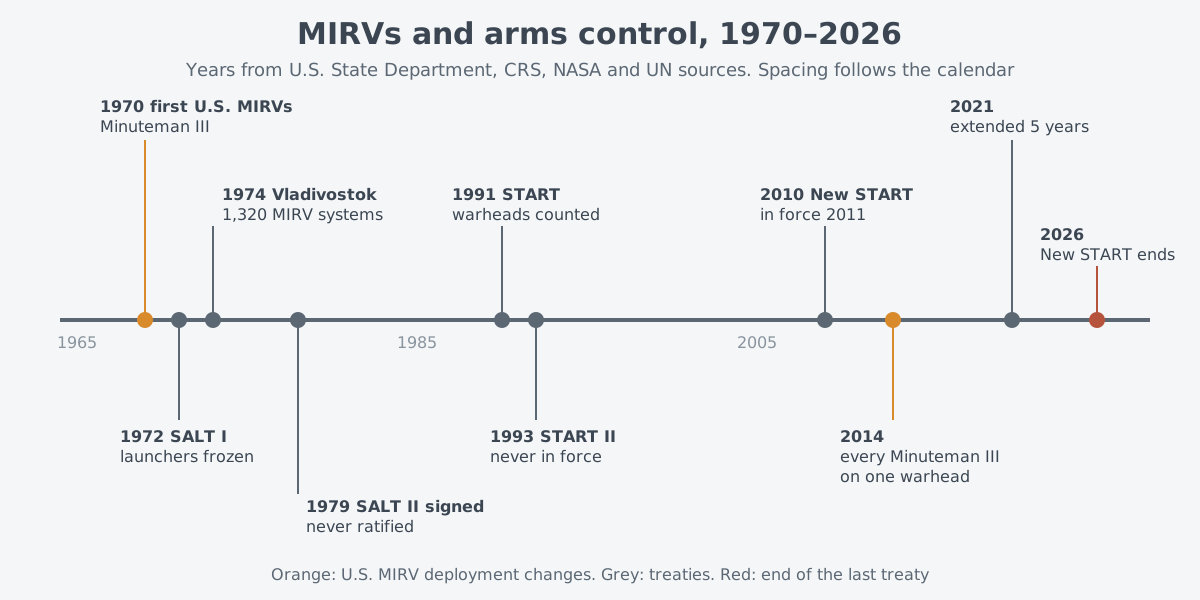
On May 26, 1972, the leaders of the United States and the Soviet Union met in Moscow and signed their first agreement to limit strategic offensive arms. That interim agreement counted launchers, the silos and tubes that missiles are fired from. Two years earlier, in 1970, the United States had already started deploying the Minuteman III, a missile that carried three warheads.
So a cap on launchers did not have to stop the number of warheads from growing. The technology behind that gap is the multiple independently targetable reentry vehicle, or MIRV. This article explains what a MIRV is, using the definitions written into treaties, and then follows what the treaties of the next half century tried to count.
One missile, several reentry vehicles
Start with the reentry vehicle, which the Definitions Annex of the 1991 START Treaty defines precisely. A reentry vehicle is the part of a missile's front section that can survive reentry through the dense layers of the atmosphere. It is designed to deliver a weapon to a target. The front section, in turn, is the part of the final stage's payload that holds one or more reentry vehicles.
A MIRV puts several reentry vehicles in that front section, and each one can be aimed at a different place. The same annex also defines a "self-contained dispensing mechanism." It is a device that separates from the final stage together with the front section and then aims and releases the reentry vehicles one by one.
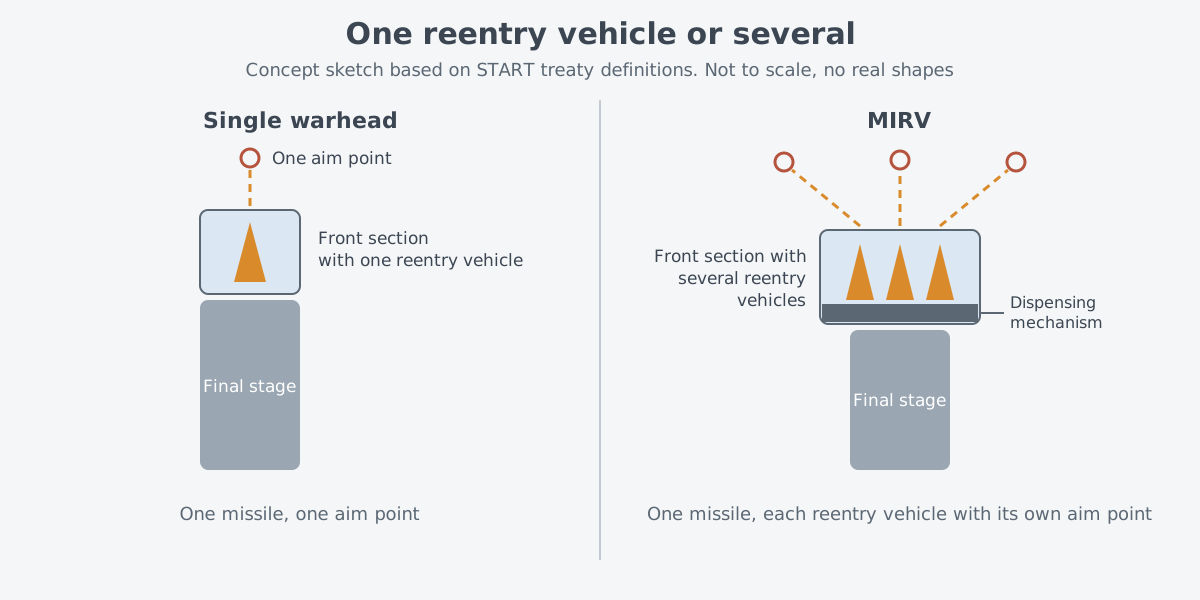
Picture a delivery van that leaves with several parcels and drops one at each house. The real thing is different. The treaty text sets names and counting rules, and the details of how the vehicles are released are outside the scope of this article.
First deployments in the 1970s
The United States began deploying the Minuteman III intercontinental ballistic missile (ICBM), with three warheads on each missile, in 1970. Deployment of the Poseidon submarine-launched ballistic missile (SLBM) followed in 1971. NASA's history of reentry describes the Minuteman III's Mk 12 system, fielded that same year: three separate warheads, each inside its own reentry vehicle.
A Congressional Research Service (CRS) report on U.S. strategic nuclear forces shows this period with unclassified estimates. U.S. delivery vehicles (ICBMs, SLBMs and heavy bombers) peaked at 2,268 in 1967 and then stayed between 1,875 and 2,200 through 1990. Warheads rose sharply through 1975, paused briefly, rose sharply again in the early 1980s, and peaked at around 13,600 in 1987.
The delivery vehicles barely changed, yet the warheads grew a great deal. The sharp rise in warheads in the early 1970s came from fielding ICBMs and SLBMs that carried MIRVs.
SALT I counted launchers
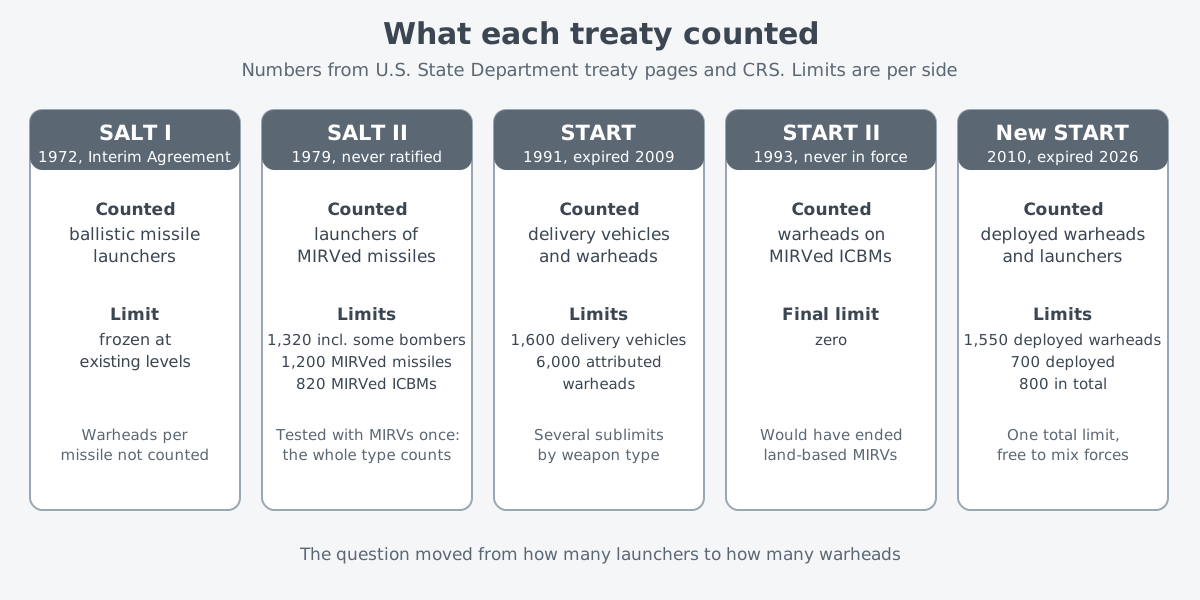
The Strategic Arms Limitation Talks (SALT) first produced two documents, both signed in Moscow on May 26, 1972. One was the Anti-Ballistic Missile (ABM) Treaty, the other an interim agreement on offensive arms. The interim agreement entered into force on October 3, 1972, and was meant to last five years. At its core, it froze each side's strategic ballistic missile launchers, both operational and under construction, at existing levels.
Yet SALT I left both sides free to enlarge their forces by putting MIRVs on their ICBMs and SLBMs. The number of launchers could stay the same while the warheads carried by the missiles in them went up. That is why MIRVs became the task for the next round.
SALT II: a ceiling on MIRVs
Talks on SALT II began in late 1972. At first they aimed to limit the number of MIRVs, and in the end to reduce it. At the Vladivostok summit in November 1974, President Ford and General Secretary Brezhnev agreed on a basic framework that included an equal limit of 1,320 on MIRV systems.
SALT II, signed in Vienna in June 1979, set three layers of limits.
| What was limited | Limit for each side |
|---|---|
| Launchers of MIRVed ballistic missiles plus heavy bombers with long-range cruise missiles | 1,320 |
| Launchers of MIRVed ballistic missiles | 1,200 |
| Launchers of MIRVed ICBMs | 820 |
The treaty also banned adding warheads to existing types of ICBMs. The counting rules mattered as much as the limits. Once a missile had been tested with MIRVs, every missile of that type counted as MIRVed, even if the type had also been tested with a single payload. Once a launcher had held or launched a MIRVed missile, every launcher of that type went into the 1,320 limit.
These rules let each side check the other without looking inside every missile. The State Department's treaty page says the two sides agreed to them to make the MIRV limits easier to verify.
SALT II never entered into force. On January 3, 1980, President Carter asked the Senate not to consider the treaty, and it was never ratified. Both countries still pledged to keep to its terms, and President Reagan agreed to abide by SALT II until it expired on December 31, 1985.
START and START II: counting warheads
The Strategic Arms Reduction Treaty (START), signed in Moscow on July 31, 1991, widened the count to warheads. It capped strategic nuclear delivery vehicles at 1,600 and warheads attributed to ICBMs, SLBMs and heavy bombers at 6,000. It also set several sublimits by weapon type and sought to cut in half the warheads on the Soviet Union's heavy ICBMs.
These limits left a mark on U.S. missiles too, since the Minuteman III was first deployed with three warheads each. In 2001, the United States took two warheads off each of 150 Minuteman missiles based at F.E. Warren Air Force Base so that it could stay under the START cap of 6,000. Under START rules it also removed and destroyed the bulkhead, the platform that holds the reentry vehicles, so those missiles could no longer carry three warheads.
START II, signed on January 3, 1993, went a step further. In its final stage of reductions, the treaty set to zero the warheads on "deployed ICBMs of types to which more than one warhead is attributed." In other words, land-based MIRVed missiles would be gone. CRS describes the aim as reducing the vulnerability of land-based weapons and easing the pressure to launch them early in a crisis.
START II never entered into force either, even though the U.S. Senate gave its consent early in 1996. When the Russian parliament finally voted in 2000, a new protocol had been attached that required its own approval, and the Senate never took up that revised treaty. As a result, the ban on land-based MIRVs was never carried out. START itself expired on December 5, 2009, after 15 years of implementation.
New START and the single-warhead Minuteman III
New START was signed on April 8, 2010, and entered into force on February 5, 2011. Each side could keep up to 800 ICBM launchers, SLBM launchers and heavy bombers, counting deployed and nondeployed ones together. Of those, at most 700 could be deployed, and deployed warheads were capped at 1,550. Deployed warheads are the warheads actually on deployed ICBMs and SLBMs, plus one for each deployed heavy bomber.
Unlike START, New START has a single limit on total warheads. With no sublimits by weapon type, each country decides its own mix of forces. CRS sees two things behind this change: less concern with Cold War models of stability, and a U.S. wish to stay flexible in shaping its own nuclear forces.
Under this treaty, the United States moved its ICBMs to a single warhead. The 2010 Nuclear Posture Review (NPR) said every Minuteman III would carry only one warhead. It added that this would strengthen the stability of the nuclear balance by reducing the incentive for either side to strike first. The Air Force finished the work on June 16, 2014.
This time, though, the front end of the missile was not changed and the bulkhead was not removed. That left the United States a way to restore warheads if the security environment changed. On February 3, 2021, the two countries used a clause in the treaty to keep it in force for five more years.
Different views of the same technology
The idea that single-warhead ICBMs are stabilizing comes from arithmetic. A CRS footnote explains it this way. Suppose it takes two attacking warheads to destroy one silo, and both sides have about the same number of warheads. Then attacking a single-warhead missile costs more warheads than it destroys, so the attack gains nothing.
Not every country reaches the same conclusion. CRS notes that concerns about crisis stability remain because Russia's modernization program includes a new large, MIRVed land-based missile. In the same passage, it adds that Russia treats its land-based MIRVed missiles as one answer to U.S. missile defenses, so it would probably reject a ban.
Some have proposed returning to ideas from earlier treaties, such as banning or limiting MIRVed missiles, to cut warheads further and also strengthen stability.
On February 5, 2026, a UN spokesperson read a statement from the Secretary-General calling the end of New START a grave moment for world peace and security. It said that for the first time in over 50 years, nothing legally binding capped the two countries' strategic nuclear forces. The Secretary-General called on both to resume talks quickly and settle on a follow-on framework with limits that can be verified.
Where this meets lasers: reading weapons through treaty text
The history of MIRVs is less a story of hardware than a story of counting. Whether a treaty counted launchers, MIRVed launchers or warheads changed how the same weapon showed up inside it. Rules such as "tested with MIRVs once, counted as MIRVed for good" also show how treaties lean on what can actually be checked.
Laser weapons have their own example of a line drawn in treaty language. Eye safety and international rules: the protocol on blinding laser weapons covers how an international protocol defines and bans laser weapons specifically designed to blind people permanently. Read side by side, the two articles show that what a treaty counts and how it defines things set the reach of the rule.
What to read next
- ICBMs: what they share with space launch vehicles: how the missiles that carry MIRVs fly in the first place.
- Ballistic missiles: why they climb high and come down: where the term reentry vehicle first comes up on this site.
- Reentry and Heat Shields: The Heat of Coming Back Through the Air: the heat a reentry vehicle meets on the way down.
- Eye safety and international rules: the protocol on blinding laser weapons: international rules on laser weapons.