The harder you pump a laser crystal, the hotter it gets. A hot crystal bends the light passing through it a little, and the beam blurs. Push for more power, and the beam gets worse.
In the fall of 1991, on a flight from the United States to Japan, a researcher came up with a different way around this problem. Make the crystal into a very thin disk, and bond one whole face of it to a heat sink.
A laser built this way is called a thin-disk laser. This article follows how the disk shape removes heat differently and how the weakness of being thin was made up for. It then traces how the design traveled to factories, laboratories and a defense test range.
What happens when a rod laser heats up
In a solid-state laser, the gain medium that amplifies light is a solid such as a crystal or glass. In conventional high-power solid-state lasers, the gain medium is shaped as a rod or a slab. Feeding it light to excite its atoms is called pumping.
Raising the power soon exposed a problem. In early lasers, raising the average power distorted the output beam and sharply reduced its spatial coherence. Heat was disturbing the path of the light.
The classic way heat spoils a beam is thermal lensing. When warmer and cooler zones form across the beam, the crystal acts like a weak lens that focuses or spreads the light. Beam quality drops as a result.
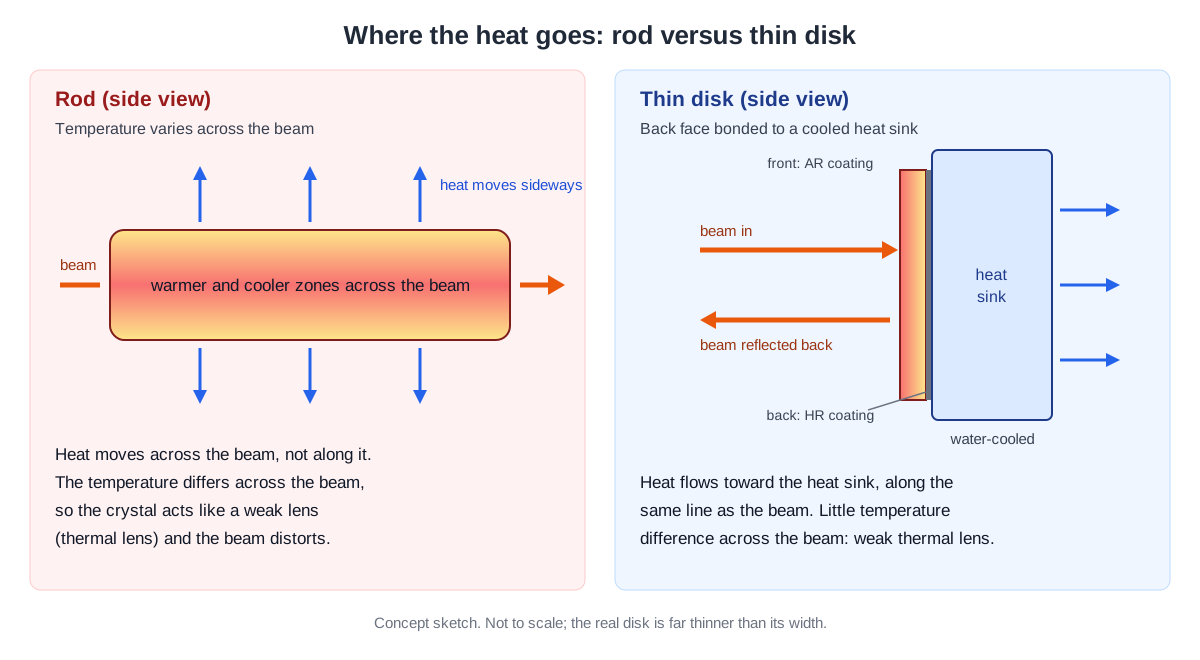
Laser builders chose to change the shape of the medium. A larger surface relative to the volume lets heat out more easily. The designs that worked best were slab lasers, thin-disk lasers and fiber lasers. But in systems with an average power of several hundred watts, the heat also has to leave without distorting the beam.
A thin disk on a heat sink
The thin-disk laser was first presented in a 1994 paper by Giesen and colleagues, and it solves the thermal problems of conventional high-power rod and slab lasers. The layout is simple. The gain medium is made into a very thin disk, and its reflective face is mounted directly on a water-cooled heat sink.
The two faces of the disk do different jobs. One face gets a highly reflective coating, and the other gets an anti-reflection coating (AR coating) that lets both the pump light and the laser light pass in. Because the reflective face sits against the heat sink, light enters the disk and bounces back out from its rear face. The disk works in reflection, a bit like a mirror.
How thin is it? Keller's textbook on ultrafast lasers puts the disk thickness in the range of about 100 µm and the pump and laser beam diameters in the range of about 1 cm. The inventor, Adolf Giesen, describes the thickness in an interview as a few hundred micrometers. Either way, the disk is far thinner than the beam is wide.
In this shape, the disk cools very well, and the heat flows mainly in one direction, toward the heat sink. That is the same line the laser beam travels along. Because the temperature gradient across the beam is weak, the thermal lens is much smaller than in a rod or slab.
The 1994 paper's abstract holds the same picture. A very thin crystal disk with one face on a heat sink can take very high pump power densities without a large temperature rise inside the crystal. With a pump beam of even intensity across its profile, the heat flows almost uniformly in one direction, perpendicular to the disk face.
In the interview, Giesen says that in real operation a disk laser shows about 100 times less thermal deformation than a traditional laser. That is the inventor's own claim, so it is worth asking what conditions the comparison assumes.
The catch of being thin: many pump passes
Being thin comes at a price. When pump light crosses the disk once, little of it is absorbed.
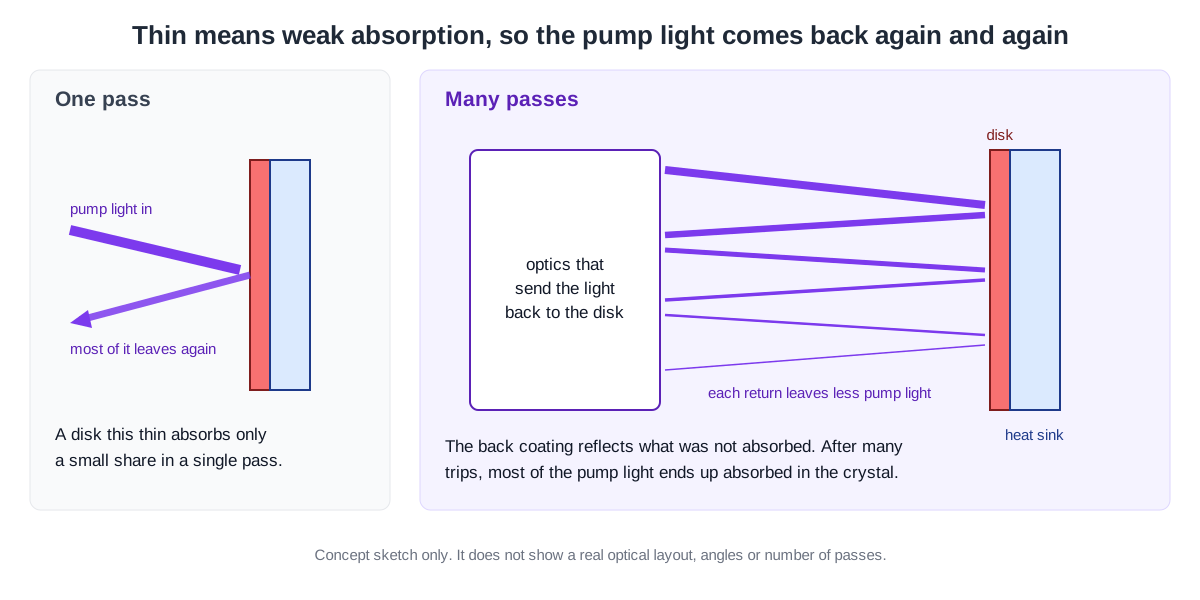
The fix is to send the same light through the disk many times. The high-reflection coating on the rear face returns light that was not absorbed, and optics outside the disk send it back in again. Typically, 16–32 passes lead to more than 90% of the pump light being absorbed in the crystal.
It is a bit like dipping a mop into a puddle once versus soaking it again and again. In practice, a mirror has to refocus the pump light into the crystal every time, and less light is left on each return. The optics that make this path are fairly involved. The idea sounds simple, but the technology is demanding.
Many passes bring a bonus. According to Giesen, absorbing the pump light this way means the pump source does not have to be especially bright for the disk laser to deliver good beam quality. The laser in the first 1994 paper was also pumped with light from a pump diode.
The crystal used to prove the design in 1994 was Yb:YAG. The design is especially suited to quasi-three-level systems, which need high pump power densities.
From an idea on a plane to factory lasers
The idea grew out of a conference. Giesen recalls that he was coming back from a meeting on solid-state lasers where one session covered Yb:YAG. The speaker said this material could power high-power laser sources if only it could be cooled well enough, a problem that looked insurmountable at the time.
The answer that came to him on the plane was a disk. A disk thin enough would be especially easy to cool over its whole area. Over the following three months, he and his team turned that thought into a concept.
According to his biography from Optica, Giesen earned his doctorate at the University of Bonn in Germany in 1982. His next research topic was RF-excited CO2 lasers, at the Stuttgart site of the German Aerospace Center (DLR). He then moved to the University of Stuttgart and began working on thin-disk lasers in 1991. He led the DLR Institute of Technical Physics from 2007 to 2016, and in 2017 he received the Charles Hard Townes Medal.
The 1994 paper proved the design by running a diode-pumped Yb:YAG disk laser at 4.4 W of output with a maximum slope efficiency of 68%. The power was small, but the paper looked far ahead. It said compact diode-pumped solid-state lasers in the kilowatt range seemed possible by enlarging the pump beam diameter or using several disks.
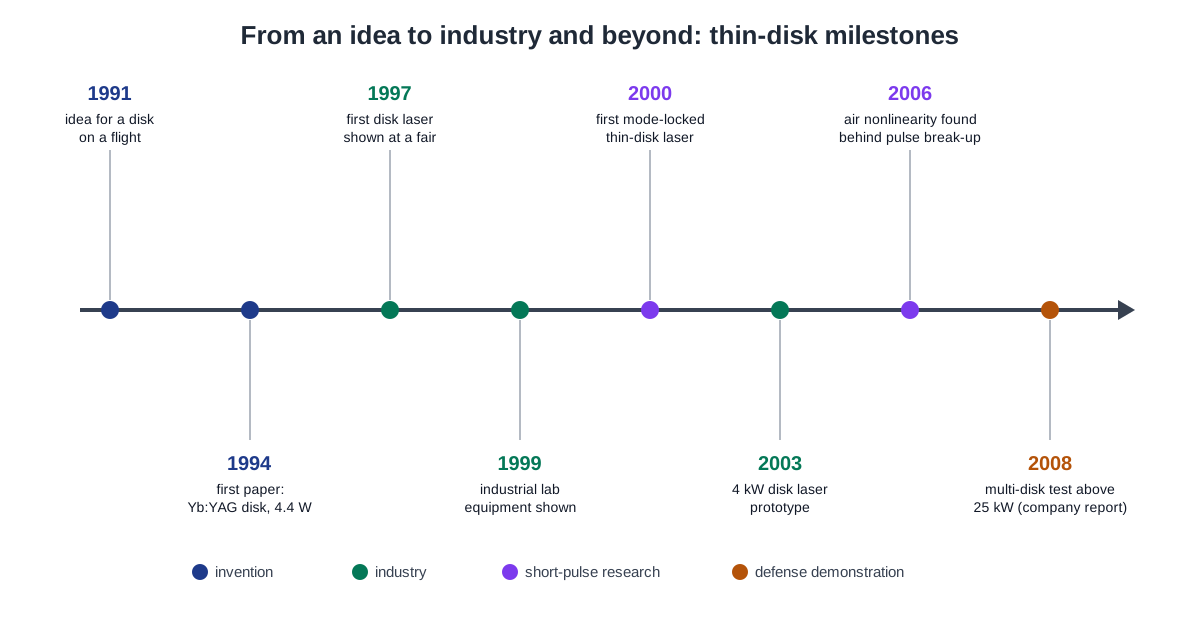
Industry got moving in the late 1990s. Giesen recalls that Jenoptik was first to show a disk laser, at a Munich laser show in 1997. TRUMPF's company history says it showed its first lab units at the LASER trade fair in 1999 and a 4 kW disk laser prototype in 2003.
TRUMPF says the prototype's high beam quality opened new uses such as scanner welding. In the TRUMPF interview, Giesen says 6,000 W disk lasers are now close to standard in industry.
How much electricity turns into light is worth a look too. TWI, a UK welding institute, gives typical wall-plug efficiency values for industrial lasers: 25–30% for Yb:YAG thin-disk lasers, also 25–30% for ytterbium fiber lasers, and 3–5% for lamp-pumped Nd:YAG lasers. How disk lasers and fiber lasers work side by side in factories is covered in Where industrial lasers are used: cutting, welding, marking, cleaning.
Short pulses and the disk
Thin disks are not limited to continuous-wave (CW) lasers that stay on. They also took an important place in research on very short pulses. In 2000, the first thin-disk laser mode-locked with a semiconductor saturable absorber mirror (SESAM) was demonstrated.
Unlike the Ti:sapphire laser, this laser was pumped directly by diodes and turned electricity into light far more efficiently. Since then, thin-disk oscillators have raised the pulse energy of ultrafast lasers from typically about 1 nJ to 80 µJ, close to five orders of magnitude. Average power rose from a typical 100 mW to more than 400 W.
Heat was the key here as well. Yb-doped laser materials can be doped more heavily so that a thin disk removes heat more efficiently. That raised the average power by at least three orders of magnitude over Ti:sapphire oscillators.
There is a trade-off. The Yb gain materials that suit high average power have so far had a much narrower gain bandwidth than Ti:sapphire. As a result, as of 2020 they had not delivered pulse energies well above 1 µJ with pulses shorter than 100 fs.
How such pulses are made is covered in Q-switching and mode locking: two ways to make short pulses. The difference between oscillators and amplifiers is covered in Oscillators and amplifiers: making light, then growing it.
The disk has limits too
The disk eased the heat problem a great deal, but it did not solve everything. The first issue is attaching the disk to the heat sink. Giesen says joining the disk to the heat sink was a key difficulty then and remains one now.
The second is the air around the disk. The pulse energy of mode-locked thin-disk oscillators at first seemed stuck below 2 µJ, and above that level the pulses became unstable or broke up into several pulses. In 2006, the Kerr nonlinearity of the air inside the laser cavity was identified as the cause. The highest powers so far have come from running in a near-vacuum, which makes the experiments more complex.
Air also makes a thermal lens. In high-power operation, the pumped area of the disk can heat up to around 100 °C, and that heat warms the air near the disk. The warm air acts as a gas lens and makes up a significant share of the disk's overall thermal lens, but it disappears when the laser runs in a vacuum. Even after the disk shrank the thermal lens so much, the remaining share became worth chasing.
The third is amplified spontaneous emission (ASE). As the name says, it is light emitted on its own that gets amplified inside the medium. A 2008 conference abstract in the DLR repository cites several numerical models. By those models, the CW output demonstrated by then sat far below the scaling limits set by ASE.
Pulses were a different story. Pulsed lasers built on thin-disk amplifiers reached similarly high average power, yet their pulse energy stayed moderate, around 100 mJ. The numerical models concluded that, with the typical high-power CW disk design, ASE limits the pulse energy to a few joules.
Where this meets laser weapons
Thin disks also appeared in defense testing. In a news release dated June 3, 2008, Boeing reported that its new thin-disk laser system had been fired again and again in recent tests. Each firing at its facility in West Hills, California, reached more than 25 kW for several seconds. The system combined several thin-disk lasers into one.
The company claimed it had proven that the same architecture and technology could scale to a 100 kW-class system. It also said it used commercial lasers from the automotive industry. It is an example of technology grown in factories moving into high-energy laser (HEL) testing.
This announcement is the company's own account and should be kept apart from what happened afterward or which lasers today's laser weapons use. The broader shift of laser weapons from chemical to electric lasers is covered in A history of laser weapons: from chemical to electric lasers.
The idea behind the thin disk carries over to other designs. Reshaping the medium so heat leaves easily puts it in the same family as the fiber laser, and more broadly it is one answer to the problem of thermal management.
What to read next
- Cooling and thermal management: where the heat that did not become light goes: a wider look at why lasers make heat and the many ways to deal with it.
- Why fiber lasers became so widely used: from the lab to the factory: how the fiber, another shape that sheds heat well, spread.
- Slab Lasers: Solid-State Lasers Built on a Flat Crystal: covers the flat crystal that, along with the rod and the disk, came out of the effort to handle heat.