Leave a light bulb on for a while and the glass gets hot. A laser crystal also warms up as it makes light. That heat is the wall every solid-state laser hits when its power goes up. How evenly and how fast the heat leaves decides both the shape of the beam and how much power the laser can deliver.
The slab laser is one of the older answers to that problem. It uses a flat, plate-shaped crystal instead of a round rod and sends the beam back and forth through the plate in a zigzag. This article looks at why a plate handles heat better, what the zigzag path fixes, and how the design showed up in remote sensing, short-pulse research and laser weapon research.
When a rod crystal heats up
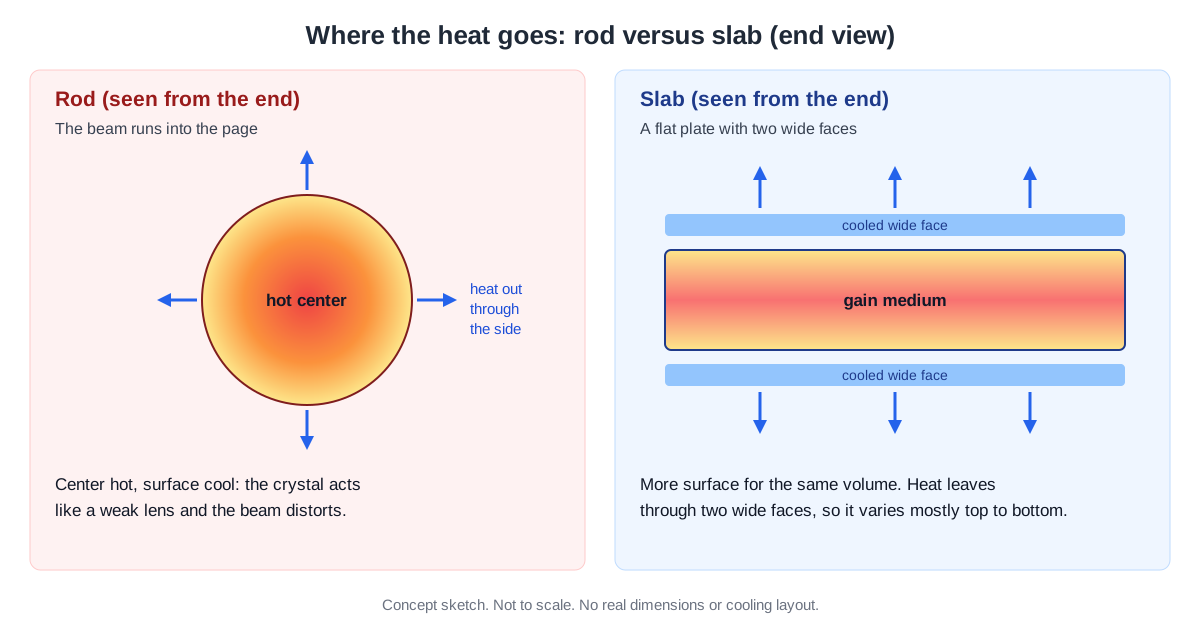
For a long time the usual shape for the gain medium of a solid-state laser was a round rod. When a rod is cooled through its side, its surface stays cool while its center runs hot.
Light travels at a slightly different speed where the temperature differs. A crystal with a hot center therefore acts like a weak lens, focusing or spreading the light. This is called thermal lensing.
The temperature difference also leaves stress inside the crystal. In a stressed crystal, light sees a different refraction depending on its polarization. That effect is stress birefringence.
The trouble grew as power went up. A 2020 review paper sums up that in early lasers, raising the average power distorted the output beam and sharply reduced its spatial coherence. One response was to change the shape of the medium so it had more surface for its volume. The most successful shapes to come out of this were slabs, thin disks and fibers.
Turning the rod into a slab
For the same volume, a flat plate has more surface than a round rod. Cool the two wide faces of the plate and the heat gets a broad exit. The temperature then changes mainly through the thickness of the plate, from top to bottom. The temperature pattern that spread in every direction in a rod is sorted into one direction.
A thick baked sweet potato takes a long time to cool to the core, while thin slices cool quickly. A plate handles heat better for the same reason. A real laser is different in one way: cooling fast is not the whole story, because the beam still meets different temperatures at different places.
Laser material shapes have been tuned for a high surface-to-volume ratio so they shed heat efficiently. That work led to record results above 1 kW average power in fiber, thin-disk and slab shapes. In systems of several hundred watts, the key is to remove heat without distorting the beam.
The zigzag path: crossing hot and cool alike
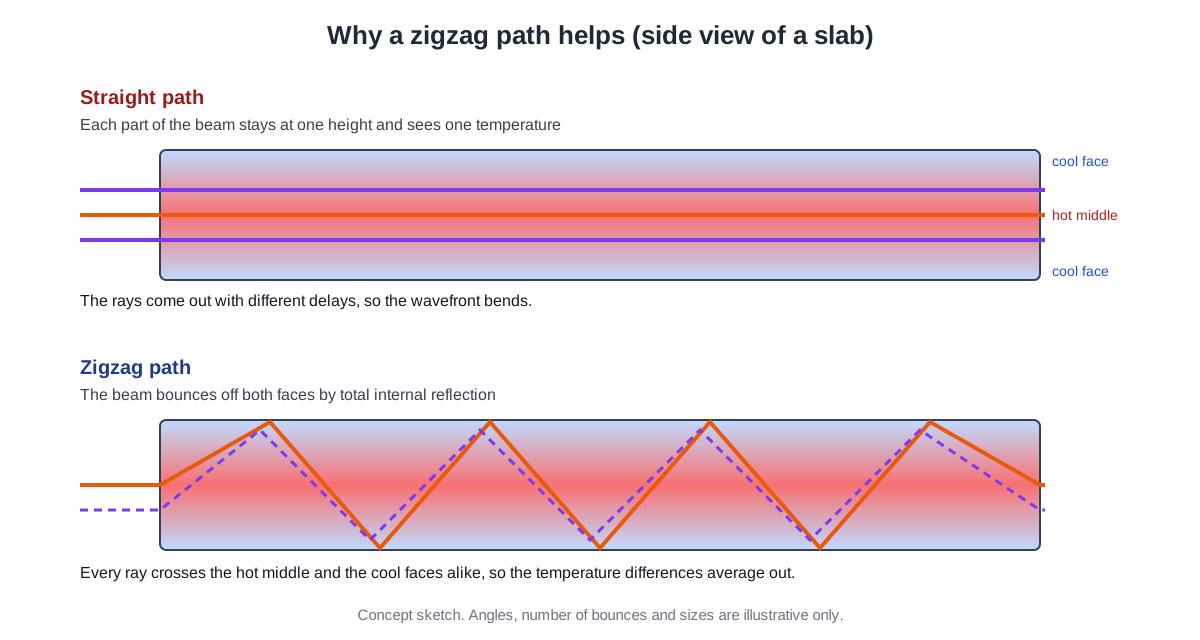
A slab is still hotter in the middle of its thickness. If the beam runs straight along the length of the slab, light at mid-height sees only the hot zone and light near the faces sees only the cooler zones. Each part of the beam is delayed by a different amount, so the wavefront bends.
The answer was to send the beam in at an angle. When the beam bounces between the two wide faces by total internal reflection, every ray passes near the cool faces and through the hot middle in turn. The temperatures each ray meets average out and become alike.
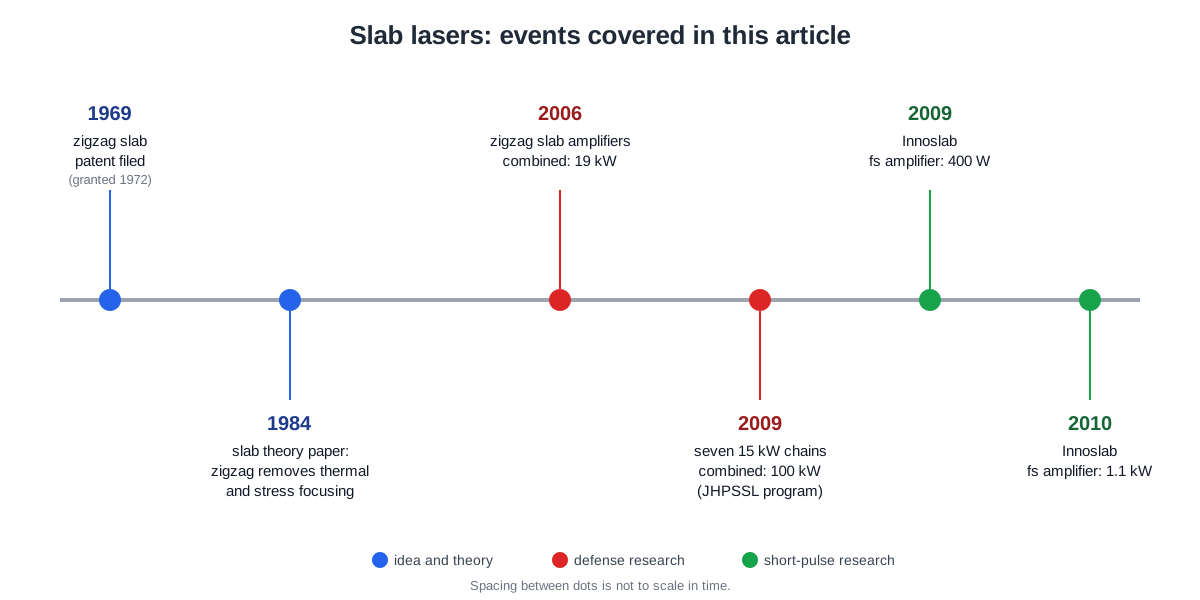
This idea appears in a 1969 patent from researchers at General Electric, granted in 1972 (US 3,633,126). The patent text explains that each ray reflects many times off the cool outer faces and crosses the relatively hot center, which averages the optical environment. This cuts both the phase distortion of the wavefront and the impact of stress birefringence. With less distortion, the device is also well suited to high-repetition-rate Q-switching.
In 1984, the IEEE Journal of Quantum Electronics published a paper that worked out in detail how heat, stress and beam propagation behave in a slab laser. Its abstract says the slab shape brings large gains over conventional rods. It also says the zigzag path removes the focusing caused by heat and stress and lowers the remaining birefringence. Note the different strength of the words: the focusing is "eliminated," while birefringence is only "reduced."
From the lab to remote sensing and big facilities
Slabs are not only a weapons story. NASA Langley Research Center and the laser company Fibertek tested a 1.6 µm light source for a differential absorption lidar that measures methane in the air. The laser that pumped that source was a single-frequency Nd:YAG slab oscillator built by Fibertek. This laser follows in the line of NASA's ALHAT and HSRL transmitters.
Very large science facilities also use plate-shaped media. High-energy lasers such as the National Ignition Facility (NIF) at Lawrence Livermore National Laboratory (LLNL) have used the white light of giant flashlamps for pumping large slabs of laser glass. LLNL explains that its new HAPLS laser needed a high repetition rate. To get there, the team had to find pump technology that puts less heat into the laser than flashlamps do and carries it away faster.
Slabs appear in short-pulse work too. A 2009 paper reported a 400 W average-power femtosecond amplifier built with an Yb:YAG slab amplifier called Innoslab. In 2010, researchers at the Fraunhofer Institute for Laser Technology (ILT) and RWTH Aachen chained two amplifier stages.
From one beam they got 1.1 kW average power, 80 MW peak power and 615 fs pulses. The system ran at room temperature without chirped-pulse amplification.
Slabs in laser weapon research
In 2006, a team at Northrop Grumman Space Technology reported in Optics Letters on combining several multikilowatt Nd:YAG zigzag slab amplifiers. One shared master oscillator feeds the amplifiers, and adaptive optics correct the wavefront of each amplified beamlet. The beamlets sit side by side, and once their phases are locked they form one beam of 19 kW.
A setup that boosts light from a small oscillator in larger amplifiers is a master oscillator power amplifier (MOPA). Merging the light of several chains into one beam is called beam combining. The phase-locked kind is covered in "Coherent beam combining: the principle, from published reviews."
The United States ran the Joint High Power Solid State Laser (JHPSSL) program. It was a joint effort of the Army, the Air Force and the High Energy Laser Joint Technology Office (HEL-JTO). In a 2009 conference abstract, researchers from the same company named the program's key goal as showing a 100 kW solid-state laser with excellent beam quality.
They described an approach that coherently combines modular 15 kW lasers. A CLEO talk that same year carried the title "100 kW Coherently Combined Slab MOPAs." It described locking the phases of seven 15 kW chains to make a single beam.
In March 2009, the U.S. Army announced that a device developed by Northrop Grumman had reached what the Army called "weapon level (100kW+)" performance in the laboratory. Textron was building a second laboratory device in the same effort.
A 2014 Army article looks back on the program. Its goal was to demonstrate coherence and power, and the result was a laboratory device not fit for the harsh conditions weapon systems face. The follow-on RELI program took up that problem, and the JHPSSL device was refurbished and moved to White Sands Missile Range. The wider story of laser weapons in those years is in "A history of laser weapons: from chemical to electric lasers."
Slab, disk and fiber
The slab eased the heat problem but did not end it. The thin-disk laser, introduced in 1994, solves the heat problems of conventional high-power rod and slab lasers. In a very thin disk, heat flows along the same line as the beam. The temperature difference across the beam is weak, and thermal lensing drops far below that of a rod or slab.
Fiber opened another path. The 2020 review notes that among the three shapes, fiber holds the record for the most average power in a beam at the diffraction limit. That record is 6 kW from a single ytterbium-doped silica fiber. Fiber set this record even though glass conducts heat roughly 10 times worse than the crystals used in slabs and thin disks.
Combining many beams to go higher still raises its own problem. A 2016 paper in Applied Optics holds that fiber and slab lasers at high power have large linewidths. As a result, their phase and intensity jump randomly in less than a nanosecond. Coherently combining such light would need equipment that controls phase precisely at rates above about 10 GHz, and the authors judged that such technology does not yet exist.
Rod, slab, disk and fiber are different answers to the same question: where the heat goes, and how evenly. The slab answers with wide faces and a zigzag path. That answer runs from oscillators in sensing instruments to kilowatt femtosecond amplifiers and the 100 kW demonstration.
What to read next
- "Cooling and thermal management: where the heat that did not become light goes": the full path of how heat forms and leaves in laser equipment.
- "Thin-Disk Lasers: Shedding Heat Through a Single Thin Crystal": the branch that solved the rod and slab heat problem with a disk.
- "What is a fiber laser? Growing light inside a thin glass fiber": the fiber side, which holds today's high-power records.
- "Solid-State Laser Trends at SPIE, 2022–2027": how thin disks and slabs appear at recent conferences.