In May 1618, three men were thrown out of a window in Prague Castle. Protestant nobles in Bohemia threw out two of the emperor's governors and a secretary. All three survived. Yet the fight that began there lasted thirty years and in the end drew in most of the kingdoms of Europe.
The conflict is often called a religious war between Catholics and Protestants. The label is not wrong, but historians each add their own caveats. This article follows how one revolt grew into a great war, why the way armies were fed left so many civilians starving, and what the peace of 1648 changed. It draws on German, Austrian and Swedish public institutions and on the treaty text.
A revolt that began at a window in Prague Castle
The stage was the Holy Roman Empire. At the time it was the largest and most populous state in Europe. It covered today's Germany and Austria and reached into Czechia, northern Italy, southern Denmark, eastern France and western Poland.
Seven electors chose the emperor. Even once elected, he shared power with about 60 princes, 140 counts and abbots, and some 60 imperial cities.
Two camps stood inside this empire. On one side was the Catholic Habsburg dynasty; on the other, a union of Protestant princes. In 1618 the Protestant estates of Bohemia rose against Habsburg rule, and the throwing from the window was how it started.
The defenestration itself shed no blood. Both governors and the secretary survived, and only one of them was badly hurt. So the political scientist Herfried Münkler looks less at the event than at the choice that followed.
Ferdinand, the king of Bohemia, chose to crush the estates by force instead of negotiating. Yet he had no standing army and no money for a war. In Münkler's view, the war would not have happened for lack of funds if Philip III in Madrid had not helped him with money and troops.
In 1619 the Bohemian estates deposed Ferdinand and elected Frederick V, the Elector Palatine, as their king. The next year, at White Mountain near Prague, the imperial and Catholic army defeated the army of the estates, and Frederick V fled. Twenty-seven rebels were executed, the Protestant ruling class had to leave, and Bohemia was made Catholic again.
Thirty years in four phases
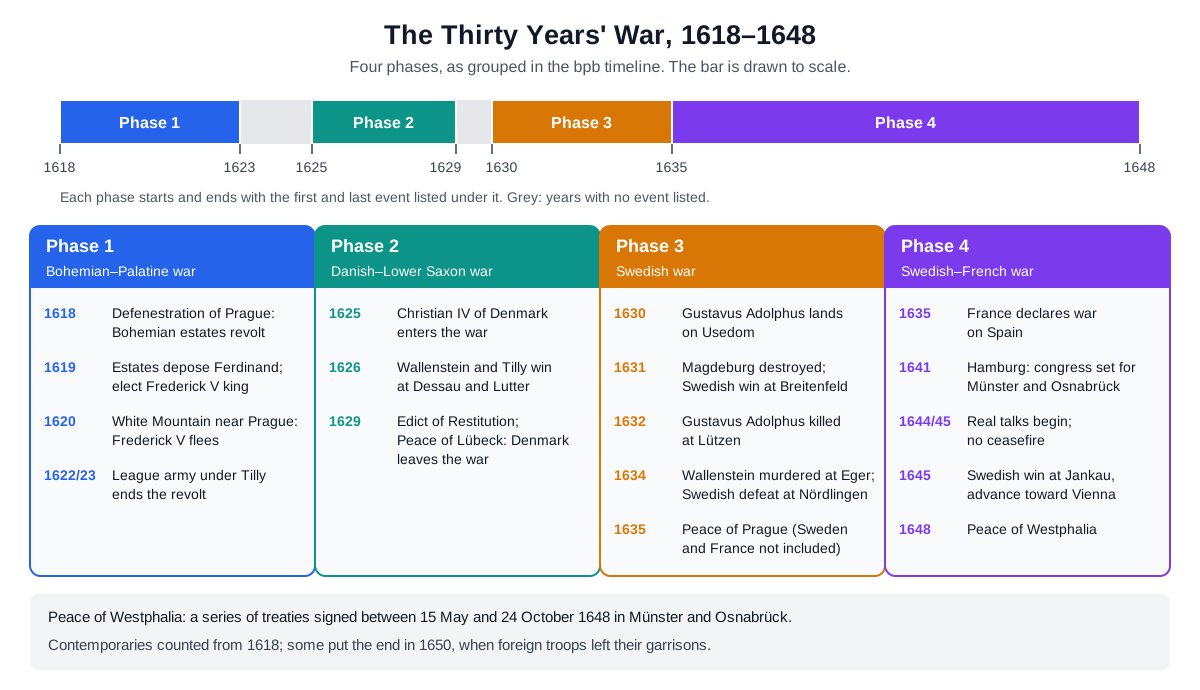
The name "Thirty Years' War" came later. People at the time counted the years from the defenestration or from the comet that appeared in 1618. Some ended the count in 1648; others in 1650, when foreign soldiers finally left their garrisons. Counted that way it was a 32-year war, but that number soon gave way to the round one.
Splitting the war into four phases is also an old habit. In 1782 a short textbook by Johann Christoph Krause of Halle divided it into the Bohemian–Palatine war, the Lower Saxon–Danish war, the Swedish war and the Swedish–French war. Today the timeline of Germany's Federal Agency for Civic Education (Bundeszentrale für politische Bildung, bpb) uses the same four groups.
The emperor's side won the first phase. In 1622 and 1623, the Catholic League army under Johann T'Serclaes von Tilly took Heidelberg and the Palatinate. It then beat the Protestant princes in the Empire and ended the Palatine–Bohemian revolt.
The second phase was Denmark's turn. In 1625 King Christian IV of Denmark joined the war on the Protestant side. The next year he lost at Dessau and Lutter to the imperial army of Albrecht von Wallenstein and to Tilly's army.
In 1629 the emperor issued the Edict of Restitution, ordering the return of former Catholic Church property secularized after 1552. That same year the Peace of Lübeck took Denmark out of the war.
Sweden opened the third phase. In 1630 King Gustav II Adolf of Sweden (Gustavus Adolphus) landed on the island of Usedom to end imperial influence around the Baltic. In 1631 Tilly's troops destroyed and plundered the Elbe city of Magdeburg, while Gustavus Adolphus beat Tilly at Breitenfeld and pushed on to the Rhine. Münkler argues that without regular French subsidies, the Swedish king could hardly have fought for long in Germany.
In 1632 Gustavus Adolphus was killed at Lützen fighting Wallenstein's army. In Sweden his only child, Kristina, became queen at the age of six, and a regency under the chancellor Axel Oxenstierna ruled until 1644. In 1634 Wallenstein was dismissed and then murdered at Eger, and the Swedes suffered a decisive defeat at Nördlingen against imperial, Catholic League and Spanish troops. In 1635 the emperor and the Elector of Saxony made the Peace of Prague, but Sweden and France were not part of it.
That is where the fourth phase begins. In 1635 France declared war on Spain. In 1641 at Hamburg, the emperor, Sweden and France agreed to hold a peace congress in Münster and Osnabrück.
Real negotiations only began in 1644–1645, and there was no ceasefire in the meantime. In 1645 the Swedes beat the imperial army at Jankau and advanced as far as Vienna.
Mercenaries, war taxes and cavalry armor: the armies of the time
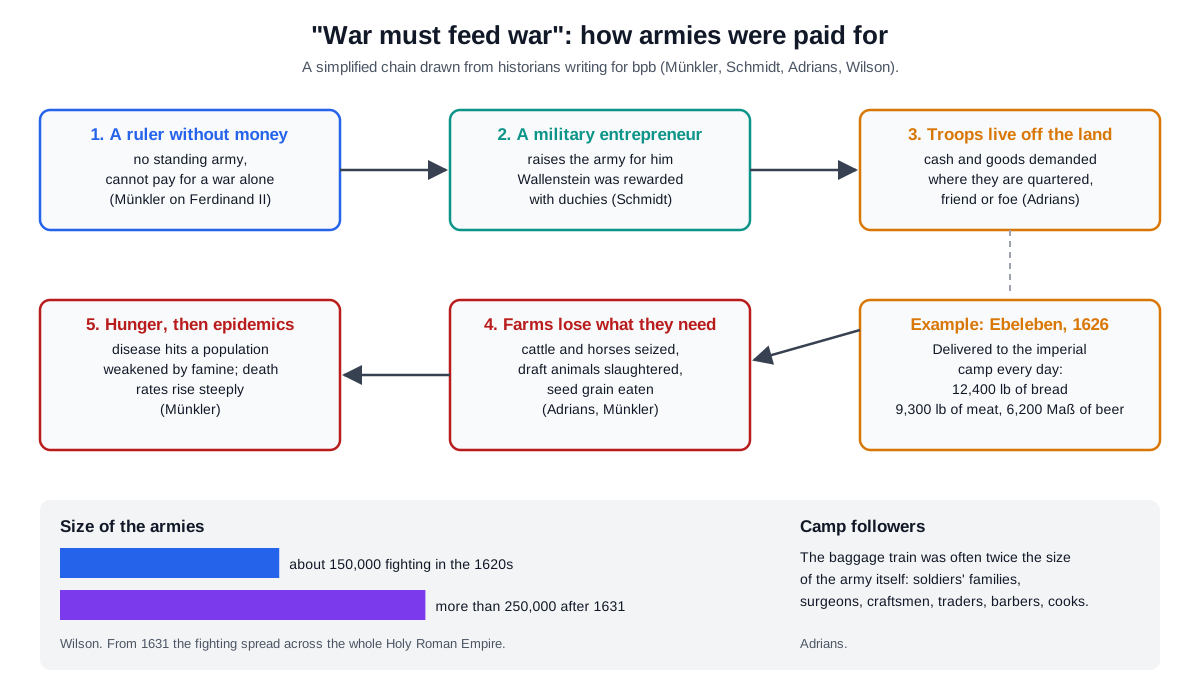
The armies of this war were built differently from today's national forces. The fighting was not done by warlords but by rulers who hired military entrepreneurs (Kriegsunternehmer). A military entrepreneur was someone who supplied an army to a ruler who had none. Wallenstein is the best-known example; the emperor granted him the duchies of Friedland, Sagan and Mecklenburg.
The problem was paying to feed those armies. Wallenstein turned the principle that "war must feed war" into his business model. Where his troops were quartered, he demanded large cash payments on top of the usual goods in kind. He did not care whether those lands were enemy or friendly.
This burden was called the contribution (Kontribution), and the longer the war lasted, the heavier it weighed on places where troops were often quartered.
How heavy was it? In 1626, in the small Thuringian town of Ebeleben, Volkmar Happe, a court councillor serving the local count, kept a record. It says the town had to deliver 12,400 pounds of bread, 9,300 pounds of meat and 6,200 Maß of beer to the imperial camp every day. In many places cattle and horses were seized, fields could not be plowed, and hunger grew worse.
A long train of camp followers (Tross) went behind each army. It was often twice the size of the army itself, with soldiers' families, surgeons who cared for the wounded, craftsmen and traders, barbers and cooks.
The armies grew, too. From 1631 the fighting spread across the whole Empire, and the number of people fighting rose from about 150,000 in the 1620s to more than 250,000.
The Royal Armoury in Stockholm (Livrustkammaren) gives a glimpse of the equipment. One piece is a cuirassier's half-armor, likely German work from the early 1600s. It combined a helmet with a visor, a bulletproof breastplate and backplate, and arm and thigh guards, with tall leather boots. This heavy horseman fought with a sword and with pistols carried in holsters on the saddle.
Even the king was not safe from bullets. At Lützen on 6 November 1632, a musket ball crushed Gustavus Adolphus's elbow, and he died on the field after taking several more wounds.
The fine linen shirt of his that the Royal Armoury has displayed was one of three layered against the cold. Souvenir collectors later tore large pieces off it. His horse Streiff, hurt in the same battle, died later. The relics of Lützen were kept apart in the Royal Dressing Room.
Sweden was a major player in this war and became a military power through it. The royal household kept the relics of Lützen to show him as a Protestant hero king, fallen in battle for his faith, his kingdom and his people.
What civilians paid, and numbers that differ by source
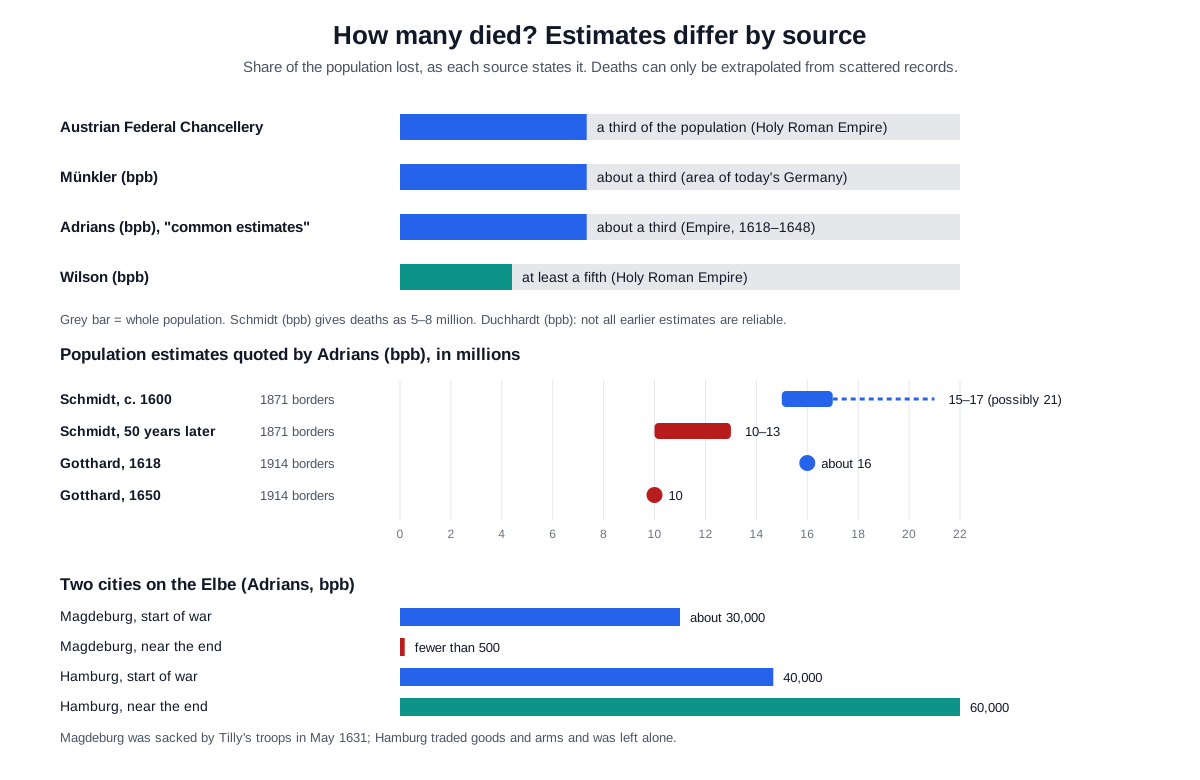
What is left in the villages when war taxes and looting go on for years? Draft animals were slaughtered and the seed for spring sowing was eaten.
Then epidemics struck people already weakened by hunger. Death rates rose steeply, and in many places whole districts were emptied.
So how many people died? There is no single answer. The total can only be extrapolated from scattered individual records, and each source counts a different area.
- Austrian Federal Chancellery: a third of the population of the Holy Roman Empire lost their lives.
- Münkler: about a third of the population in the area of today's Germany died.
- The historian Georg Schmidt: between 5 and 8 million people died, and more than half of all houses and buildings were destroyed.
- Peter H. Wilson: the Empire's population shrank by at least a fifth and only returned to its prewar level in the early 18th century.
Population estimates also come as ranges. Frauke Adrians sums them up for the bpb.
Schmidt's estimate for the German borders of 1871 runs from 15–17 million people around 1600, possibly 21 million, to 10–13 million fifty years later. For the borders of 1914, the historian Axel Gotthard estimates about 16 million in 1618 and 10 million in 1650. Heinz Duchhardt adds that not all earlier estimates are reliable.
The damage was uneven. The worst of it fell on a belt running from Pomerania and Mecklenburg through Brandenburg, Anhalt, Thuringia and the Palatinate down to Baden. By contrast, some places in north-west Germany were barely touched, Münster among them.
Two cities on the Elbe show the gap. At the start of the war, Magdeburg had about 30,000 inhabitants and Hamburg 40,000.
In May 1631 Magdeburg burned, and thousands of its people fell victim to Tilly's troops. Near the end of the war, fewer than 500 people lived there. Hamburg traded goods and weapons, commanders on both sides left it alone, and its population grew to 60,000.
The Thirty Years' War is one of the first wars in which personal records document people's suffering in detail. Only about 10–15% of the population could read and write, yet diaries, chronicles and letters from some 250 witnesses are known today. In the summer of 1646 Hans Heberle, a shoemaker in Weidenstetten, a village 15 km north of Ulm, wrote: "This is the 23rd flight."
Even such records cannot be read at face value. Schmidt points out that the writers did not witness everything they wrote down; some copied from pamphlets, and some exaggerated to be heard. He adds that saying so does not play down the suffering people went through.
Was it a religious war? Differing views
People at the time read the war as God's judgment. In late autumn 1618 a huge comet stood in the evening sky, and it was taken as a sign that divine wrath was near. So was this a war fought over faith? Historians answer differently.
Wilson notes that the most widespread interpretation sees it as the last and largest war of an age of religious wars that began with the Reformation in 1517. He also points out that the 17th century had no idea of splitting life into "religious" and "secular." To see where religion stood in the war, he says, 21st-century ideas about faith must first be set aside.
Münkler argues that calling it simply a religious war is too simple. In his account, it was a religious war too. But it was also a war over the sharing of power within states, and a war over what Europe's political order should be.
He gives examples. The Elector of Saxony, traditionally the leader of the Protestant side, backed the emperor from 1618 to 1631. France, guided by the Catholic cardinal Richelieu, opposed the Catholic imperial house.
Schmidt goes further. He holds that, seen from today, it was not a war of faith and was fought mainly over power-political interests. The Royal Armoury's exhibition text stands between these views. It notes the usual picture of a Catholic–Protestant religious war, then adds that it was also a contest for power in Europe in which sides kept changing.
The interpretations have their own history. According to the bpb editorial, 19th-century German historians recast the war as a national trauma, and that reading also served to justify Prussia's great-power ambitions.
The peace of Münster and Osnabrück
How did the war end? Wilson argues that it did not end because both sides were exhausted. The main powers concluded that further fighting could cost them the gains they had already made. The emperor agreed to talks in two Westphalian cities, Münster and Osnabrück, which were declared neutral for this purpose in 1643.
The talks dragged on for five years. The Peace of Westphalia is the name for a series of treaties made in the two cities between 15 May and 24 October 1648. By then, a fight that began as a revolt of Bohemian nobles had become a struggle between the Habsburgs and the French Bourbons for dominance on the continent.
The English version of the emperor's treaty with the French king declares in its first article "a Christian and Universal Peace." The second article sets out a perpetual oblivion and amnesty for everything done since the troubles began. Aloysius Contarini, the ambassador of Venice, mediated.
France gained sovereignty over the bishoprics of Metz, Toul and Verdun. The emperor gave up his rights over Breisach and the landgraviate of Upper and Lower Alsace.
The same treaty gives its dates twice. The day the congress was agreed at Hamburg appears as 25 December 1641 "N.S." or the 15th "O.S." The day set for meeting in the two cities appears as 11 July 1643 N.S. or the 1st O.S. The two styles are exactly ten days apart.
The same day was written in two reckonings, so when reading dates from this period, it pays to check which style is used.
The effects reached beyond the Empire. The Peace of Münster, signed earlier in January 1648, gave the Dutch Republic diplomatic recognition. The Swiss cantons were formally released from all their duties toward the imperial crown. Duchhardt names France and Sweden, the two guarantors of the peace, as clear winners.
Wilson sees the Palatine Wittelsbachs, who lost their status and half their lands, as the true losers. So were the Bohemians and other exiles who lost their property, and the ordinary people who had suffered for so long.
Signatures did not bring peace overnight. After the signings of 30 January and 24 October there was a postwar period that at first differed only gradually from wartime. The war between France and Spain only ended with the Peace of the Pyrenees in 1659. Within the Empire, the peace served from 1654 as a fundamental law, and the Empire lasted until 1806.
In international relations theory, this peace is often seen as the starting point of the modern order of sovereign states. That reading is called the "Westphalian system." Historians disagree here, too.
- Wilson: it was a step in that direction, but the treaties themselves barely mention it. If anything, the peace consolidated the Empire and helped it last until 1806.
- Münkler: a system of equal states took the place of the imperial primacy of the House of Habsburg.
- Schmidt: it did not create an order based on sovereignty and equality. Even so, the religious articles set out individual freedoms that were unmatched in Europe at the time.
- Duchhardt: it did not create a new European peace order, but the system of states was rearranged.
What to read next
- The Gunpowder Revolution: How Muskets and Cannon Changed Armies — how the gunpowder weapons carried by these armies took hold.
- The English Civil War: When King and Parliament Went to War — the war in which England's king and parliament fought each other.
- Military logistics: performance must be sustainable — how feeding and moving an army is organized today.
- Turning points in military technology — moments since the 20th century when new technology changed warfare.
- A history of laser weapons: from chemical to electric lasers — how laser weapons, another branch of weapons technology, developed.