Imagine a military buys a new radar and a new interceptor missile. The radar sees far, and the missile is fast. If what the radar sees never reaches the missile side, the two machines simply work apart under the same sky.
Military capability does not come from one machine's performance alone. The machines that see, the ones that decide, and the ones that act have to be linked before they can do one job together. A linked group like this is called a "system of systems." What follows looks at what that name covers, what it takes to link machines, and what risks the links bring.
A list of equipment is not a capability
For a long time, weapons were bought one at a time. In a 2023 report, the U.S. Government Accountability Office (GAO) found that the Department of Defense (DoD) has historically put individual systems ahead of joint capabilities and interoperability. When the military departments bought weapon systems, they usually looked first at what each system could do. Links between systems, the ability to share data, and functional compatibility came second.
That is changing. DoD now accepts that its systems have to operate on more complex battlefields, where far more connection is needed.
Think of a soccer team. Eleven excellent players still cannot play as a team if their passes never connect. Real weapon systems differ in one important way. Players gather under one coach at the same time, while weapon systems were built in different eras for different purposes, and each has its own managing office and budget.
A single weapon versus a system of systems
One document takes this problem head on: the Systems Engineering Guidebook from the Pentagon's research and engineering office. Most DoD capabilities today come from a group of systems often called a system of systems (SoS). The guidebook defines an SoS as the grouping that forms when independent systems, each useful on its own, are combined. Together they make a bigger system with capabilities of its own.
A single system also has parts, relationships between those parts, and a whole that is more than the parts added up. In that sense, an SoS is a system too. But not every system is an SoS. The difference is whether the pieces inside are "parts" or "systems" that are useful by themselves.
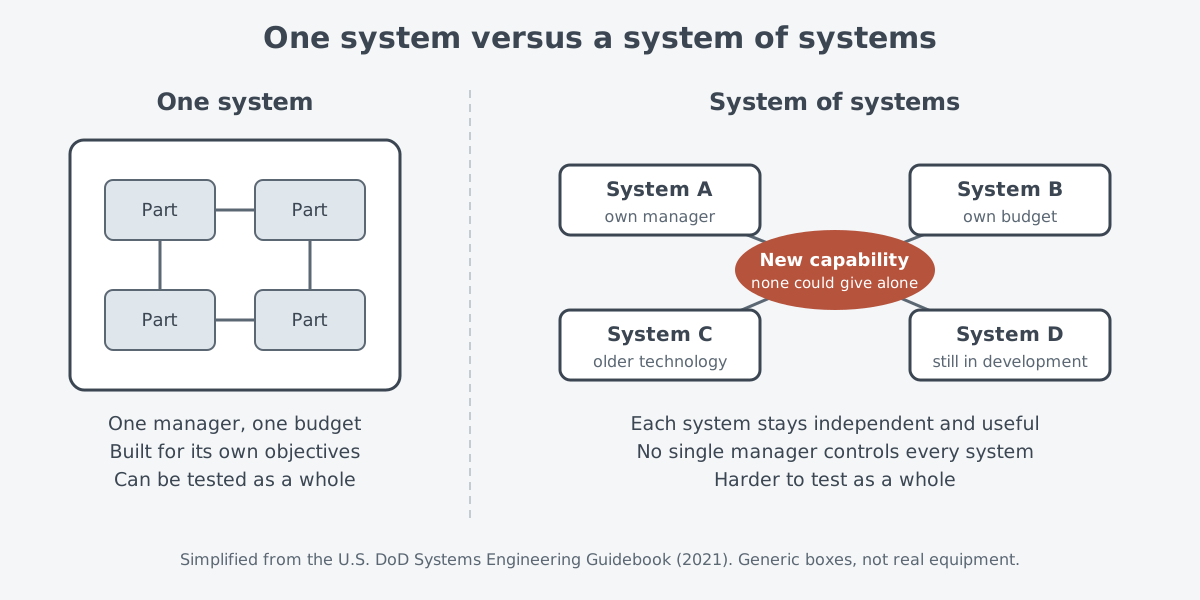
The systems inside an SoS come from many backgrounds. Technologies that matured decades apart end up side by side. A system designed for one purpose may now serve a new goal that did not exist when it was fielded. This is why, in a complex SoS, the dependencies between systems have to be tracked.
Here is a shortened version of the guidebook's comparison table.
| Item | One system | System of systems (SoS) |
|---|---|---|
| Stakeholders | Fairly clear | Two or more levels, with interests that may compete |
| Management | Program management and funding line up | No single manager controls all the member systems |
| Objectives | Designed for its own operational objectives | Must deliver joint capability from systems whose goals did not come from current SoS goals |
| Life cycle | Follows an established acquisition process | Many life cycles across many programs overlap |
| Testing | Testing the system is possible | Harder, because life cycles are out of step and systems are independent |
Not every SoS has the same shape. The guidebook lists four types, and they differ most in how strong central management is. A directed SoS is engineered for set purposes and centrally managed over a long period. Its member systems can still operate on their own, but normally they follow the central purpose.
An acknowledged SoS has recognized objectives, a named manager and resources. Even so, each member system keeps its own owner, objectives, funding, and way of development and support. In a collaborative SoS, systems work together more or less voluntarily toward central purposes they have agreed on. A virtual SoS has no central management authority and no agreed-upon purpose.
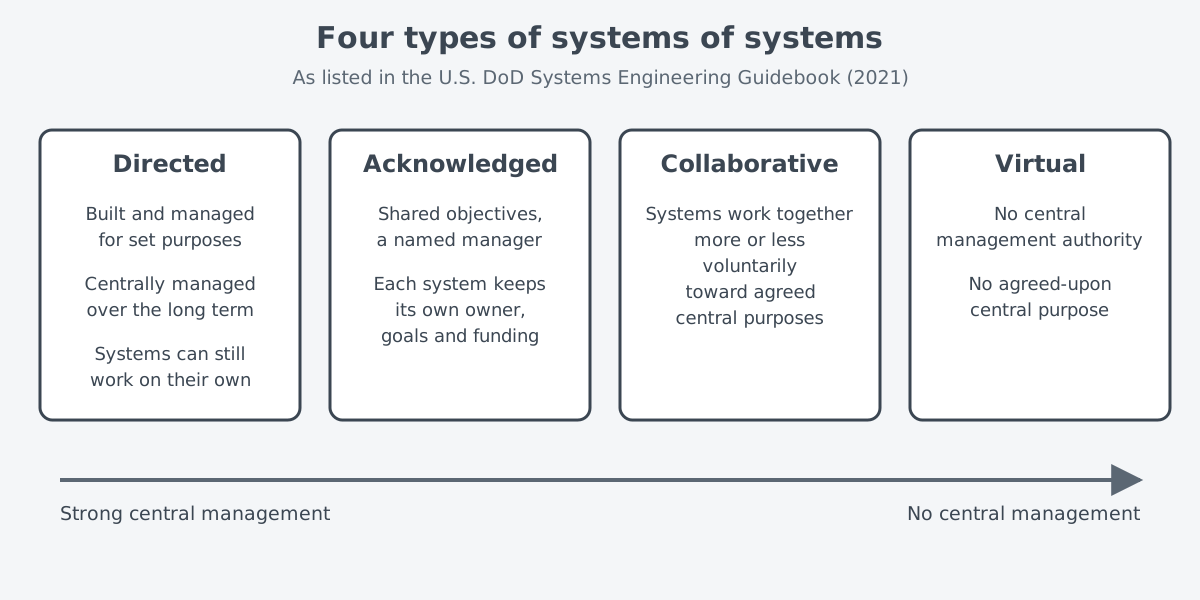
As more systems are networked, this list takes on a wider meaning. Efforts to link systems and share information across the battlespace have grown, so most DoD systems can now also be seen as parts of a "virtual" SoS. Many systems are already linked even though nobody planned them as one SoS.
Sensors, command and control, and weapons: three blocks
The easiest way to picture an SoS in defense is to split it into three blocks. Sensors do the seeing, and command and control (C2) gathers what was seen and makes decisions. Weapons create the actual effect.
NATO describes its Integrated Air and Missile Defence System (NATINAMDS) in exactly these terms. It is a network of linked national and NATO systems built from three kinds of pieces: sensors, weapon systems, and C2 assets.
The United States wants to stretch these links across all its services. A 2022 primer from the Congressional Research Service (CRS) describes Joint All-Domain Command and Control (JADC2) as a DoD concept. Its aim is one network that links the sensors of all five services: the Army, the Navy, the Marine Corps, the Air Force and the Space Force. Before this, each service built its own tactical network that did not work with the others.
The flow JADC2 has in mind follows the three blocks. It gathers data from many sensors, uses AI algorithms to pick out targets, and then recommends a suitable weapon to the commander. That weapon may be kinetic or nonkinetic, such as a cyber or electronic weapon. Defense officials say a future conflict could force decisions within hours, minutes or even seconds, while today's process takes several days.
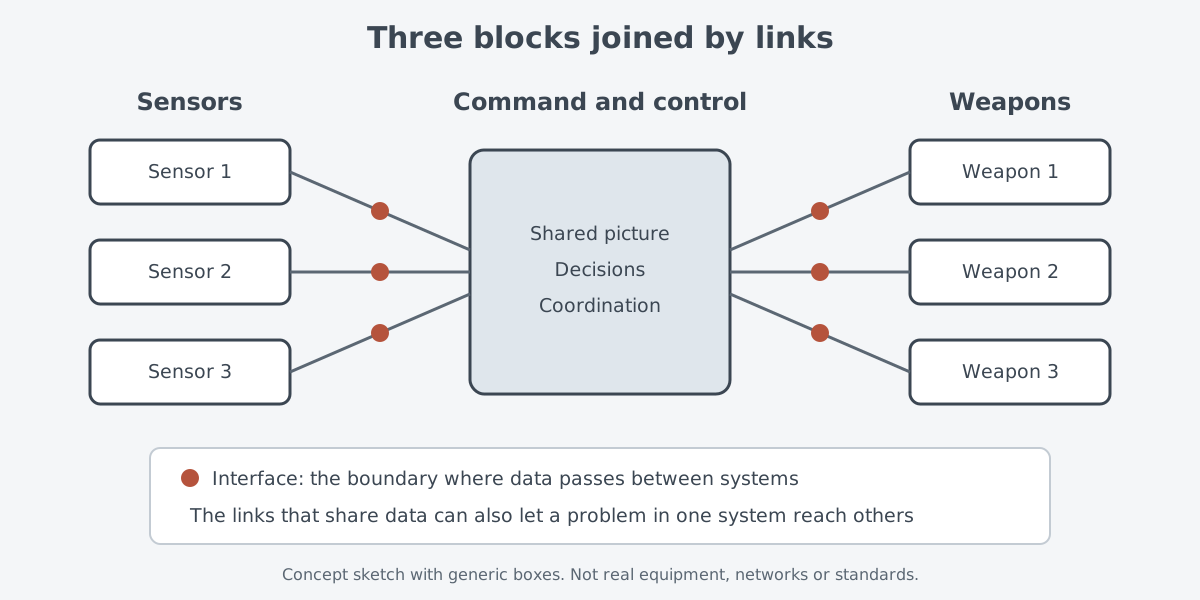
The lines between the blocks are the key. In an SoS, effort goes into finding the systems that serve the shared goal and letting data, control and functions flow between them. Boundaries and interfaces between systems matter because they are the channels that carry the data. How information from many sensors becomes one picture is covered in more detail in "Integrated air defense and sensor fusion."
If you place a laser weapon in this picture, it goes in the weapons block. That one laser weapon is itself a set of linked parts, and its makeup is explained in "A laser weapon is more than a laser: the system at a glance."
Why connection is also a weak point
Is more connection always better? GAO's 2018 report on weapon systems cybersecurity found that DoD weapon systems depend more on software and are more networked than ever before. Automation and connectivity are the base of modern military capability, yet for the same reason they make weapon systems more open to cyberattack.
Links help weapons exchange information for command and control, communications and battlespace awareness. But if an attacker gets into one of the linked systems, the connecting networks may let that attacker reach the others. Even when a new system is built to be more secure, linking it to an older system puts the new one at risk. Even without a direct link, a mission can be at risk if the new system relies on the older one to complete it.
Relying on other systems is not only a cyber issue. When one program needs what another program does or delivers in order to meet its own requirements, that relationship is called a dependency. A weapon that relies on new sensor capabilities from another system is one example.
Dependencies can cause two kinds of trouble. If the needed prototypes do not arrive on time, the schedule slips. If the two designs cannot together deliver the full capability from start to finish, performance suffers.
Some people question broad connection itself. Skeptical analysts, as summarized by CRS, ask whether the technology is mature enough and whether the cost is affordable. They also ask whether anyone can actually deploy a network that links sensors to shooters securely and reliably in a deadly setting full of electronic warfare.
The human role is another open question. Some ask who would hold decision authority across domains and how big a part people must play in real-time decisions. They also ask whether cutting back human involvement in military decisions is appropriate. How much judgment to hand to machines leads into the next topic, "Autonomous weapons and human control."
Public policy terms: interoperability and JADC2
When official documents talk about connection, the word that appears most often is interoperability. NATO defines interoperability as the ability of Allies to act together in a coherent, effective and efficient way, so they can reach tactical, operational and strategic objectives.
This does not mean everyone must use the same equipment. What matters is that equipment can use shared facilities, link up and communicate with other equipment, and exchange data and services. Interoperability spans several dimensions: technical (equipment and systems), procedural (doctrine and procedures), human (terminology and training), and information. The way to reach it is through standardization, training and exercises, along with lessons learned, demonstrations, and tests and trials.
Almost every DoD system works inside an SoS and relies on other systems to deliver the capability users want. The DoD Systems Engineering Guidebook gives a more concrete definition. Interoperability is the requirement that a system interact with other systems by passing information, energy or matter.
Think of a missile launched from an aircraft. The missile must be interoperable with the aircraft that carries it. Information passes between them, and a mechanical interface holds the missile in place until launch.
Interoperability is essential for building an SoS. In DoD, every system must pass interoperability certification before it goes into service, and the Joint Interoperability Test Command handles that certification.
JADC2, with its plan to link the sensors of all five services, is in the end an interoperability problem too. As of GAO's January 2023 report, DoD was at an early stage of developing JADC2. By then it had not settled details like which current systems would feed into it.
The DoD implementation plan quoted in that report admitted that development work at the time was not following interoperability and common data standards. Each military department often built its own command and control solutions, and the other departments might not know about them. A system of systems is a technical term, but it is also a question of how organizations that grew up apart learn to work together.
What to read next
- Autonomous weapons and human control: the official debate on how humans and machines share judgment in linked systems.
- Integrated air defense and sensor fusion: how information from the sensor block comes together into one picture.
- Lasers, interceptor missiles and guns: how they share the work: how weapons divide the work inside the weapons block.