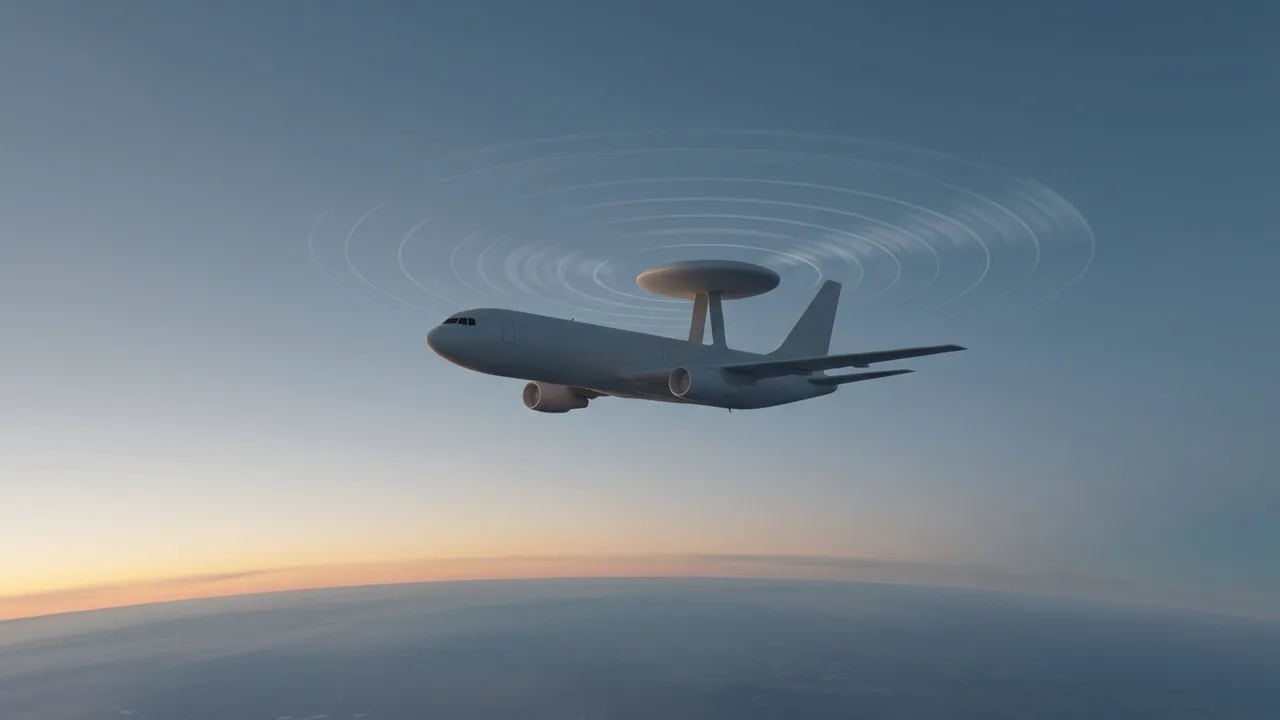
From a tall observation deck you can see places that buildings and hills hide from people on the ground. Radar works much the same way. A radar on the ground can easily miss an aircraft flying low far away, while the same radar lifted high into the sky sees much farther.
An airborne early warning and control (AEW&C) aircraft puts that idea on a plane. It carries a large radar high above the ground, watches the sky and the sea, and gathers what it sees into one picture that it shares with other units. You can think of it as a control tower floating in the sky. But why does it have to go so high?
Why height lets a radar see farther
The Earth is round, and a radar beam travels almost in a straight line. As the U.S. National Weather Service (NWS) puts it, the beam does not follow the curve of the Earth's surface. In normal air the beam does bend a little, but slightly less than the Earth curves.
So the gap between the beam and the ground grows with distance. An aircraft flying low far from a ground radar ends up under the beam, out of sight. Weather radar has the same problem: for a distant storm, even the lowest beam may only see into the middle part of the storm.
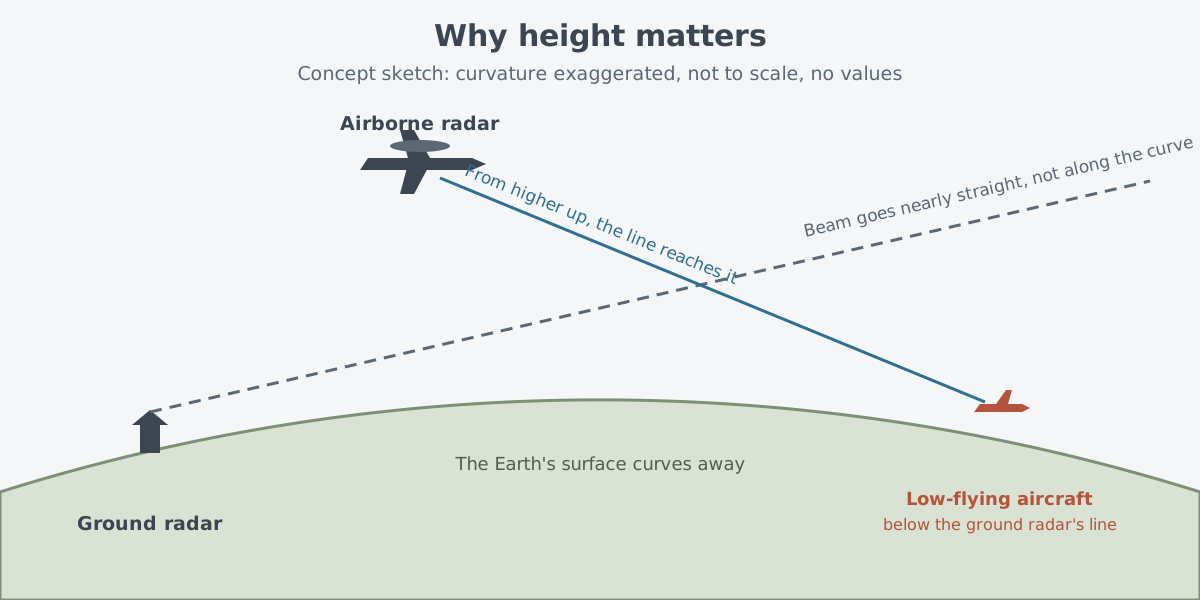
Raise the radar, as in the diagram, and the line looking down reaches the same aircraft. The U.S. Air Force says the E-3 Sentry can detect threats where ground-based command and control cannot reach: underneath its coverage and beyond it. Numbers help too. One NATO E-3A flying at 9,150 m watches an area of more than 312,000 km², roughly the size of Poland.
Detection distances are listed separately by target height. Targets at low altitude are detected within 400 km, and targets at medium altitude within 520 km.
Height also brings a new problem. Looking down, the radar also picks up echoes from the ground, called clutter. The E-3's radar works with an identification friend or foe (IFF) system, filters out these ground echoes, and finds, identifies and tracks friendly and enemy aircraft flying low. Its coverage reaches from the surface to the stratosphere, above both land and water.
Early warning and control: two jobs in one name
The first half of the name, early warning, means seeing first and telling others first. The NATO Airborne Early Warning and Control Force (NAEW&CF) puts watching the airspace and spotting airborne threats early at the top of its list of roles. The sky is not the only concern. The list also includes tracking and identifying ships and building a radar picture of what is happening in a maritime area.
The second half, control, means putting what it sees to use. According to the U.S. Air Force fact sheet, the E-3 gives the Joint Air Operations Center an accurate, live picture of the battlespace, showing friendly, neutral and hostile activity. The mission crew on board split the work of surveillance, identification, weapons control, battle management and communications. NATO notes that, over communication links, that information can reach other users on the ground, on ships and in aircraft almost as it happens.
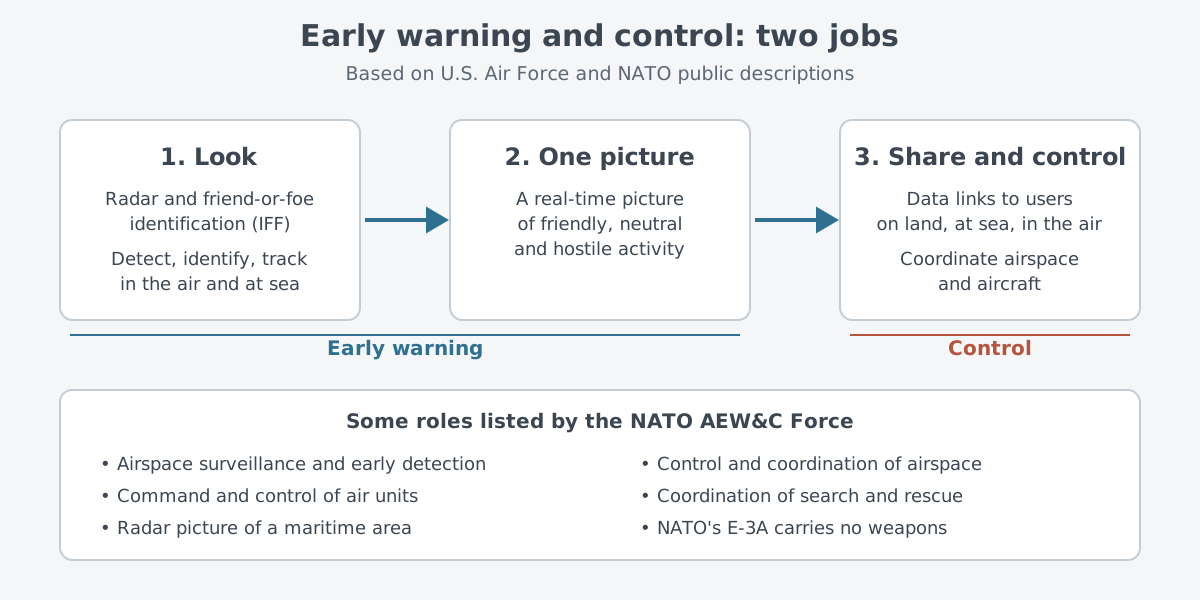
The list of roles also includes controlling and coordinating the airspace and the aircraft in it, and coordinating search and rescue. This is where the control tower comparison fits. It is not a perfect match, though. Unlike a tower fixed on the ground, it watches from high up with its own radar, and during operations and exercises it also commands and controls military air units.
All of this takes many people. Four people fly a U.S. Air Force E-3, while 13–19 specialists work the mission, and that number depends on the mission. NATO's E-3A carries no weapons.
A rotating dish, or a radar that stays still
The most striking feature of the E-3 is the big disk on its back. It is a Boeing 707/320 airliner airframe, modified to carry a rotodome (a rotating radar dome) 9.1 m across. On NATO's E-3A, the rotodome turns once every 10 seconds. The antenna sweeps around the aircraft one direction after another.
The E-7 Wedgetail takes a different path. It is based on a Boeing 737 airliner, and CRS says it uses a multirole electronically scanned radar that covers 360 degrees. How a radar can change beam direction without turning a dish is the subject of "Phased arrays and AESA radar: steering without moving".
Some of these aircraft fly from aircraft carriers. The U.S. Navy's E-2D Advanced Hawkeye is the newest member of the E-2 family. It flies from carriers in all weather and handles airborne early warning and command and control. Its crew of five is two pilots and three mission systems operators.
A short timeline: from the E-3 to what comes next
Engineering, testing and evaluation of the first E-3 started in October 1975. In March 1977 a U.S. Air Force wing received its first E-3s, and NATO received its first E-3 in January 1982. Unusually, NATO owns and operates the E-3A itself; few military assets are like that.
The E-7 began in Australia. Australia signed a contract with Boeing in 2002 to develop and buy six aircraft, finished the first deliveries in 2009, and reached full operational capability in 2015. Turkey and South Korea also fly the aircraft. At sea, the E-2D reached initial operational capability in October 2014.
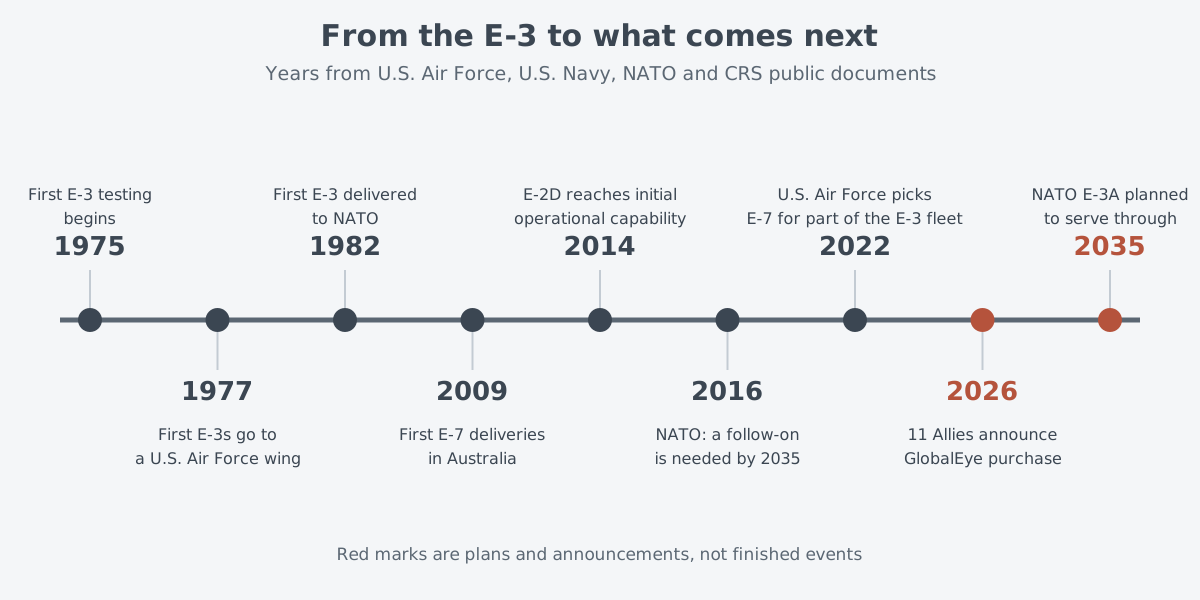
A major decision came in 2022. The U.S. Air Force decided to replace part of its E-3 fleet with the E-7. Its FY2023 budget request proposed retiring 15 of 31 E-3s and moving the money to the replacement.
At the 2016 Warsaw Summit, NATO Allies declared that they would need a follow-on to the E-3 by 2035. In 2026, eleven Allies announced that they would jointly buy the Saab GlobalEye to serve as the alliance's new AWACS, taking over from part of the aging E-3A fleet. The existing E-3As are to keep flying through 2035 after a final life extension program.
Why replacing them is hard: age, parts and cost
According to CRS, Air Force officials gave three reasons to replace the E-3. They pointed to how old the aircraft are, a low mission capable rate, and the fact that parts for 40-year-old aircraft can no longer be bought. A mission capable rate shows how many aircraft are actually available for use, so a low rate means fewer aircraft ready to fly.
Replacing them is not simple either. An earlier replacement effort, the E-10, was cancelled outright in 2010. Speeding up the E-7 is hard too. In July 2022 the Air Force's acquisition executive said there were few ways to do so, pointing out that it needs major changes to a normal 737 and software development.
The cost is high as well. From the first purchase to the final life extension, the NATO countries in the program have spent or committed about USD 13 billion in total. That is far too much for any single country to pay alone.
An aircraft is not the only answer under discussion. The U.S. Air Force has said it intends to move airborne battle management to space-based systems in the end. As of the 2022 CRS paper, though, it was unclear when such a space radar constellation would be working. NATO's new approach also aims to link NATO-owned, multinational and national assets on the ground, in the air, at sea and in space.
Where this meets lasers: the same horizon
Laser weapons face the same wall, because laser light crosses the atmosphere on an almost straight path. As a result, CRS explains, high-energy laser (HEL) weapons can only engage what lies in their line of sight. Targets over the horizon or hidden behind other objects are out of reach. It is the same story as a radar beam that does not bend along the Earth's curve.
As long as a system relies on radio waves or light that travel straight, the horizon remains a problem it has to solve, for radar and laser alike. To see what parts a laser weapon needs besides the laser itself, read "A laser weapon is more than a laser: the system at a glance".
What to read next
- "Radar: measuring distance and motion with radio waves": the basic way a radar measures distance and motion
- "Phased arrays and AESA radar: steering without moving": how a radar like the E-7's works without a rotating dish
- "Integrated air defense and sensor fusion": combining many sensors into one picture