
When the news mentions a "hypersonic missile," it can sound like a brand-new kind of very fast weapon. Yet long-range ballistic missiles, which have existed for decades, fly in the same speed range. So what is different about a hypersonic glide vehicle (HGV)?
The answer lies less in speed than in the way it flies. This article separates the speed word "hypersonic" from the flying method called "gliding." It then follows what that difference makes harder and where opinions split.
"Hypersonic" is a word about speed
A common yardstick for flight speed is the Mach number. You get it by dividing how fast an object moves by how fast sound travels in the air around it. The speed of sound changes with the type of gas and its temperature. So Mach 5 does not always mean the same number of kilometers per hour.
NASA's Glenn Research Center, part of the U.S. space agency, divides flight into regimes by Mach number. Below 1 is subsonic, near 1 is transonic, and above 1 is supersonic. Once the flow passes Mach 5, five times as fast as sound, it is called hypersonic.
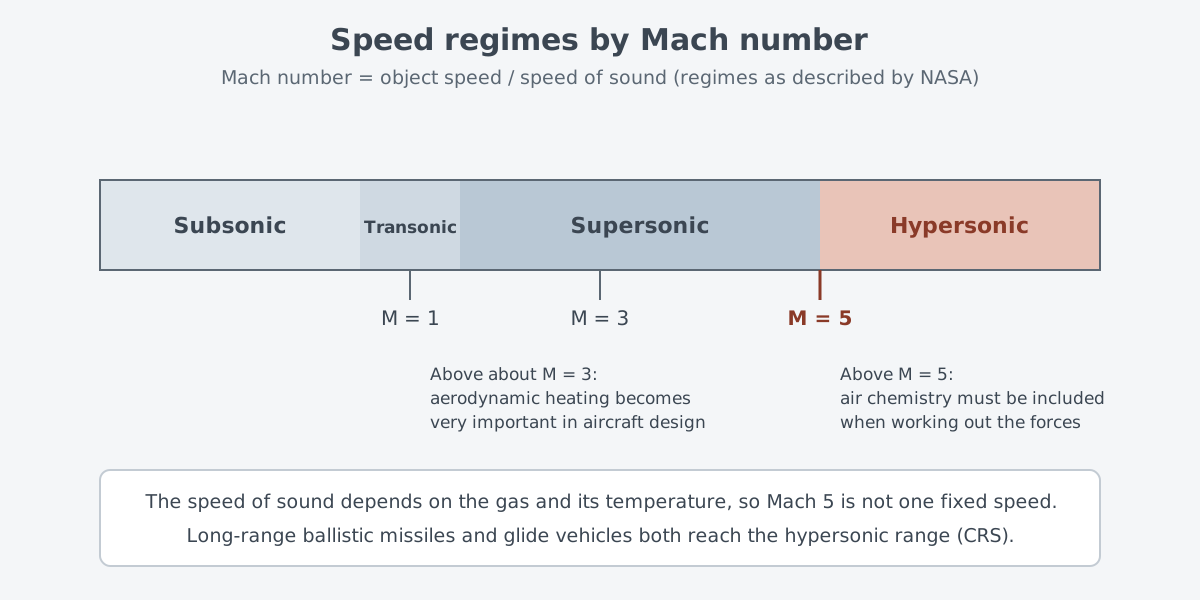
The air behaves differently in each regime. From high supersonic speeds above Mach 3, aerodynamic heating, the warming of the vehicle by the air, becomes a major design issue. At hypersonic speeds, part of the object's energy goes into exciting the bonds of nitrogen and oxygen molecules. Anyone working out the forces then has to account for air chemistry as well.
The best-known example is the Space Shuttle. It re-entered the atmosphere at around Mach 25, and the hot air around it turned into an ionized plasma. The point to remember is simple. "Hypersonic" is the name of a speed range, not the name of a type of weapon.
A ballistic missile flies like a thrown ball
Throw a ball at an angle and it rises, then falls along a curved path. Physics textbooks call this kind of motion, with acceleration from gravity only, projectile motion, and the path a trajectory. The textbook math leaves out air resistance, but in practice air resistance cannot be ignored completely.
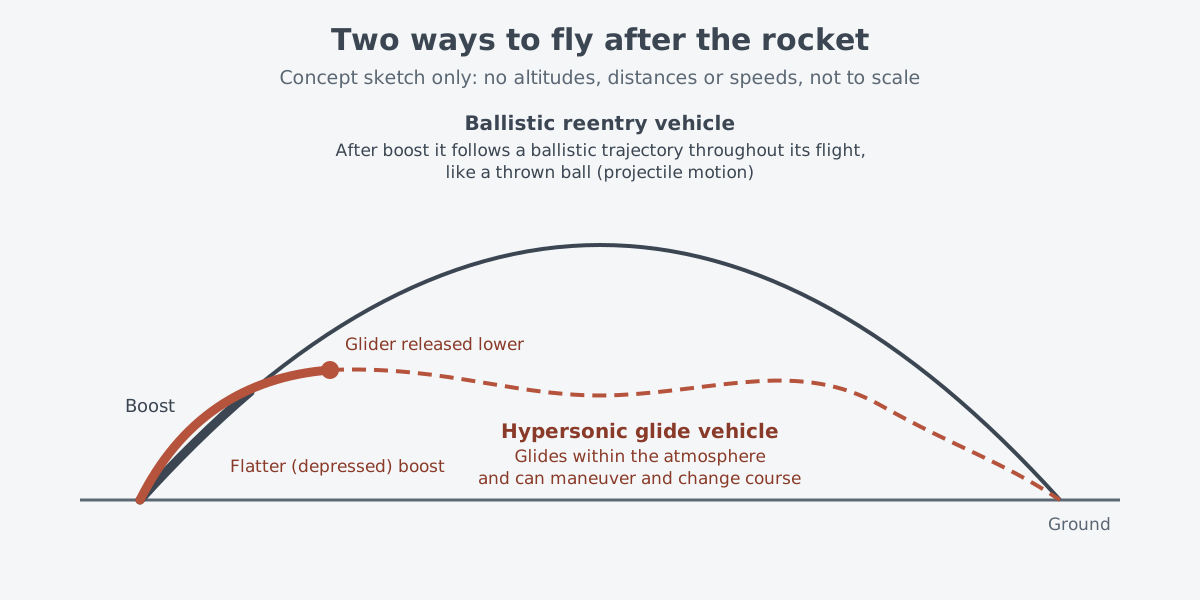
In a ballistic missile, a rocket pushes the payload up, and then a ballistic reentry vehicle carrying the warhead follows a ballistic trajectory for the rest of its flight. A Congressional Research Service (CRS) primer on missile defense splits a ballistic missile's flight into four phases: boost, post-boost, midcourse and terminal. Some sources fold post-boost into the others and use three phases, boost, midcourse and terminal, which Layered missile defense covers in more detail.
How fast is a ballistic missile? A CRS report notes that, like every long-range ballistic missile, hypersonic weapons can fly faster than Mach 5, at roughly 1–5 miles per second. All ballistic missiles reach hypersonic speeds, even those whose reentry vehicles cannot glide. The word "hypersonic" alone cannot tell a ballistic missile from a glide vehicle.
A glide vehicle differs after release
Hypersonic weapons come in two main groups. A hypersonic glide vehicle is launched by a rocket and then glides to its target. A hypersonic cruise missile flies on a fast air-breathing engine called a scramjet. When a glide vehicle is paired with its rocket booster, the whole system is often called a boost-glide weapon.
Between a missile carrying a glide vehicle and one carrying a ballistic reentry vehicle, the key difference is not speed. It is whether the vehicle can steer onto a new course once it has left the rocket booster. A glide vehicle would not outrun a ballistic reentry vehicle either.
The shape of the path can differ too. Many delivery concepts assume a booster that climbs on a lower, flatter (depressed) path than a standard ballistic missile and lets the glider go at a lower altitude. This is not required, though.
The glide vehicle sketched in a U.S. study, the Falcon Study, was an unpowered vehicle meant to stay inside the atmosphere at hypersonic speed while steering toward its target.
How does something go far without an engine? Think of a paper airplane. A glider moving downward feels three forces. Weight always points toward the Earth's center, lift acts at right angles to the flight path, and drag acts along the path against the motion.
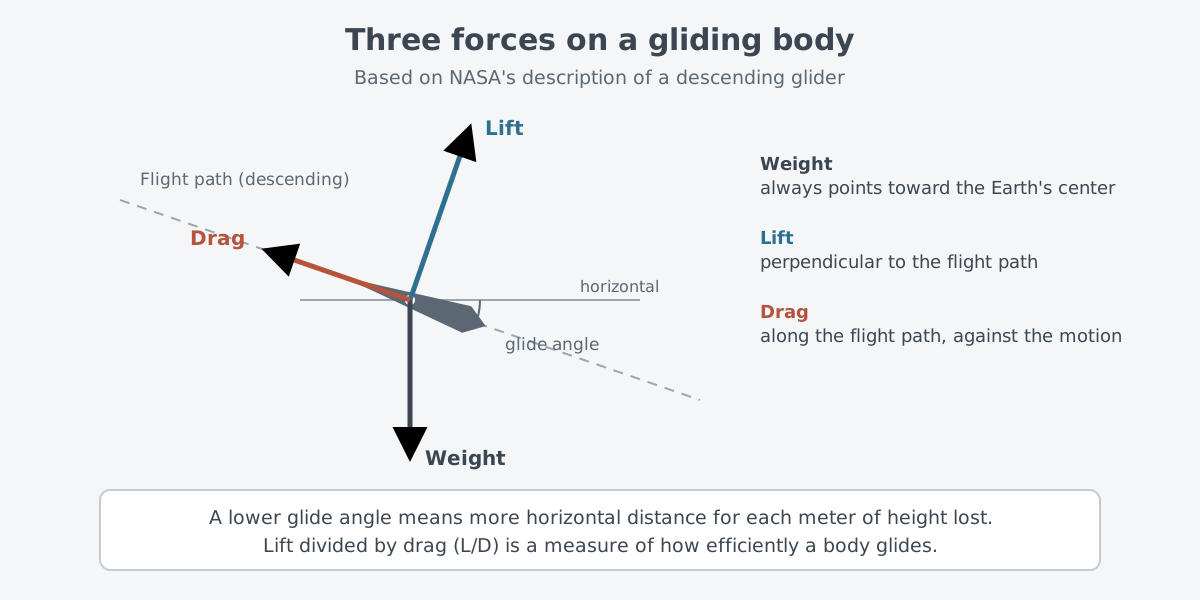
The angle between the horizontal and the flight path is called the glide angle. A shallower glide angle carries the glider farther for each bit of height it gives up. A glider with a higher lift-to-drag ratio (L/D) is more efficient.
A paper airplane and a glide vehicle differ even in how the air behaves, however. A glide vehicle flies at hypersonic speed, where the air heats the vehicle and air chemistry has to be taken into account.
What becomes harder, and what is debated
CRS says speed, maneuverability and a low flight altitude could make hypersonic weapons harder to detect and defend against. Its example is ground-based radar. Ground radar may see such a weapon only late in its flight, which leaves less time to judge and respond.
The booster's climb would likely be spotted like any ballistic missile launch, but where the released glider will go is hard to know in advance. It would still arrive much sooner than an aircraft or a subsonic cruise missile, taking minutes rather than hours. The maneuvering serves either to get past missile defenses or to hit more accurately near the target.
Official sources also record the other side. CRS quotes three findings from the Congressional Budget Office (CBO):
- Both hypersonic and ballistic missiles suit operations outside an adversary's anti-access zones.
- In a conflict, hypersonic missiles would probably survive no better than ballistic missiles carrying warheads that can maneuver. The exception is when those ballistic missiles meet very effective long-range defenses.
- Buying and fielding hypersonic missiles could cost a third more than ballistic missiles with maneuvering warheads that reach as far.
Experts disagree as well. Some analysts argue that boost-glide weapons, being fast, accurate and able to maneuver, will change the character of warfare. Others doubt it. They point out that, even without maneuvering warheads, countries with ballistic missiles could strike U.S. forces and allies for a long time already.
Hot air and test facilities
Heat is one reason hypersonic glide vehicles are hard to build. As shown above, at these speeds the air heats the vehicle and its own properties change. Hypersonic test facilities simulate the speed, pressure and heating of hypersonic flight. Meeting these conditions also means developing special metals and ceramics.
Facilities have also been limited. A study by the Institute for Defense Analyses (IDA) counted 48 key U.S. test facilities and mobile assets for hypersonic work in 2014. In that year's assessment, IDA judged that no U.S. facility could create full-scale, combined aerodynamic and heat loads above Mach 8 for as long as needed. CRS adds that U.S. test infrastructure has changed in several ways since that study.
Flight tests have not always gone to plan. On April 22, 2010, the Department of Defense held the first test of HTV-2, a test vehicle that the Defense Advanced Research Projects Agency (DARPA) developed under its Falcon program. DARPA's early results showed controlled flight in the atmosphere, but the data link went silent nine minutes after launch. The Department reviewed the results to find out why the vehicle failed in flight.
Development status in public reports
Boost-glide programs exist in all three U.S. services: the Navy, the Army and the Air Force. The United States, unlike Russia and China, has no publicly known effort to build glide vehicles for nuclear warheads. For that reason, CRS expects U.S. gliders to need greater accuracy and to be harder to develop.
The Department of Defense asked for $3.9 billion for hypersonic weapons in fiscal year 2026. The fiscal year 2025 request had been $6.9 billion.
Russia's glide vehicle, Avangard, carries a nuclear warhead and rides on SS-19 long-range ballistic missiles. Russia tested it in 2016 and 2018. On December 27, 2019, Russia said two SS-19 missiles carrying Avangard had been activated. China has put the DF-17 into operational service; this medium-range ballistic missile can carry a glide vehicle.
Names need care as well. Several countries are testing more and more maneuverable systems that fly at hypersonic speeds, yet some of them do not count as "hypersonic weapons" under the CRS report's definition.
Where this meets lasers: reading speed words in the news
How to read laser weapon news showed that a single figure such as "kW-class" leaves out many conditions, and "hypersonic" works the same way. When you see the word in a story, ask what it describes. It may mean only speed, a vehicle that glides after leaving its rocket, or one that also maneuvers and changes course. These are three different pieces of information.
There is also one direct link to lasers, in a view held by some analysts that CRS describes. Space-based sensor layers, tied to tracking and fire-control systems, could steer high-performance interceptor missiles or directed energy weapons toward a target. In theory, that could become a future option for defending against hypersonic weapons. This is an analysts' view and does not mean such a system exists.
What to read next
- Ballistic missiles: why they climb high and come down: a closer look at the ballistic trajectory and flight phases touched on here.
- Ramjets and scramjets: engines without fans: the engines behind the other branch of hypersonic weapons, cruise missiles.
- Layered missile defense: why defense comes in layers: why defenses are split across the phases of flight.