On the morning of 5 June 1967, the Israeli Air Force began attacking Egypt's airfields. At that moment Field Marshal Amer, who led Egypt's armed forces, was in a plane on his way to visit troops in Sinai. Because of the air attacks, his plane could not land for more than an hour. Meanwhile, Egyptian aircraft sitting on the ground were destroyed one after another.
The fighting stopped six days later, on 10 June. By then Israel held the Sinai Peninsula, the Gaza Strip, the West Bank of the Jordan, East Jerusalem and the Golan Heights. That is why the conflict is called the Six-Day War.
How was the first day's strike prepared, and how did that one day shape the next five? And why did such a large victory fail to bring peace? This article follows those questions through the U.S. State Department's Office of the Historian, two studies by George W. Gawrych published by the U.S. Army's Combat Studies Institute (1990 and 1996), and UN records.
May 1967: three weeks of crisis
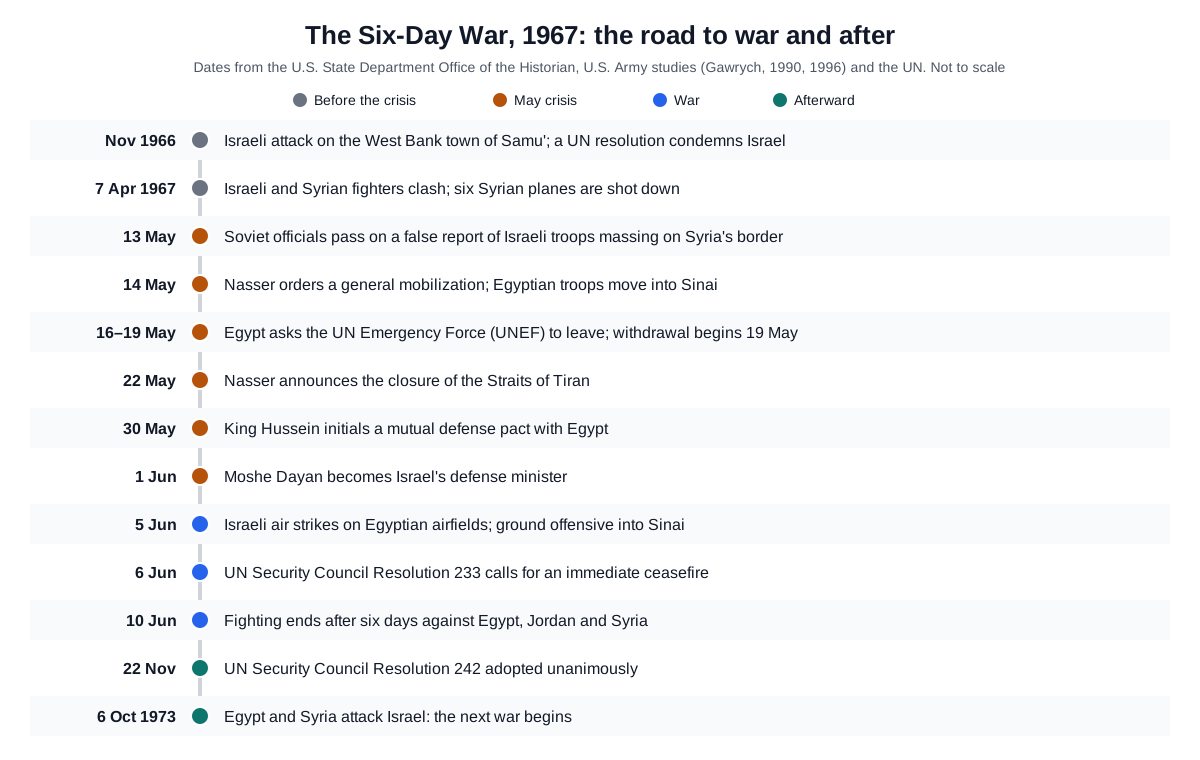
After the Suez War of 1956, the United Nations Emergency Force (UNEF) stayed between Egypt and Israel for more than ten years. The border was still not quiet. Fatah and other Palestinian guerrilla groups attacked targets inside Israel. After an Israeli raid on Samu', a town in the West Bank, in November 1966, the United States voted for a UN resolution condemning Israel.
By the spring of 1967, Israel was retaliating hard against Syria, and Syria's leaders were demanding that Egypt step in. On 7 April, Israeli and Syrian fighters clashed in a large air battle, and six Syrian planes were shot down.
A false report turned up the heat. On 13 May, Soviet officials warned Syria and Egypt that Israeli troops were gathering along the Syrian frontier. The next day, Egyptian President Gamal Abdel Nasser ordered a general mobilization and sent large numbers of troops into Sinai. By June, Egypt had six divisions in Sinai, about 100,000 men and 900 tanks.
On the evening of 16 May, the Egyptian military asked the UNEF commander to pull back from the observation posts on the border. The force could stay on Egyptian soil only with the consent of Egypt's government. UN Secretary-General U Thant agreed to comply, and the withdrawal began on 19 May.
Israel had already said it would treat renewed raids across the border, or Egypt shutting the Strait of Tiran to Israeli ships, as a cause for war. On 22 May, Nasser declared the straits closed to Israel.
The United States now faced three unwelcome options. In 1957, President Eisenhower had promised that Washington would see a blockade of that waterway as an act of war. President Johnson played for time. He looked for support for "Regatta," a plan for several seafaring countries to sail a "probing force" past the blockade, but he could not get it.
On 30 May, Jordan's King Hussein went to Cairo and initialed a mutual defense pact with Egypt. With Jordan in the Arab coalition, pressure on Israel to strike first grew. Israel had already called up 60,000 to 70,000 reservists after the UNEF withdrawal was accepted.
Johnson kept warning Israel against preemption. Yet by the time Israel actually moved, several of his advisors had concluded that Israel "going it alone" would serve U.S. interests best. On 4 June, Israel's political leaders approved war with Egypt.
An army that bet on its air force
Israel's war plan carried a strong memory of 1956. That year, Israeli forces, working with Britain and France, captured the whole Sinai Peninsula. The international community, led by the United States, condemned the attack and pressed the three countries until they withdrew. Moshe Dayan, Israel's chief of the General Staff in 1956, became defense minister on 1 June 1967 and wanted to avoid a repeat.
The original plan was to take only the Gaza Strip and northeastern Sinai and use them as bargaining chips to reopen the Strait of Tiran. Dayan widened the goal to all of Sinai short of the Suez Canal. The main military aim was to destroy as much of Egypt's armed forces as possible.
The air force stood at the front of this plan. The lesson Israel's commanders took from 1956 was that holding the skies had made their ground operations in the desert much easier. In the years that followed, they built the air force into the leading service, and by 1967 it received half of the whole defense budget.
That money bought modern French aircraft such as the Mirage IIIC, the Mystère IVA and the Super Mystère. Ezer Weizman, the air force commander from 1958 to 1966, raised the standards for selecting and training pilots. The most capable young people began going to the air force instead of the paratroopers.
At the center of Israel's military strategy was the preemptive air strike. The idea was to destroy the enemy's air force on the ground first, win air superiority, and then use the air force to support the ground battle. Air superiority means one side holds the sky over the battlefield and can operate without much interference from enemy aircraft.
Doing both jobs as one required much closer teamwork between the air and ground forces. So after the 1956 war, air force command moved to the General Headquarters in Tel Aviv. There the air force commander worked under one roof with the chief of the General Staff. The ground forces were also rebuilt as a fast-moving army led by large tank formations, with the main battle tank (MBT) at their core.
The morning of 5 June
When the Israeli Air Force began striking Egypt's airfields, Egypt's armed forces were under orders to hold a defensive posture and absorb an Israeli first strike. The attack came while Egypt's commanders were away from their posts. Field Marshal Amer, the air force commander and other senior officers were in a plane headed for Sinai. The main commanders in Sinai were gathered at Bir al-Thamada waiting for him.
Amer did not get back to his General Headquarters until 9:30 Israeli time. All times in this article are Israeli time. Egyptian time was one hour later.
The two books describe the result in different terms. Gawrych's 1990 study says that after three hours of bombing runs, Israeli pilots had destroyed 85% of the Egyptian Air Force. His 1996 study says that Israeli pilots, flying mainly French-made aircraft, destroyed 304 Egyptian planes on the ground. The Israeli Air Force then did similar damage to the smaller Jordanian and Syrian air forces.
The aircraft alone did not produce this result. The 1996 study points to excellent intelligence, detailed planning and a high level of training.
Accounts differ on when the ground war began. Non-Arab writers say the lead units of Sharon's division crossed the border at 8:15, about half an hour after the air force began its strikes. The Egyptian side says a border clash had already taken place an hour and a half earlier.
Once Israel held the sky, the air force's job changed. With the Egyptian Air Force wrecked on the ground, Israeli pilots became "flying artillery" for the ground forces. Israel's armor doctrine of the time neglected combined arms, the joint use of tanks, infantry and artillery. In Gawrych's 1990 view, that weakness did not hold the Israelis back in 1967.
Six days, front by front
While the air force struck three air forces on the first day, Israel's ground forces launched a major offensive into Sinai. After breaking through at Rafah and Abu Ageila in eastern Sinai, tank-led armored brigades with little or no infantry support led the advance across the desert.
That afternoon, Dayan ordered an attack on Jordan. On the morning of the third day, King Hussein approved a general withdrawal of the Jordanian army from the West Bank. On the fourth day, Israeli units reached the Suez Canal and Nasser admitted defeat. The last two days were spent taking the Golan Heights from Syria.
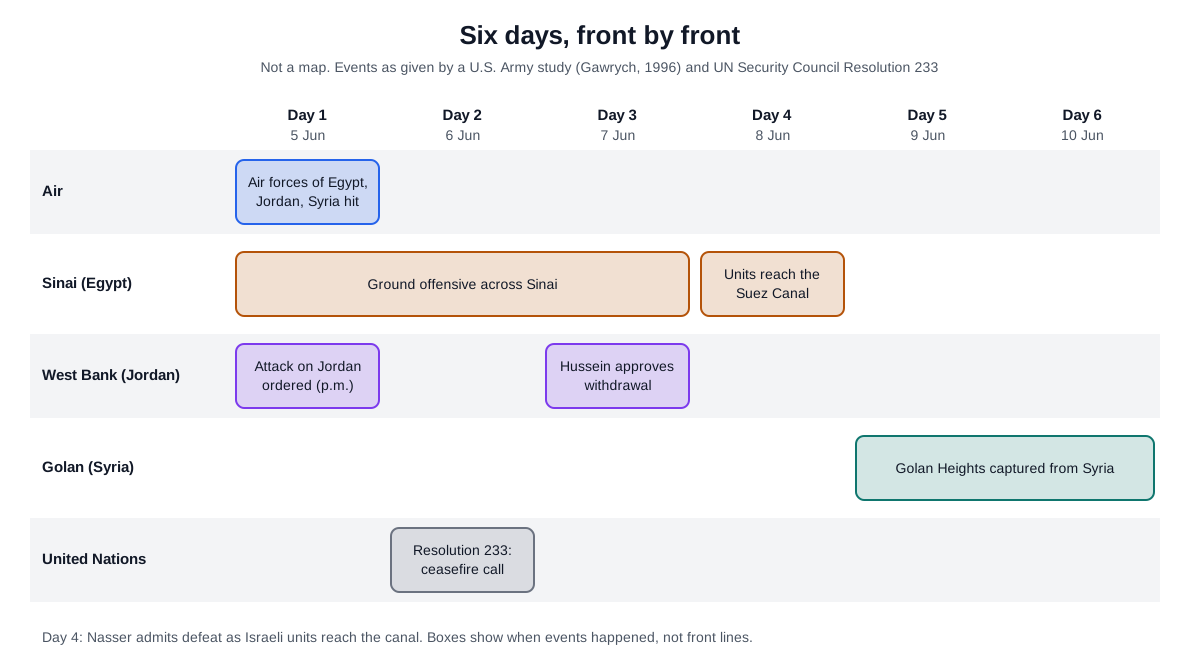
On 6 June, the second day of the war, the UN Security Council unanimously adopted Resolution 233. It called on the governments involved to move at once toward a ceasefire as a first step and to halt all military activity in the area.
From the start, the United States wanted a ceasefire. Its aim was to prevent an Arab defeat so severe that the Soviet Union would feel forced to step in. Egypt and several other Arab states, for their part, charged that Washington had aided Israel and cut off diplomatic ties.
Ceasefire and Resolution 242
When the fighting stopped on 10 June, the map had changed a great deal. The Sinai Peninsula, the Gaza Strip, the West Bank, East Jerusalem and the Golan Heights were under Israeli occupation. By Gawrych's 1996 count, the land under Israeli control had grown fourfold.
After the war, the U.S. position settled into "land for peace." Israel would withdraw from the occupied territories, and in return it would make peace agreements with its Arab neighbors.
On 22 November 1967, the UN Security Council unanimously adopted Resolution 242. It stressed that gaining territory by war is not acceptable and set out two principles together. One was the withdrawal of Israeli armed forces "from territories occupied in the recent conflict." The other was an end to all states of war, with respect for every state's right to live in peace inside secure, recognized borders without threats.
The resolution also called for a fair solution to the refugee problem. Israelis and Arabs read it differently. Even so, the Office of the Historian notes that Resolution 242 remained the foundation of every later U.S. effort to settle the Arab-Israeli dispute.
The cost and what it left behind
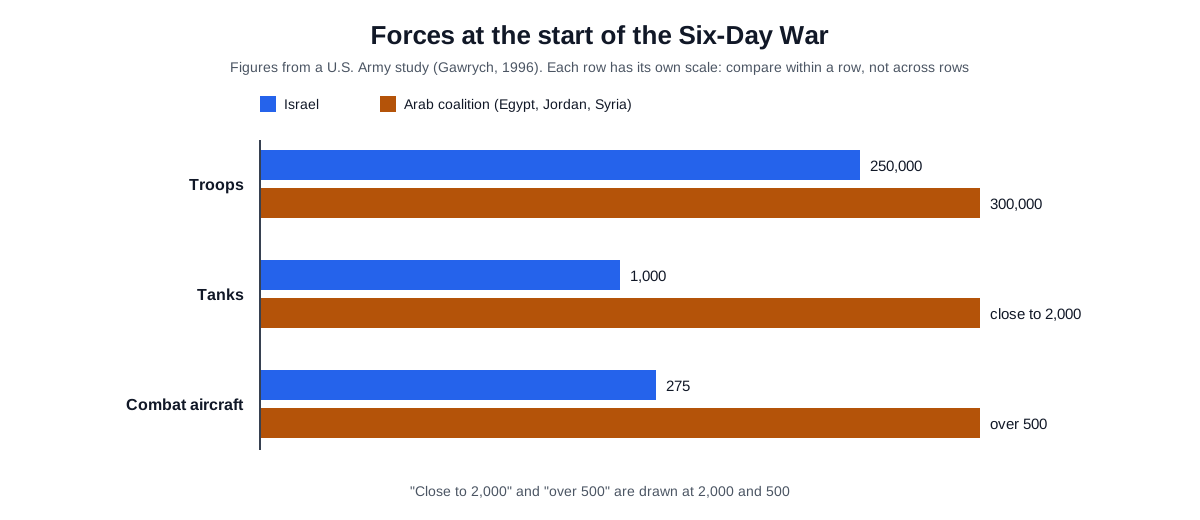
According to Gawrych's 1996 study, Israel went to war with 250,000 troops, 1,000 tanks and 275 combat aircraft. The coalition of Egypt, Jordan and Syria had 300,000 troops, close to 2,000 tanks, and over 500 fighters and bombers.
The losses were heavy. Israel lost 983 killed, 4,517 wounded and 15 missing. Egypt's casualties numbered over 10,000, and Egypt lost 85% of its air force and 80% of its ground equipment. Jordan lost 80% of its armor and suffered 700 killed and 6,000 wounded and missing, and Syria's figures were somewhat lower than Jordan's.
Soldiers were not the only ones caught in the fighting. Some UNEF units still waiting to go home were trapped by the fighting in Gaza, and 15 UN troops died.
The head of the UN Relief and Works Agency for Palestine Refugees (UNRWA) wrote a 1967 report that covered field visits up to the end of June. It estimated that at least 150,000 people had left the West Bank. Of these, 80,000 to 100,000 may have been refugees already registered with UNRWA. The report also put the movement of people in Syria at around 80,000.
The battlefield victory was large, but peace did not follow. In Gawrych's 1996 view, Israel's battlefield success in 1967 did not bring peace with any Arab state and instead hardened Arab resolve. He also argues that Israel built its victory on three pillars: intelligence, the air force and armor. Israel then expected Arab armies to fight the next war as they had in 1967.
After the war, Israel's army put even more weight on armor, while infantry and artillery were neglected. A number of infantry brigades were converted into armored units. The air force grew from 275 combat aircraft in 1967 to 432 by the summer of 1972, and Israel's main arms supplier changed from France to the United States.
Then, less than seven years later, on 6 October 1973, Egypt and Syria attacked Israel. How the lessons of 1967 were tested in that war is the subject of the next article.
What to read next
- The Yom Kippur War, 1973: The Shock of Antitank and Surface-to-Air Missiles. The war in which the same countries met again six years later.
- Main battle tanks: is it all about the gun? What makes a tank like those that crossed the desert in 1967 good or bad.
- Air-to-air missiles: what the missile sees The principles behind weapons used in the fight for the sky.
- Integrated air defense and sensor fusion How a system that defends the sky from the ground is put together.