A ship at sea has few places to hide. A big mass of metal runs its engines, sends out exhaust and cuts through the water in plain view on an open surface. Even so, navies have long worked to make their ships harder to see.
What exactly do they reduce, and how? This article looks at where the signals that ship stealth tries to cut come from, using the law of reflection and how sound behaves under water. It then follows the public history from painted camouflage to the Sea Shadow test ship and the Zumwalt-class destroyer.
A ship gives off many signatures
Stealth is often described as technology that makes things invisible. Its real meaning is more modest. The Defense Advanced Research Projects Agency (DARPA) describes military stealth as reducing the signature, or apparent presence, of assets such as ships and planes.
A single ship gives off more than one signature. A hull that sends radar waves back, heat from the exhaust, sound spreading through the water, the ship's magnetic field and its visible outline all count. So does the wake left on the water after the ship passes.
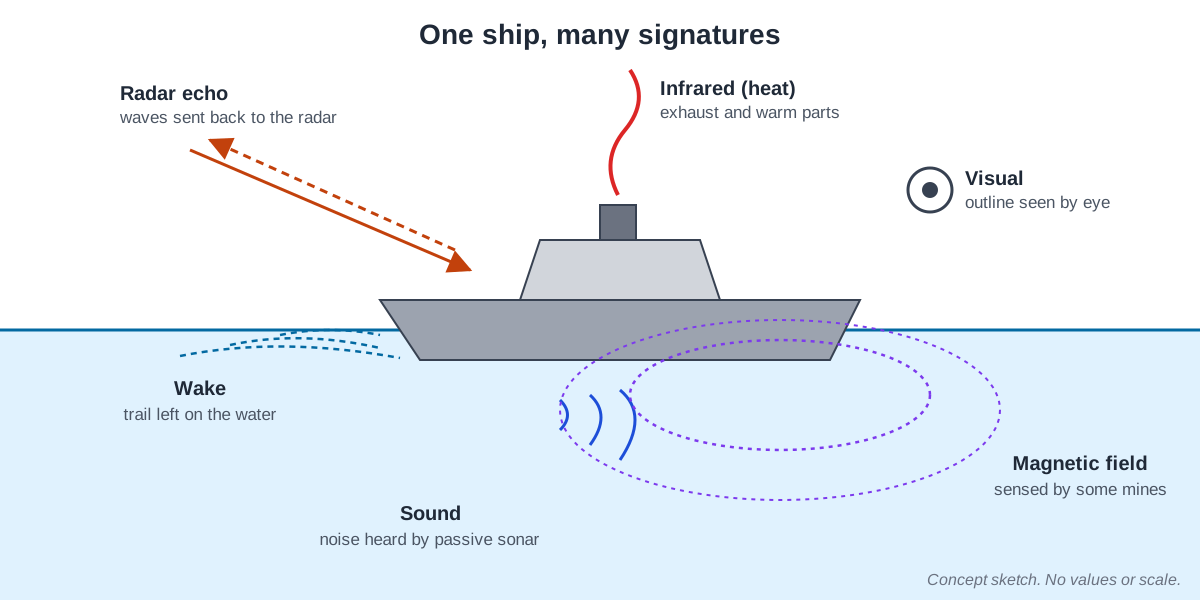
Cutting one still leaves the others. That makes ship stealth less a single device than a design problem that handles many signatures at once. The sections below take them one at a time.
Radar: tilted walls send the echo elsewhere
A radar sends out microwaves, catches the echoes and times them to find how far away an object is. To show up less on radar, a ship has to send back less echo. The size of that echo is the radar cross section (RCS). The Congressional Research Service (CRS) defines RCS as "the amount of measurable radar signal reflected back to its source."
Size alone does not set the RCS. It depends on the target's shape and material, and on the radar's frequency and polarization. The body shape, small surface details, inlets and exhausts each add their own share.
A mirror helps show why shape matters. Light that hits a smooth surface bounces off at the same angle it came in. That is the law of reflection, and the angles are measured from a line perpendicular to the surface. A wall facing the radar head-on sends the echo straight back, while the same wall tilted sends it up or down instead.
Two surfaces meeting at a right angle do the opposite. Light entering such a corner goes back parallel to the way it came, whatever the angle it arrived at. A corner reflector uses exactly this property.
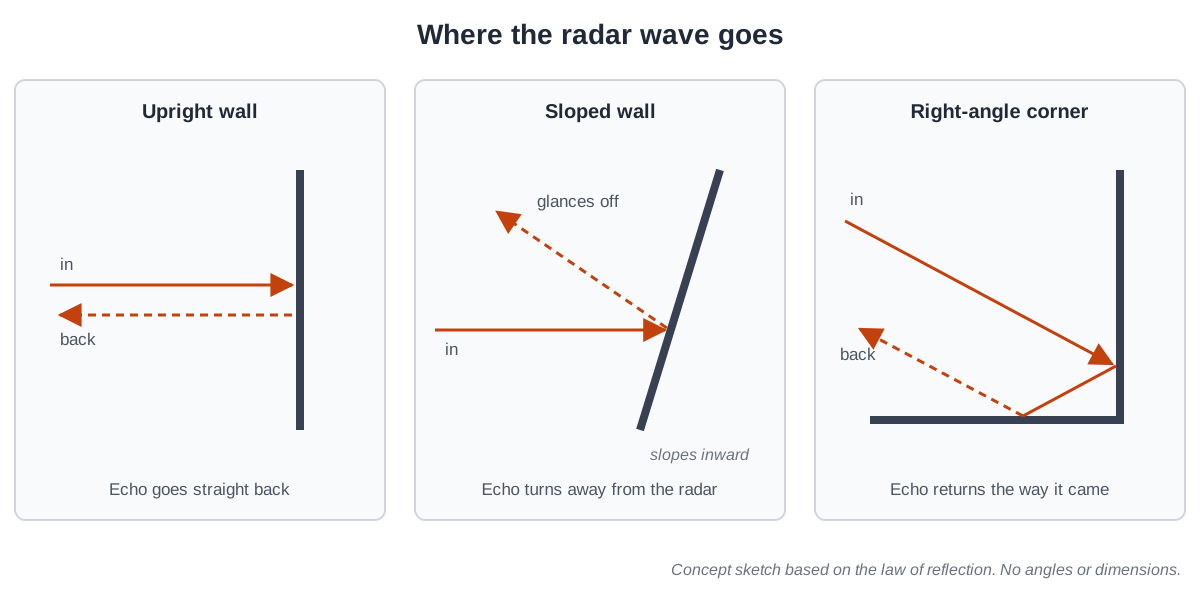
The mirror comparison only goes so far. Real radar waves scatter in more complex ways at a ship's edges, small surface details and materials. Besides shaping, there is also radar-absorbing material, which cuts the echo through what the surface is made of. At sea, engineers also had to check how seawater affects such material, a point that comes up again with Sea Shadow.
The sides of a Zumwalt-class destroyer lean in toward the middle of the ship the higher they rise above the waterline. This is called a tumblehome hull, while a conventional hull flares outward as it rises. CRS describes it as a hull design "for reduced detectability."
Sound and heat: signatures from below and from the stacks
Under water, sound travels farther than radar waves or light. That is why sonar, which uses sound, is the tool for looking under the sea. Passive sonar makes no sound of its own. It only listens for the noise that submarines, ships and other objects make.
The sound of the machinery that drives a ship therefore becomes a signature someone can hear. A 2000 CRS report on electric drive treated acoustic noise as an important part of how detectable a ship is overall. For submarines, it noted, noise remains the most reliable way to detect and track them at longer ranges.
This is where hopes for electric drive came from. Electric drive was expected to be much quieter than mechanical drive, and ships using it were expected to be harder to detect. The report also judged that stealth, including quieter operation, was becoming more important for surface warships too, even though it had traditionally mattered less for them.
Heat shows up as infrared light. An infrared image draws its signal from how much the temperature of an object differs from what lies behind it. Electric drive comes up here as well. With less space needed for air intakes and exhaust ducts, a surface ship could cut both its infrared signature and its RCS.
Magnetism and wake: traces a passing ship leaves behind
A ship creates a large magnetic field around itself. Some underwater mines sense such a field coming close and go off. Reducing a ship's magnetic signature is called degaussing.
In July 2008, the Office of Naval Research (ONR) installed a prototype degaussing coil on the destroyer USS Higgins (DDG 76). The coil used superconducting ceramic material, rather than traditional copper cable, to cancel the ship's magnetic signature. It was the first time anyone had measured a high-temperature superconducting degaussing loop on a naval combatant.
A wake is the trail a ship leaves on the surface after pushing through the water. The 2000 CRS report suggested that the new propeller and stern layouts electric drive allows could shrink a surface ship's wake signature. That, in turn, could make the ship harder to spot for remote sensors overhead.
From painted camouflage to Zumwalt
People have managed signatures for longer than you might think. According to DARPA, the practice of managing signatures is more than a century old. It began with camouflage painted on warships and later spread to aircraft and submarines. In both world wars, engineers were already working to make ships less visible to the eye and to radar.
Modern ship stealth came over from aircraft. Ben Rich, who led Lockheed's Skunk Works at the time, first suggested taking what he had learned on the F-117 and using it on submarines. The Department of Defense only showed interest after he adapted the idea to surface ships. The DARPA contract that followed was to try stealth ideas and materials on surface ships, and to test what seawater does to radar-absorbing materials.
The prototype, Sea Shadow (IX-529), was assembled in great secrecy inside a submersible barge. DARPA describes it as a ship made of flat facets that showed stealth technology working on the water. Its first trials in 1981 were a big disappointment. The wake was unexpectedly huge and could be detected by sonar and from the air, and the cause turned out to be propellers installed backwards.
Once the problem was found, the project went on. The ship was completed in 1984 and was tested at night in 1985 and 1986. Sea Shadow never got past the testing stage; it was first shown to the public in 1993 and scrapped in 2006. Its lessons still went into submarine periscopes and newer destroyers.
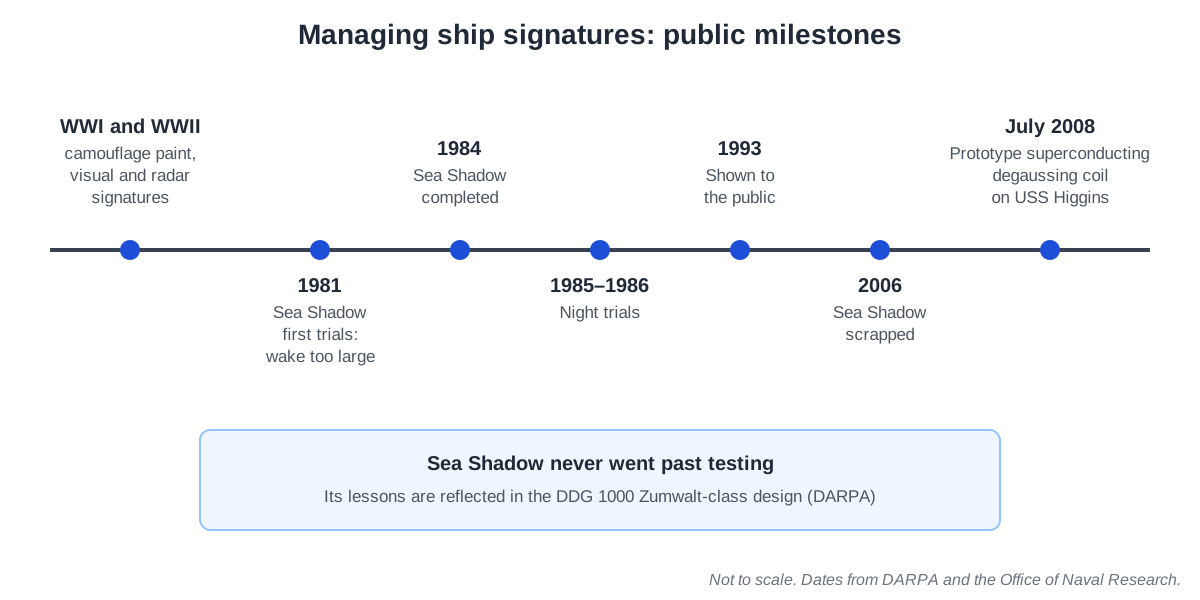
One of those newer ships is the DDG 1000 Zumwalt class. CRS lists several new technologies in this destroyer. They include the tumblehome hull described above and an upper structure built partly from large composite sections rather than steel or aluminum. Integrated electric drive is on the list too.
The composite superstructure was used on the first two ships only, not the third. For what a destroyer is, see Destroyers and frigates.
The limits: harder to see, never gone
By definition, stealth means reducing a signature. It does not mean removing it. Even Sea Shadow, built to test stealth concepts and materials, disappointed in its first trials because of its wake. It showed that while one signature is being refined, another can remain.
New technology also takes time to settle in. A June 2024 report from the Government Accountability Office (GAO), quoted by CRS, looked at the DDG 1000 program. All three ships were built, yet four critical technologies were still not mature. The Navy aims to prove three of them fully mature in operational testing, and those three deal with signature, computing and radar on the ships.
The idea that electric drive cuts signatures also appears as an expectation in the 2000 report. Phrases like "promises to be quieter" and "might reduce" describe a forecast, not a result. When reading public material on ship stealth, it helps to keep that difference in mind.
Where this meets lasers: the returning signal
Behind radar stealth sits one question: how much comes back? The law of reflection and corner reflectors are rules people first learn with light. Lasers work on the same question.
Finding distance by sending out light and timing its return continues in Measuring with lasers: range finding and lidar basics. Just as radar times a microwave echo, a laser rangefinder times an echo of light.
What to read next
- Radar cross section: why a big aircraft can look small: a closer look at the value that expresses echo size as an area.
- Radar-absorbing materials and structures: cutting the echo with materials rather than shape.
- Sonar: why sound is used to see underwater: the principle on the listening side.
- Stealth aircraft: truly invisible?: the aircraft history that ship stealth grew out of.