In January 1917, British codebreakers had a telegram from the German foreign minister in front of them. It was meant for the German envoy in Mexico, and Britain was not on the list of recipients. A few months later, the telegram was published widely in American newspapers.
Getting information from signals that other people send is called signals intelligence (SIGINT). This article explains what the term covers. It then follows how the agencies that do this work came into being, from World War I to the early Cold War, using the public history records of governments.
Radio waves do not belong only to the sender
Radio waves are the electromagnetic waves with the longest wavelength in the electromagnetic spectrum. Heinrich Hertz showed that they exist in experiments in the late 1880s. When you tune a radio to a specific frequency, it receives those waves and turns them into vibrations in the speaker, which you hear as sound.
One point matters here. A radio simply receives the waves. It does not ask whom they were meant for. The sender has a recipient in mind, but cannot stop another receiver from picking up the same waves.
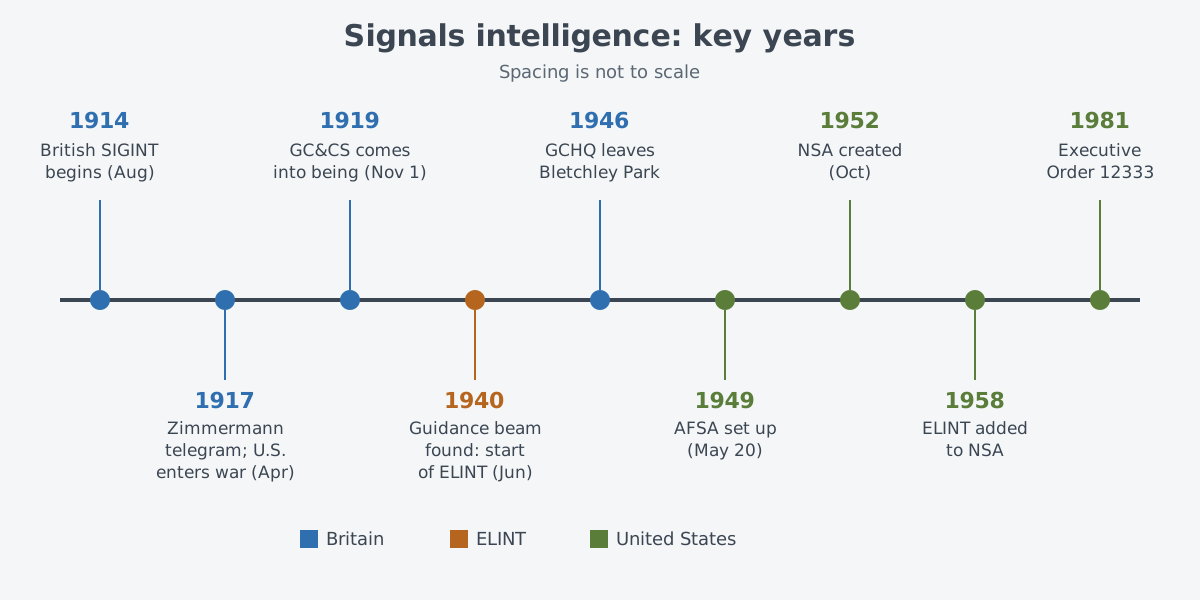
When World War I broke out in 1914, Britain paid attention to exactly this. According to GCHQ's history pages, the Admiralty and the War Office set up intelligence units because they judged that intercepting German radio traffic would let Britain anticipate German plans. British signals intelligence began that August.
Communications intelligence and electronic intelligence
Signals intelligence has two broad branches. One is communications intelligence (COMINT), which deals with messages that people exchange. Telegrams, radio messages and voice all fall here.
The other is electronic intelligence (ELINT). A CIA paper declassified in 1993 quotes the directive that defined it: collecting and processing information on foreign "non-communications" electromagnetic radiation. In other words, ELINT leaves out radiation used for voice or for communications such as telegraph. It covers signals that do not carry messages, such as radar and navigational aids.
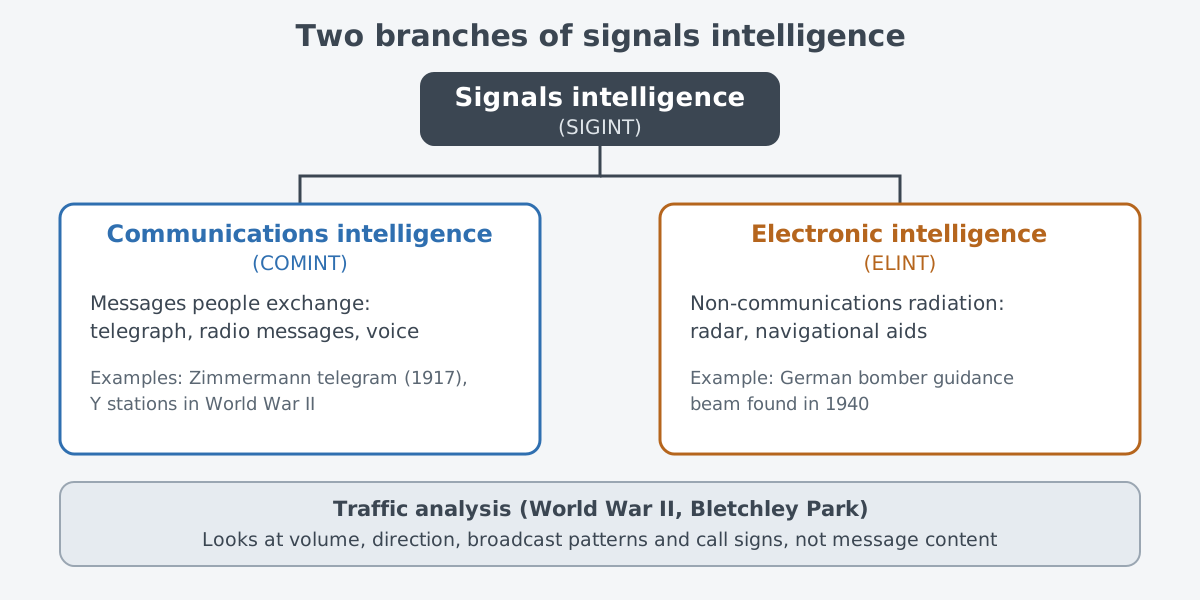
COMINT is a bit like reading a letter, and ELINT is a bit like watching a lighthouse beam to learn where the lighthouse stands. In practice, neither relies on the human eye. Both go through receiving equipment and the hands of analysts. Played aloud, such signals sound like the static a radio picks up during a thunderstorm.
World War I: what one telegram changed
Room 40 at the Admiralty and MI1(b) at the War Office were set up at the start of the war. Within a short time they had a sophisticated system for handling German radio traffic. From 1916 this intelligence helped against air raids, and it gave insight into German naval movements before the Battle of Jutland. During the major German offensive of 1918, signals intelligence staff worked on the front line.
The best-known case is the telegram from the opening. German Foreign Minister Arthur Zimmermann sent it to the German envoy in Mexico. It offered Mexico United States territory in return for joining the German side. British codebreakers deciphered it in January 1917.
Britain did not reveal what it had found right away. The U.S. National Archives explains that the British waited, to keep their intelligence work hidden and to make use of growing anti-German feeling in the United States. On February 24, Britain passed the telegram to President Wilson, and on March 1 American newspapers published it widely. On April 6, Congress declared war on Germany.
The National Archives judges that the telegram clearly helped pull the United States into the war. GCHQ sees the same episode as a lesson in balancing the use of intelligence against the protection of its source, a lesson it calls still relevant today.
Signals intelligence had proved its worth during the war, so Britain decided to keep the work going in peacetime.
The naval and military units merged into the Government Code & Cypher School (GC&CS), which became official on 1 November 1919. Its public job was to protect British government communications. Its secret mission was to break other countries' messages. This organization later took the name GCHQ.
World War II: listening stations and information beyond the content
Between the wars, GC&CS had great success against foreign diplomatic codes. It had much less success against the machine ciphers used by the armed forces of the countries Britain faced in 1939, Enigma being the most famous. When the war began, GC&CS relocated to Bletchley Park and started using the name GCHQ.
Where did the messages come from? Radio intercept stations across Britain, called Y stations, took down the enemy's enciphered messages. The Bletchley Park Trust calls them the "raw material" for the codebreaking and intelligence work.
Some sections at Bletchley Park looked at messages without breaking them at all, in work called traffic analysis. Instead of the content, it studied the volume, direction, broadcast patterns and call signs of enemy traffic. From that alone, analysts worked out how enemy forces were organized and where they were. It also added context to decrypted messages and drew intelligence even from messages nobody had broken.
It is a little like learning who writes to whom, and how often, just by looking at envelopes. Real traffic analysis, though, dealt with the whole daily flood of traffic rather than a few envelopes. SIXTA, the largest of these sections, was part of the operation against German Army and Air Force Enigma.
Electronic intelligence also began in Britain at this time. In June 1940, the scientist R. V. Jones concluded that Germany had built a radio beam to guide its bombers regardless of weather or darkness.
A Royal Air Force search aircraft then found the beam, and the CIA paper calls this "the birth of present day ELINT." Before the word ELINT existed, the British called the work "Noise Listening."
Insights from the Poles and the French, and new people such as Alan Turing, helped GCHQ at Bletchley Park grow into an industrialized intelligence agency. GCHQ credits Bletchley Park with producing intelligence that, in its words, saved thousands of Allied lives and with seeing the birth of modern computing. The story of the people who broke Enigma continues in "Enigma and Bletchley Park: The People Who Broke the Cipher Machine."
The Cold War: pulling scattered organizations together
After World War II, U.S. signals intelligence units were still split among the Army, the Navy and the Air Force. On May 20, 1949, the Armed Forces Security Agency (AFSA) came into being inside the Department of Defense to direct their communications and electronic intelligence work. In practice, though, AFSA had little power.
On December 13, 1951, President Truman ordered a committee to review the government's communications intelligence activities. Known as the Brownell Committee, it delivered its report, in five parts, on June 13, 1952. According to an editorial note from the State Department's Office of the Historian, its main finding was about duplication. Four organizations, the Army, the Navy, the Air Force and AFSA, were doing overlapping work in many areas.
In October 1952, Truman and the National Security Council (NSC) adopted most of the committee's recommendations, and the National Security Agency (NSA) was created in place of AFSA. Communications intelligence, once a military activity split among three services, became a single national activity.
Electronic intelligence was left out at first. The 1952 directive gave the NSA director no authority to collect ELINT, and that work stayed with the military services. In 1958, ELINT was added to NSA's responsibilities, making NSA the national authority for both branches of signals intelligence.
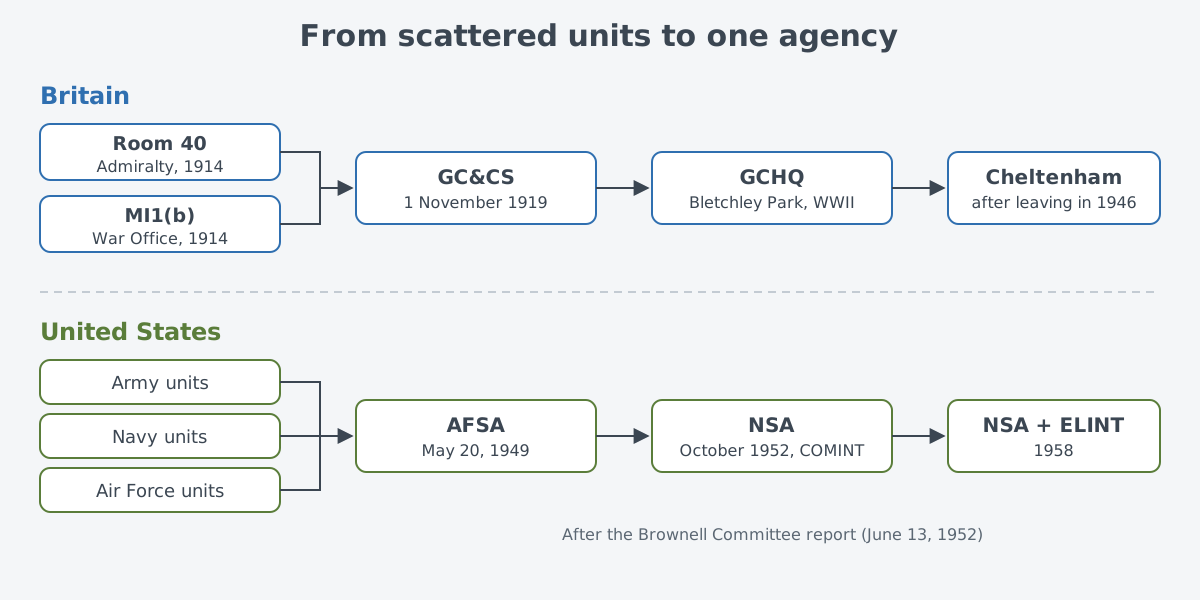
Britain's agency also moved after the war. GCHQ moved out of Bletchley Park in 1946. It spent a short time in the London suburbs and then settled in Cheltenham. Its opponent changed from the Axis powers to the Warsaw Pact, while its partnership with the United States and the Commonwealth went on.
Law, oversight and open questions
Listening to radio waves also means reaching into other people's communications. So laws and orders set out who may do this work and how far it may go.
In the United States, the main framework is Executive Order 12333, signed on December 4, 1981. It makes NSA responsible for setting up and running a single, effective organization for SIGINT. Without a delegation from the Secretary of Defense, no other department or agency is allowed to carry out SIGINT. Another line says that inside the United States, or when aimed at U.S. persons, intelligence agencies must choose the least intrusive collection method that is workable.
Today the U.S. Intelligence Community has 18 elements. A 2024 primer from the Congressional Research Service (CRS) describes NSA as specializing in cryptology, which covers signals intelligence and information assurance. It describes the National Reconnaissance Office (NRO) as building and operating satellites and ground stations mainly to collect imagery and signals intelligence. You can read more about gathering information from orbit in the reconnaissance satellites article.
The history in this article comes from records that intelligence agencies and governments released themselves. A line such as "saved thousands of lives" is best read as that agency's own assessment, with the speaker kept in mind. The same habit helps when reading news about laser weapons. How to sort out who said what, and on what basis, is the subject of How to read laser weapon news.
What to read next
- Electronic warfare: the invisible contest: what militaries do in the electromagnetic spectrum beyond listening.
- Radar: measuring distance and motion with radio waves: how radar works, the best-known kind of signal that ELINT listens to.
- Enigma and Bletchley Park: The People Who Broke the Cipher Machine: a separate article on World War II codebreaking.