When a news story mentions an "8,000-ton frigate," most readers take the number as the ship's weight. That is not wrong. But nobody put the ship on a scale. The number is the weight of the water the ship pushes aside.
The same ship can also have different numbers depending on the condition it was measured in, and even the ton comes in more than one size. This article explains what displacement means when people describe a warship's size, and what to check when you read the figure. It draws on a physics textbook and on public government and international sources.
A ship is held up by the water it pushes aside
Anything placed in water feels an upward push. This push is the buoyant force. Its size equals the weight of the water the object pushes aside, which is Archimedes' principle. When the object weighs more than this push, down it goes.
So how does a ship made of steel float? The textbook answers with clay.
Drop a lump of clay into water and it sinks. Shape the same clay into a boat and it floats. The boat shape pushes aside more water and gets more lift, while the amount of clay stays the same.
Steel ships work the same way. In the end, an object's average density decides whether it floats.
For a floating ship, the mass of the ship equals the mass of the water it has pushed aside. That is why a ship's weight can be stated as the amount of water it displaces, and that figure is its displacement. The same idea explains why a loaded ship sits deeper than an empty one. It is heavier, so it has to push aside more water to stay afloat.
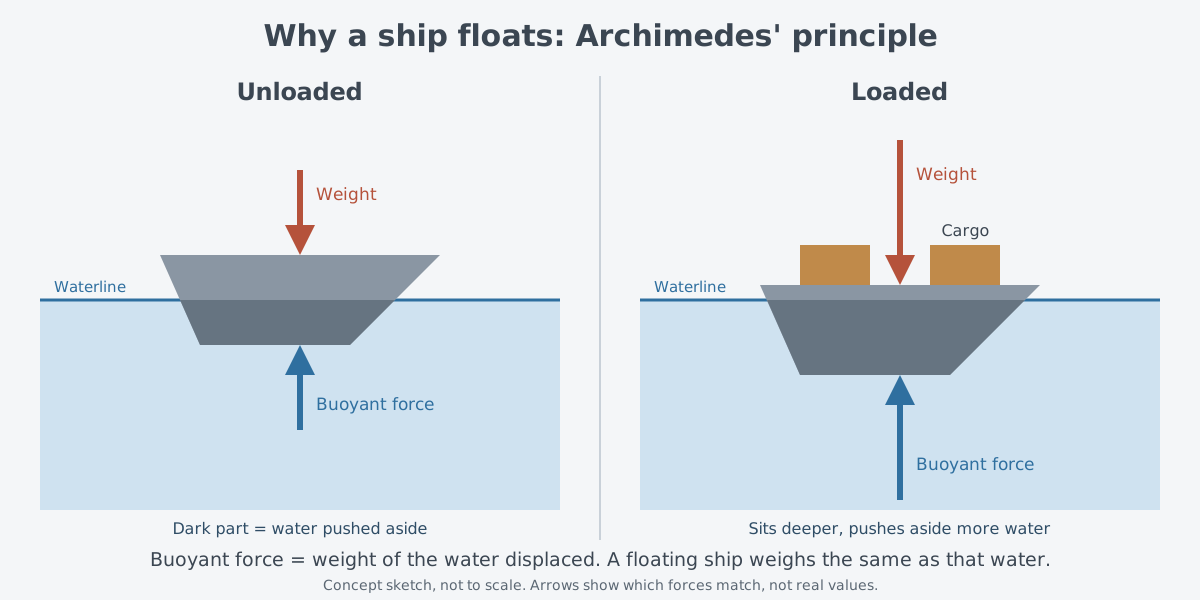
The clay boat is a handy picture, but a real ship is different. A warship takes on and unloads people, fuel, ammunition, and food, so the water it displaces keeps changing. To say a ship "displaces so many tons," you first have to say which condition the number describes.
One ship, several displacements
One place where that condition was written into treaty language is the Treaty for the Limitation of Naval Armament. It was signed in Washington on February 6, 1922. Its parties were the British Empire, France, Italy, Japan, and the United States. The treaty set limits on warship size, and it also wrote down how that size was to be measured.
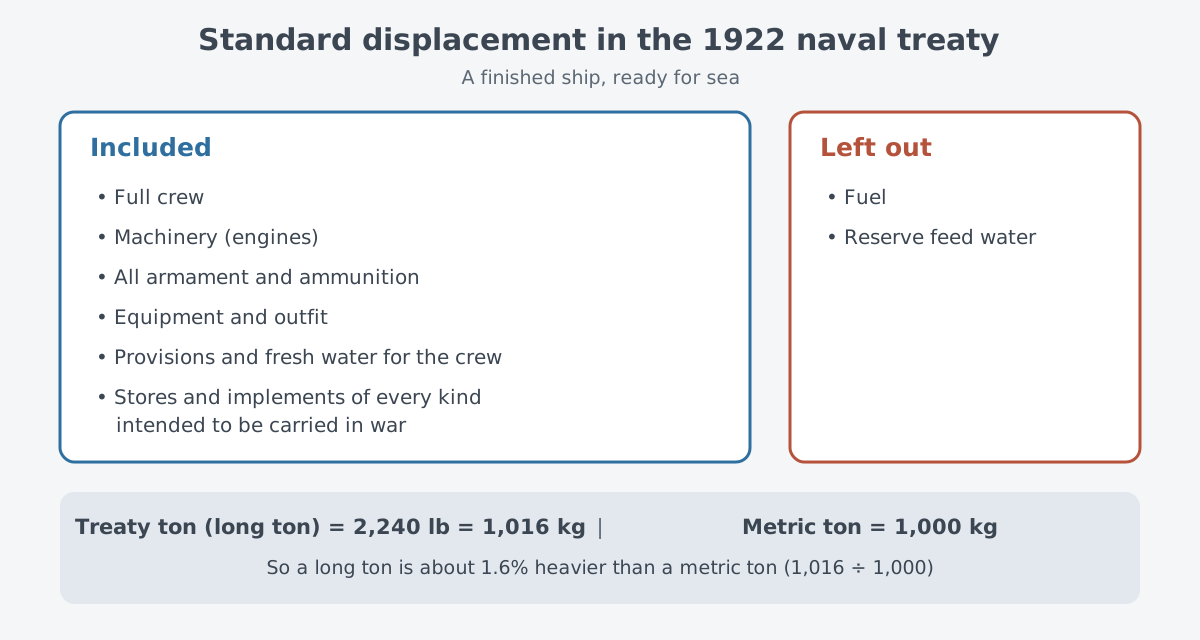
Under the treaty, standard displacement is the displacement of a finished ship ready to go to sea. It is fully manned and has its machinery and equipment aboard.
It carries all its armament and ammunition, its equipment and outfit, and provisions and fresh water for the crew. It also carries the stores and implements of every kind meant to be carried in war. Two things are left out: fuel and reserve feed water.
The treaty stated its limits in these terms. A capital ship was a warship, other than an aircraft carrier, whose standard displacement was over 10,000 tons or that carried a gun larger than 8 inches (203 mm). No capital ship over 35,000 tons standard displacement could be built or acquired.
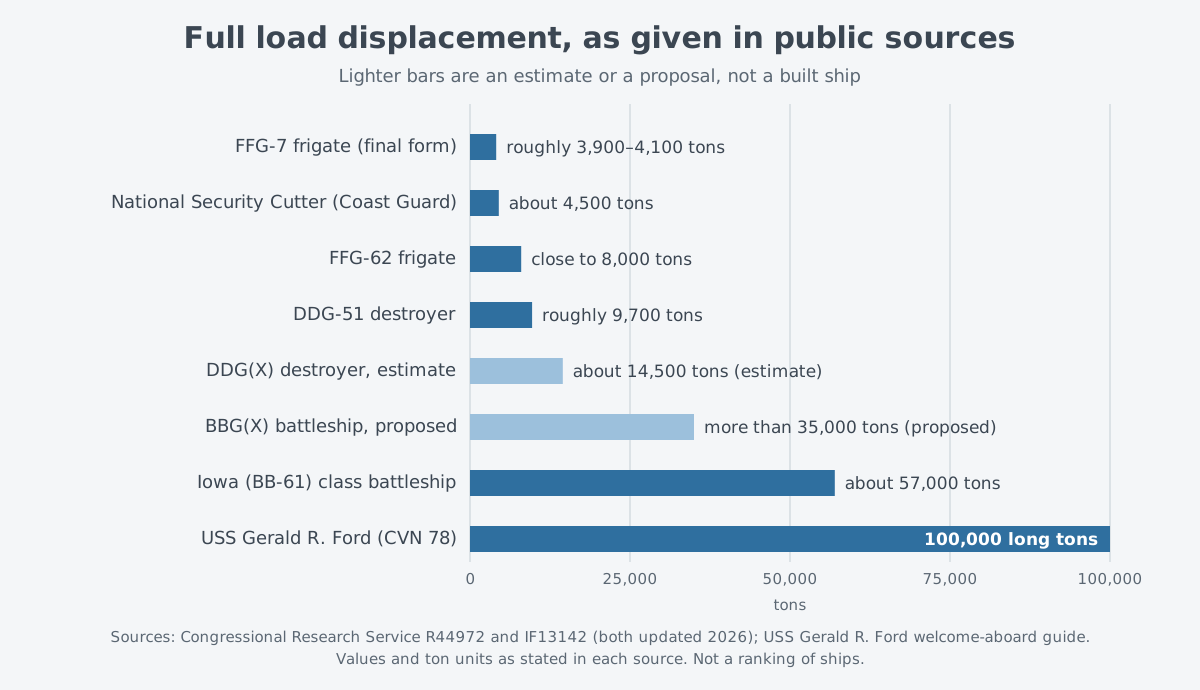
Today, U.S. government sources mostly describe ship size with full load displacement. A report from the Congressional Research Service (CRS) gives roughly 9,700 tons for the DDG-51 destroyer. It gives roughly 3,900–4,100 tons for the FFG-7 frigate in its final form, a class that joined the fleet from 1977 to 1989. The 1922 standard displacement leaves out fuel and is a different measure from the start, so the two figures should not be compared directly.
Not every ton is the same
The ton itself comes in more than one size. The 1922 treaty said that "ton," except where it said "metric tons," meant a 2,240-pound (1,016 kg) ton. The long ton found in U.S. sources today is a ton of this size. A metric ton is 1,000 kg, so a long ton is about 1.6% heavier.
The treaty text puts both units side by side, writing a limit as "10,000 tons (10,160 metric tons)." A country that stated displacement in metric tons was treated as holding the same displacement converted into 2,240-pound tons. Ships already finished kept the ratings measured under their own national systems.
The difference still shows up in today's sources. Naval Sea Systems Command described one ship as over 4,000 metric tons, and a CRS footnote gives that as over 3,936 long tons.
The welcome-aboard guide for the carrier Gerald R. Ford (CVN 78) lists the ship at "100,000 long tons full load." The ship was commissioned on July 22, 2017.
A 1.6% gap looks small for a single number. Still, when sources use different units, the same ship can appear to have different figures, so it pays to read what kind of ton is meant.
A merchant ship's tonnage is not a weight
Merchant ships add another twist. The "gross tonnage" (GT) quoted for a cargo ship or a passenger ship is not displacement. It has "ton" in its name, but it comes from volume, not weight.
In 1969 the International Maritime Organization (IMO) adopted a convention on tonnage measurement. It was the first attempt at one worldwide system that succeeded. It calculates gross tonnage and net tonnage (NT) separately. Gross tonnage depends on the volume of all the enclosed spaces in the ship, and net tonnage comes from a formula based on the volume of the cargo spaces.
Gross tonnage is the basis for crewing rules, safety rules, and registration fees, and both figures are used to work out port dues.
So a "tens of thousands of tons" cargo ship and a "tens of thousands of tons" aircraft carrier may not be measured on the same scale. One figure describes enclosed space. The other describes the weight of water pushed aside.
There is also an international agreement on how deep a ship may sit. IMO's Load Lines convention starts from a long-held view: limiting how deep a ship may be loaded does a great deal for its safety. The convention expresses that limit as a freeboard.
The first load line convention dates from 1930, and it rested on the idea of reserve buoyancy. The assigned load lines have to be marked on both sides of the ship at its middle, together with the deck line.
Length and names do not tell you the size
If two ships are about the same length, are they about the same size? The U.S. Navy's Iowa (BB-61) class battleships, built during World War II, were 887 feet long and displaced about 57,000 tons at full load. They carried large amounts of very thick, heavy armor plate.
The new guided missile battleship, BBG(X), proposed in December 2025, was described at 840 to 880 feet long and more than 35,000 tons full load. The lengths are close, but the displacements, about 57,000 tons against more than 35,000 tons, are far apart.
It works the other way, too. The FFG-7 was about 455 feet long and the DDG-51 is about 510 feet, a difference of roughly 12%. Their full load displacements, roughly 3,900–4,100 tons and roughly 9,700 tons, differ by more than a factor of two.
Type names do not settle the question either. CRS notes that the DDG-51, at 9,700 tons, and the FFG-62, at 8,000 tons, differ in size by under 20%. One is called a destroyer and the other a frigate, yet their displacements are fairly close. What letters like DDG and FFG mean is covered under ship type symbol.
Hull shapes and growing weight
The hull is the body of the ship. A ship with a single hull is called a monohull. Some ships, though, have several hulls side by side.
The U.S. Navy's Littoral Combat Ship (LCS) was built to two designs. A 2016 post from the Government Accountability Office (GAO) explains that the Freedom variant has a single steel hull topped with an aluminum superstructure. The Independence variant is built of aluminum alloy as a trimaran: one main hull with two smaller outrigger hulls beside it. Ships of the same type can differ this much in body shape and material.
Displacement is not a number that is fixed once and left alone. At contract award, the FFG-62 was expected to displace about 7,300 or 7,400 tons at full load. That estimate rose by several hundred tons while the design was worked out, ending close to 8,000 tons.
Weight can keep growing after a ship enters service. When the Navy designs and builds a new ship, it tries to keep a "service life allowance," a 2013 GAO report explains. This is room for the weight to grow, so that new and heavier equipment can be added during the ship's years of service. The Navy usually sets this allowance for two things, the ship's overall weight and its vertical center of gravity, which governs stability.
How adding new equipment to a finished ship differs from building it in from the start is picked up on the ship side of the laser article Weight and platforms.
What to read next
- Destroyers and frigates: why warships have different names: the history behind names that no longer match size.
- Aircraft carriers: turning a ship into an airport: what goes inside a 100,000-long-ton ship.
- Weight and platforms: fitting on a vehicle, ship or aircraft: the conditions to weigh when a laser weapon goes on a ship.