Robot arms welding car bodies along a painted line on a factory floor are a familiar sight. Ask which country has the most of these robots for the size of its workforce, though, and the answer is Korea. In the same country, the past few years have brought large deals and government plans built around robots that walk on two legs like people.
Hyundai Motor Group bought the US robot maker Boston Dynamics. Samsung Electronics announced that it would become the largest shareholder of Rainbow Robotics, a company that grew out of KAIST. The government, for its part, put out a robot strategy, a basic plan and a humanoid alliance.
Which of these have already happened, and which are still plans? The company announcements and government documents here were checked in October 2026.
The country with the densest factory robots
A common yardstick for how widely robots are used is robot density. It is the number of industrial robots in operation divided by the number of manufacturing employees, usually given per 10,000 employees. Using the workforce as a gauge of how big an economy is puts large and small countries on the same scale.
In World Robotics 2025 figures released on April 8, 2026, the International Federation of Robotics (IFR) put Korea first in the world at 1,220 robots per 10,000 employees. That figure has grown by 7% a year on average since 2019. Singapore follows with 818, then Germany with 449 and Japan with 446, while the United States ranks eighth with 307. The world average is 132.
Korea's electronics and automotive industries stand behind this number, as the two biggest buyers of industrial robots. In the January 2024 release (World Robotics 2023), Korea stood at 1,012, so the figure has kept rising since then.
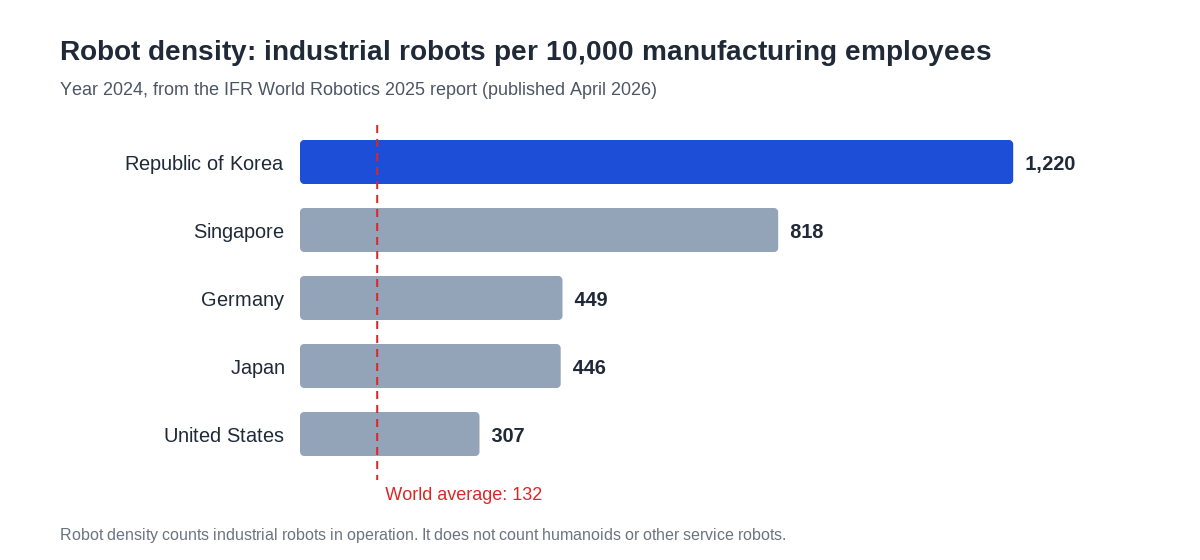
Robot density counts industrial robots such as the arms on a factory line. It says nothing about how far walking robots or humanoids have spread. Still, the large number of robot-buying factories in Korea helps explain why the company plans below keep pointing at factories.
A story that began with Hubo
On June 5–6, 2015, the finals of the DARPA Robotics Challenge took place in Pomona, California. The US Defense Advanced Research Projects Agency ran it to push human-supervised robot technology for disaster response. Team KAIST took first place. DARPA's page on the contest still shows its robot, DRC-Hubo, cutting an opening in a wall with a tool.
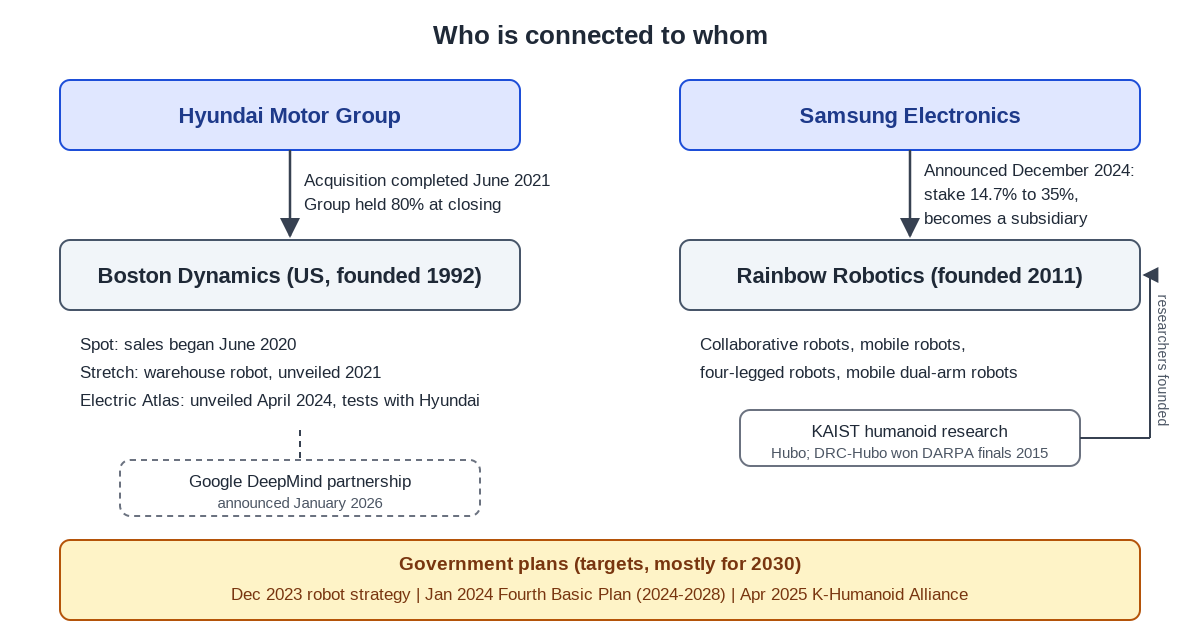
Hubo is a two-legged walking robot developed at KAIST's Humanoid Robot Research Center. Samsung Electronics' 2024 announcement describes Hubo as Korea's first robot to walk on two legs, and says the researchers who built it founded Rainbow Robotics in 2011. A robot from a university lab turned into a company.
Starting from Hubo's core technology, Rainbow Robotics has brought collaborative robots, mobile robots, four-legged walking robots and mobile dual-arm robots to market. A collaborative robot is a robot arm made to work alongside people, and a mobile dual-arm robot puts two arms on a wheeled body. The company calls itself a "full-stack robotics company."
Hyundai Motor Group and Boston Dynamics
Boston Dynamics was founded in 1992 as a spin-off from the Leg Lab at MIT in the United States. It showed the first generation of its humanoid Atlas in 2013 and, in June 2020, began selling the four-legged Spot as its first commercial robot. Around the time of the 2021 acquisition, it also introduced Stretch, the first product it designed specifically for warehouses and distribution centers.
On June 21, 2021, Hyundai Motor Group completed its purchase of a controlling interest in the company from SoftBank. This came after regulatory approvals and other conditions were met. The deal valued Boston Dynamics at US$1.1 billion, and no other financial details were disclosed. At closing, the group held 80%, and SoftBank kept the remaining 20% through an affiliate.
The deal was meant to give the group a robotics value chain, from making robot components to smart logistics solutions. A company that builds cars in large numbers and a company that builds walking robots now sat in the same group.
Atlas heads for the factory: plans and dates
The electric Atlas, unveiled in April 2024, came with a plan to test its uses with a small group of customers over several years, starting with Hyundai. The companies are covered one by one in A Map of Humanoid Robot Makers: Tesla, Figure, Boston Dynamics, Unitree and More.
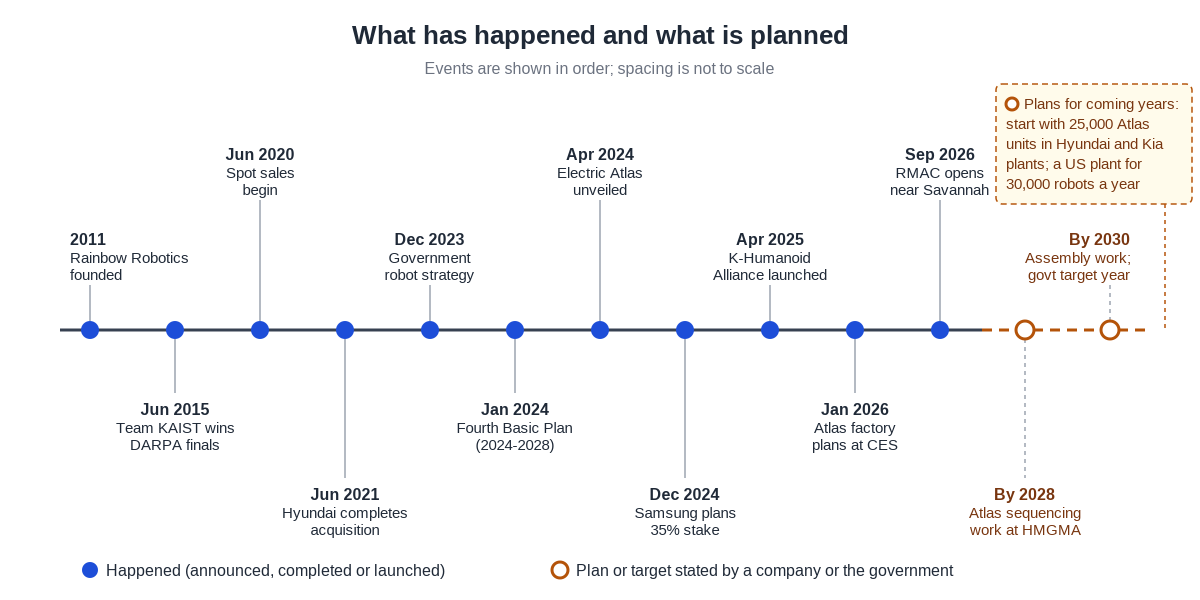
At CES on January 6, 2026, Hyundai Motor Group put dates on its plans. First, a facility called the Robot Metaplant Application Center (RMAC), where robots are trained and validated before they go to a factory, was set to open in 2026. Second, Atlas robots trained there would start sequencing tasks by 2028 at HMGMA, the group's plant in Georgia in the United States. More complex work such as assembly would start by 2030.
The first plan came true that autumn. Boston Dynamics announced on September 21, 2026 that RMAC had opened inside Hyundai Motor Group Metaplant America near Savannah, Georgia.
The group also laid out two more plans for the coming years. It would begin with 25,000 units across Hyundai and Kia plants and widen from there. It would also build a US plant able to make 30,000 robots a year. Both numbers are still plans.
At CES in January, Boston Dynamics and Google DeepMind also announced a partnership. The plan is to pair Boston Dynamics' humanoids with DeepMind's Gemini Robotics models. The plans also include a loop in which data from real factory work flows back to RMAC to retrain the robots.
The RMAC opening has happened, while 2028, 2030, the 25,000 units and the 30,000-a-year plant are targets the company has set. An Atlas prototype was first shown at the group's CES 2026 Media Day. Instead of a public price, Boston Dynamics' Atlas page says its team will contact qualified prospects, and it lists a four-step path to adoption: prepare, evaluate, train and adopt.
Samsung Electronics and Rainbow Robotics
On December 31, 2024, Samsung Electronics announced that it would become the largest shareholder of Rainbow Robotics. It had first bought a 14.7% stake in 2023 for KRW 86.8 billion, and the next step was to exercise a call option that raises the stake to 35%. A call option is a right to buy more shares on terms agreed in advance.
With the larger stake, Rainbow Robotics becomes a subsidiary included in Samsung Electronics' consolidated financial statements. The aim is to speed up work on future robots such as humanoids. Rainbow Robotics' collaborative robots, its two-armed mobile robot and its self-driving mobile robots are also to be put to work automating Samsung's own factories and logistics.
Samsung also set up a Future Robotics Office that reports directly to the CEO. Oh Jun-Ho, one of Rainbow Robotics' founders and an honorary professor at KAIST, was named to lead it. He was to leave Rainbow Robotics and serve Samsung as an advisor while running the office.
This relationship is at a different stage from Hyundai and Boston Dynamics. The first is an acquisition completed in 2021, while Samsung's larger stake was announced at the end of 2024. Both companies name humanoids as a goal, but what actual products appear, and when, will only be clear from each company's later announcements.
Government plans: a strategy, a basic plan and an alliance
On December 14, 2023, the Ministry of Trade, Industry and Energy announced its "Advanced Robot Industry Vision and Strategy." Its targets for 2030 include more than KRW 3 trillion in public and private investment and a market of more than KRW 20 trillion. It also aims to deploy more than 1 million robots across manufacturing, logistics, welfare and safety.
Other goals are to train more than 15,000 specialists and to grow more than 30 intelligent robot companies with sales above KRW 100 billion. The plan also invests KRW 200 billion in a national robot test field.
The announcement also says advanced robots have the potential to reach beyond traditional manufacturing such as cars and shipbuilding into new fields such as the defense industry, space and aviation. Here a government document names the point where robots meet defense.
A month later, on January 16, 2024, the government confirmed its "Fourth Basic Plan for Intelligent Robots (2024–2028)." The Intelligent Robots Act calls for such a plan every five years, and this one puts the earlier strategy into action. It aims to raise the domestic share of core robot components to 80% by 2030, secure more than 15,000 core specialists, revise 51 regulations and prepare robot ethics guidelines.
On April 10, 2025, the "K-Humanoid Alliance" was launched. About 40 companies, universities and other groups signed the agreement, and the government said it expects more than KRW 1 trillion in investment by 2030. The plans include developing a robot AI foundation model for robot makers to share by 2028 and building infrastructure such as virtual simulators, with a "Korean Cosmos" as the goal.
Telling announcements, plans and sales apart
Robot news often spreads as video first, and even the events in this article sit at different stages. The Boston Dynamics acquisition is a deal completed in 2021, and Spot is a product on sale since 2020. The electric Atlas was unveiled in 2024, went through customer tests and got its training center in September 2026. Factory work (2028 and 2030) and the 25,000-unit rollout are plans.
Government numbers need the same care. One million robots, KRW 3 trillion and 80% are targets for 2030, and KRW 1 trillion is the investment expected when the alliance launched. How far each target is met has to be checked against later government reports.
Company self-descriptions also deserve a careful read. Boston Dynamics calls Atlas "the world's first enterprise-grade, industrial humanoid robot," and its About page calls Atlas "the world's most dynamic humanoid robot." These are the company's own words for promoting its products, not results of tests against other companies' robots.
As numbers for Korea's robotics industry, robot density is already high, while humanoids are at the stage of plans and trials. Keeping those two stories from blurring into one number is the first step in reading news from this field.
What to read next
- What Is Physical AI: Artificial Intelligence with a Body: the broader trend behind Atlas and Gemini Robotics.
- A Map of Humanoid Robot Makers: Tesla, Figure, Boston Dynamics, Unitree and More: companies outside Korea, side by side.
- Defense Research Agencies: What DARPA and ADD Do: the agency that ran the robotics challenge Hubo entered.
- Dual-Use Technology: When Civilian Tech Becomes Military Tech: how factory robots and defense meet.
- The Debate over Military Physical AI: Company Policies and International Talks: what robot makers have pledged about weapons.