In the summer of 2003, a new request began to come from U.S. forces in Iraq. They wanted more "up-armored" Humvees: the wheeled, multipurpose HMMWV with extra armor. Four years later, in 2007, the U.S. Department of Defense (DOD) began a major purchase to replace most up-armored Humvees in Iraq with a different vehicle, the MRAP.
What changed the vehicle? Bombs hidden by the road, known as improvised explosive devices (IEDs). This article follows the change from armor kits to the MRAP and then to the M-ATV for rough terrain, after IEDs came to cause a large share of U.S. casualties. The sources are reports to Congress by the Government Accountability Office (GAO) and the Congressional Research Service (CRS).
It looks at how fast the purchase moved and what that speed cost. It also asks why the numbers on effectiveness do not settle on a single value.
Roadside bombs cause a large share of casualties
"IED" is a term that covers both roadside bombs and suicide car bombs. A February 2008 CRS report found that IEDs had caused over 70% of all U.S. combat casualties in Iraq, and 50% of those in Afghanistan. These figures count both killed and wounded, and they rest on Defense Manpower Data Center counts from October 7, 2001, through August 18, 2007.
A July 2008 GAO report gives a slightly different value, putting about 75% of casualties in current combat operations down to IEDs, with the two wars taken together. The two figures come from different dates, and one counts each war separately while the other combines them.
U.S. troops were not the only victims. Car bombs also hit police stations, markets and mosques, and the dead included local people along with U.S. troops.
The first answer: more armor on the Humvee
The first answer was to harden the vehicles already in use. From the summer of 2003, forces asked for up-armored Humvees and add-on armor kits to protect soldiers and Marines on distribution and force protection missions. The up-armored Humvee gives more protection against rifle rounds and blasts, and the add-on kit gives some extra protection to a vehicle that had none.
Supply did not keep up. In September 2004, the theater had 5,330 up-armored Humvees against a need for 8,105. In a Center for Army Lessons Learned study cited by GAO, the risk of IED harm to people and equipment fell sharply in an up-armored Humvee.
Trucks fared much the same: in November 2003 the Army first set a need for 3,780 armor kits for five types of trucks. It did not finish building them until February 2005, or installing them until May 2005. That took 18 months from the first request, and by then the need had grown a great deal. For the 7,847 kits added later, the time from request to delivery grew shorter.
The Marine Corps was raising a different need. In February 2005, Marine commanders filed an urgent operational need for armored tactical vehicles for areas made dangerous by IEDs, rocket-propelled grenades and small arms fire. At first the Marine Corps chose the up-armored Humvee as the answer. Over the next 18 months, the field kept asking for vehicles with stronger mine protection.
A contest of adaptation
Did more armor end the problem? Insurgents adapted quickly to countermeasures, and by 2008 newer, more sophisticated IEDs were in growing use. Several DOD officials said protective equipment sometimes seemed less effective after only a few months in the field.
The U.S. response did not rest on vehicles alone. Gathering intelligence and jamming, which disrupts parts of the radio spectrum, were major lines of effort. In January 2006, DOD set up the Joint IED Defeat Organization (JIEDDO) to lead and coordinate the counter-IED effort; a February directive then tasked it with the counter-IED strategic plan. According to a 2012 GAO report, over $18 billion had been appropriated to JIEDDO, and there was a widespread consensus that the IED threat would remain influential in future conflicts.
Handling information was part of the contest. DOD tightly controlled IED threat data so that the enemy would not learn which designs had worked and which had not. As a result, some in the industry that built countermeasures said they could not get all the information they needed.
What an MRAP is
MRAP stands for Mine-Resistant, Ambush-Protected. The name covers not one model but a family of vehicles built by a range of U.S. and foreign companies. Most use a "V"-shaped hull and armor plating to protect against mines and IEDs.
The MRAP program was a joint effort headed by the Navy and Marine Corps to buy armored vehicles that protect people from mine blasts, fragments and direct-fire weapons. The vehicles came in three categories by size and role.
| Category | Size and role | Carries |
|---|---|---|
| I | Smallest. Mainly urban operations | Up to 7 people |
| II | Multi-mission: security, convoy escort, troop or cargo transport, medical, explosive ordnance disposal, engineering | Up to 11 people |
| III | Largest. Mainly clearing mines and IEDs | Up to 13 people |
The MRAP did not first appear in 2007. Since 2003, the Army and Marine Corps had used two of them, the Category III Buffalo and the Category II Cougar, in small numbers in Iraq and Afghanistan. Their main jobs were route clearance and explosive ordnance disposal. These vehicles soon gained a name for protecting their crews well, and some suggested they might carry troops better than up-armored Humvees.
A timeline, 2003–2011
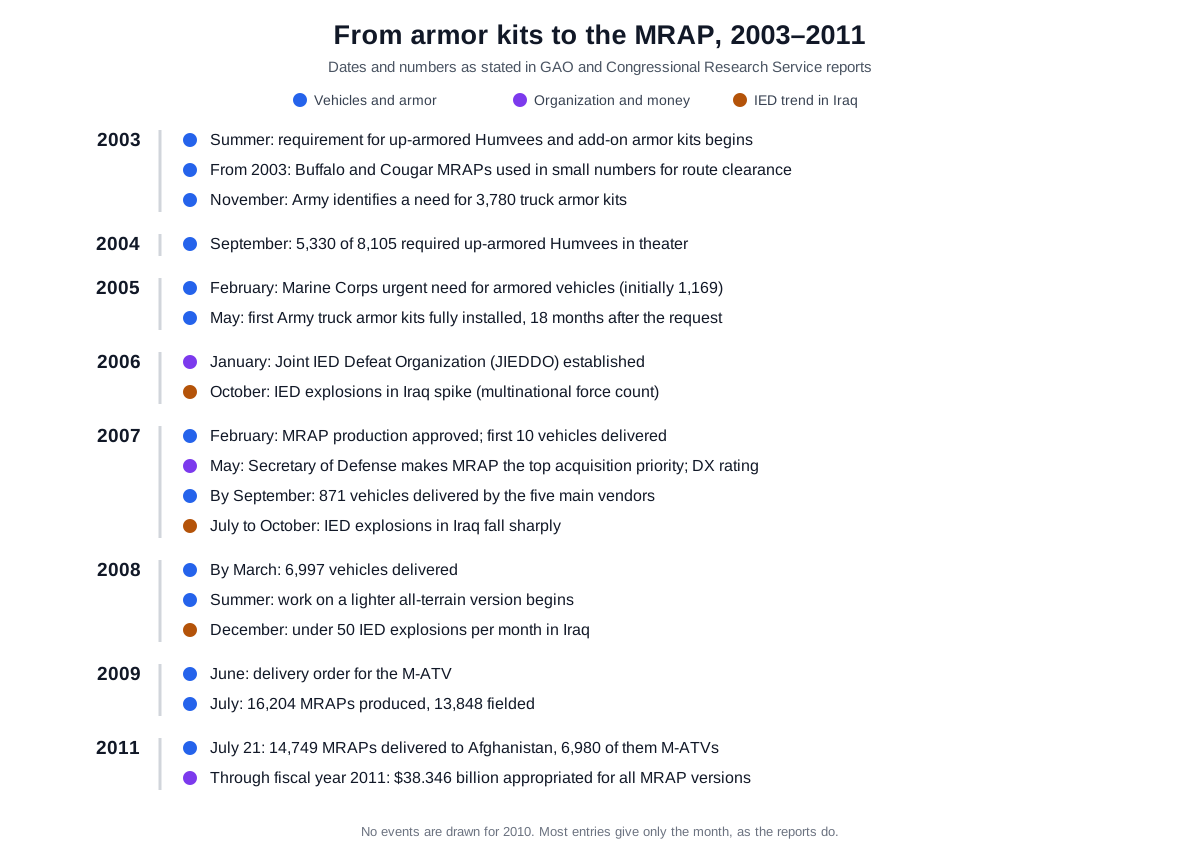
The early part of the timeline is the period of adding armor to existing vehicles, and from 2007 the MRAP purchase takes center stage. From the summer of 2008, a lighter version for Afghanistan's terrain follows its own track.
The top acquisition priority
From early 2007 the required numbers grew fast. Marine Corps leaders reportedly decided in February 2007 to replace all up-armored Humvees in Iraq with MRAPs, while the Army planned to keep relying on its Humvees. On March 26, 2007, the DOD-wide requirement stood at 7,774 vehicles. In May, Army leaders also began to weigh the same idea, and on June 28 the Joint Requirements Oversight Council (JROC) reportedly endorsed replacing every Humvee with an MRAP.
The numbers show the scale of the change. The Marine Corps' 1,169 vehicles in the 2005 urgent need statement became an approved requirement of 15,838 vehicles by July 2008, plus 133 for ballistic testing. The Army's share alone was 12,000.
A memo from the secretary of defense settled the decision. On May 2, 2007, Secretary of Defense Robert Gates wrote that "the MRAP program should be considered the highest priority Department of Defense acquisition program." That same month he set up the MRAP Task Force. He also approved a DX rating, which requires related contracts to be accepted and carried out ahead of contracts without that rating.
The way of buying was unusual too. Requirements were kept to a minimum, and the program leaned heavily on vehicles already on the market. Judging that no single company could supply all the vehicles in time, DOD signed contracts with nine companies and bought at least 4 vehicles from each for testing. Mission equipment such as radios went in at a government site after the vehicles were bought.
That work fell to the Space and Naval Warfare Systems Center (SPAWAR) in Charleston, South Carolina, which finished 1,157 vehicles in April 2008 alone. DOD put money into expanding steel and tire production. Some companies bought steel and parts with their own money before orders came in. Their contracts did not require it, and the companies carried the risk.
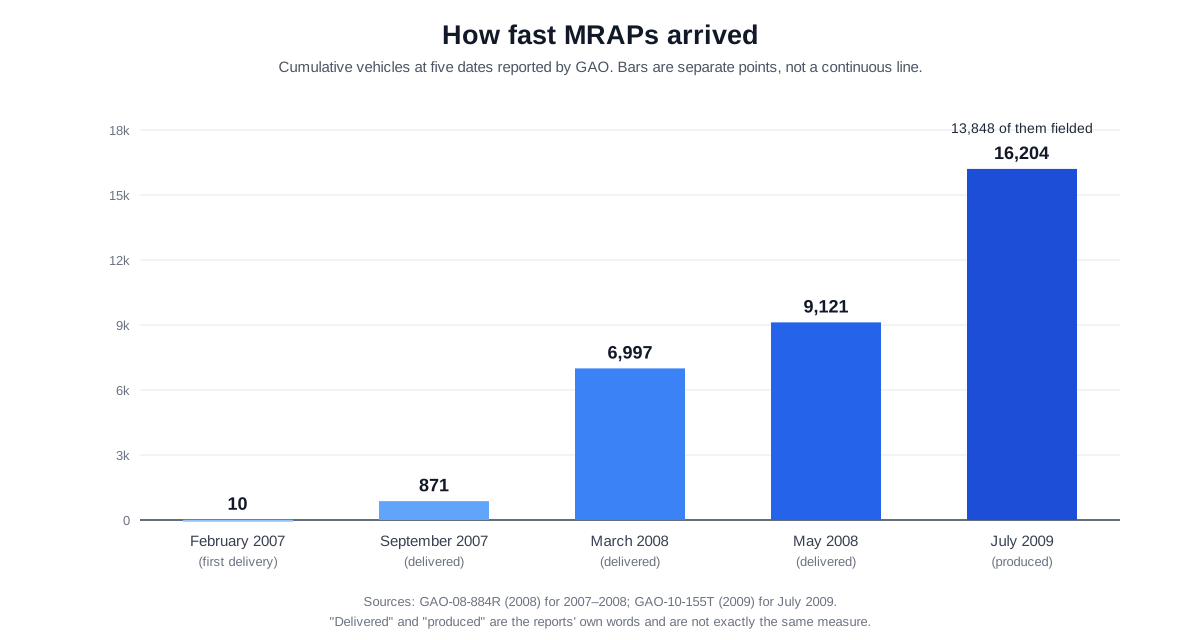
Deliveries began in February 2007 with 10 vehicles from one company. By September 2007, 871 had arrived; by March 2008, a little over a year after the contracts, 6,997; and by May 2008, 9,121. As of July 2009, 16,204 MRAPs had been produced, and 13,848 of them were in use in the two wars.
Speed had a price. DOD policy normally calls for weapons to be fully tested before they reach users. For the MRAP, thousands of vehicles were ordered before operational testing began, and thousands more before it ended. GAO judged that this approach delivered an urgently needed capability but also raised performance, sustainability and cost risks.
The numbers on effectiveness
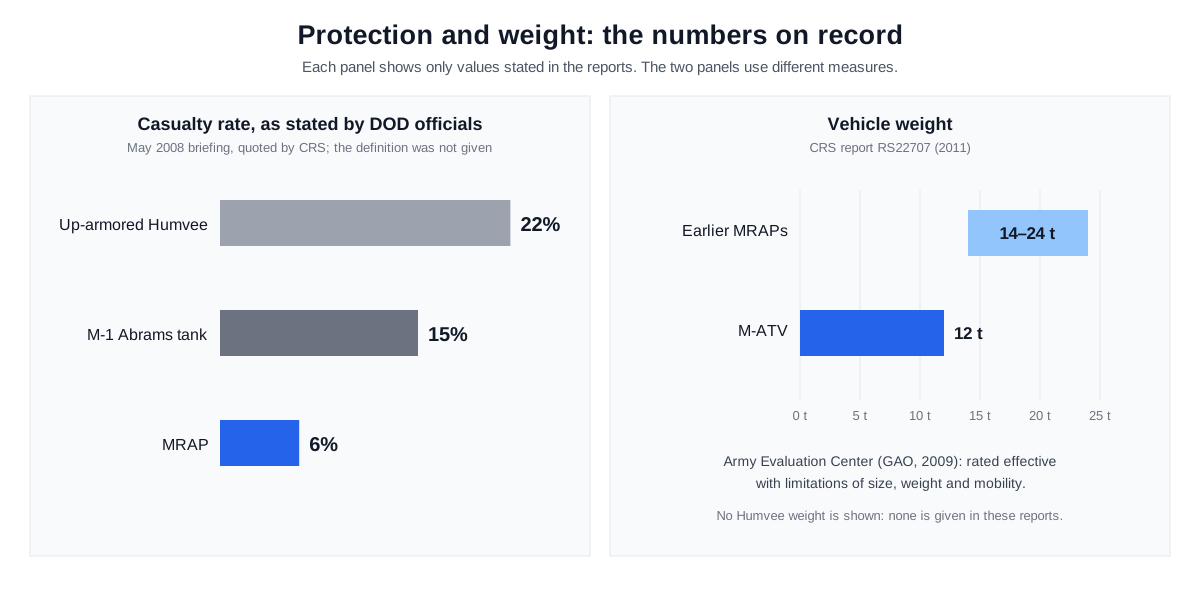
How well did the MRAP protect people? In a May 2008 briefing, DOD officials gave the MRAP a casualty rate of 6% and called it the most survivable vehicle in the U.S. arsenal. They put the M-1 Abrams tank at 15% and the up-armored Humvee at 22%. The record does not say how the rate was calculated.
Larger figures exist too: in a 2011 newspaper interview with the departing Secretary Gates, it was suggested that MRAPs were 10 times safer than Humvees during IED attacks. The MRAP Joint Program Office reportedly estimated that MRAPs had saved up to 40,000 lives, with 10,000 of them in Iraq and 30,000 in Afghanistan. It based the estimate on the number of attacks and the troops inside the vehicles. Some defense experts said these estimates seemed too high.
Views in the field depended on the job. In a field survey of over 300 soldiers, troops were satisfied with the MRAP overall. They saw it as well suited to combat logistics patrols, route clearance, raids, quick reaction forces and other missions with a large force on foot. They saw it as poorly suited to mounted patrols in tight urban areas or long off-road operations.
Over the same period, IED explosions in Iraq fell sharply. The count spiked in October 2006 during Ramadan, stayed high until July 2007, and then fell sharply until October 2007. By December 2008 they were below 50 per month, back to the level of early 2004.
That figure counts explosions that happened, not attacks a vehicle withstood. So it measures something other than the vehicle's effect.
Commanders said rapidly fielded counter-IED equipment and approaches saved lives. Yet other factors are also named for Iraq's security gains, such as the added surge forces and many Sunni Arabs turning against violence. In early 2008, effective IED attacks in Afghanistan were in fact rising.
Limits of a heavy vehicle, and the M-ATV
Protection came with weight. The Army Evaluation Center rated every MRAP effective "with limitations," and those limitations included vehicle size, weight and mobility. DOD also accepted that MRAPs had limits, above all in off-road mobility and transportability. Problems with reliability, mobility and safety led to design changes, fixes after production, and changes in how the vehicles were used.
Concerns had already surfaced in 2007. The Marine Corps said MRAPs were not expeditionary because of their logistics needs, and that they did not suit ships. Moving them far was costly as well. According to press reports, shipping one MRAP cost $135,000 by air and $18,000 by sea.
Afghanistan's roads exposed these limits further. In the summer of 2008, DOD began to look at a lighter MRAP that could handle bad roads and rough terrain. The result, the M-ATV, weighs 12 tons, lighter than the 14–24 tons of earlier MRAPs, and moves better off-road.
The delivery order went out in June 2009. Once again production and testing overlapped heavily, so any test problems carried a risk of costly rework.
DOD approved a purchase goal of 25,700 vehicles, 8,100 of them M-ATVs. By July 21, 2011, Afghanistan had received 14,749 MRAPs, including 6,980 M-ATVs. Yet many MRAPs sent to Afghanistan were not in use, because they had been judged too heavy for some roads and short on cross-country mobility.
The threat did not stand still either. As Afghan insurgents used larger IEDs, casualties among M-ATV occupants rose, and DOD added more armor to the M-ATV. That armor was meant to protect the crew better, but there was concern that it could make the vehicle heavier and less stable. The worry was that it could be too heavy for many roads in Afghanistan and more likely to roll over.
What it left behind
Start with the money. Through fiscal year 2011, appropriations for every MRAP version came to $38.346 billion. The largest year was fiscal 2008, at $16.838 billion, and no procurement funds were requested for fiscal 2012. Production funding up to 2009, about $22.7 billion, came mostly from supplemental rather than regular appropriations.
GAO split the lessons of this purchase into two groups. Declaring it the top priority with a DX rating, and having supplemental funds, were major reasons for its success, yet both are hard to carry over to other programs. Using only proven technologies, keeping requirements to a minimum, adding strong competition and keeping final integration with the government were, in its view, transferable.
The vehicles also left work for after the war. With the Iraq drawdown, the Army and Marine Corps planned to store most early MRAPs overseas, bring some home for training, and give some to logistics and route clearance units. These plans changed as more troops went to Afghanistan. Even in 2009, long-term sustainment costs were not yet well understood.
The next vehicle was already on the way. Starting in fiscal 2012, the Army and Marine Corps planned to phase in the new Joint Light Tactical Vehicle (JLTV) in place of the Humvee fleet. In August 2009, GAO pointed out a risk of unplanned overlap among the MRAP, the M-ATV and the JLTV, one that needed to be managed.
This story meets lasers once. A press report repeated in the February 2008 CRS report said the Army planned to put a 1-kilowatt solid-state laser able to destroy IEDs on a vehicle by 2010. What came of that plan is not recorded there. For what a laser weapon really is and how it differs from the movies, see What is a laser weapon?
Within a few years, roadside bombs changed the shape of U.S. military vehicles, the way they were bought and where the money went. What remained was a purchase goal of 25,700 vehicles, and the question of where to stand between protection and mobility.
What to read next
- Infantry fighting vehicles and APCs: how they differ from tanks: the basic kinds of armored vehicles that carry troops.
- Composite and reactive armor: the blocks on a tank: the principles of the armor materials that protect vehicles.
- Active protection systems: defending beyond the armor: ways to protect a vehicle other than thicker armor.
- Military logistics: performance must be sustainable: what it takes to keep a large fleet running over time.
- Jamming and spoofing: interference versus deception: the basic ideas behind radio interference.
- "The Iraq Insurgency and the Surge: The War After the War": the political and military background to the rise of roadside bombs in Iraq.
- "The War in Afghanistan, 2001–2021: Twenty Years in Outline": the other war in which the M-ATV served.