In June 2010, about 7.7 million km from Earth, a square sheet 20 m across its diagonal unfolded in space. It was 0.0075 mm thick and made of a plastic called polyimide. This was IKAROS, a solar sail test craft built by the Japan Aerospace Exploration Agency (JAXA).
Wind did not push this sail. Sunlight did. Yet light has no mass.
How can something massless push an object, and how weak is that push? The answer comes from the momentum that light carries, plus two numbers.
No mass, but momentum
Throw a ball at a box and the box slides a little. The ball hands its momentum to the box. You can think of momentum as the amount of "shove" a moving thing can pass on when it hits something.
A photon, the particle of light, has no mass but does carry momentum. When photons strike a plate, whether they are taken in through absorption or bounce off, that momentum passes to the plate. The more photons hit each second, the larger the force. This force, spread evenly over a surface, is called radiation pressure.
The ball picture only goes so far. A ball's momentum depends on its mass and speed, while a photon's momentum depends on its energy alone. So the pressure on a plate follows the intensity of the light, not its color. For how photons relate to wavelength, see light basics.
The name invites one mix-up. The Sun also gives off a stream of particles called the solar wind, but that is not what drives a solar sail. Sunlight is. A NASA solar sail presentation makes the point in a slide title: sunlight, "not the Solar Wind!"
Absorb once, reflect twice
Picture a black plate and a mirror standing side by side in sunlight. The black plate takes in the light, and the photons' momentum stops there. The plate gets one push, equal to what the photons brought.
A mirror sends the light back. Each bouncing photon gives up the momentum it brought and leaves with new momentum pointing the other way. The plate gets that share as a second push. An ideal mirror that reflects all light hitting it straight on feels twice the pressure of a plate that absorbs everything.
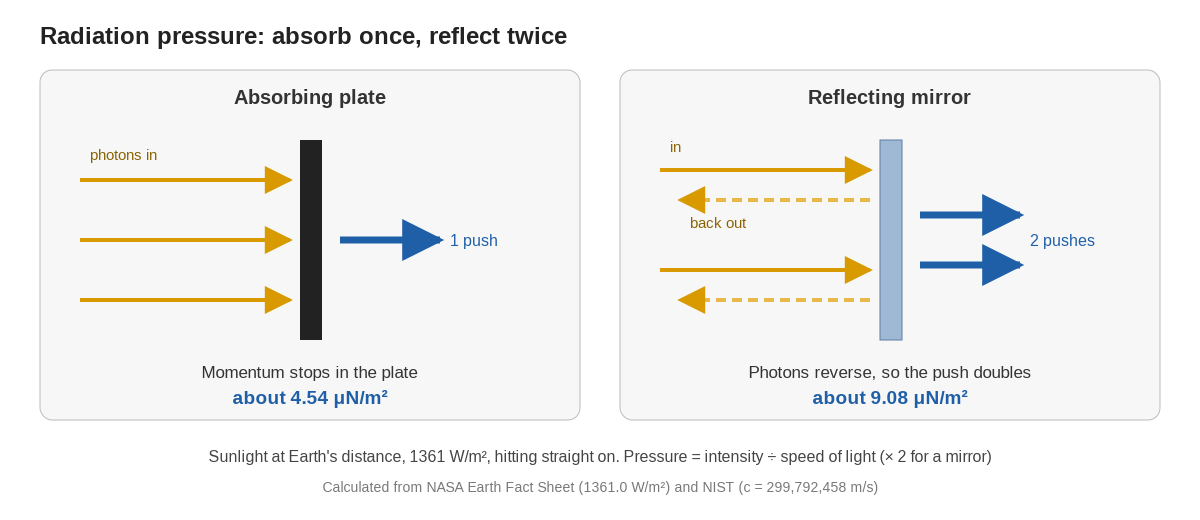
This is why solar sails are thin, shiny sheets. The better a sail reflects, the bigger the force it gets from the same sunlight. Absorbed light does one more thing besides pushing: it heats the plate.
The push of sunlight on 1 m²
Two numbers are enough to size the force. NASA's Earth fact sheet lists solar irradiance at Earth's distance as 1361.0 W/m². That means a 1 m² surface receives 1361 J of sunlight energy each second. The speed of light is fixed at 299,792,458 m/s.
The pressure on an absorbing plate is the intensity divided by the speed of light. A mirror gets twice that.
Pressure on a mirror ≈ 2 × 1361 W/m² ÷ 299,792,458 m/s ≈ 9.08 μN/m²
An absorbing plate feels about 4.54 μN/m² and a mirror about 9.08 μN/m². A micronewton (μN) is one millionth of a newton. NASA's solar sail presentation uses the same 9.08 as the reference radiation pressure when it compares sails at Earth's distance from the Sun.
Converting to weight shows how small this is. The 9.08 μN on a 1 m² mirror equals the weight of an object of less than 1 mg on Earth. Sunlight weakens farther from the Sun, so a sail's acceleration also grows or shrinks with its distance from the Sun.
The 1.12 mN that IKAROS measured in space
IKAROS lifted off from Tanegashima on 21 May 2010 on an H-IIA rocket, together with the Venus probe Akatsuki. Its mass at launch was about 310 kg, and its body was a cylinder 1.6 m in diameter. The sail was spread by the centrifugal force of the spinning body. Thin solar cells, an attitude control device and science sensors sat on the sheet.
Sail deployment began on 3 June and was confirmed as a success on 10 June. JAXA then tracked the orbit closely and caught small speed changes from sunlight using Doppler measurements of the radio signal. On 9 July it announced the thrust from solar light pressure: 1.12 mN, matching the expected value. By JAXA's own conversion, that equals the weight of an object of about 0.114 g on Earth.
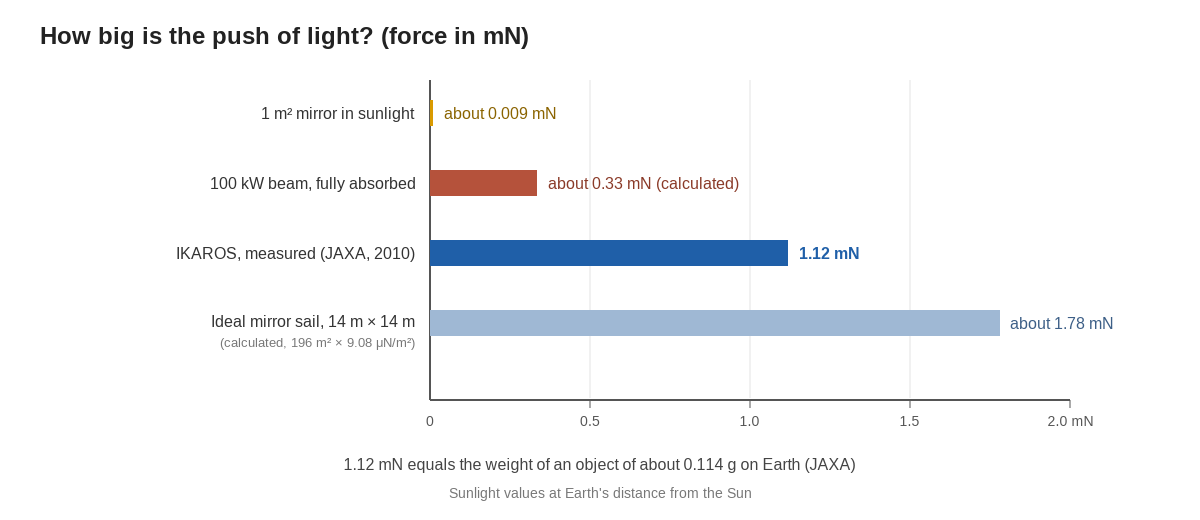
What would an ideal mirror sail give? A square 14 m on a side is 196 m². Multiply by 9.08 μN/m² and you get about 1.78 mN. The measured value is lower.
A real sail is not a flat mirror. NASA's material lists billowing of the sheet and diffuse reflection, where light scatters instead of bouncing in one direction, as signs of a sail that is "not ideal."
Small as it was, the number set a record. JAXA said IKAROS produced the largest photon acceleration in the history of interplanetary flight.
By around December 2011, after meeting all its goals, IKAROS was nearly out of attitude-control propellant. It went into its fifth hibernation in May 2015, and since then its radio has stayed silent. JAXA ended IKAROS operations on 15 May 2025.
When a small force adds up
Divide 1.12 mN by about 310 kg and the acceleration is roughly 0.0000036 m/s each second. If the same force acted all day, speed would rise by about 0.3 m/s. Over 30 days it would be about 9 m/s. In practice the sail's angle and distance from the Sun change, so this is only a rough figure.
Next to a rocket engine, this force is tiny. But a sail uses no propellant to push itself. As long as the sail material and electronics survive in space, the force keeps coming. Solar sailing collects a small but steady push over a long time.
The direction can change too. Tilting the sail changes the direction of the push, and that force can spiral an orbit inward toward the Sun or outward away from it. IKAROS also tested orbit control by turning its sail with liquid crystal devices and other means.
Why bigger sails are better: NEA Scout and ACS3
With pressure this small, the way to get more force is more area. Introducing its ACS3 test craft, NASA explains that because radiation pressure is small, a sail must be large to produce thrust efficiently.
ACS3 launched on 23 April 2024 on a Rocket Lab Electron rocket from Māhia, New Zealand. From a 12U CubeSat about 23 × 23 × 34 cm, the size of a small microwave oven, it unfolded a sail about 9 m on a side. Fully spread, the sail covers about 80 m². Its supporting booms are a carbon-fiber reinforced composite, 75% lighter than earlier metal booms.
Before that, NASA's NEA Scout, a 6U CubeSat carrying an 86 m² sail, launched together with Artemis 1. As of the NASA presentation, however, it had not made radio contact with the ground.
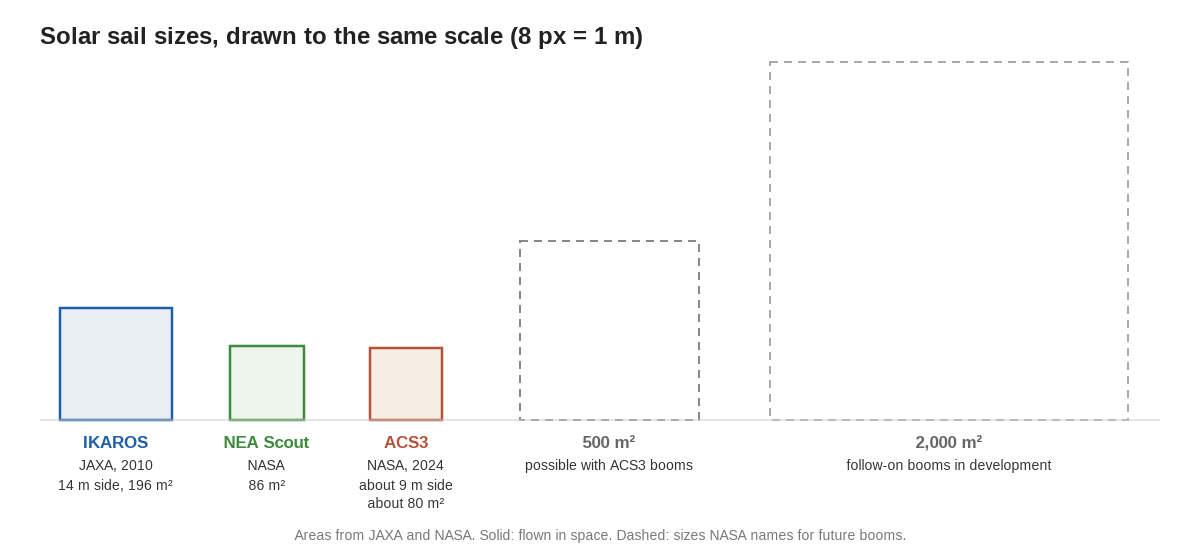
A bigger sail also weighs more. So the heart of this technology is a very thin sheet and very light supports. NASA says the ACS3 boom technology could serve sails up to 500 m², and a follow-on boom now in development could reach 2,000 m².
Pushing with a laser instead of sunlight
There are also ideas for pushing a sail with a laser instead of sunlight. The last slide of a NASA solar sail presentation honors Robert Forward as the "father" of laser beamed energy propulsion. It sketches laser-pushed sails alongside distant goals such as interstellar probes.
Running the same arithmetic for a laser shows again how weak light pressure is. If a plate absorbs all of a 100 kW beam, the force is 100,000 W divided by the speed of light, about 0.33 mN. That is less than a third of what IKAROS got from sunlight. For a feel for kW and W, see a feel for power.
That is why a laser weapon does not damage a target by pushing it. While the same 100 kW beam pushes with 0.33 mN, it delivers 100 kJ of energy into the target every second. The absorbed energy turns into heat.
Power versus energy is covered in power, energy and intensity. Why that heat takes time to build up is the subject of why a laser weapon does not finish "the instant it fires".
What to read next
- Light basics: waves, wavelength, frequency and photons: a second look at photons, the particles that carry momentum.
- Power, energy and intensity: W, J and W/cm²: how to read intensity units such as 1361 W/m².
- Why a laser weapon does not finish "the instant it fires": how light works through heat rather than through its push.