One source says "30 dBm output," another says "1 W" and a third says "20 dB gain." Side by side, it is hard to tell which is bigger. In fact 30 dBm and 1 W are the same power, and 20 dB is not a power at all but a ratio of 100 times.
This note gathers only what you need to convert between these units. It covers the prefixes m, k, M and G, dB as a ratio, dBm as power measured against 1 mW, and a table of common values. What a watt itself measures is covered in "Power, energy and intensity: W, J and W/cm²".
Why sources use different units
Laser product pages and news stories usually give power in W or kW. Sources on optical communications and fiber components, on the other hand, favor the decibel (dB) and dBm. The decibel recommendation of the International Telecommunication Union (ITU) opens by pointing to the frequent use of the decibel at the ITU.
Neither habit is wrong. dB is especially handy for working out a setup with many parts connected in a row. Reading sources from both sides means knowing how to convert.
One thing to check first. Before converting the W figure of a pulsed laser, see whether it is the average power. Average power is the energy delivered over a time interval divided by that interval, and it can be very different from the peak power of a single pulse.
Prefixes: m, k, M, G
The small letter in front of a unit says which power of ten to multiply by. The International Bureau of Weights and Measures (BIPM), which maintains the International System of Units (SI), sets the names and symbols. The ones you meet most often when reading power are below.
| Symbol | Name | Multiply by | Example |
|---|---|---|---|
| μ | micro | 10⁻⁶ | 1 μW = 0.000001 W |
| m | milli | 10⁻³ | 1 mW = 0.001 W |
| k | kilo | 10³ | 1 kW = 1000 W |
| M | mega | 10⁶ | 1 MW = 1000000 W |
| G | giga | 10⁹ | 1 GW = 1000000000 W |
The most common slip is mixing up m and M. 1 mW and 1 MW differ by 10⁹, a billion times. The SI Brochure says that, apart from da, h and k, prefixes for multiples are upper case and prefixes for fractions are lower case. Kilo, with its lower-case k, is the exception.
A prefix symbol is attached to the unit symbol with no space. Only the number and the unit are separated, as in "1 mW".
dB: turning ratios into sums
The decibel (dB) writes the ratio between two powers as a logarithm. It is one tenth of a unit called the bel (B), hence the name. For two powers P₁ and P₂, the ratio is worked out like this.
value in dB = 10 × log₁₀(P₂ ÷ P₁)
log₁₀ asks how many times you multiply 10 to reach a number. So 10 times is 10 dB, 100 times is 20 dB and 1000 times is 30 dB. Twice is 10 × log₁₀(2) ≈ 3.01, which is why 3 dB is often called "double." Half is −3 dB.
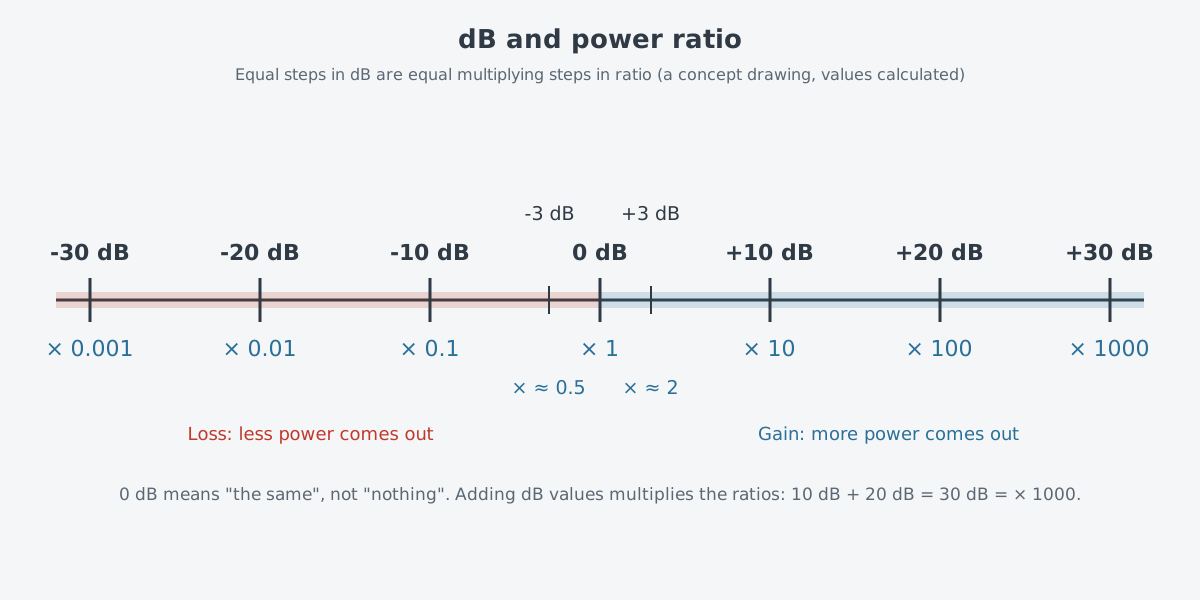
The point of dB is that multiplication becomes addition. Ten times and then a hundred times is a thousand times, and in dB you simply add 10 dB + 20 dB = 30 dB. A setup with ten parts in a row only needs its dB values added and subtracted in turn.
Think of a staircase: dB is the floor number and the ratio is the height of that floor. The floors are evenly spaced, but unlike an ordinary staircase, each floor up is ten times higher than the last. That is why 0 dB means "the two powers are equal," not "nothing."
For quantities like voltage or current, whose square is proportional to power, the factor is 20 instead of 10. The ITU recommendation sets this rule so that the dB value matches the power ratio. Most quantities in optics are powers, so every calculation in this note uses the factor 10.
dBm: power relative to 1 mW
A dB value is only a ratio, so "20 dB" alone does not tell you how much power there is. To give a power itself in dB, you need a reference power. The BIPM brochure says it is important to state which quantity is meant and what reference value is used.
dBm is the value with the reference set at 1 mW. The ITU recommendation's full form is dB(mW), usually shortened to dBm. With a 1 W reference, the unit is dBW. To work it out, put 1 mW in place of P₁ in the dB formula above.
So 0 dBm is 1 mW, 10 dBm is 10 mW, 30 dBm is 1 W and 60 dBm is 1 kW. 0 dBW is 1 W, the same as 30 dBm. A negative dBm value does not mean negative power; it means less than 1 mW. −30 dBm is 1 μW.
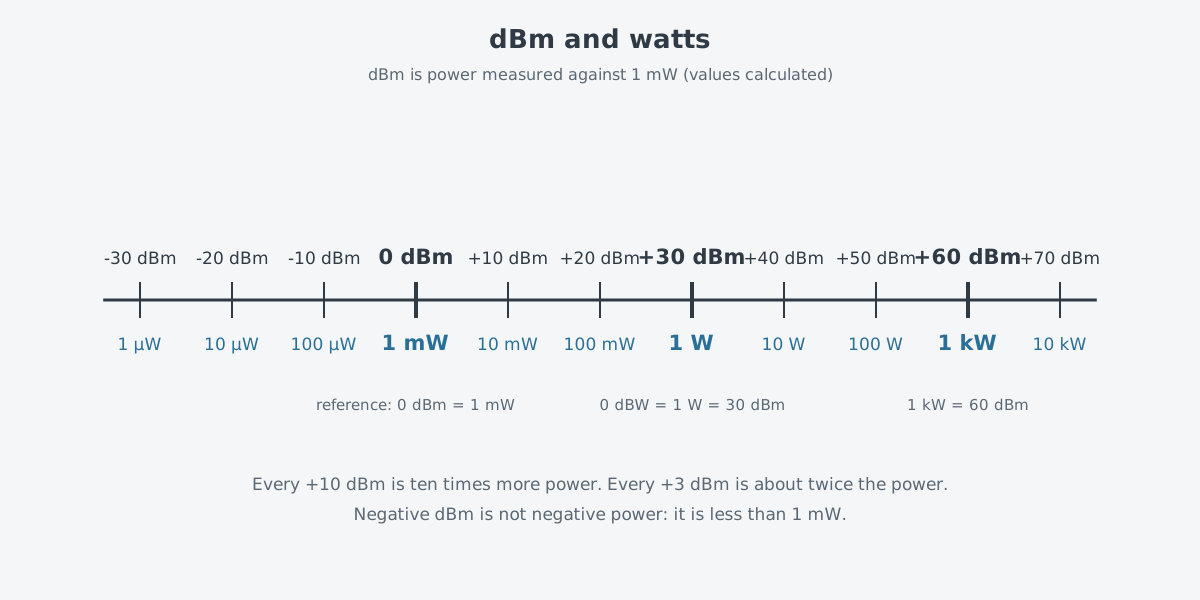
Three rules keep the arithmetic straight. Adding dB to dBm gives dBm. Subtracting one dBm value from another gives the ratio of the two powers, in dB. Adding two dBm values to each other has no meaning.
Two beams of 1 mW each make 2 mW together, which is about 3 dBm. Writing "0 dBm + 0 dBm = 0 dBm" is wrong. To combine powers, convert to W, add, then convert back to dBm.
A table of common values
The values in the two tables below come straight from the two formulas above, rounded to three significant figures. Calling 3 dB "double" and 6 dB "four times" is just rounding 2.00 and 3.98.
| dB | Ratio | dB | Ratio |
|---|---|---|---|
| 0 dB | 1 | 0 dB | 1 |
| +1 dB | 1.26 | −1 dB | 0.794 |
| +3 dB | 2.00 | −3 dB | 0.501 |
| +6 dB | 3.98 | −10 dB | 0.1 |
| +10 dB | 10 | −20 dB | 0.01 |
| +20 dB | 100 | −30 dB | 0.001 |
| +30 dB | 1000 |
| dBm | Power | dBm | Power |
|---|---|---|---|
| −30 dBm | 1 μW | 30 dBm | 1 W |
| −10 dBm | 0.1 mW | 33 dBm | 2.00 W |
| 0 dBm | 1 mW | 40 dBm | 10 W |
| 3 dBm | 2.00 mW | 50 dBm | 100 W |
| 10 dBm | 10 mW | 60 dBm | 1 kW |
| 20 dBm | 100 mW | 70 dBm | 10 kW |
Values not in the table can be estimated by combining 10 dB and 3 dB steps. For example, 43 dBm is 40 dBm plus 3 dB, so it is about twice 10 W, or roughly 20 W.
Where it is used: gain, loss, transmission
The ITU recommendation defines gain as an increase in power between two points and loss (attenuation) as a decrease, and says this ratio is usually given in decibels. It also asks that the kind of loss be named, for example insertion loss.
Take gain first. An application note from an optics company puts the usual small-signal gain of one pass through a rare-earth-doped gain fiber at about 20 dB or higher. Bulk doped materials give about 5 dB. 20 dB is 100 times, which matches the same note's point that gain can reach 100 times or more.
Ordinary fiber with no gain material does the opposite and loses a little light. In a typical optical fiber, loss is lowest near 1.3 μm and 1.5 μm, below 1 dB/km, which is why optical communications pays special attention to these wavelengths. If the loss were 1 dB/km, 79.4% of the light would remain after 1 km, and after 10 km it would be 10 dB down, leaving 10%.
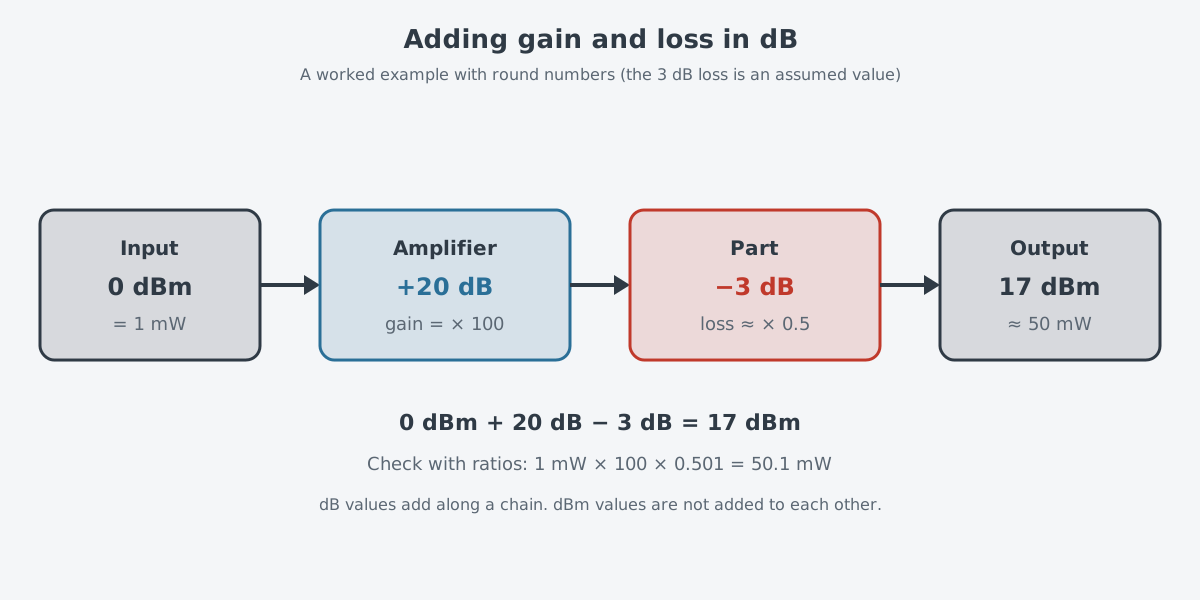
A chain of gains and losses fits on one line in dB. Light at 1 mW (0 dBm) that passes a 20 dB gain becomes 20 dBm, or 100 mW. If it then passes a part with an assumed 3 dB loss, it leaves at 17 dBm, about 50 mW.
Transmission can be written in dB too. A filter that lets half of the light through has about 3 dB of loss, and one that passes 10% has 10 dB. The optical density (OD) printed on laser safety eyewear uses the same logarithmic scale, so OD 1 is 10 dB (10% passes) and OD 3 is 30 dB (0.1% passes).
The U.S. Army Public Health Center explains that eyewear with an OD of 3.0 blocks 100 times more light than eyewear with an OD of 1.0. In dB, that is a 20 dB difference.
The same agency stresses, though, that the OD needed always depends on the particular laser. Even OD 6.0 eyewear may not cut a given laser's exposure to a safe level, so a large OD is not safe for every laser. What else to look for on eyewear labels is covered in "Laser safety: classes and how to read eyewear labels".
What to read next
- "Power, energy and intensity: W, J and W/cm²": what the watt converted in this note actually measures.
- "Finding open sources: where to look for government reports, papers and standards": how to find and read official documents, such as the ones that define these units, yourself.