Light has one more property besides brightness and color. It is the direction in which the electric field vibrates, called polarization. When laser light is sent through ordinary fiber, that direction changes easily.
Polarization-maintaining fiber (PM fiber) is built to hold that direction. From the outside it looks much like ordinary fiber, but its cross section contains structures added on purpose. This article covers why polarization drifts in ordinary fiber, how PM fiber prevents it, which types exist, where they are used, and what makes them demanding.
The basics of polarization are in "Polarization: the direction in which light vibrates". A short note on PM fiber as one fiber component is in "Isolators and fiber components: keeping light from going backwards". Here that single paragraph grows into a full article.
Why polarization drifts in ordinary fiber
Light whose electric field vibrates within a single plane is called linearly polarized. What happens when such light enters a single-mode fiber (SMF)?
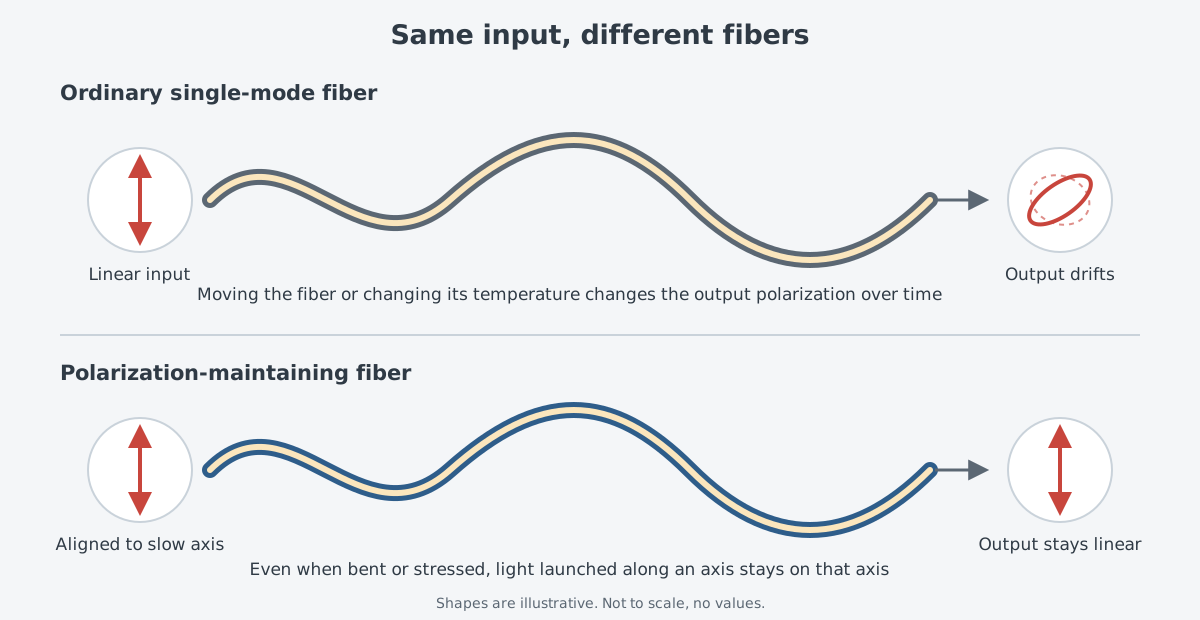
If the fiber is moved or the surrounding temperature changes, the polarization of the light at the exit changes over time. This happens even in short pieces of fiber. The same linearly polarized input can leave with a different polarization today and tomorrow, or in the morning and the evening.
Where only the power of the light matters, this may not be a big problem. But many uses need a steady output polarization, such as sensing and communications.
The performance of fiber interferometers and sensors that rely on light interference, fiber lasers, and electro-optic modulators depends on the polarization of the light passing through. Manufacturers developed PM fiber to deal with this drift at the output.
Making two paths different on purpose: birefringence
PM fiber rests on birefringence. Some materials have one refractive index for light polarized in one direction and a different index for light polarized at right angles to it. A different refractive index also means a different speed.
PM fiber makes this property large on purpose inside the fiber. Two polarizations at right angles to each other end up moving at different speeds. This creates two principal axes in the fiber, at right angles to each other. The axis where light goes faster is the fast axis, and the one where it goes slower is the slow axis.
These two axes are the key to how PM fiber holds polarization. Suppose the input light is linearly polarized and lined up with one of the two axes, fast or slow. Then the output keeps its linear polarization along that same axis, even under outside stress on the fiber.
A railway track is a useful picture: on rails, a cart rolls only along the direction of the track. The real fiber differs in one way. Its two axes are not walls that hold light in place. They come from giving two polarizations different speeds, and the effect only works if the input is lined up with one axis from the start.
How are the axes made? Several types of PM fiber place stress-applying parts around the fiber core. These parts put mechanical stress on the glass and split it into a fast axis and a slow axis. Some large-mode-area PM fibers for lasers use PANDA-style stress rods in this way to raise the birefringence and hold polarization.
How well polarization is held is expressed as the polarization extinction ratio. It describes how much of a beam is linearly polarized along one axis. The output is sent through a rotating polarizer onto a detector, and the brightest and darkest readings are compared.
Types seen in cross section
The differences between PM fibers show up in the cross section. Even around 1997, the industry used several polarization-preserving core and cladding structures. The main named shapes are these.
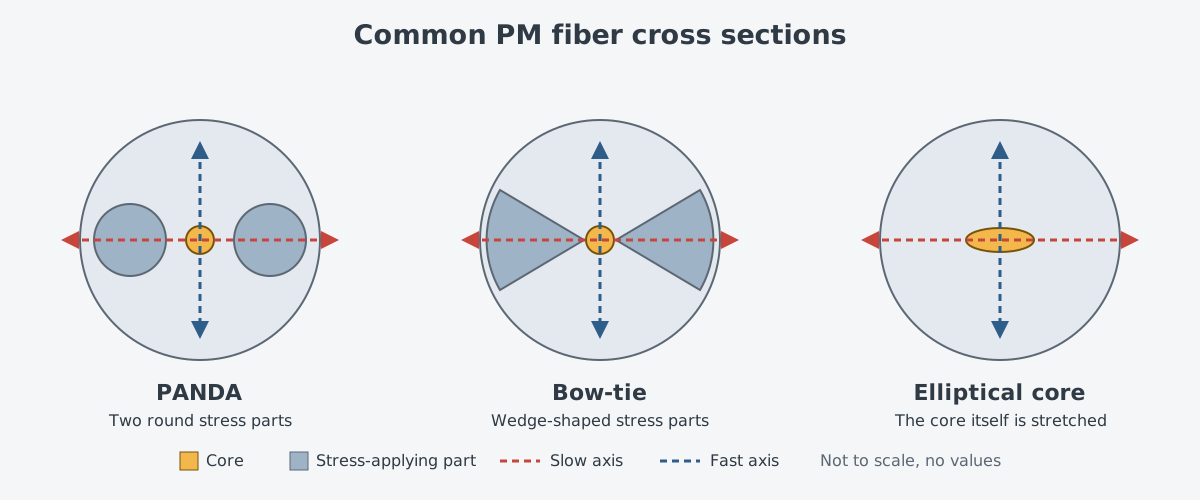
- PANDA: One round stress-applying part sits on each side of the core. The name is short for "Polarization-maintaining AND Absorption-reducing fiber." Fujikura, which makes this fiber, says the symmetry of the cross section and the even makeup of the stress parts give it strong polarization-holding behavior, and that it suits both fusion splices and connectors.
- Bow-tie: The stress-applying parts are wedge-shaped on either side of the core, so the cross section looks like a bow tie.
- Elliptical stressed cladding: The stress-applying region around the core has an elliptical shape.
- Elliptical core: Instead of stress rods, the core itself is stretched into an ellipse. An optical frequency comb experiment described in an ultrafast laser textbook also used a fiber whose polarization holding came from an elliptical core.
Some fibers have similar names but do a different job. Polarizing fiber goes further than holding polarization: it keeps only the guided polarization and quickly suppresses all other states. Spun PM fiber is made to preserve circular rather than linear polarization, and it is offered for fiber-optic current sensors.
Becoming a product in the 1980s
The commercial story of PM fiber goes back to the early 1980s. Fibercore is a specialty fiber company with its development and manufacturing site in Southampton, England. It traces its start to the know-how and fiber-making skills of the optical fiber group led by Professor Payne at the University of Southampton. Its first success was spun low-birefringence fiber in 1982.
Bow-tie PM fiber came next. The company describes the bow-tie PM fiber it developed in 1983 as probably the first fiber of its type to reach the market, and says it is still made today. An elliptically birefringent version followed in 1989.
One use from this period is the fiber-optic gyroscope. In the company's account, these high-birefringence fibers made it possible to apply the principles of interferometry to many uses, such as solid-state fiber gyroscopes. These gyroscopes serve aviation, aerospace, marine, defense, and surveying; in the company's view they are much more accurate, quicker to respond, and more dependable than older designs.
Where it is used
Fiber gyroscopes. A fiber gyroscope relies on the principle of interference, and a coil of wound fiber is its core sensing element. Special gyro PM fibers exist to make these gyroscopes more precise. Their maker, Exail, explains that the coil has a direct effect on how sensitive, stable, and accurate the whole system is.
Fiber lasers. Some lasers need linearly polarized output. In a master oscillator power amplifier (MOPA), which grows the light of an oscillator through several amplifier stages, PM fiber can be used to get linearly polarized output. Coherent offers large-mode-area PM fiber for uses that need linearly polarized output and names laser systems for industry, medicine, and defense among them. How oscillators and amplifiers fit together is in "Oscillators and amplifiers: making light, then growing it".
Beam combining. Polarization matters most in coherent beam combining (CBC), which merges the light of many amplifiers into one beam. Two beams polarized at right angles to each other do not interfere; only their intensities add. A 2016 review adds that each amplifier output also needs a fixed polarization state, and that PM fiber can guarantee this.
Large-mode-area doped fibers for booster and kW-class amplifiers in coherent beam combining also come in both PM and standard single-mode forms. The principle is in "Coherent beam combining: the principle, from published reviews", and why laser weapons need beam combining is in "Why beam combining is needed, and its three approaches".
Optical frequency combs. An ultrafast laser textbook describes an experiment in which holding polarization decided the result. When a mode-locked laser's pulses were used to make a broad spectrum spanning an octave, a polarization-maintaining highly nonlinear fiber gave a spectrum with excellent coherence. In the same experiment, a non-PM fiber also produced a broad spectrum, but the signal the team wanted to measure could not be detected. The textbook reads this as the fixed polarization keeping the interaction of the strong electric fields stable.
What it gives and where it falls short
The gain is clear. Linearly polarized light launched along an axis remains on it, even under outside stress on the fiber. That lets fiber be used where polarization must not wander, such as interferometers, gyroscopes, modulators, linearly polarized lasers, and beam combining.
The demands come from the same place.
- The input has conditions. Polarization is held only when the input is linearly polarized and lined up with the fast or slow axis. Lining up the axis is the first step in using PM fiber.
- The fiber alone is not enough. A PM fiber system needs dedicated fiber and connectors, plus careful assembly and alignment, to perform well.
- Every connection has to carry the axis. PM connectors have a positioning key lined up with the fiber's slow axis, so they mate with other connectors or parts at only one angle. It is not enough for one fiber to be PM; the axes of the connected parts must match too.
- The type depends on the polarization needed. PM fiber that holds linear polarization, polarizing fiber that keeps only one polarization, and spun fiber that holds circular polarization are not interchangeable parts.
What to read next
- "Polarization: the direction in which light vibrates": the basics this article builds on, such as linear polarization, birefringence, and wave plates.
- "Coherent beam combining: the principle, from published reviews": why and how light from amplifiers with fixed polarization is merged into one beam.
- "How a fiber guides light: core and cladding": the fiber structure that PM fiber is built on.