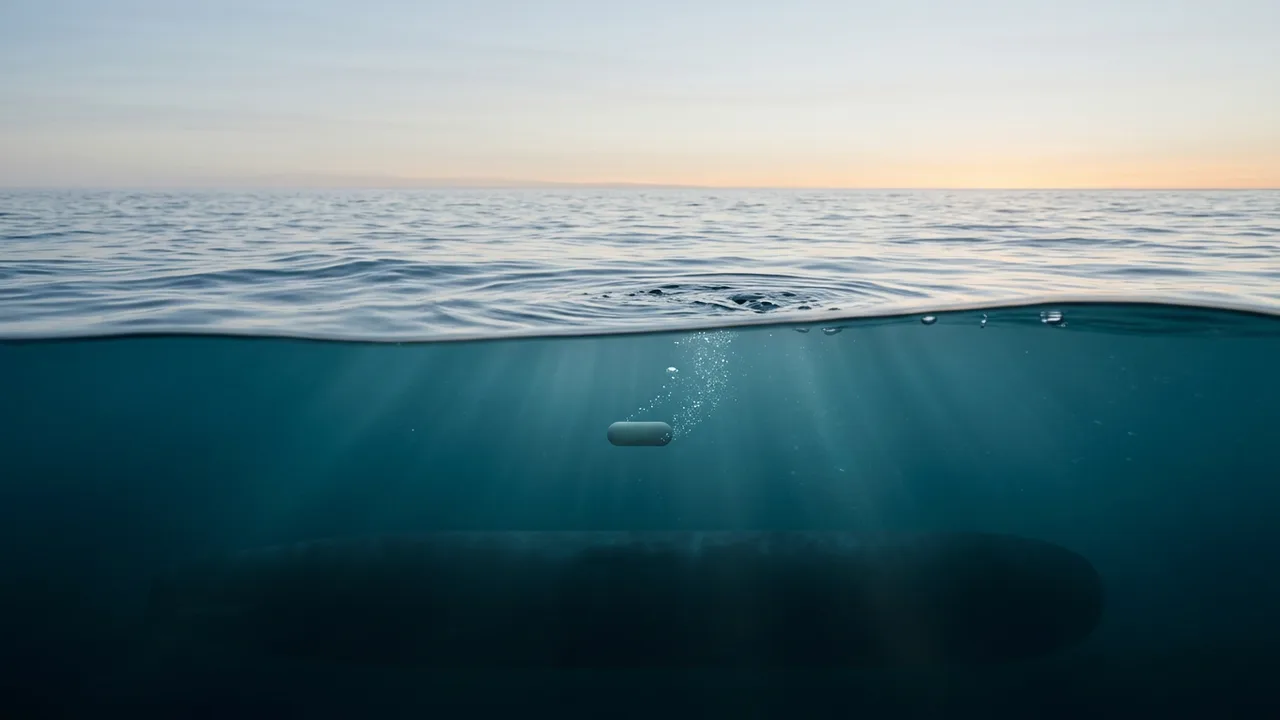
How does a missile inside a submerged submarine get into the sky? Lighting a rocket motor under water might seem like the obvious answer. Polaris, the U.S. missile that first did this, worked differently.
The name submarine-launched ballistic missile (SLBM) already holds half of the answer. This article takes the name apart, compares an SLBM with the cruise missiles that submarines also fire, and follows the order of a launch from under the sea. It ends with the line from the first SLBM to today and the reasons government documents give for keeping these weapons under the sea.
Taking the name apart
SLBM splits into three parts. "Submarine-launched" is where it starts, "ballistic" is how it flies, and "missile" means it is a guided weapon.
A Congressional Research Service (CRS) defense primer presents the SLBM as one leg of a triad.
From the early 1960s on, the United States has kept three kinds of long-range nuclear delivery vehicles, called the "triad." One is the intercontinental ballistic missile (ICBM) based on land. Another is the SLBM, carried by strategic nuclear submarines (SSBNs). The third is the heavy bomber.
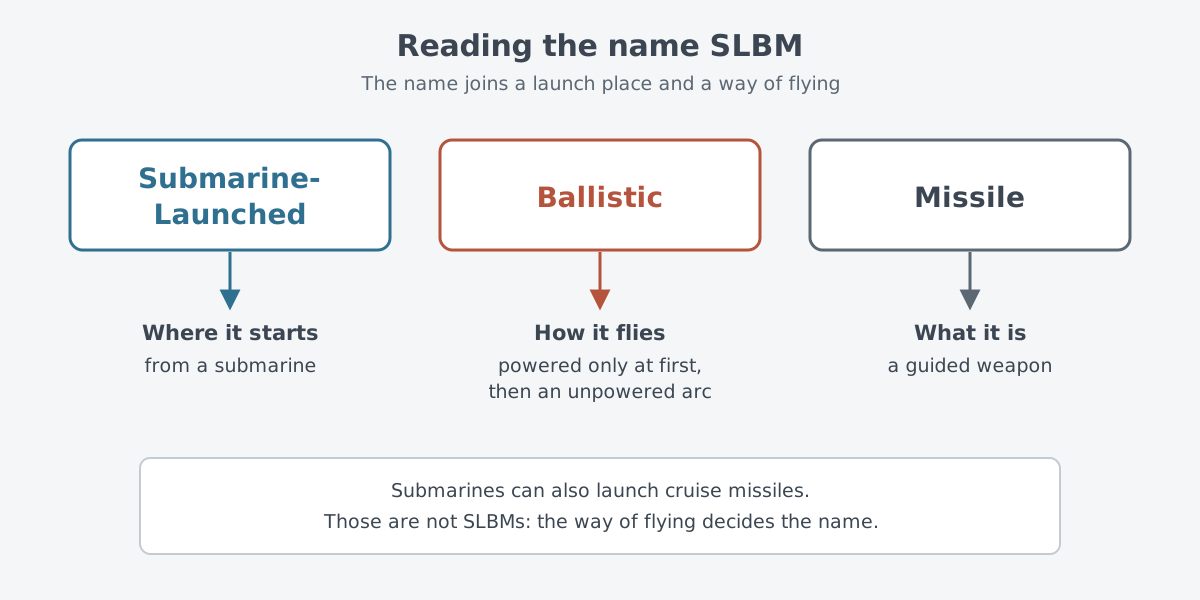
So it helps to remember SLBM and SSBN as a pair. The SSBN is the boat, and the SLBM is the missile it carries.
Ballistic and cruise missiles fly differently
Start with the middle word, "ballistic." Once its first, powered stretch of flight is over, a ballistic missile climbs out of the atmosphere and coasts without power. It then reenters the atmosphere, heading for a point chosen in advance. The engine works only at the start, and the long part of the trip happens with the engine off.
Guidance follows the same split. A traditional ballistic missile is guided while its engine is running and unguided during free flight, once the engine is off.
A cruise missile is the opposite. It is a guided weapon that keeps its propulsion going and flies inside Earth's atmosphere, rather than following an arcing path set by the initial launch.
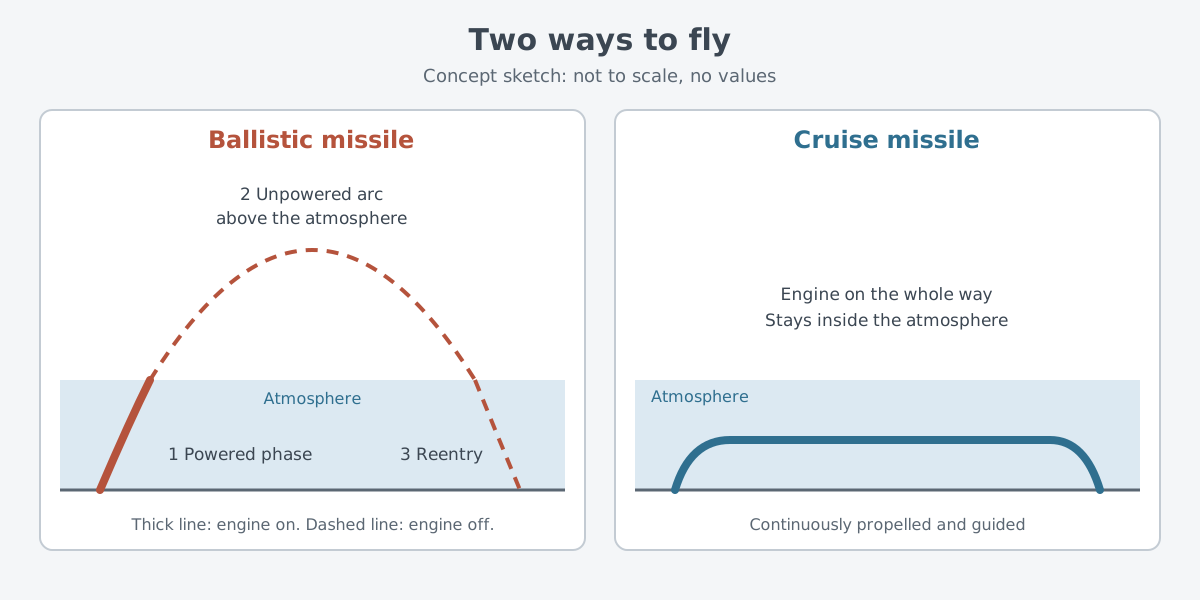
Think of a thrown ball and a flying bird. A ballistic missile is like the ball after it leaves the hand, and a cruise missile is like a bird that keeps flapping. The comparison has limits. A ballistic missile climbs above the atmosphere and comes back in, over heights and distances that no thrown ball comes close to.
Not everything fired from a submarine is an SLBM
Is every missile that leaves a submarine an SLBM? No. The name depends on how the missile flies, not only on where it starts.
Tomahawk is the best-known example: a CRS primer on precision-guided munitions calls it a long-range cruise missile. It is designed for launch both from submarines, as the UGM-109, and from surface ships, as the RGM-109. Tomahawk is a subsonic cruise missile, slower than sound. Even when it leaves the same submarine, it flies inside the atmosphere with its engine running, so it flies differently from an SLBM on a ballistic path.
Submarines and cruise missiles go back further. After World War II, the Navy tested Loon cruise missiles by launching them from submarine decks. Then, in 1955, Regulus I became the first cruise missile the U.S. Navy put into actual service.
Submarine labels split in a similar way. The UK government's guide to its nuclear deterrent describes the current Astute class as nuclear-powered attack submarines with conventional weapons, and says they protect the ballistic missile submarines (SSBNs). Two nuclear-powered submarines can carry different names because they do different jobs and carry different weapons.
How a launch from under the sea begins
Now back to the opening question: a launch under water needed technology very unlike a launch on land. Lockheed Martin built Polaris. According to its history article, streams of compressed air pushed the missile out of the submarine. The first-stage engine lit only after the missile was a safe distance away.
The missile was built to break through the water surface, and its onboard guidance took over from that point. The Royal Air Force Museum's record of Polaris gives the same order. Each missile sat in its own launch tube in the submarine, gas and steam drove it out, and the first-stage motor fired once the missile was clear of the water.
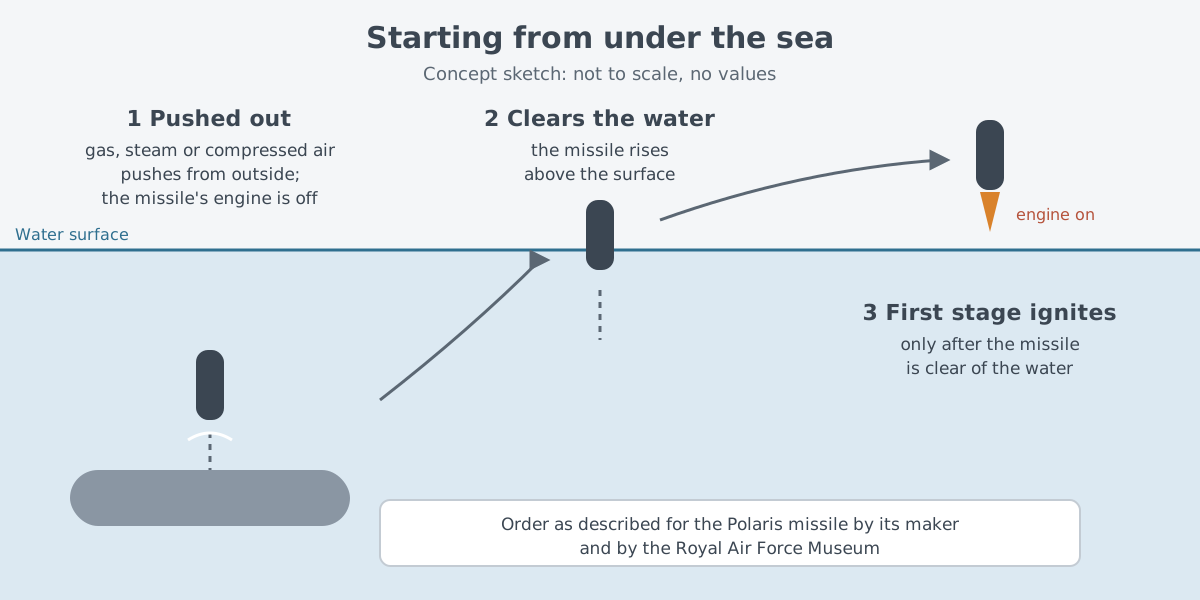
The museum compares the moment to a cork popping out of a toy popgun. The real thing differs. A cork just drops after it flies out, while the missile starts its own engine once it is out of the water and flies on.
Pushing first and igniting later is commonly called cold launch. For examples on surface ships and in land-based silos as well, continue with Cold launch: why some missiles pop out before igniting.
From the first SLBM to today
On July 20, 1960, a UGM-27 Polaris left the submarine USS George Washington in the first successful launch of this fleet ballistic missile. The launch showed that a submarine could fire a strategic weapon from under the sea, and Polaris A1 was the missile that brought in the submerged launch capability.
The Navy's focus shifted around the same time. In the early 1960s, the solid-fuel Polaris SLBM replaced Regulus I. Across the late 1950s and the 1960s, ballistic missiles mostly took the place of cruise missiles as the main tools of nuclear deterrence. Cruise missiles did not vanish, though.
Later generations followed. Poseidon took over from Polaris in 1971, and in 1979 the first missile of the Trident series replaced Poseidon. Lockheed Martin says that over the following six decades the program produced six generations of SLBMs.
| Year | Event | Source |
|---|---|---|
| 1955 | Regulus I cruise missile enters service | National Air and Space Museum |
| 1960 | First successful Polaris launch from a submarine | Lockheed Martin |
| Early 1960s | Regulus I replaced by the Polaris SLBM | National Air and Space Museum |
| 1971 | Poseidon succeeds Polaris | Lockheed Martin |
| 1979 | First missile of the Trident series | Lockheed Martin |
What about today? CRS states that the U.S. Navy now operates 14 Trident (Ohio-class) SSBNs, which carry the D-5 SLBM. The Navy is buying 12 new Columbia-class submarines. Patrols by the first of them were planned to start in FY2031, but the Navy now says that boat is running late.
The United Kingdom also relies on SLBMs. The UK government says its ballistic missile submarines have patrolled the seas since April 1969. Since its last air-launched nuclear weapon was withdrawn in 1998, submarine-launched Trident missiles have been its only nuclear delivery system. The current Vanguard class entered service in 1994 and carries Trident II D5 missiles, and the Dreadnought class takes over in the 2030s.
Why keep them under the sea: what government documents say
Why put these missiles under the sea instead of on land? CRS quotes the 2010 U.S. Nuclear Posture Review (NPR), which judged SSBNs and their SLBMs to be "the most survivable leg" of the country's nuclear triad. It also pointed out that ICBMs and SLBMs are not exposed to air defenses.
The idea of survivability goes back to the start of the program. Lockheed Martin's anniversary article says that in 1955 the U.S. chief of naval operations asked for a nuclear deterrent able to come through a surprise attack intact. Still, the NPR wording is the U.S. government's judgment about its own forces. It should not be read as a conclusion that carries over to other countries' SLBMs or to any particular situation.
The third leg has a different character. Bombers, unlike ICBMs and SLBMs, can be sent forward where others can see them, as the review puts it.
Taking a name apart is a habit that helps with other weapons news too. Reading the wording in laser weapon reports is covered in How to read laser weapon news.
What to read next
- Cold launch: why some missiles pop out before igniting: the push-first, ignite-later method, with examples from submarines, ships and land-based silos.
- Ballistic missiles: why they climb high and come down: a closer look at the stages of ballistic flight.
- Cruise missiles: how they resemble aircraft: missiles that keep their engines on inside the atmosphere.