At 9:29 p.m. on July 27, 1953, the U.S. Navy heavy cruiser USS Saint Paul fired a single 8-inch shell off Wonsan. The round was timed to land a few seconds before the armistice took effect at 10 p.m. The Naval History and Heritage Command (NHHC) records it as the last shot fired by U.S. naval forces in the Korean War.
Behind that one shell lay more than two years of negotiation. Even while the talks went on, fighting continued on ridge after named ridge. What did the two sides argue about for so long at the table, what happened on the ridges, and what was left at the end?
This article follows both lanes, the talks and the front, from the first meeting at Kaesong in July 1951 to the signing at Panmunjom in July 1953.
Why talks opened in the summer of 1951
A year into the war, both sides had seen their limits. The truce talks entry in the Encyclopedia of Korean Culture sums it up this way. The communist side realized it could not take the whole peninsula by force, and the UN side had to accept that punishment by force had its limits too.
U.S. Navy history material draws the same picture. After both Chinese spring offensives failed at great cost, the battle lines grew more and more static, and the same hilltops changed hands again and again.
The first proposal came from the Soviet Union. On June 23, 1951, J. Malik, the Soviet representative at the United Nations, proposed truce talks in a UN broadcast, and the United States accepted. On July 8 liaison officers from both sides settled the procedures at Kaesong, and on July 10 the plenary sessions opened at Naebongjang in the Goryeo-dong area of Kaesong.
The UN delegation was made up of U.S. generals and admirals led by Vice Admiral C. T. Joy of the U.S. Navy, along with Major General Paik Sun-yup of the South Korean army.
On the communist side were General Nam Il of North Korea and Chinese generals. In late October 1951 the talks moved from Kaesong to Panmunjom.
Five items on the agenda
The first fight was over what to talk about. The UN side wanted to discuss only purely military matters that had to come before a truce, such as the demarcation line, supervision of the truce and prisoners. The communist side wanted to settle the 38th parallel as the line and the withdrawal of foreign troops first.
On July 26, sixteen days after the talks began, the two sides agreed on five agenda items.
| Item | Subject |
|---|---|
| Item 1 | Adopting the agenda |
| Item 2 | Setting the military demarcation line |
| Item 3 | Methods and bodies for supervising the truce |
| Item 4 | Arrangements for prisoners of war |
| Item 5 | Recommendations to the governments concerned |
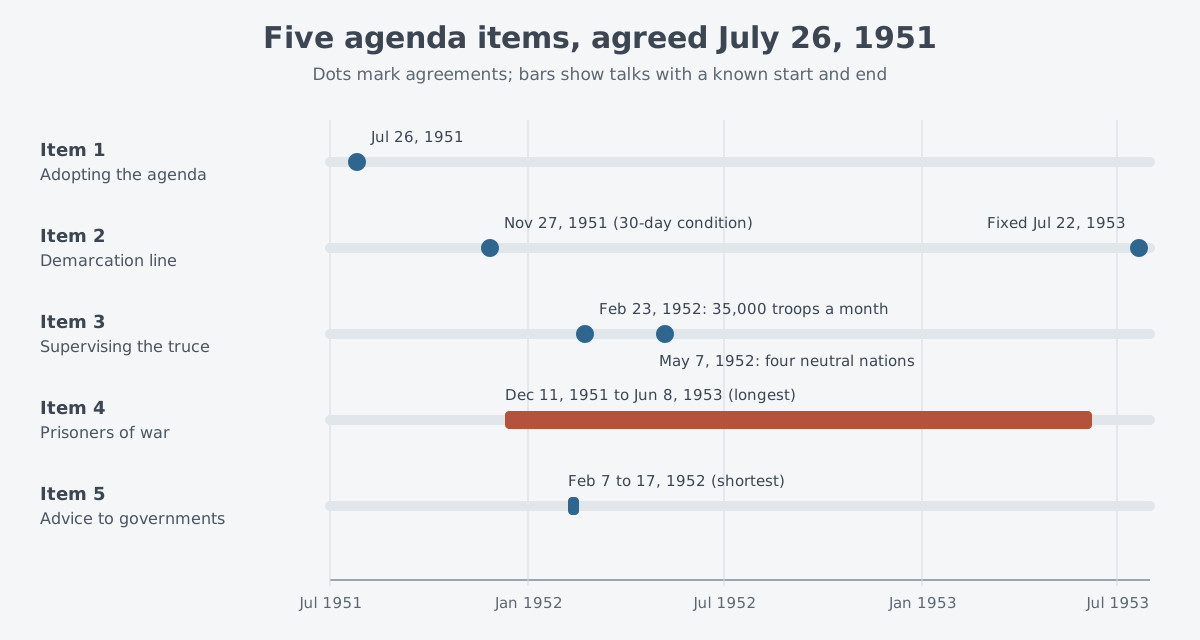
Item five was settled first. Talks on it began on February 7, 1952, and ended in agreement eleven days later, on February 17. It called for a political conference within three months after the armistice took effect.
Item three was settled in two steps. On February 23, 1952, the two sides agreed that after the truce up to 35,000 foreign troops a month could rotate in and out. On May 7 they agreed on a supervisory body of four nations: Sweden and Switzerland, named by the UN side, and Poland and Czechoslovakia, named by the communist side.
Item four, the prisoners, took the longest. At first it had been expected to be easy.
Words at the table, blood on the ridges: 1951
The talks carried one condition from the start. Both sides would keep up military operations until a final agreement was reached. The encyclopedia's truce talks entry describes the result as a war of words at the conference table and a war of blood on the front.
While negotiating, the UN forces kept up pressure with limited attacks on narrow objectives. The communist forces attacked to retake lost positions, or struck UN positions that jutted out to the north in order to gain the upper hand at the talks. When the communist side announced a suspension of the talks over the demarcation line on August 22, 1951, the fighting grew fierce again.
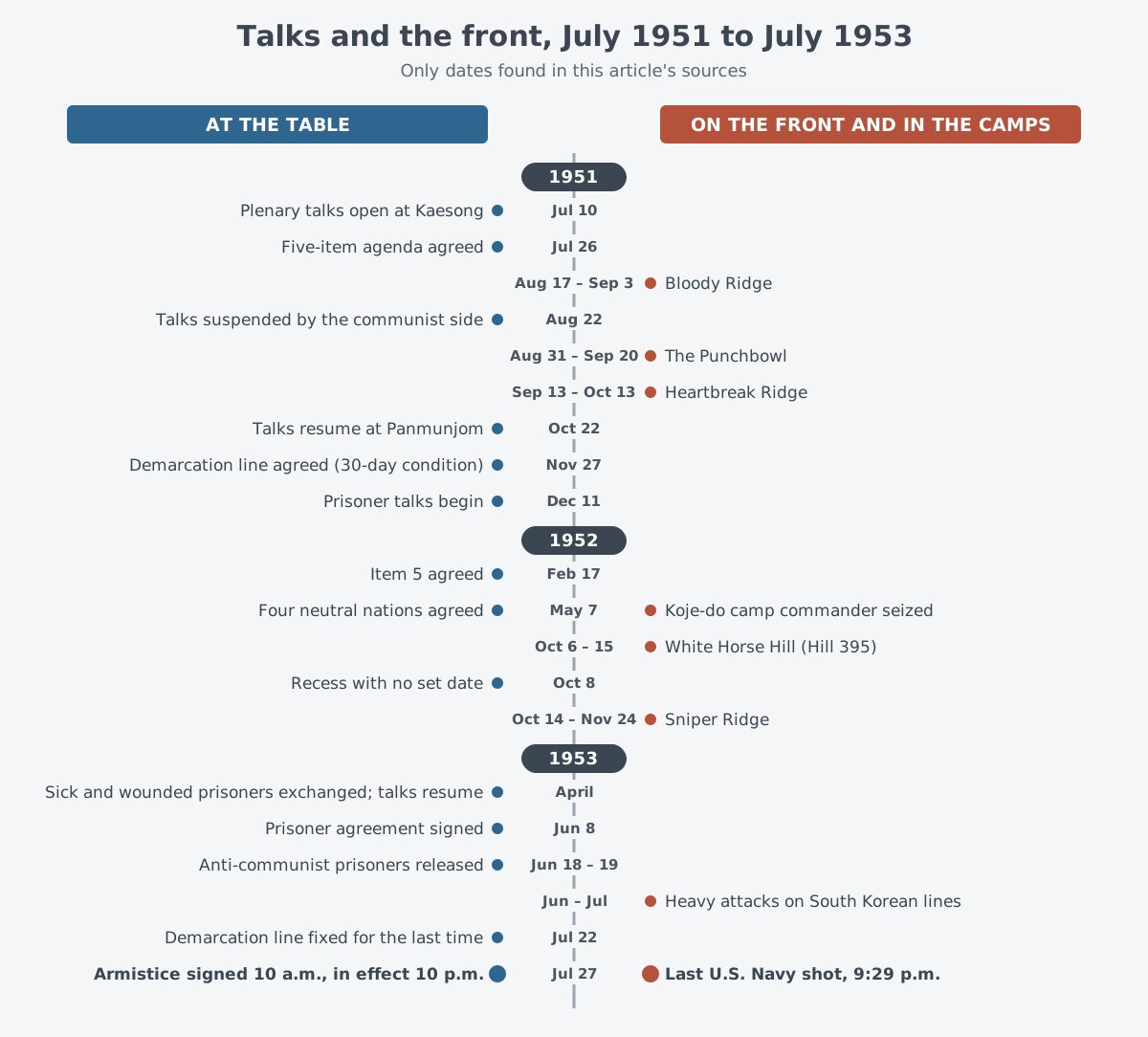
The major fighting of that late summer and autumn took place in the hills north of Yanggu in Gangwon Province. The UN forces struck one limited objective after another, staying within bounds that would not widen the war.
- Bloody Ridge, August 17 to September 3. A ridge joining Hills 983, 940 and 773, named by the U.S. military newspaper Stars and Stripes. The U.S. 2nd Division and the 36th Regiment of the South Korean 5th Division drove off the North Korean 12th and 24th Divisions and took the ridge. The 36th Regiment lost more than 1,000 men killed and wounded, and South Korean and American casualties together came to the size of one regiment.
- The Punchbowl (Haean Basin), August 31 to September 20. The U.S. 1st Marine Division and the 1st Regiment of the South Korean Marine Corps took the hills to the north and east of the Haean Basin and secured the basin.
- Heartbreak Ridge, September 13 to October 13. The U.S. 2nd Division attacked Hills 894, 931 and 851, while the South Korean 7th Division attacked alongside from across the valley. Over the month UN casualties came to about 3,700, and North Korean and Chinese casualties were estimated at about 25,000.
After this run of attacks, the talks resumed at Panmunjom on October 22 at the communist side's request. The demilitarized zone entry in the Encyclopedia of Korean Culture sees the UN offensive as what brought the talks back.
The line drawn first
On item two, the UN side proposed the current line of contact between the two armies, and the communist side proposed the 38th parallel. In the end the line-of-contact proposal was accepted, and a demarcation line agreement was signed on November 27, 1951.
Its terms come down to three points. Fighting would continue until the armistice was signed. The current line of contact would be the demarcation line, with a demilitarized zone 4 km wide, 2 km on each side. The line would hold only if an armistice was signed within 30 days; if not, the line of contact at the time of signing would become the demarcation line.
The 30 days simply passed. No truce had been reached by December 27, so this line lost its meaning, and the demarcation line was not fixed again until July 22, 1953.
The prisoner question that took a year and a half
Talks on prisoners began on December 11, 1951. When lists were exchanged that month, the UN side gave 132,474 names, while the communist list of South Korean and UN prisoners held 11,559 names.
The bigger issue was the principle of repatriation. The UN side argued for voluntary repatriation, letting each prisoner choose among South Korea, North Korea, China and Taiwan. The communist side insisted on forced repatriation, sending every prisoner home without condition.
U.S. Navy history material points to the same issue as a major reason the talks bogged down. Many of the Chinese soldiers who had surrendered did not want to go back to China.
The results of the April 1952 UN Command screening of prisoners appear differently in different entries. The truce talks entry says that of about 170,000 communist prisoners, civilian internees included, 100,000 wanted voluntary repatriation. The Korean War entry says the UN side reported about 83,000 who wished to go home, 76,600 to North Korea and 6,400 to China.
The communist side again demanded forced repatriation. The talks, which had already stopped for about two months from February 27, 1952, went into a recess with no set date on October 8.
The camps were not quiet either. In 1952 the prisoner camp on Koje-do (Geoje Island) held about 150,000 prisoners: 130,000 North Korean and 20,000 Chinese.
On May 7 the camp commander, Brigadier General Francis T. Dodd, was seized by prisoners while meeting their representatives at the gate of Compound 76, and he was not freed until the evening of May 10.
His successor, Brigadier General Charles F. Colson, replied that the prisoners' demands would be accepted, but the UN commander, General M. W. Clark, declared that promise void because it had been obtained under duress.
The encyclopedia's author traces the root of the riots to conflict between pro-communist and anti-communist prisoners and to direction by the communist side.
October 1952: White Horse Hill and Sniper Ridge
In the same month the talks stopped, two of the largest hill battles of the war were fought near Cheorwon and Gimhwa in Gangwon Province.
White Horse Hill (Hill 395), October 6 to 15. The South Korean 9th Division, holding White Horse Hill north of Cheorwon, was attacked by the Chinese 38th Army. Over ten days the hill was fought over 12 times and changed hands 7 times before the South Korean division held it.
The same encyclopedia entry gives two figures for the losses. One sentence says about 10,000 Chinese troops were counted as killed, wounded or captured; another says about 13,000 Chinese troops were destroyed. South Korean 9th Division casualties were reported at about 3,500.
Sniper Ridge, October 14 to November 24. A small ridge 7 km north of Gimhwa, about 580 m high and about 1 km² in area. The South Korean 2nd Division fought the Chinese 15th Army over it for 42 days. The Chinese lost the strength of two regiments and pulled back north of Mount Osong, and the South Korean side also suffered casualties the size of one regiment.
On the South Korean army side these two battles are called the two great battles of the Korean War. The Chinese side recorded the fighting at Sniper Ridge and nearby Triangle Hill together under the name of the Shanganling campaign. The same autumn's fighting entered each side's records under a different name.
The last knots of 1953
After Stalin died in March 1953, the talks sped up. In April the two sides first exchanged sick and wounded prisoners. An agreement on exchanging sick and wounded prisoners was reached on April 11, and the exchange began on April 20. The date the talks resumed differs by source: April 16 in the truce talks entry and April 26 in the Korean War entry.
At 2 p.m. on June 8, the prisoner agreement was signed at Panmunjom. Lieutenant General W. K. Harrison Jr., chief UN delegate, and General Nam Il signed it, and it was drawn up in English, Korean and Chinese.
Prisoners who refused repatriation would be handed to a Neutral Nations Repatriation Commission of Switzerland, Sweden, Poland, Czechoslovakia and India, with the Indian representative as chair.
The South Korean government and people strongly opposed a truce. The first national rally against a truce was held on June 10, 1951, in Pusan, the wartime capital. After March 1, 1953, the opposition movement spread until rallies had been held some 7,000 times by the end of May. The South Korean representative never signed the armistice agreement.
Over two days starting June 18, anti-communist prisoners walked out of the camps on President Syngman Rhee's decision. Of 35,698 prisoners in eight camps, 27,388 escaped, and 56 died in the process. The communist side protested strongly and halted the talks again. They resumed only after the UN side promised to make sure the South Korean army would also observe the armistice.
The United States sent a special envoy, W. S. Robertson, on June 25. President Rhee agreed to the truce around July 11 or 12, and the conditions included a mutual defense treaty between South Korea and the United States and long-term economic aid.
The fighting went on in the meantime, with especially heavy attacks on South Korean lines. On July 22 the military demarcation line was fixed for the last time.
July 27: signatures and the last shot
At 10 a.m. on July 27, 1953, Lieutenant General Harrison and General Nam Il signed the armistice agreement and its supplementary agreement at Panmunjom. Then General Clark, the UN commander, Kim Il Sung, commander of the North Korean army, and Peng Dehuai, commander of the Chinese forces, each signed at their own rear headquarters.
The agreement took effect at 10 p.m. that night. In the British House of Commons the same day, Minister of State Selwyn Lloyd reported that it had been signed at 2 a.m. British time, and that firing would stop 12 hours after that. He called it "over three years of war including two years of negotiation" and said the people of Korea had suffered the most of all.
Even the number of meetings is counted differently. The United Nations Command counts 158 meetings before the parties agreed to sign. The encyclopedia's truce talks entry says the signing took place at the 159th plenary session.
Another count says that by the October 1952 recess alone, the talks had met 200 times over a year and used 345 hours. The United Nations Command calls this the longest negotiated armistice in history.
What the armistice left behind
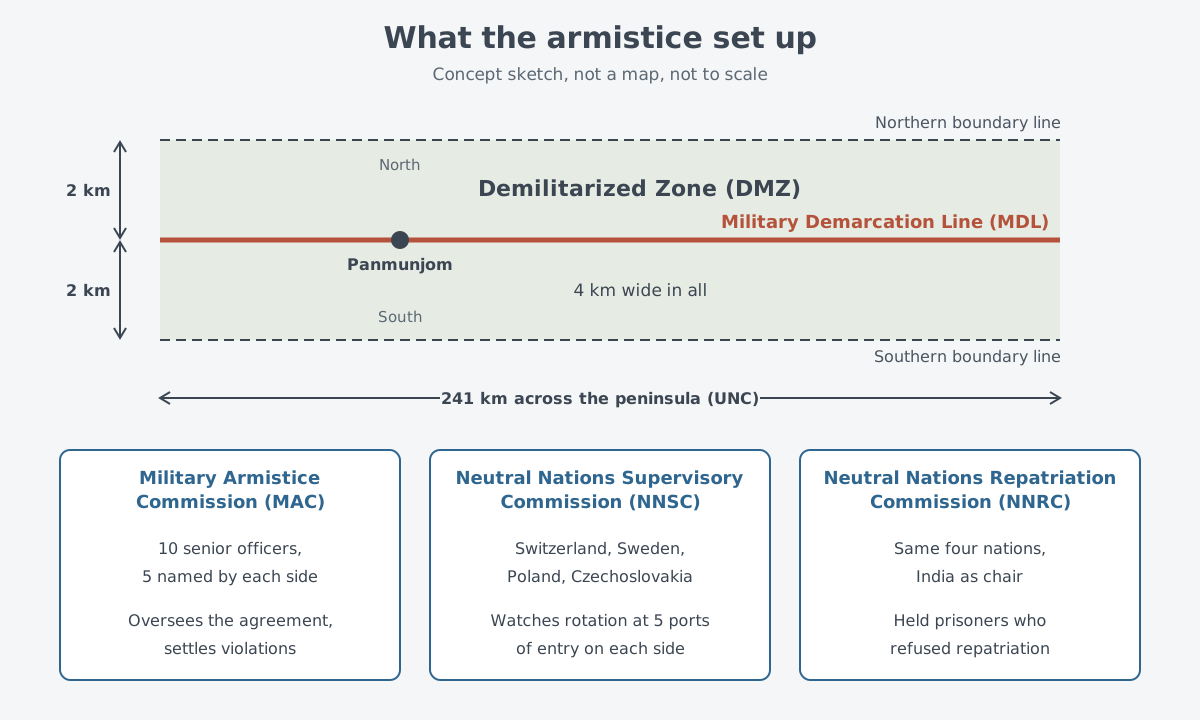
The agreement drew a Military Demarcation Line (MDL) on the last line of contact. Both sides pulled back 2 km from it to form a Demilitarized Zone (DMZ) 4 km wide, which the United Nations Command gives as 241 km long.
Three bodies were set up to watch over the line.
| Body | Members | Task |
|---|---|---|
| Military Armistice Commission (MAC) | Ten senior officers, five named by each side | Oversee the agreement and settle violations through talks |
| Neutral Nations Supervisory Commission (NNSC) | Switzerland, Sweden, Poland, Czechoslovakia | Watch troop and equipment rotation at five ports of entry on each side, and investigate and report violations outside the DMZ |
| Neutral Nations Repatriation Commission (NNRC) | The same four nations, with India as chair | Hold prisoners who refused repatriation and let them choose again |
Prisoners who refused repatriation heard explanations from their home countries while under the repatriation commission's care. The period is given as up to 90 days in the prisoner agreement entry and as four months in the repatriation commission entry. Of 22,604 prisoners in all, 88 chose a neutral country, and on January 23, 1954, the UN side released 23,000 prisoners who had refused repatriation after the explanation period ended.
The political conference never reached a settlement. The agreement was formally adopted by the UN General Assembly on August 28, 1953, but the 1954 talks in Geneva, Switzerland, produced no peace treaty. In the words of the encyclopedia's Korean War entry, the armistice agreement was left as the only official document. The State Department's Office of the Historian calls the 1953 result an "uneasy truce" and sees the split of the peninsula into two states as having hardened at that point.
For a fuller account of these two years from the U.S. Army side, the U.S. Army Center of Military History publishes Truce Tent and Fighting Front by Walter G. Hermes. The book covers the truce talks, the hill fighting that went on during them, and the prisoner riots on Koje-do in one volume.
What to read next
- The Outbreak of the Korean War: Dawn, June 25, 1950. The first day of the war these talks brought to a halt.
- MiG Alley: The Jet Air War over Korea. The fight in the sky above the ridges during the same years.
- Self-propelled howitzers: guns that move themselves. A way to think about the role of heavy artillery in the hill battles, through today's artillery systems.
- Military logistics: performance must be sustainable. What it takes to support a front that did not move for two years, seen through today's ideas of logistics.
- A history of laser weapons: from chemical to electric lasers. Another branch of how weapons technology developed after the 1950s.