June 25, 1950, was a Sunday. At 10 a.m. Seoul time, the U.S. ambassador in Korea, Muccio, cabled the Secretary of State that North Korean forces had crossed into South Korean territory at several points that morning. When the message reached Washington, clocks there still read 9:26 p.m. on Saturday, June 24.
Why did the war start that morning, and how did Seoul fall within three days? This article follows the four days from June 25 to June 28. It uses the U.S. diplomatic telegrams sent at the time, the UN Security Council resolutions, and entries in the Encyclopedia of Korean Culture from the Academy of Korean Studies. Where times and dates differ between sources, each one is named.
How the 38th parallel became a border that was not a border
When Japan surrendered on August 15, 1945, Korea was split at the 38th parallel for military convenience, with Soviet forces in the north and American forces in the south. According to the State Department's Office of the Historian, the two powers had agreed during World War II to divide Korea there for a time. The purpose was to supervise the departure of Japanese troops. It was not drawn as a line between two countries.
In December 1945 the foreign ministers of the United States, Britain and the Soviet Union met in Moscow and agreed on a five-year trusteeship for Korea. A U.S.-Soviet Joint Commission met in 1946 and 1947 and broke down both times without a solution. In September 1947 the United States took the Korean question to the United Nations. In November the General Assembly voted to hold elections across Korea under a UN Temporary Commission on Korea.
The Soviet commander refused to let the commission into the north. The May 1948 election was held only in the south. The Republic of Korea was founded in August, and the Democratic People's Republic of Korea was proclaimed in September. Soviet troops began to leave that October, and U.S. troops finished leaving in June 1949, keeping only a military advisory group of about 500.
Once two governments stood on either side of it, the temporary dividing line became, in the words of the 1995 "Korean War" entry, "a border that was not a border." By 1950 tension between north and south had grown so high that two ever more hostile armies faced each other along the parallel.
On the eve: the gap in troops and equipment
By October 1948, when Soviet troops left, the north already had four fully armed infantry divisions and the 105th Armored Battalion equipped with Soviet-made T-34 medium tanks. In 1949, 25,000 Korean soldiers who had served in the Chinese Communist army came over to North Korea. The "Korean War" entry says that, as a result, ten North Korean divisions with 130,000 troops stood along the 38th parallel, with a reserve of 100,000 organized behind them.
The South Korean army reached about 100,000 troops by 1949, after a marine corps and an air force were added. But its equipment was poor and it had no reserve. Four of its eight divisions were far from the 38th parallel, tied down fighting guerrillas in the rear.
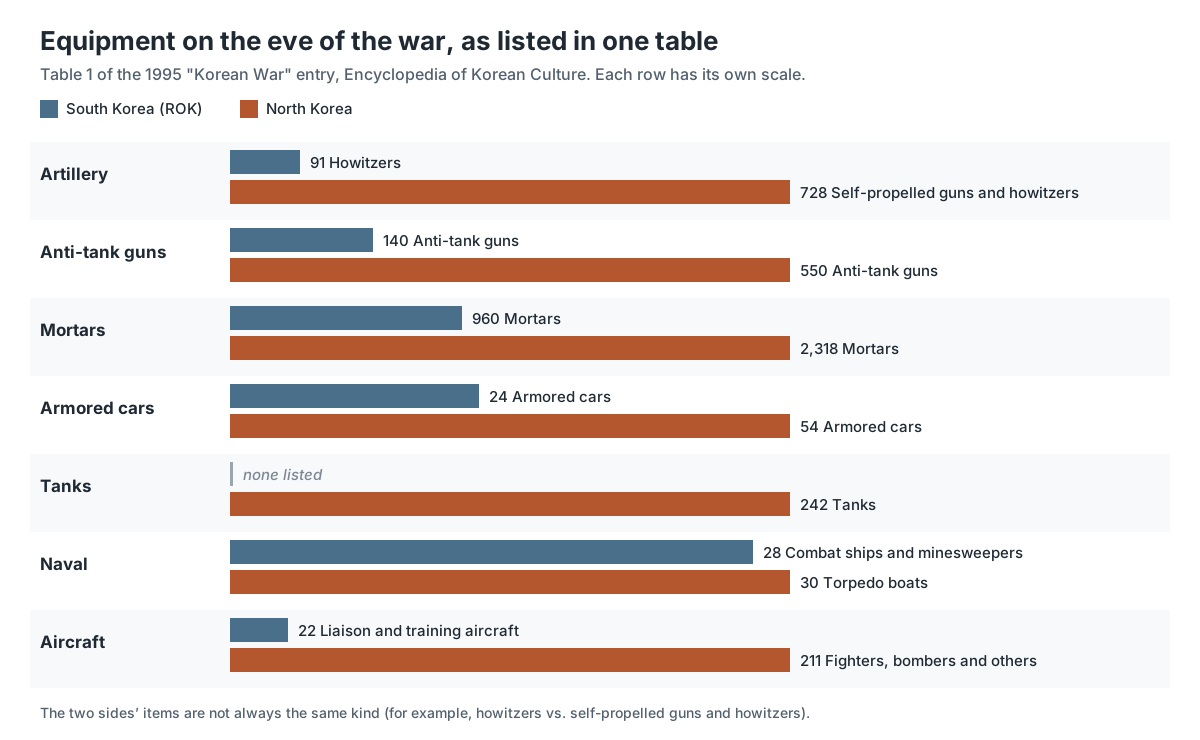
The gap shows more clearly in numbers. In the entry's table, North Korea had 242 tanks, while the South Korean column lists no tanks at all. Mortars were 960 against 2,318, and aircraft were 22 South Korean liaison and training planes against 211 North Korean fighters, bombers and others.
The two columns do not always count the same kind of thing. The 728 North Korean guns listed beside 91 South Korean howitzers combine self-propelled guns and howitzers of all kinds. At sea, the South is credited with 28 combat ships and minesweepers and the North with 30 torpedo boats, which are different types of vessel.
The 1995 entry lists four outside factors behind the decision for war. The first two are the communist victory in mainland China in October 1949 and the completed withdrawal of U.S. troops in June 1949. The third is Secretary of State Dean Acheson's January 1950 statement leaving Korea and Taiwan outside the U.S. defense line in the Far East. The last is Kim Il Sung's visit to Moscow in late 1949, where he obtained Stalin's approval.
A U.S. National Archives teaching guide also says Acheson implied Korea lay outside the U.S. "defense perimeter." Some read this as a sign that Washington would not step in to protect South Korea.
In early April 1950, Kim Il Sung settled on a plan to unify Korea by force at a meeting of the Workers' Party's central political committee. Around the same time, the north pressed a peace campaign, including a proposal to hold a joint legislative meeting in Seoul. The 1995 entry reads this as a move to hide the invasion plan.
Four in the morning, June 25
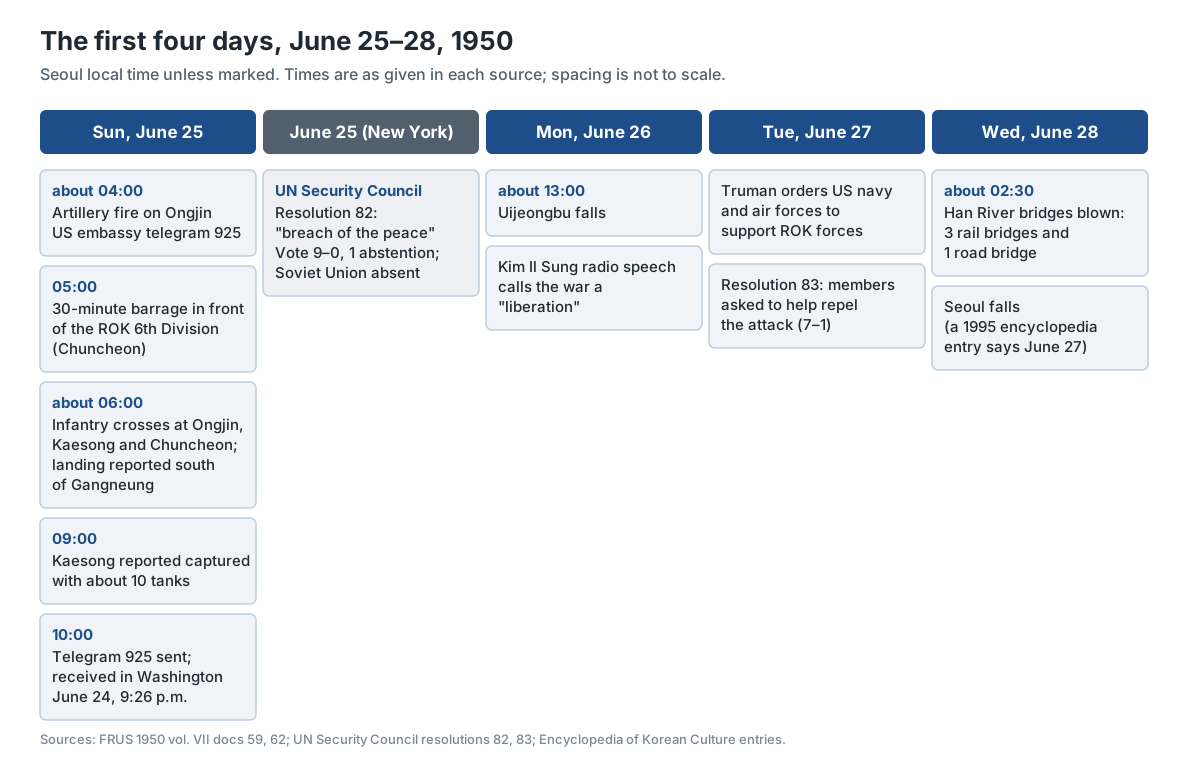
Muccio's telegram 925 was based on South Korean army reports, partly confirmed by reports from field advisers of the Korean Military Advisory Group (KMAG). According to the telegram, the attack began at about 4 a.m. with North Korean artillery fire on the Ongjin peninsula. Around 6 a.m., foot soldiers from the north started across the line near Ongjin, Kaesong and Chuncheon, and a landing was reported south of Gangneung on the east coast.
Kaesong reportedly fell at 9 a.m., and about 10 North Korean tanks took part. Other forces, led by tanks, were reported closing in on Chuncheon. Muccio wrote that the nature and manner of the attack made it look like an all-out offensive against South Korea.
Other records give slightly different times. In the encyclopedia's entry on the Chuncheon battles, a 30-minute barrage fell on the front of the ROK 6th Division at 05:00, followed by infantry led by self-propelled guns. To the west, the ROK 1st Division faced a barrage that began before daybreak and North Korean forces led by T-34 tanks.
At 1 p.m. the same day, the station WVTP made an announcement approved by the ambassador. It said that "at 4 o'clock this morning" North Korean forces had begun attacks on South Korean positions at a number of places on the parallel.
The broadcast added that it could not yet be determined whether the north intended all-out war. It asked American mission staff to remain in their homes or at work as much as they could. Its words were noticeably more cautious than the telegram sent to Washington.
How the first news traveled
Seoul and Washington were many hours apart. Telegram 925, sent from Seoul at 10 a.m. on June 25, arrived at the State Department at 9:26 p.m. on Saturday, June 24. The watch officer notified officials at 10:15 p.m., and at 11 p.m. two copies went to the White House for the President.
Washington had already heard the news from the press. UP news bulletins reported that night that North Korean forces had launched a general offensive across the border. A call to the embassy in Seoul did not get through, so the State Department sent telegram 612 asking the embassy to advise urgently. That telegram was written before 925 arrived.
On hearing the news, the United States called an emergency meeting of the UN Security Council on the 25th. Resolution 82, adopted that day, determined that the attack on South Korea from the north was a "breach of the peace." It called for an immediate end to hostilities and for the North Korean authorities to withdraw their forces to the 38th parallel at once.
The vote was 9 to 0, with 1 abstention (Yugoslavia). The Soviet delegate was not there. The National Archives guide explains that the Soviet Union had walked out six months earlier because the UN would not accept a delegate from China.
Uijeongbu and Chuncheon: two different first days
Uijeongbu, on the road to Seoul, faced the North Korean I Corps, the main attacking force. The encyclopedia's "Battle of Uijeongbu" entry, written in 2013, says the North Korean army aimed to take Seoul and the Han River bridges by June 26. Its forces in this area numbered more than 48,000. Facing them, the ROK 7th Division had only about 4,500 men on hand because many were on leave or passes.
To hold Uijeongbu, army headquarters rushed in units from around Seoul, divisions from Daejeon, Daegu and Gwangju, and even the cadet battalion of the Korea Military Academy. But units from the rear set out battalion by battalion, before they were fully organized. Uijeongbu fell at about 13:00 on the 26th.
The collapse at Uijeongbu spread along the whole front. With Seoul now in danger, three more divisions pulled back to hold a line: the ROK 1st, 6th and 8th. On June 26, Kim Il Sung said in a radio broadcast that the war was being fought to "liberate" the south and unify the country.
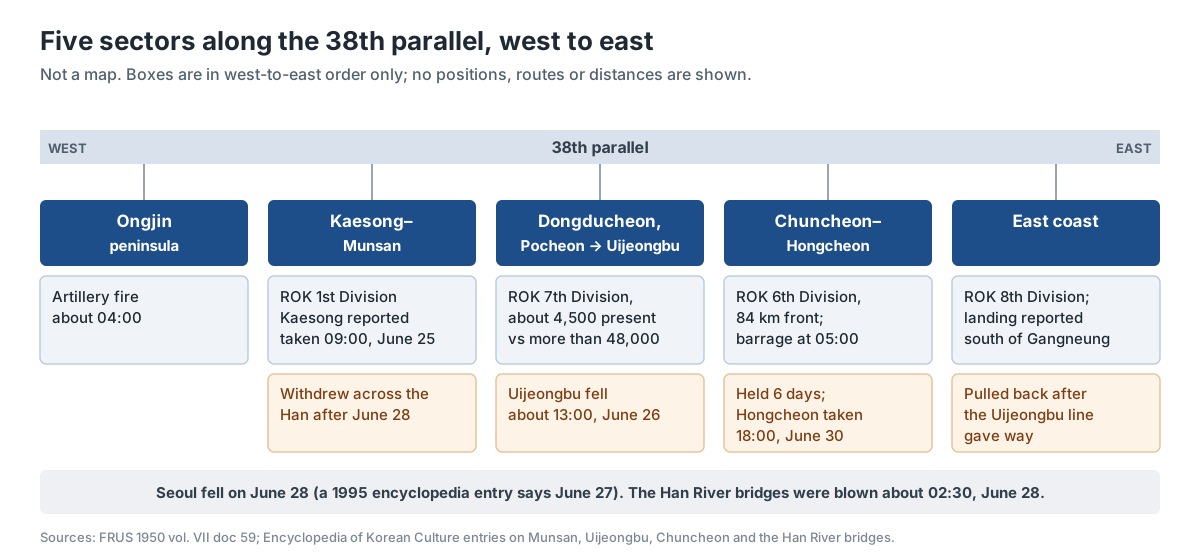
Chuncheon went differently. The ROK 6th Division held a wide front of 84 km from Gapyeong to Hyeon-ri. The North Korean II Corps could not cross the Soyang River on the first day.
The division held out for six days along the Soyang River and the Malgogae pass near Hongcheon, and the North Korean army took Hongcheon only at 18:00 on June 30. The encyclopedia's Chuncheon entry judges that this gave the South Korean army time to form a defense line south of the Han River.
The Han River bridges and the fall of Seoul
On the evening of the 27th, North Korean forces pressed on the outskirts of Seoul behind their tanks. After midnight on the 28th, some tanks swung toward Cheongnyangni, where no South Korean troops were deployed, and broke into the Hongneung area at about 2 a.m. Told that tanks were in the city, the army chief of staff, Major General Chae Byong-duk, ordered the chief engineer, Colonel Choi Chang-sik, to blow the Han bridges.
At about 2:30 a.m. on the 28th, engineers who had been ready since the afternoon before cut three railway bridges and one road bridge. Dozens of vehicles on the bridges were wrecked, and many people were killed or wounded. One single-track rail bridge was not fully destroyed and was later used by North Korean forces.
The demolition was criticized for cutting the escape route while the main South Korean forces defending the outskirts and many civilians were still north of the river. Choi Chang-sik, the officer held responsible, was executed by firing squad in September 1950. Twelve years later, in 1962, a retrial found him not guilty.
Sources disagree on the day Seoul fell. The 1995 "Korean War" entry says North Korean forces had already taken Seoul on June 27. The "Battle of Munsan" entry, written the same year, says Seoul fell on June 28. The Australian War Memorial says only that Seoul was captured within a week.
In the west, the ROK 1st Division found its retreat blocked once Seoul fell. It crossed the Han at the Haengju and Isanpo ferries and left most of its crew-served weapons and equipment behind.
Decisions abroad moved quickly too. On the 27th, President Truman ordered U.S. naval and air forces to support South Korean forces. The same day, the Security Council's Resolution 83 recommended that UN members help South Korea repel the armed attack. That vote was 7 to 1 (Yugoslavia), and Egypt and India did not take part in the voting.
In a statement the same day, Truman said that communism had moved beyond subversion and had turned to open invasion and war to take over independent nations. On the 28th, General MacArthur came from Tokyo, toured the front and asked the Pentagon to send ground troops. The U.S. 24th Infantry Division soon arrived from Japan but was not strong enough to turn the tide, and the fighting moved on to the Naktong River line around Busan.
An army facing tanks
Tanks appear again and again in the records of the first three days. About 10 tanks joined the attack on Kaesong, and the forces that pushed toward Uijeongbu and Seoul also led with tanks. As the table showed, the South Korean army had no tanks, and its 140 anti-tank guns were far fewer than the north's 550.
The encyclopedia's entry on Kim Pung-ik shows this gap in a single scene. On June 26, Major Kim, commander of an artillery school training battalion, moved his unit to Geumo-ri (Chukseokryeong), north of Uijeongbu. The firepower the South Korean army had at the time could not pierce the armor of a T-34.
He aimed a 105 mm field gun directly at a tank and destroyed it with the first round. As the crew made ready for a second shot, a tank round struck them, killing him and his men.
Something similar happened at Chuncheon. Second Lieutenant Shim Il of an anti-tank gun company destroyed two self-propelled guns in a close-in attack. Near Hongcheon, South Korean troops formed anti-tank teams that destroyed about 10 more. All of these fights took place without enough weapons to stop tanks and self-propelled guns.
What to read next
- Main battle tanks: is it all about the gun?: how tanks changed after the T-34 of 1950
- Anti-tank guided missiles: rockets versus guided missiles: the infantry's anti-tank weapons after the days of field guns and close-in attacks
- The Pusan Perimeter: Dabu-dong and the Last Line: the summer fighting around Busan after June 28