A destroyer carries more than the engines that turn its propellers. It also carries separate engines whose only job is to make electricity. All of the electrical equipment on the ship runs on that power. So why not merge the two sets of engines into one and send the power wherever it is needed at the moment?
That question sits behind what the U.S. Navy calls integrated electric propulsion. The answer runs through naval gas turbines that came from aircraft jet engines and more than a hundred years of ups and downs for electric drive. It ends with the reason shipboard lasers turn into a question about a ship's electricity.
How a gas turbine drives a ship
Most modern airliners and military aircraft are powered by gas turbines, better known as jet engines. The compressor works like many rows of airfoils, each row raising the pressure a little. Fuel is added to the compressed air in the burner and ignited. The turbine works like a windmill, pulling energy out of the hot flow and turning the compressor through a central shaft.
An aircraft jet engine pushes the remaining flow out of a nozzle to make thrust. There is another way to take the power, as rotation. A turboprop engine uses most of the exhaust energy to turn the turbine and passes that rotation to a drive shaft and a gearbox.
When the gearbox drives something other than a propeller, the engine is called a turboshaft. Turboshaft engines are used in many helicopters, in tanks and in boats.
The engines of U.S. Navy surface combatants are gas turbines too. A 2000 report by the Congressional Research Service (CRS) describes them as adapted airliner jet engines that run on jet fuel. U.S. Navy submarines and most of its aircraft carriers use steam turbines, with the steam made by heat from a nuclear reactor. Ships with lower top speeds can use diesel engines.
From aircraft engine to ship engine
The idea of putting gas turbines in ships came after the aircraft jet engine. Trewby presented a paper on the subject to the Institute of Marine Engineers in 1954. In his account, Britain did not give naval gas turbines serious thought until Frank Whittle's work led to Britain's first aircraft jet engine in 1941. In August 1943 a contract was placed for three naval gas turbines called Gatric.
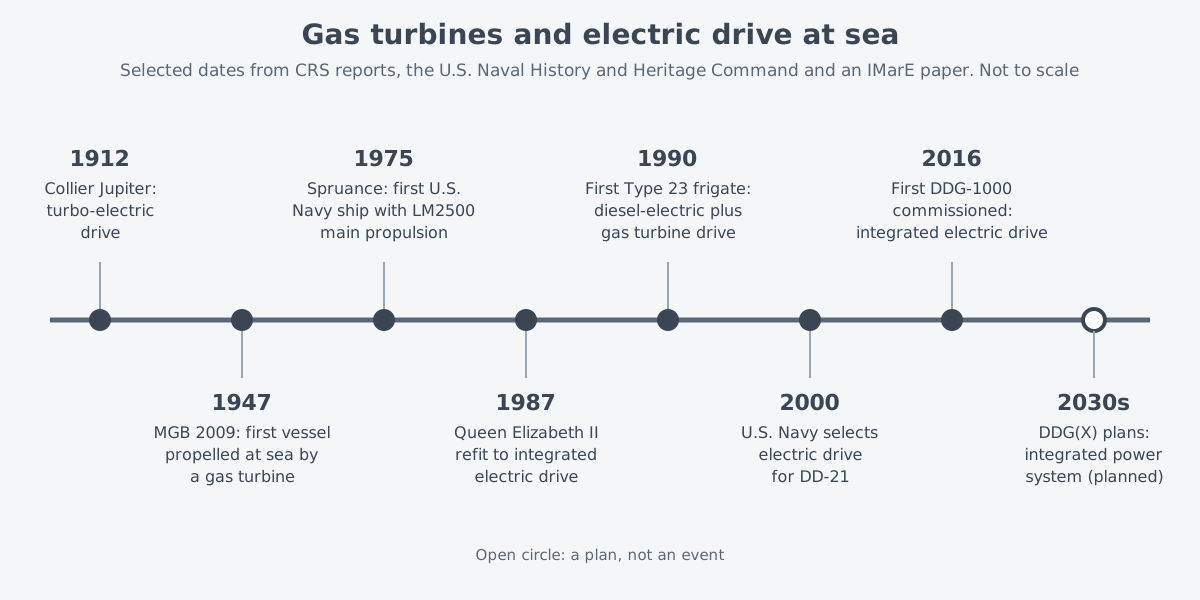
The test boat was MGB 2009. Fitting a Gatric in place of the center one of its three Packard petrol engines was finished in July 1947. In August that year, MGB 2009 became the first vessel anywhere to be driven at sea by a gas turbine.
A prime mover is the engine that first produces the power to move a ship. Trewby concluded that the greatest single advantage of the gas turbine for warships was its ability to pack more power into less weight and space than any other prime mover.
In the United States, one aircraft engine became the basis for a ship engine. The manufacturer, GE Aerospace, says that about 50 years ago the U.S. Navy needed a replacement for its existing steam turbine propulsion plants. Its engineers turned the CF6 aircraft engine into a gas turbine for marine and industrial use, and that became the LM2500. An engine derived from an aircraft engine in this way is called an aeroderivative.
The destroyer Spruance (DD-963) was commissioned on September 20, 1975. According to the Naval History and Heritage Command (NHHC), she was the first U.S. Navy ship to use four LM2500s for main propulsion. Three other gas turbines drove generators for her electrical power. This split, with propulsion engines on one side and generator engines on the other, is where the next part begins.
Mechanical drive: two sets of engines
The drive system of a ship carries power from the engines to the propellers. It does the job of a car's gearbox and driveshaft. Around the world, mechanical drive is the norm for most large merchant ships and warships.
In mechanical drive, the engine's fast rotation travels along a rigid shaft to reduction gears, which turn it into the slower rotation that suits a large propeller. The car comparison only goes so far. In a real ship, the engines, reduction gears, shafts and propellers have to sit in a long line along the bottom of the hull.
A mechanical-drive ship has two sets of engines. One set drives the ship, and the other runs generators that make electricity for all of the ship's electrical equipment. Take the Arleigh Burke (DDG-51) class destroyer. It has four large gas turbines for propulsion and a separate set of three smaller gas turbines that make electricity.
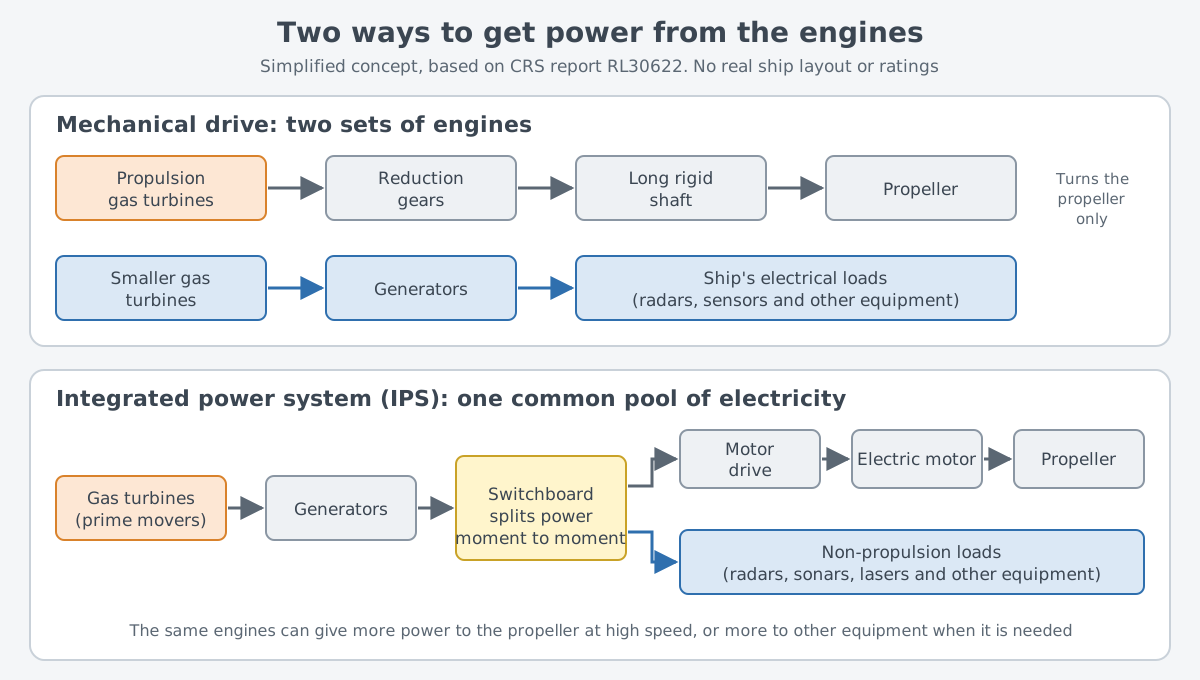
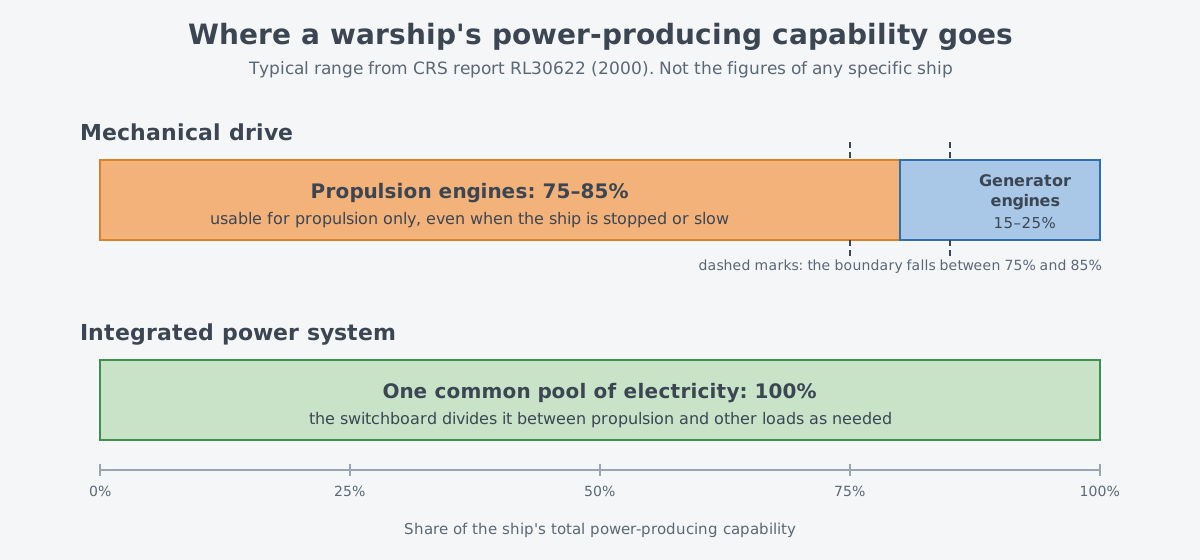
The catch is the difference in size. According to the 2000 CRS report, the propulsion engines of a mechanical-drive ship typically make up 75–85% of its total power-producing capability. That power is tied to propulsion and cannot be used for anything else, even when the ship is stopped or moving slowly.
Electric drive and integrated electric propulsion
Electric drive puts electricity between the engine and the propeller. A generator turns the engine's fast rotation into electricity, and cables carry it toward the stern to a motor drive. The motor drive adjusts the voltage and frequency so the electric motor runs at the speed wanted, and the motor turns the electricity back into slow rotation for the propeller.
The next step is integrated electric drive (IED). It is also called the integrated power system (IPS), after the name of the U.S. Navy's development program.
In an integrated power system, the electricity from one set of engines goes into a single pool. A switchboard splits it into two flows, one for propulsion and one for other equipment, and can change the split from moment to moment. Even at high speed, the ship can briefly send power to equipment that needs a short, strong burst without slowing down noticeably.
The main parts are the engines, generators, switchboard, motor drives, motors, propellers and a distribution system that carries the remaining electricity to other equipment. Some auxiliary equipment still runs on steam, hydraulics or compressed air. Converting that equipment to electricity as well would give an all-electric ship, which some observers see as the natural next step after integrated electric drive.
An idea more than a century old
Electric propulsion is not new. Electric drive goes back to about 1910, when the first large electric motors and generators appeared. At that time, electric drive developed in the United States and mechanical drive with reduction gears developed in Britain were both being refined and competed with each other.
Naval writer Geoffrey Wood, quoted by CRS, starts the history of electric propulsion in warships in 1912 with the U.S. Navy collier Jupiter. Powered by a turbo-electric system, she became the prototype for later installations in capital ships. Jupiter was later rebuilt as Langley (CV-1), the Navy's first aircraft carrier, an experimental one, and joined the fleet in 1922. Of three New Mexico class battleships ordered in 1914, the lead ship was given a turbo-electric system while under construction.
The contest was settled in the 1920s. Britain developed a light, highly efficient mechanical drive, and mechanical drive became the main way to propel ships. Analyst Norman Friedman, also quoted by CRS, points out that the naval arms treaties after World War I made saving weight vital, and geared turbines were far lighter. During World War II, the U.S. Navy brought turbo-electric plants back for destroyer escorts because the country lacked enough gear-cutting capacity.
After World War II, mechanical drive stayed dominant, and submarines were the only warships that widely adopted electric drive. The diesel-electric plant became their standard system. That story continues in Diesel-electric, AIP and nuclear submarines.
Power electronics changed the picture. From the mid-1970s, better motors and, above all, better motor drives meant electric drive could become the more cost-effective choice, even for larger naval ships. Semiconductor devices that handle large flows of power made it possible to build motor drives that deliver high-quality power efficiently to large motors.
The same devices also made it possible to tie propulsion and other equipment into one electrical network. An AC motor's speed is controlled by changing the frequency of the power from the motor drive. Other equipment on a ship needs power at a steady frequency, so earlier AC electric drives were limited to propulsion alone.
In 1985 the United Kingdom began building the Type 23 frigate. For quiet towing of sonar at up to about 15 knots, these ships run on a low-power diesel-electric drive. Above that, gas turbines drive the shafts mechanically. The first one entered service in 1990.
Merchant ships changed too. In 1987 the liner Queen Elizabeth II had her mechanical drive replaced with integrated electric drive during an overhaul. That set the stage for electric drive to spread across the cruise ship industry.
What you gain and what it costs
The 2000 CRS report lists the expected benefits of electric drive as lower life-cycle cost, a quieter ship, more payload and more power for uses other than propulsion. Fuel comes first. Depending on the type of ship and how much time it spends at each speed, an integrated electric-drive warship may use 10–25% less fuel than a similar mechanical-drive ship. The Navy estimated savings of 15–19% for a ship like a surface combatant.
Space changes as well. The mechanical-drive need to line everything up from engine to propeller is known as "the tyranny of the shaft line." Electric drive lets the parts sit where they use space better, and may even let the turbine engines sit higher in the ship. The space freed up can carry more payload, such as weapons or sensors.
Electric drive is also expected to be much quieter than mechanical drive. The most interesting benefit, though, is a large supply of power for things other than propulsion.
Examples of those uses include laser weapons, high-power microwave (HPM) weapons, electromagnetic railguns, electromagnetic aircraft launch and recovery systems, and strong radars and sonars. The weapons in particular may need peak power measured in tens of megawatts (MW), and giving a mechanical-drive ship that much extra generating capacity would be very expensive.
There are costs. The listed drawbacks are higher near-term costs, more program risk, more system complexity and lower efficiency at full power. Most sources said electric drive would at first cost more to buy. It is also less mature than mechanical drive for naval ships, so it can add technical and schedule risk.
The efficiency question is worth a closer look. Energy is lost each time rotation is turned into electricity and back into rotation, so at full power electric drive can be less efficient than mechanical drive. Warships, however, spend only a small share of their time at full power.
By one estimate, a warship spends about 80% of its time at half speed or less, which is roughly one-eighth power or less. For that reason, CRS judged that for warships the gains at partial power will likely more than offset the losses at full power.
From Zumwalt to DDG(X)
In January 2000 the U.S. Navy chose electric-drive propulsion for its planned next-generation destroyer, DD-21. After several name changes the program became DDG-1000 in April 2006, and its ships are today's Zumwalt class.
According to a 2025 CRS report, the DDG-1000 design includes many new technologies, among them integrated electric-drive propulsion. Its estimated full load displacement is 15,656 tons, and the first ship was commissioned on September 7, 2016.
Power and cooling became issues for the existing DDG-51 too. Starting in FY2017, the Navy has bought DDG-51s to the Flight III design. It adds the new SPY-6 radar along with matching changes to the ship's power and cooling systems.
The next destroyer, DDG(X), was planned around an integrated power system from the start. The Navy has described DDG(X) as having more room to grow than DDG-51 Flight III: more space, more weight it can carry, and more electrical power and cooling. It has planned to procure the first ship in the early 2030s.
A Navy budget document quoted by CRS says future large surface combatants must be able to host directed energy weapons. It adds that they need an efficient integrated power system to manage changing loads.
Work remains. A June 2025 report by the Government Accountability Office (GAO) noted that the Navy intends to model the IPS at a test site on land. The results, however, may not be ready in time to fully inform the design before detailed design. After the Administration announced a new guided missile battleship program, BBG(X), on December 22, 2025, some press reports said the Navy intends to suspend work on DDG(X).
Where this meets lasers: electricity as the magazine
Shipboard lasers tie straight into this story about electricity. A 2026 CRS report describes the Navy's solid state lasers (SSLs) as weapons that run on electricity taken from the ship's general power supply. They can be fired over and over for as long as the laser keeps working and the ship has fuel to make electricity. The Navy installed its first prototype SSL on a ship in 2014.
A warship's surface-to-air missiles and close-in guns can shoot down only a certain number of targets before they run out of ammunition. CRS calls this the limit of depth of magazine and sees lasers as having the potential to improve it greatly.
So the conditions for carrying a laser are the ship's electricity and cooling. One of the issues listed for Congress is whether ships the Navy plans to build, other than BBG(X), will have enough space, weight, electrical power and cooling capacity for lasers.
The Navy has said BBG(X) is to carry two lasers rated at 300 kW or 600 kW of beam power each. How this pairing of size, weight and power (SWaP) with cooling shows up inside the laser equipment itself is covered in Power supplies and chillers and Cooling and thermal management.
What to read next
- Destroyers and frigates: why warships have different names: what the destroyers and frigates in this article actually are.
- Diesel-electric, AIP and nuclear submarines: propulsion in submarines, where electric drive took hold first.
- Electromagnetic railguns: launching with electricity: one example of a naval weapon that needs a lot of power.
- Turbofan Engines: How a Fighter Engine Pushes Air: the aircraft jet engine that naval gas turbines grew from.
- Power supplies and chillers: the equipment behind a laser: the equipment that handles electricity and heat behind a laser.