Gather a month of counter-drone news and the laser turns out to be one tool among several. October brought interceptor drones that catch drones in nets, microwaves that knock out electronics in one go, low-cost interceptor missiles, and AI command software that ties them together. A site about lasers looks at all of these for a simple reason: to judge where the laser fits, it helps to know what sits next to it.
This letter in brief
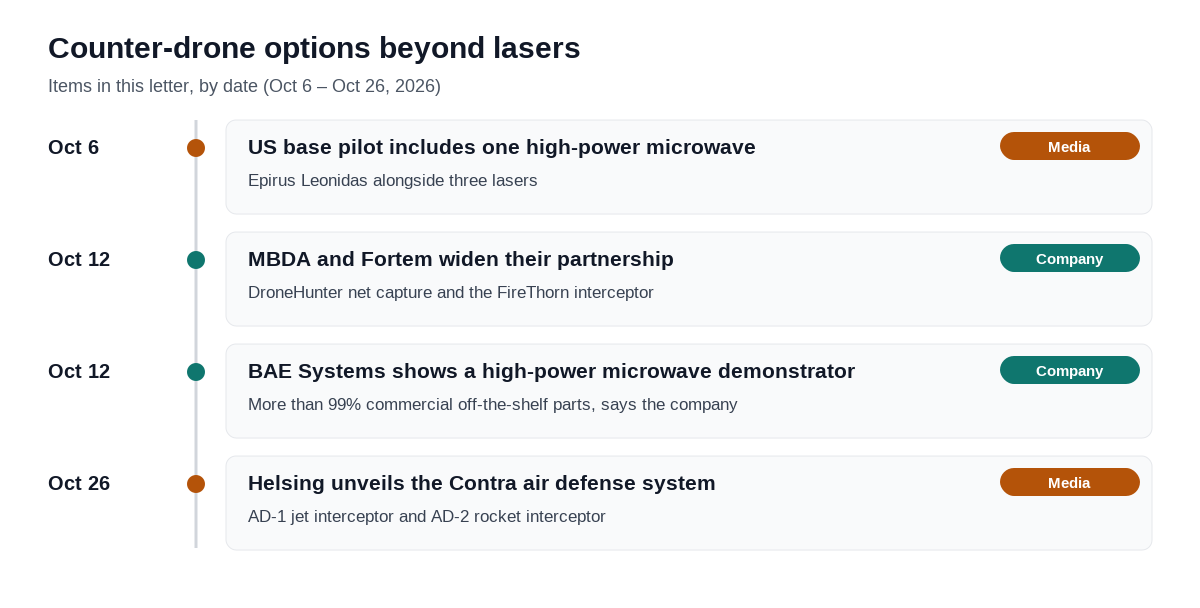
- On October 12, MBDA and Fortem widened their partnership and offered the net-capture interceptor DroneHunter and the autonomous interceptor FireThorn, and on the same day BAE Systems showed a high-power microwave (HPM) demonstrator.
- On October 26, Helsing announced Contra, an AI-directed air defense system, along with the AD-1 and AD-2 interceptors, and the US Pentagon's homeland pilot put one microwave next to three lasers.
- FireThorn's price and performance, and the power and effective range of BAE's microwave, were not disclosed. Helsing's two interceptors had not finished flight testing when they were reported.
Nets and warheads: MBDA and Fortem
On October 12, the European missile maker MBDA announced a wider partnership with the US counter-drone company Fortem Technologies. MBDA will now offer Fortem's DroneHunter interceptors to customers as "a layer" added to their existing air defense networks. DroneHunter is a low-collateral net-capture tool for dense environments.
FireThorn, developed by the two companies together, is a different kind of tool. It puts an MBDA warhead, approved for NATO use, on a fast autonomous airframe from Fortem that a radar guides to the target. It is a hard-kill tool for high-threat engagements. Speed, range and price are not in the announcement.
The wider picture of catching drones with drones is in using drones to catch drones.
Defense without ammunition: BAE Systems' high-power microwave
On the same day, BAE Systems unveiled two systems at the Association of the U.S. Army (AUSA) show. They are the Multi-Domain Artillery Cannon System (MDACS) and a high-power microwave (HPM). Both are "capability demonstrators," in the company's words. That means they show a capability rather than a finished product.
Two points stand out in the HPM description. More than 99% of the parts are commercial off-the-shelf, which removes the supply burden of traditional ammunition. It can also keep defeating drone swarms for as long as power is available.
Power, effective range and test results were not disclosed. More detail is in the BAE Systems HPM letter.
Air defense tied together by software: Helsing Contra
On October 26, the German defense startup Helsing announced the Contra air defense system and two interceptor missiles. Breaking Defense, quoting the company release, and Defence Industry Europe, quoting a Helsing post on X, both describe Contra. The release calls it an "AI-controlled autonomous air defence system" built to protect countries from large drone and missile attacks. Contra can also link up with interceptors and counter-drone gear that customers already have.
There are two new interceptors. The jet-powered AD-1 Inferno is, in the release's words, capable of aerial loitering, swarming and repeated re-engagements. The rocket-powered AD-2 Ambush reaches Mach 2.5. Breaking Defense gave its range as about 20 km, and Defence Industry Europe as more than 20 km.
The release gave no price in numbers, only that the interceptors will "significantly" undercut existing ones. At the Berlin briefing, a co-founder told reporters that each missile would cost less than €100,000, according to the drone outlet DroneXL. The same article said neither interceptor had finished flight testing, and that deliveries would start no sooner than April to June 2027. A major push for lower-cost interceptors is under way across NATO countries, Breaking Defense added.
Three lasers and one microwave: the Pentagon pilot
The list for the Pentagon's homeland counter-drone pilot, reported by Defense News on October 6, has four directed energy weapons. Three are lasers, and the only microwave is Epirus's Leonidas.
The difference between the two fits in a few lines. A laser has to stay on a single drone until it burns through, then move to the next one. A microwave can stop a whole swarm at once by swamping its electronics. Because the microwave spreads over a wider area, though, nearby equipment could be hit too.
The job each tool takes
Nets cause little collateral damage, warhead interceptors destroy high-threat targets, and microwaves take on swarms at once. Lasers fire one target at a time, but precisely and without ammunition. That is why "a layer" and "layered" keep coming up in company announcements.
Cost claims need care. The pilot article listed as advantages that lasers and microwaves cost far less per shot than a missile or gun round and leave no unexploded ordnance behind. In the same article, the pilot's director said he did not trust per-shot math alone, such as a claim that a shot "only costs 8 cents." The price of the equipment and the cost of running it count too.
That math is covered in the cost of drone defense. How a microwave knocks out electronics is in stopping drone swarms with high-power microwaves. For the laser side, continue with lasers against drones.
What to read next
- Stopping Drone Swarms with High-Power Microwaves: for how a microwave takes on a drone swarm at once.
- Using Drones to Catch Drones: Interceptor Drones: for how net capture and warhead interceptors differ.
- Lasers, interceptor missiles and guns: how they share the work: for the place each tool takes in layered defense.