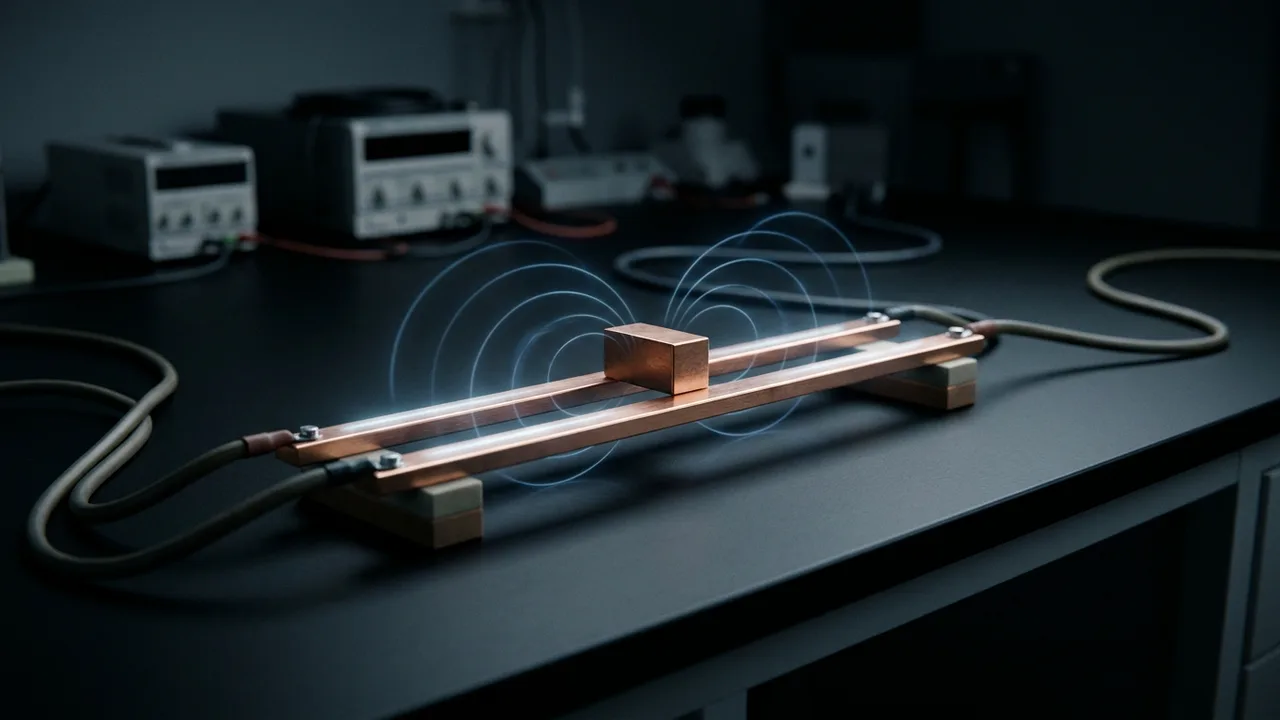
Mention firing a gun and most people picture gunpowder going off. So could you push an object out of a barrel with electricity alone, and no gunpowder at all?
That idea is behind the electromagnetic railgun. This article explains how a railgun works using a textbook idea: a magnetic field pushes on an electric current. It then follows how the U.S. Navy developed the weapon and why it stopped, using a Congressional Research Service (CRS) report.
Electricity instead of gunpowder
CRS describes the railgun as a gun that fires a projectile with electricity rather than chemical propellant, meaning gunpowder. Electricity takes over the job the gunpowder used to do. For that reason, CRS adds, Navy officials sometimes call the railgun a "launcher" rather than a gun.
Where does the electricity come from? A railgun on a ship draws on the electricity the whole ship generates. Shipboard solid-state lasers do the same. That shared point links it to laser weapons later in this article.
The principle: a force from current and magnetic field
The principle is in the textbook. A magnetic field pushes on moving charges. A current in a wire is just charge moving through it, so the wire itself is pushed.
For a straight wire in a field that is the same everywhere, that force fits on one line. F is the force, I the current, L the length and direction of the wire inside the field, and B the magnetic field.
F = I L × B
You find the direction of the force with your right hand. Point your fingers the way the current flows and bend them toward the field. The thumb now shows which way the force acts. So the force is at right angles to both the current and the field.
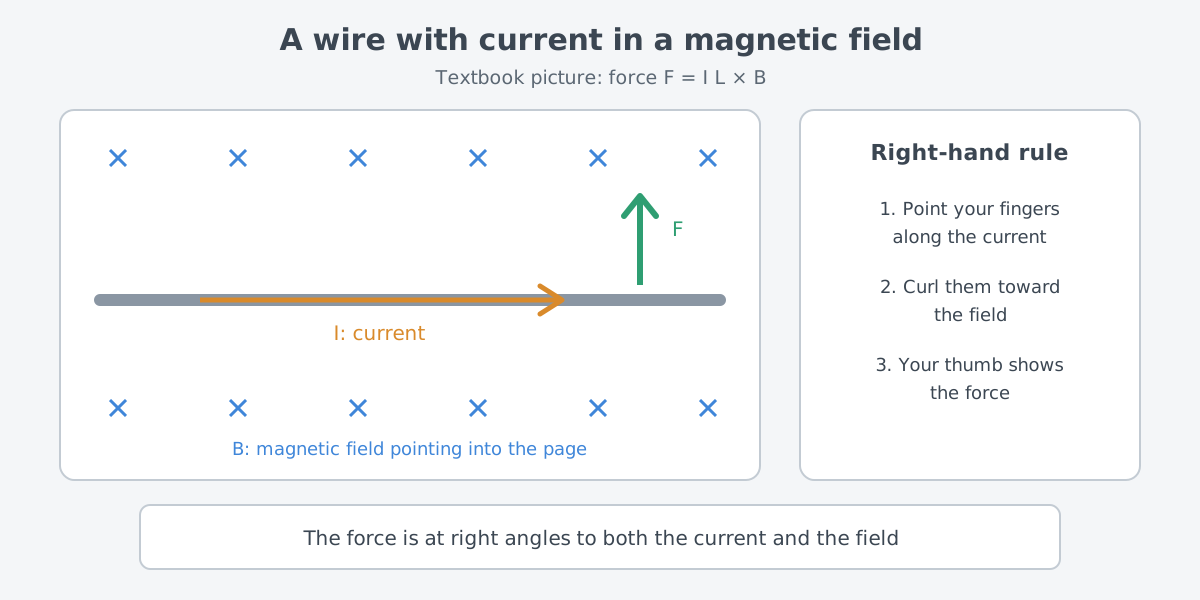
One more fact helps. A wire carrying current makes its own magnetic field in circles around it. A railgun uses both facts in one device: current makes a magnetic field, and current inside a magnetic field feels a force.
Two rails and a sliding conductor
The Navy description quoted by CRS goes like this. The magnetic field from a very large current drives a metal conductor that slides between two rails, called the armature, and that sends the projectile out.
Follow it in the picture. Current leaves the power source along one rail, crosses the armature and comes back along the other rail. The currents in the two rails make a magnetic field between them, and the current through the armature feels a force in that field. The right-hand rule shows that the force points along the rails, away from the power source.
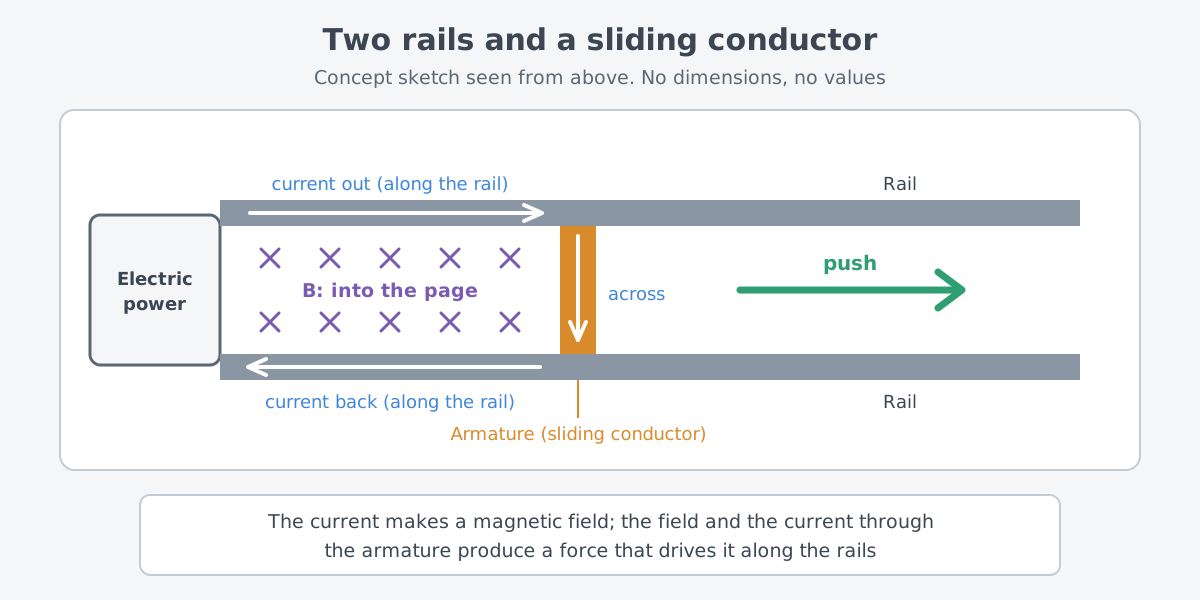
You could compare it to an invisible hand that keeps pushing a sled along a pair of rails. The real thing is different. What pushes is the force between the current and the field, not a hand, and producing that force takes a large current. The power system that delivers that current also appears among the remaining challenges listed later.
The same principle also shows where the railgun parts from laser weapons. CRS says plainly that the railgun does not count as a directed energy weapon (DEW). It does not aim electromagnetic energy at a target the way a laser does; it gets its effect by firing a physical projectile.
The U.S. Navy's development history
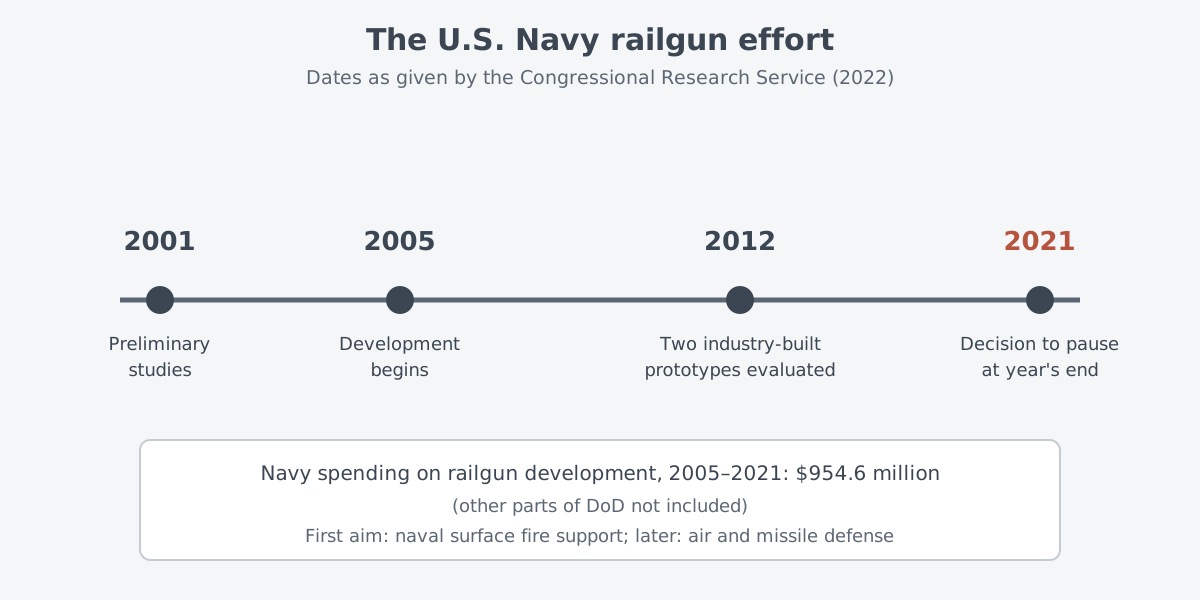
The Navy did preliminary studies starting in 2001 and began developing the railgun in 2005. According to CRS, the Navy spent $954.6 million on railgun development from 2005 through 2021. Money spent elsewhere in the Defense Department is not counted in that figure.
The first aim was naval surface fire support: firing from the sea toward the shore to back up friendly forces on land, such as Marines. Later the Navy judged that the railgun might also serve for air and missile defense, and for a time that raised its interest.
What could a gun fired by electricity instead of gunpowder add to a ship? CRS first points to a limit Navy surface ships face when defending against drones and anti-ship missiles: shallow "depth of magazine." Once a ship has used up its surface-to-air missiles and close-in gun rounds, it has to leave the fight and travel a long way to reload. CRS saw lasers and the railgun as able to deepen that magazine a great deal, noting that a ship's magazine can hold railgun projectiles by the hundreds.
The Navy first ran tests with prototypes it had built itself, then paid for two prototype demonstrators built by industry. Evaluation of those two prototypes began in 2012.
Development also led somewhere unexpected. The Navy realized that the guided projectile it was building for the railgun could also be fired from ordinary powder guns, such as 5-inch naval guns and 155 mm guns. That concept was given the names GLGP and HVP.
Why it paused: the challenges on record
The Navy's budget request for fiscal year 2022 proposed halting further work on the railgun and GLGP programs and asked for no research and development money for either. A Navy statement quoted by CRS said the service had decided to put railgun research and development on hold when 2021 ended.
The statement gave three reasons: tight budgets, the difficulty of fitting the weapon into a ship's combat systems, and the expectation that other weapon ideas would mature. The Navy said the decision was in line with department-wide efforts to free up resources for other priorities, including directed energy, hypersonic missiles and also electronic warfare systems.
CRS sorted the challenges still left into four areas: the launcher itself, the projectile, the power system, and fitting the weapon onto the ship. The principle fits on one textbook line, but turning it into a weapon on a ship involved all four of these areas.
Where this meets lasers: both run on electricity
A railgun and a laser weapon send out different things: one a projectile, the other light. Yet both draw their electricity from the ship's power supply. Both are, in the end, weapons that run on electricity.
On the laser side, this is judged by wall-plug efficiency: the share of the electricity put in that comes out as light. What power and efficiency mean for the size of a system continues in Power and efficiency.
What to read next
- Power and efficiency: the share of electricity that becomes light sets the size of the system: why efficiency matters for weapons that run on electricity.
- What is a laser weapon? Film versus reality: what the term directed energy weapon refers to.
- Cooling and thermal management: where the heat that did not become light goes: what is needed when electricity that did not become light is left as heat.