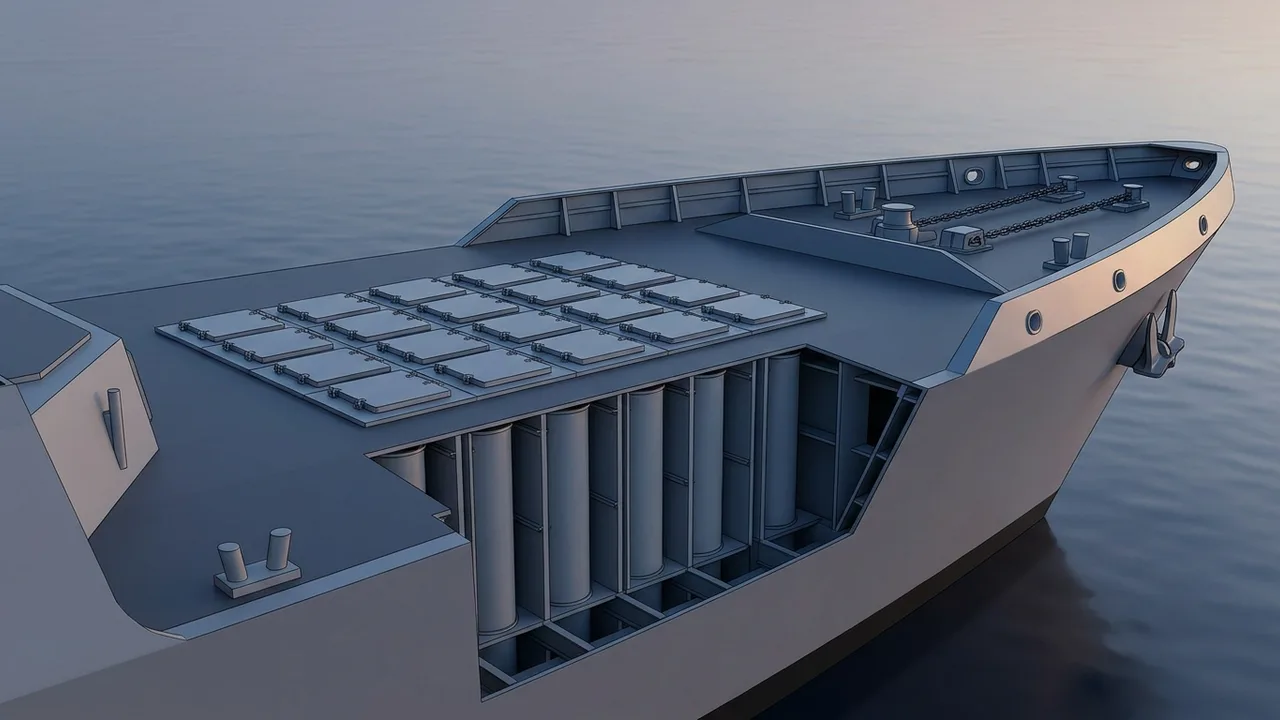
Photos of a destroyer often show a patch of the deck covered with square lids, lined up like a checkerboard. There is no turret and no launch rail in sight. So where are the missiles?
They sit right under those lids. Each missile stands upright in a cell below the deck and goes straight up when its hatch opens. This arrangement is known as a vertical launch system (VLS).
The sections below start with how cells and modules fit together and how many cells different ships carry. They then look at why a VLS is a separate topic from launch methods such as cold launch, and at the limit it faces at sea.
A magazine that stores missiles standing up
The Congressional Research Service (CRS) uses the name VLS for the installation where the missile cells of a cruiser or destroyer are grouped in one place. Each cell takes one canister, a launch case, and the missile rides inside it.
A VLS is both a storeroom and a launcher. On the FFG-62 frigate, for example, it is the main way the ship keeps and fires its missiles, though not the only way. The Mark 41 (MK 41) is the U.S. Navy's standard VLS design.
The layout looks a little like a row of apartment mailboxes. The slots stand in a line, and each takes one case. Unlike a mailbox, though, each cell's job depends on what is inside it, and opening the lid is the moment of launch.
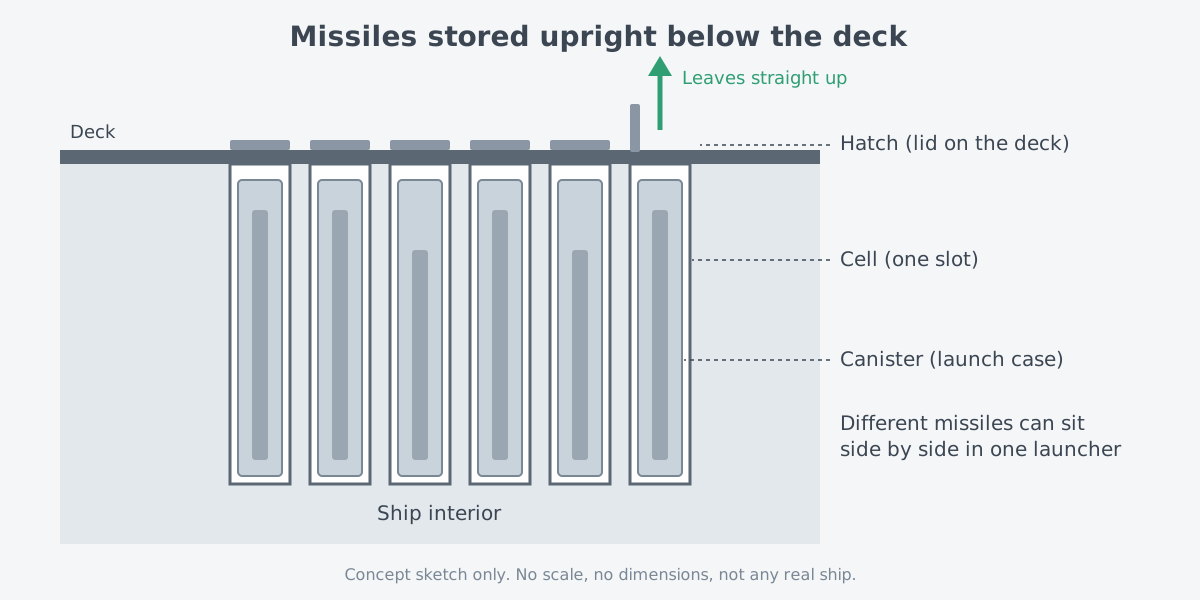
Why put it below the deck? Lockheed Martin, which makes the MK 41, claims that placing it below deck raises availability, survivability, and versatility. The company adds that it removes problems that older shipboard launchers and single-mission launchers used to have.
Cells and modules: eight cells to a block
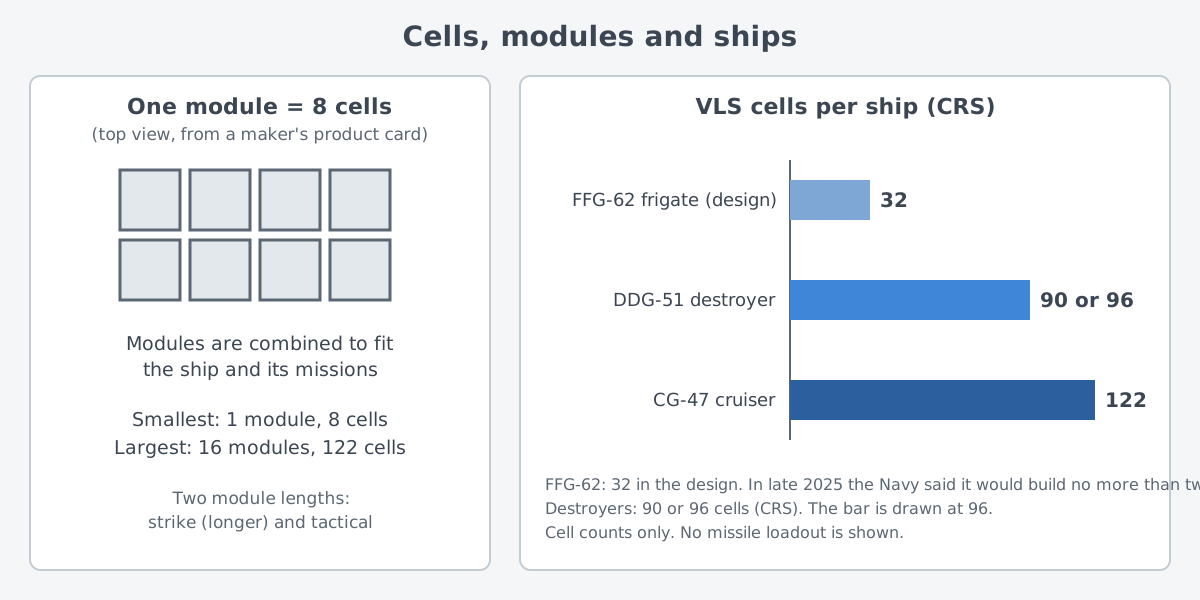
A VLS is not built one cell at a time. According to the maker's product card, the basic unit of the MK 41 is an eight-cell module. Modules are grouped in whatever number suits the mission and the hull, and 13 configurations are in use today.
The smallest is one module with 8 cells. The largest uses 16 modules and has 122 cells. The number of modules times 8 does not always equal the cell count. Sixteen times 8 is 128, yet the largest setup on the product card has 122 cells.
Modules also come in two lengths. The longer strike module can launch large missiles. The shorter tactical module holds the same kinds of missiles, except two kinds: Tomahawk cruise missiles and missiles built for ballistic missile defense. In other words, a long missile needs a long module.
This layout is not unique to one company. Roketsan's vertical launcher, MİDLAS, is also built from 8-cell modules with one canister per cell.
Many kinds in one cell: bringing weapons together
The maker's main selling point for the MK 41 is that one installation covers many missions. Lockheed Martin claims it can talk to weapon control systems and missiles across anti-air, anti-surface, anti-submarine, land-attack, and ballistic missile defense work. It also claims the system was designed so any missile can go into any cell.
The basis for this is an open architecture. Both the link to weapon control and the mechanical and electrical link to the missile are built as open interfaces. The idea is that one installation handles missiles for many missions, instead of several launchers that each fire only one kind of missile.
The design has been in service a long time. Since the mid-1980s, the MK 41 has kept a common mechanical structure while its electronics were improved again and again. The 2024 product card lists 17 navies, more than 30 ship classes, and more than 200 ships.
Different ships, different cell counts
Cell counts differ from ship to ship, and CRS reports also call these cells tubes. The FFG-62 frigate was designed with 32 Mark 41 VLS cells. The March 2024 edition notes that those who wanted 48 pointed out that 48 is half of what recent DDG-51 destroyers carry. In announcements in November and December 2025, the Navy said it would build no more than two FFG-62s and start a new frigate program, FF(X).
According to the CRS report on shipboard lasers, cruisers in the Navy carry 122 cells, while its destroyers carry either 90 or 96. When the 22 cruisers of the Ticonderoga class (CG-47) retire, the surface fleet is expected to lose a large share of its VLS cells.
The shape of the VLS itself can change, too: the Zumwalt (DDG-1000) class was built with a new kind of VLS from the start. The CRS destroyer report (December 2024 edition) describes a Navy plan to take one gun off each of these ships. Wide vertical launch tubes for the new hypersonic CPS missile would go in its place. The example shows that a large missile needs its own, larger tube.
Vertical launch and hot or cold launch answer different questions
A VLS answers the question "Where is the missile kept, and which way does it leave?" The answer is: in a cell below deck, straight up.
Launch method is a different question. In cold launch, the missile is pushed out first and its own motor starts afterward. So hot or cold answers "Where does the motor start?", and that choice is separate from whether the launch is vertical.
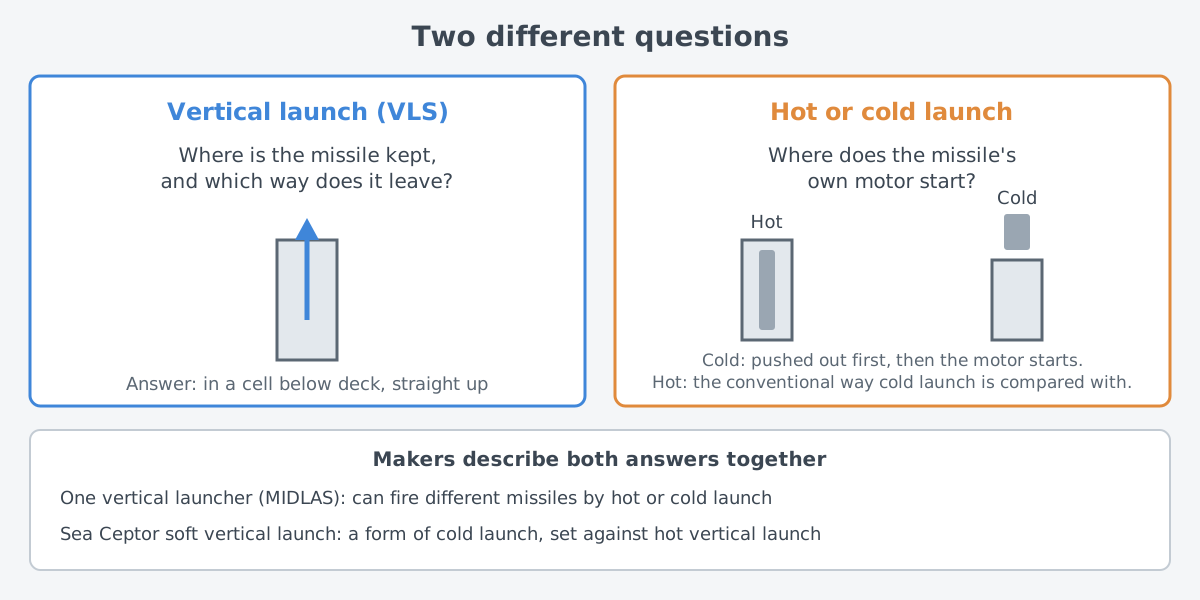
Maker documents show both answers side by side. MİDLAS, the vertical launcher mentioned above, keeps guided missiles in canisters below deck. The Roketsan catalog says it can fire several missile types by hot or cold launch on orders from the ship's combat system. One vertical launcher, then, takes both launch methods.
Sea Ceptor's soft vertical launch (SVL) is offered by L&T MBDA as a form of cold launch, and the company sets it against conventional hot vertical launch. The word "vertical" stays the same; only "hot" and "cold" change.
The limit: hard to refill at sea
A VLS has a clear limit. Its cells cannot be refilled while the ship is under way, so the ship must go back to a port or to calm, sheltered water. While the ship is under way, the missiles already in its cells are all it can fire from its VLS.
The term for this problem is depth of magazine. A CRS report names a limited depth of magazine and a poor cost exchange ratio as two key limits when surface ships defend against drones and anti-ship missiles. The ship can stop only a certain number of threats before its surface-to-air missiles and close-in weapon system (CIWS) ammunition run out.
What happens when they run out? The ship may have to pull out of the fight, sail to a safe place to reload that may be hundreds of miles off, and then sail back.
Where this meets lasers
This is one reason shipboard lasers come up so often. A solid-state laser on a ship runs on the ship's own electricity. It can keep firing as long as the laser does not break down and there is fuel to make power. On that basis, CRS sees a potential for a high-energy laser (HEL) to greatly improve depth of magazine.
A VLS and a laser have even met in the same spot. On the amphibious ship USS Portland, the laser sits near the bow inside a trunk structure first meant for a VLS that was never installed. The ship was chosen because it had room, weight to spare, and power cables already in place.
That does not mean lasers replace missiles. CRS itself speaks of a "potential." Why a laser beam needs time to damage a target is covered in Why a laser weapon does not finish "the instant it fires".
What to read next
- Cold launch: why some missiles pop out before igniting: a closer look at pushing a missile out of its cell first.
- Close-in weapon systems: a warship's last layer: the last layer that defends a ship alongside its VLS missiles.
- Layered missile defense: why defense comes in layers: a wider view of why defense is split into layers.