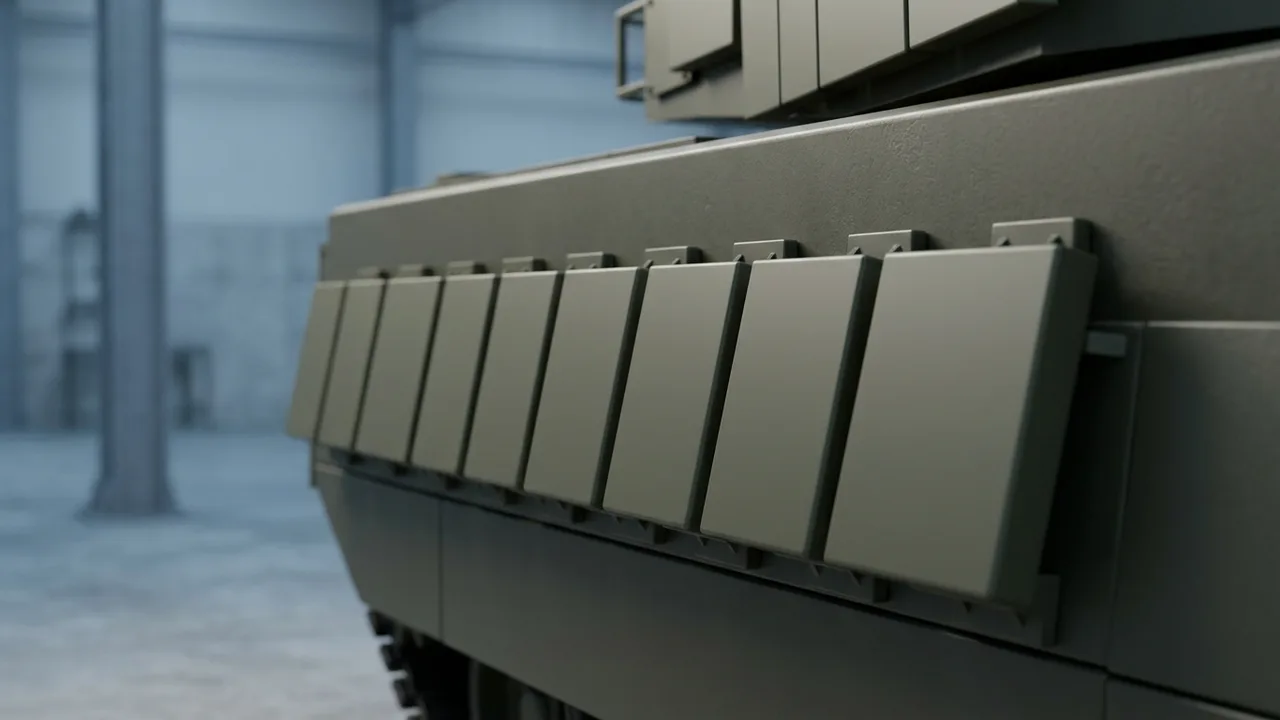
Look at enough photos of tanks and you will notice rows of brick-like boxes on the sides of the hull or turret. They can pass for storage bins. On U.S. Army Bradley fighting vehicles and Abrams tanks, though, some of those blocks are armor tiles built to react on their own when they are hit.
How is that different from composite armor, which sounds similar? Composite armor is armor made by combining materials, while reactive armor is an add-on tile with explosive inside that goes off the moment it is hit. One protects by combining materials, the other by reacting when struck.
More armor means more weight
A combat vehicle's armor protects the crew inside and the vehicle itself. When threats grow, protection has to grow too, and one way is to add something on top of the armor the hull already has. A 2010 paper in a Korean defense industry journal names three kinds of add-on armor.
The first is passive armor. Materials are layered or arranged in a special way and attached to the basic hull. The second is reactive armor, which comes as tiles mounted outside the main armor. The third is an active protection system (APS), which relies on technology that detects and recognizes a threat in order to respond.
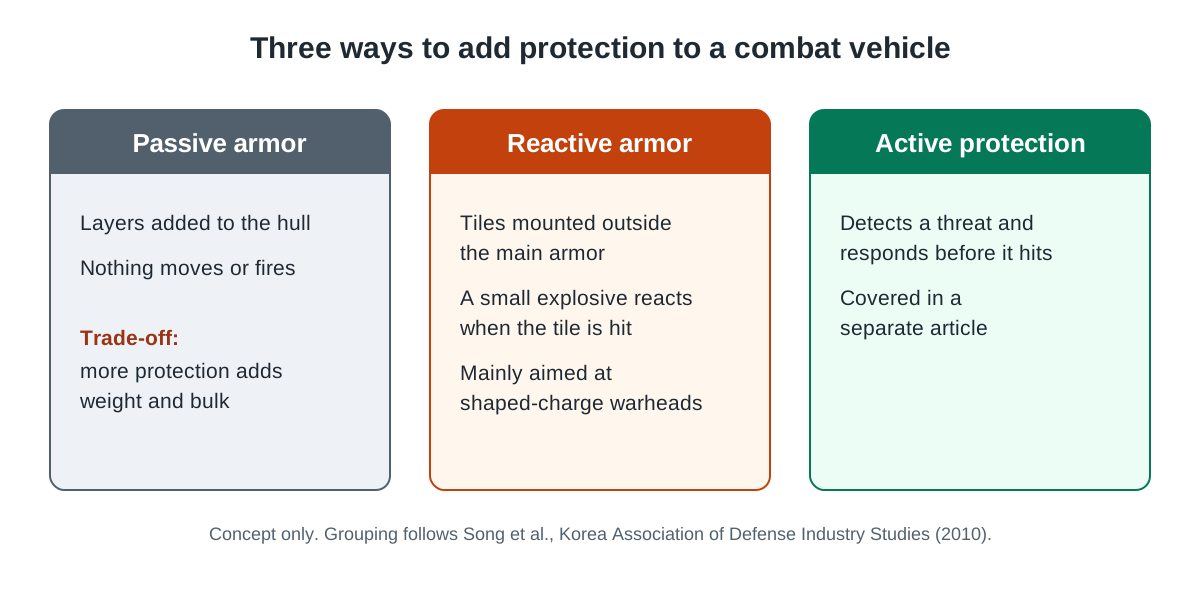
Passive armor comes with a clear cost. Raise its protection to meet bigger threats, and the vehicle gets heavier and bulkier at the same time. How much protection to add and how much weight the vehicle can take always have to be weighed together.
Composite armor: combining materials
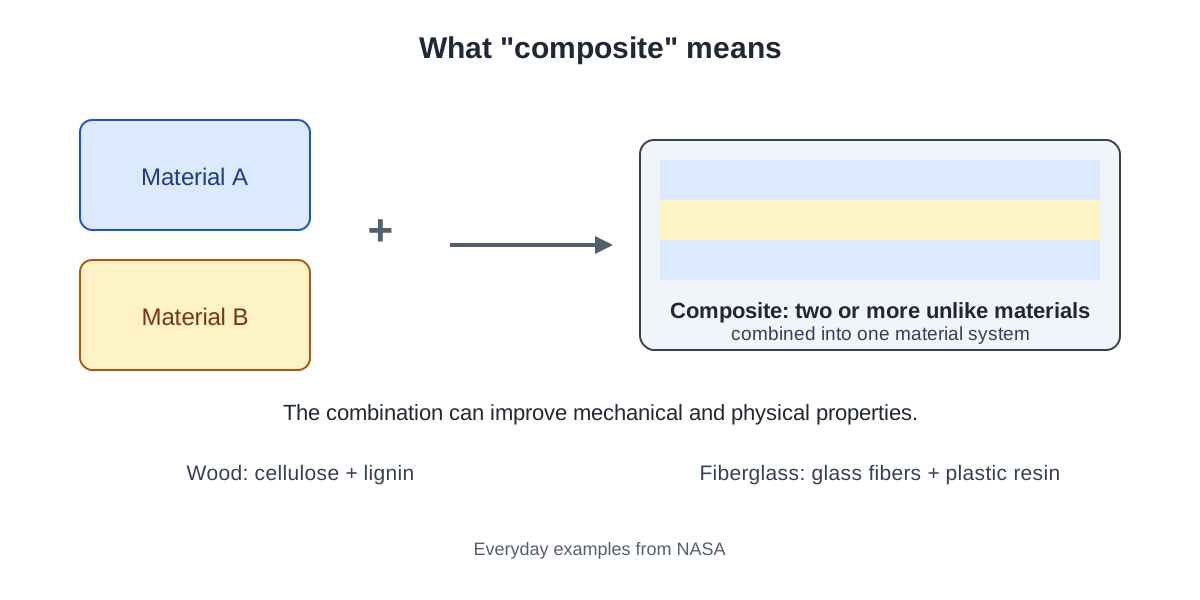
In composite armor, the word "composite" carries its materials-science meaning. A composite material joins two or more different materials into a single material system so that its mechanical and physical properties improve. NASA's examples are everyday materials far from armor. Wood is made of cellulose and lignin, and fiberglass is made of glass fibers and plastic resin.
It resembles a coach putting players with different strengths on one team. Players, though, still run separately for the whole game, while a composite acts as one piece once it is combined.
The same idea is used in armor that protects vehicles. Passive armor, as described above, attaches high-strength, lightweight materials that are layered or arranged on the hull. Composite armor is the name for armor made by using several materials together, and some composite armor uses high-performance fiber along with other commercial materials.
In 2010 the U.S. Army's Rock Island Arsenal opened a Composite Armor Center together with BAE Systems. The composite armor it planned to make was meant not only for Army ground vehicles but also for civilian armored cars and protective gear worn by soldiers. At the same event, a company representative said demand for lighter vehicle armor and body armor keeps growing.
Reactive armor: tiles that react when hit
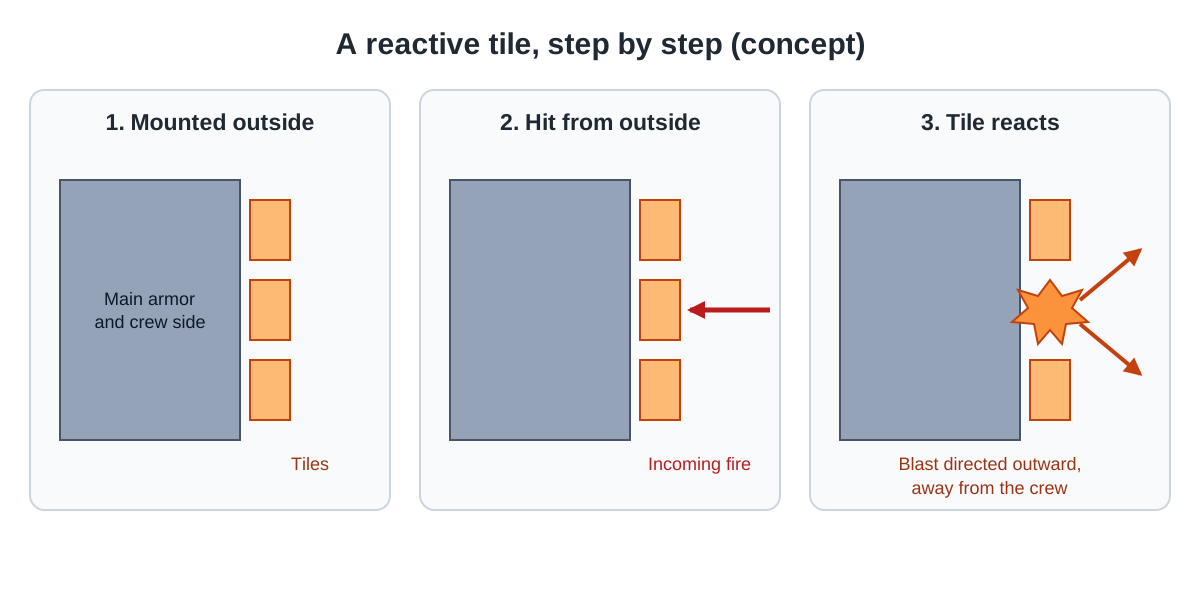
Reactive armor works on a different idea. The reactive armor tiles on a Bradley hold small explosives that go off when incoming fire hits them. The U.S. Army says these blasts cut the harm done to the vehicle and weaken the round that struck it. On the Bradley, the system is made up of 96 tiles mounted on the outside of the vehicle.
Tiles that use explosive this way are called explosive reactive armor (ERA). The explosive inside the tile goes off when it is struck by the stream of metal that an anti-tank shaped-charge round forms, called a metal jet. The force of that blast breaks up the metal stream.
A car airbag, which also goes off at the moment of impact, has something in common with it. The difference lies in where each one sits and what it does. An airbag cushions a person from the inside, while a reactive tile sits outside the vehicle and uses a blast to break up the attack itself.
Reactive armor was developed mainly against the shaped-charge warheads of anti-tank rounds and missiles. Because it mounts outside the main armor, it can be added to existing tanks without major changes to the armor itself, which is counted as one of its strengths.
When it came into use
According to a 2010 paper, Israel's Rafael was the first to fit reactive armor to combat vehicles. Israel put reactive armor on M-60 and Centurion tanks during the war in Lebanon in the 1980s.
The U.S. Army's Bradley entered service in 1981. In 1995, General Dynamics Armament and Technical Products won a Defense Department contract to make Bradley armor tiles. That first contract was for over 2,000 sets of reactive tiles. An Army contract specialist said the tiles help the vehicles survive direct hits from many kinds of anti-armor weapons, such as rocket-propelled grenades (RPGs) fired from the shoulder.
Tanks got them too: in 2017, the 1st Battalion, 66th Armor Regiment was in Europe supporting Atlantic Resolve. On Feb. 28 its crews started fitting the Abrams reactive armor tile (ARAT) set to their M1A2 Abrams tanks. The tiles sit on the left and right of the hull and turret, giving the tank and crew one more layer of protection.
Limits and what came next
Reactive armor uses a blast, so where that blast goes also matters. The Abrams tiles are mounted at an angle so that the blast goes down or up, which lets the impact deflect outward rather than toward the crew.
Damage to the vehicle itself is another issue. The journal paper notes that work has focused on non-energetic and more advanced reactive armor, to reduce the damage the hull takes when reactive armor goes off. As an example, it says the United States and Israel developed a hybrid reactive armor for the Bradley fighting vehicle.
People nearby matter too. When ordinary reactive armor goes off, metal plates or fragments can fly out and threaten friendly soldiers close by. The risk that the blast breaks structures and harms friendly forces is counted among the problems of reactive armor.
Active protection, which responds outside the armor, has limits as well. As of 2010, when the paper came out, the technology for detecting and recognizing threats was still in development. There were limits on which threat weapons it could handle and on how many times it could protect the vehicle. This approach is covered separately in "Active protection systems: defending beyond the armor."
Where this meets lasers: reading promotional claims
The Imperial War Museums (IWM) hold a record of a promotional film about the Challenger tank, made in January 1983 by the British Military Vehicles and Engineering Establishment (MVEE). The record's summary says the film shows the importance of firepower, protection and mobility, and it presents Chobham armour as used for protection "against all forms of attack." Chobham armour is the name of the armor that this record puts forward as the Challenger's protection.
That line introduces a promotional film rather than a test result. The summary alone does not tell you which attacks are stopped, or how well, and the 2010 paper also notes that technical disclosure of foreign protection systems is limited. The habit of checking who said something, and where, carries straight over to laser weapon news. How to read phrases like "kW-class" and "cost per shot" is covered in How to read laser weapon news.
What to read next
- Main battle tanks: is it all about the gun?: looks at firepower, protection and mobility together in one tank.
- Active protection systems: defending beyond the armor: covers the third approach, which responds before a hit.
- Anti-tank guided missiles: rockets versus guided missiles: shows how the weapons that armor is meant to stop developed.
- How to read laser weapon news: explains how to tell promotional phrases from official facts.