On 14 November 1965, sixteen UH-1 "Huey" helicopters lifted off from Plei Me in Vietnam's Central Highlands with soldiers aboard. They were headed for a clearing in the Ia Drang Valley near the Cambodian border, a landing zone called X-Ray. Fifty years later, at a commemoration, one soldier who rode in those helicopters recalled that it had been "just another day for us."
That "other day" stretched into three. Together with the fight at Landing Zone Albany that followed, it became what the US Army counts as the Vietnam War's first major battle. The unit that flew the soldiers in was not an ordinary infantry division, either. It had half the usual ground vehicles and 4.5 times the usual aircraft: the first division built to fight by helicopter.
How did that division come about, and what did its helicopters carry at the Ia Drang, and fail to do? This article follows the public US government records in order.
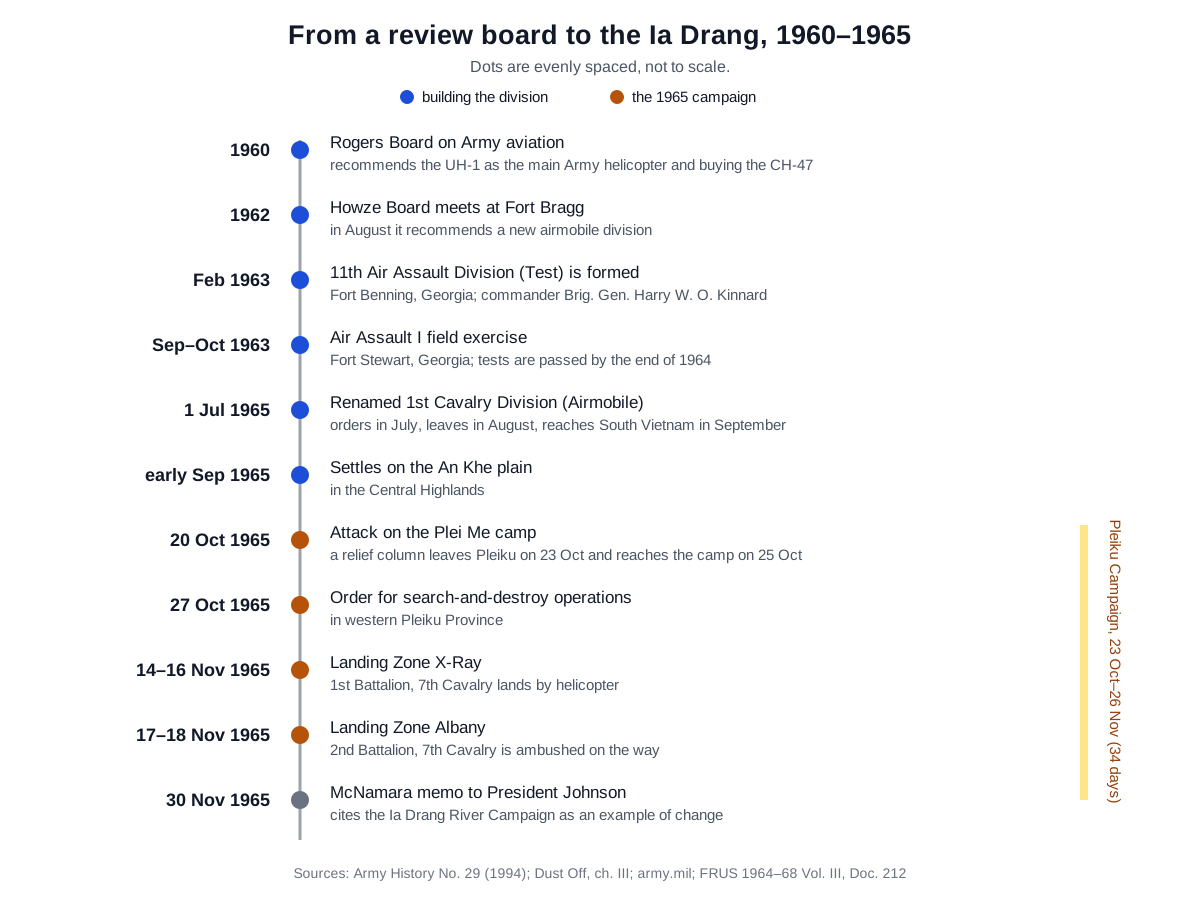
How a helicopter division came about
It began with a review board in 1960. Lieutenant General Gordon Rogers led a board charged with upgrading Army aviation, especially helicopters. The board recommended making the UH-1 the Army's main helicopter and buying the CH-47 Chinook, a twin-engine cargo helicopter.
In 1962, Secretary of Defense Robert McNamara ordered a fresh look at the tactical mobility of ground forces. The focus was airmobility: using helicopters to carry troops to where they were needed, and to give close air support from the air as well. McNamara put Lieutenant General Hamilton Howze, who had been the Army's first aviation director, in charge of a board. The Howze Board met that year at Fort Bragg, North Carolina.
The board pictured troops flown in by helicopter and dropped wherever they were needed, so they could meet the enemy fast. In August 1962 it recommended a new airmobile division, complete with an air ambulance platoon. The Department of Defense put off a decision on the full recommendation. Instead, it chose to build and test one air assault division with its own helicopter battalion.
On 7 January 1963, the Army's Deputy Chief of Staff for Operations ordered an experimental division. In February the 11th Air Assault Division (Test) was formed at Fort Benning, Georgia, under Brigadier General Harry Kinnard. That September and October, a field exercise at Fort Stewart, Georgia, called Air Assault I, tested the control of air assault battalions and companies. It also tested the problems an air ambulance platoon would face.
By the end of 1964 the division had passed its airmobility tests. On 1 July 1965 it became an operational division and took the name 1st Cavalry Division (Airmobile). The test division's units were combined with resources of the 2d Infantry Division at Fort Benning. The result took the name of the 1st Cavalry Division, which had been in Korea since 1950.
How it differed from a standard division
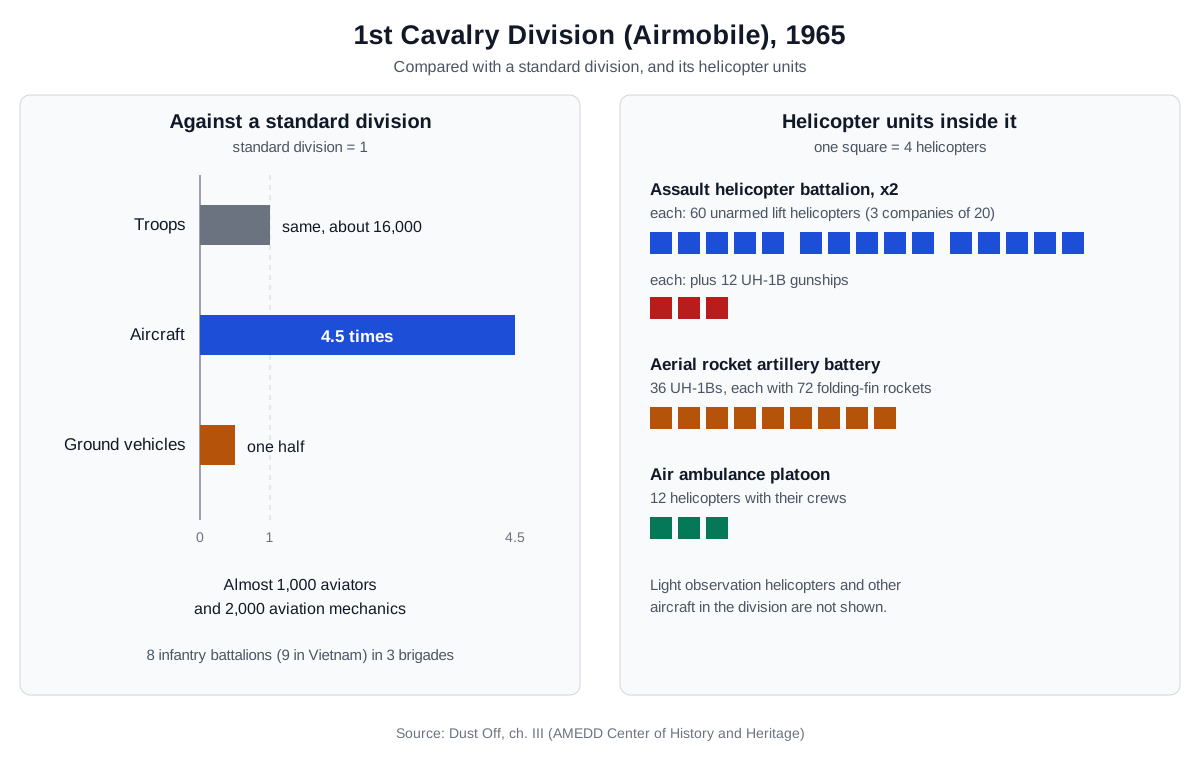
The new division had about 16,000 troops, the same as a standard division. What changed was how it moved. It had 4.5 times the standard number of aircraft and half the ground vehicles, with almost 1,000 aviators and 2,000 aviation mechanics.
It had eight infantry battalions, later nine in Vietnam, grouped into three brigades. Two assault helicopter battalions carried the troops. Each had 60 unarmed lift helicopters in three companies of 20, plus a separate company of 12 UH-1B gunships.
Artillery went into the air too. The aerial rocket artillery battery had 36 UH-1Bs, each carrying 72 folding-fin rockets. Guns on the ground moved by helicopter as well: in Vietnam, helicopters could carry light and medium guns between fire bases fairly quickly when needed.
An air ambulance platoon of 12 helicopters was part of the division from the start. At the center of all this was the UH-1 Huey. The same type carried troops, flew as a gunship, evacuated the wounded and hauled cargo, while heavier loads went in transport helicopters such as the CH-47 Chinook and the CH-54.
Why helicopters? South Vietnam lacked a wide road network, and the roads it had were often attacked by the Viet Cong or the North Vietnamese Army (NVA). A 1994 article by Herbert P. Lepore in the Army's journal Army History names three advantages American ground forces had, tactical mobility, firepower and logistics support, and the helicopter delivered all three.
From Plei Me to the Ia Drang Valley
One veteran remembers that the rumor of the division going to Vietnam was confirmed by President Johnson's announcement on 28 July 1965. The division got its orders in July, left in August and reached South Vietnam in September. In early September it settled on the An Khe plain in the Central Highlands.
In early October, the North Vietnamese 32d and 33d Regiments moved into western Pleiku Province, between the Cambodian border and Plei Me. Plei Me was a Special Forces camp 43 km south of Pleiku, and the 66th Regiment was soon to arrive. On 20 October the 33d Regiment attacked four companies of the South Vietnamese Civilian Irregular Defense Group (CIDG) holding Plei Me.
On 23 October a South Vietnamese armored relief force left Pleiku, covered by 1st Cavalry Division artillery. It was ambushed at 5:50 pm on the 24th, broke through and reached the besieged camp the next day.
On 27 October, General Westmoreland ordered the division commander, Major General Kinnard, to carry out search-and-destroy operations in the western part of Pleiku Province. It was the first time the division had been given a mission of unlimited offense. Before the November fighting, the division's scouts of the 1st Squadron, 9th Cavalry, had already looked over the area.
Three days at Landing Zone X-Ray
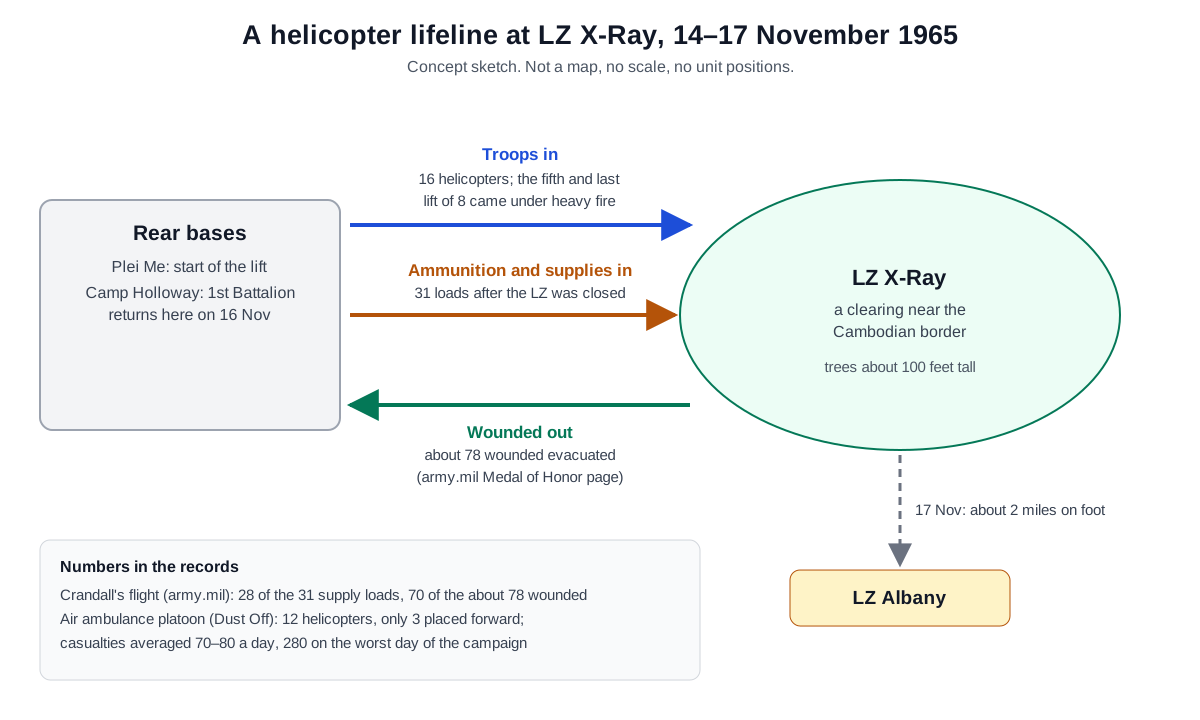
On 14 November, sixteen helicopters of Company A, 229th Assault Helicopter Battalion, led by Major Bruce Crandall, lifted troops from Plei Me to X-Ray. Aboard was the 1st Battalion, 7th Cavalry, commanded by Lieutenant Colonel Harold Moore, and its Company B landed first.
On a mountain overlooking the landing zone were the newly arrived North Vietnamese 66th Regiment and what remained of the 33d. By early afternoon, North Vietnamese soldiers in the hundreds were attacking the 1st Battalion around the landing zone. On the fifth troop lift, which was also the last and used eight helicopters, the zone was under fire from rifles, automatic weapons, mortars and rockets. The helicopters still waiting to land were ordered back to base.
That evening, Company B of the 2nd Battalion, 7th Cavalry, went in to help, and another attack came on the morning of the 15th. On the 16th, the 2nd Battalion, 5th Cavalry, and the rest of the 2nd Battalion, 7th Cavalry, came in and took over the landing zone. The 1st Battalion, which had landed first, returned to Camp Holloway with Company B of the 2nd Battalion.
The losses for those three days differ slightly by source. A 2015 army.mil article gives 80 US soldiers killed and 124 wounded.
The army.mil Medal of Honor page for Crandall quotes Joe Galloway, the UPI reporter who went through the battle with Moore's battalion. By his count, 79 infantrymen and one Air Force pilot were killed and 130 were wounded. Estimates of North Vietnamese dead range from 600 to 1,200, depending on the source.
The numbers weigh differently at the scale of one company. Company B of the 1st Battalion, led by John Herren, had 46 men killed or wounded out of 122 in the first two days.
Ammunition in, wounded out
When Crandall got back to base after the fifth lift, he learned that all medical evacuation to the 1st Battalion had been cut off. As he explained it, medevac pilots at the time could not land until a landing zone had been "green" for five minutes. "Green" meant the zone was not under constant attack.
Without anyone asking him to, Crandall decided to fly the wounded out himself, and when he called for volunteers, Captain Ed Freeman stepped forward. Crandall's own helicopter was unarmed.
Crandall's Medal of Honor citation records 14 landings. After the landing zone was closed, 31 helicopter loads went in carrying ammunition and supplies, and Crandall's flight brought 28 of them. Of the about 78 wounded who were evacuated, it carried out 70. Another paragraph on the same army.mil page says he made the flight "21 more times," so the count does not agree even within one source.
President Bush presented the Medal of Honor to Crandall at the White House on 26 February 2007. He said Crandall flew three different helicopters that day and that two were damaged too badly to stay in the air. By their last landing, Crandall and Freeman had been flying for more than 14 hours.
According to the 2001 White House remarks, Freeman first received the Distinguished Flying Cross for that day and was awarded the Medal of Honor on 16 July 2001. The army.mil page on Crandall says instead that both men earned the Distinguished Service Cross, so the records differ.
For the soldiers on the ground, the flights meant more than supplies. Herren recalled that the flights showed the wounded would be flown out without waiting for the shooting to stop.
The medical records show a somewhat different scene. Dust Off is a history from the Army Medical Department's history center. It describes the battalion surgeon flying in on an air ambulance platoon helicopter with four medics and supplies, and starting treatment at once. By that night, the book says, every wounded man had been flown out by the air ambulance platoon together with gunships that came back. The two records stress different answers to who carried the wounded out.
The medical load was heavy. On average, a reinforced brigade of about 3,000 men was committed to the Ia Drang at any one time. Casualties averaged 70–80 a day, with 280 on the worst day.
The 15th Medical Battalion could place only three helicopters forward. Troop-carrying helicopters took the less badly hurt out of the landing zones, which eased the platoon's load.
The forest was a problem too. In his after-action report, Moore wrote that enemy fire and dense trees 100 feet (about 30 m) tall kept the wounded from being picked up where they fell. Soldiers had to carry them to the one landing zone that was safe enough.
Albany and the questions that remained
On the morning of 17 November, the remaining troops left X-Ray. The 2nd Battalion, 7th Cavalry, marched about 2 miles (about 3 km) toward nearby Landing Zone Albany and was ambushed on the way. The fighting lasted 18 hours, until dawn on the 18th.
In Galloway's words, quoted in the 2015 army.mil article, about 155 Americans were killed within six hours and another 130 wounded. Another statement of his, on the army.mil Crandall page, puts the dead at Albany at 154. He added that the two fights belonged to the Pleiku Campaign, which lasted 34 days, from 23 October to 26 November 1965. Counting the smaller clashes before and after, 305 Americans died.
How did Washington read the fighting? In a memo to President Johnson on 30 November, McNamara wrote that the dramatic recent changes were on the military side. Infiltration from the North had grown, and Communist forces were more ready to hold their ground and fight, even in big battles. He named the "Ia Drang River Campaign" of early November as an example and judged that, to meet that build-up, the Phase I forces then planned would not be enough.
Over the past year, nine regular North Vietnamese regiments had moved south. In infantry battalions, that came to 27.
Views of airmobility itself were mixed. Lepore lists four criticisms from the time.
First, commanders used the helicopter as a command post in the sky. Second, it reduced the ability or will of ground units to move on foot and pin down the enemy. Third, its noise warned the enemy that American troops were coming. Fourth, it was too lightly armed to stand up to ground fire.
There was a counterargument as well. Rough terrain and few roads favored the defender, and moving on the ground, even with armor and artillery support, was often dangerous and slow. Lepore judged that using helicopters to attack greatly reduced that advantage.
The helicopter war grew after that. From May 1966 to March 1973, the 1st Aviation Brigade managed Army aircraft in Vietnam, and the non-divisional aviation under it reached, at times, 4,000 aircraft and 24,000 troops. The AH-1 Cobra gunship first arrived in 1967.
The losses were large too. In Operation Lam Son 719 in 1971, the Army lost about 100 helicopters, most of them shot down by Soviet-built 37 mm anti-aircraft guns.
Lepore concludes that helicopters in Vietnam changed American tactical doctrine for good, and he cites a figure of about 390,000 wounded Americans saved by medevac helicopter crews during the war. The Ia Drang stands near the start of that long story. In three days and one more night, a division built to move by helicopter showed both what it could do on a real battlefield and what it still lacked.
What to read next
- Helicopter rotors: how coaxial helicopters fly without a tail rotor: how helicopters like the Huey lift off and change direction.
- Anti-aircraft artillery in the missile age: how anti-aircraft guns work and why they are still around in the missile age.
- The Vietnam War at a Glance: 1955 to 1975: the larger story before and after the Ia Drang.
- The Tet Offensive: When the Military Result and Public Opinion Split: the large offensive of 1968, two years after the Ia Drang.