A laser spec sheet says "1 W". Is that light on all the time, or packed into very short flashes? The number alone does not say, and its meaning depends on whether the 1 W is an average or a peak.
A continuous-wave laser (CW) emits light without a break. A pulsed laser emits short bursts of light again and again. With a pulsed laser, the same 1 W average can hide very different power at the moment the light comes out. Four numbers that describe the pulses, plus some simple division, are enough to see why.
Start with the units. Power is energy delivered per unit time, and its unit is W. Energy is the amount delivered over a period of time at that power, and its unit is J. In Keyence's example, a 50 W continuous laser delivers 50 J per second.
Continuous wave: light that stays on
A CW laser emits a continuous beam at a constant power. As long as the supply of excited atoms is replenished, the light does not stop.
It was not always this way. The 2018 scientific background document from the Nobel Committee for Physics notes that the first lasers ran in short bursts, but continuous operation was needed. Lawrence Livermore National Laboratory (LLNL) names helium–neon gas lasers and liquid dye lasers as lasers that emit continuous light, and ruby lasers as lasers that emit short pulses.
Pulsed: light that comes in bursts
A pulsed laser emits nothing for a little while, then a short burst of light, and then repeats that pattern. Most of the time a pulse does not come alone. Pulses follow one another at equal intervals, and that row of pulses is called a pulse train.
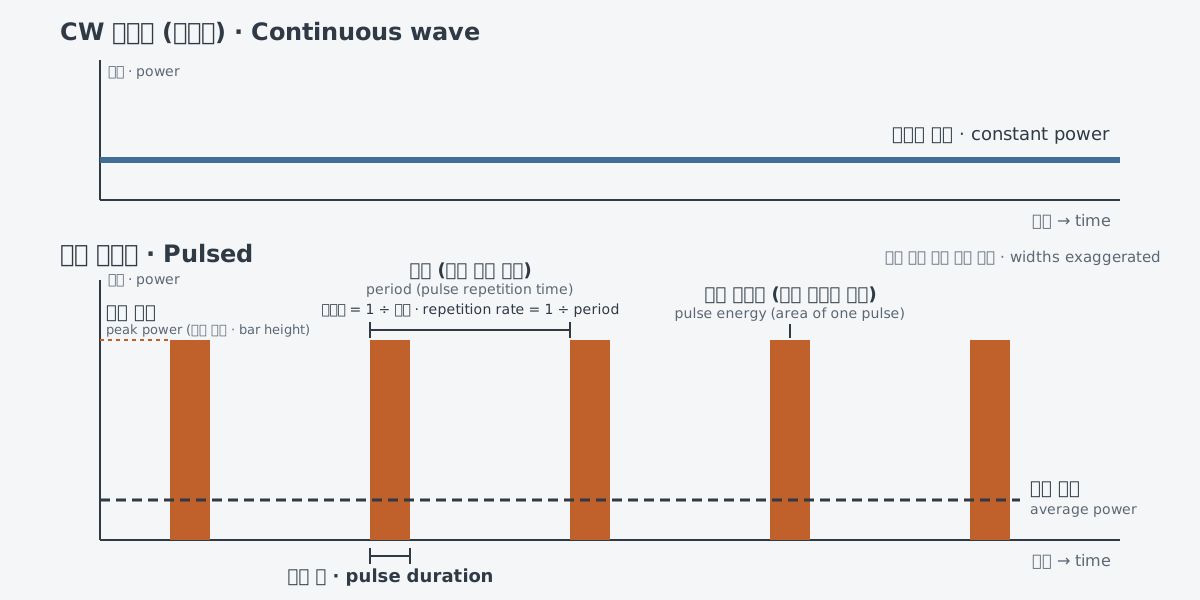
Think of CW as a running tap and a pulse as a scoop of water thrown at regular intervals. Two things differ in practice. A pulse train repeats at exactly equal intervals, unlike a scoop thrown by hand, and each pulse is far shorter.
How short? The time one pulse lasts is called the pulse duration. Keyence uses a 100 ns (nanosecond) pulse as its example.
Nano means one billionth. Cut one second into a billion slices, and 100 ns is 100 of them. Some facilities really do emit pulses on this scale. NIF, the National Ignition Facility at LLNL, emits pulses that last only billionths of a second.
There are shorter units too. Pico means one trillionth, and femto means one quadrillionth. The Nobel committee's popular-science article describes a femtosecond (fs) as "one million of a billionth of a second". With pulses this short, it says, it is possible to see events that once looked instantaneous.
A few more names turn up in writing about pulses. Lasers with picosecond and femtosecond pulses are called ultrashort-pulse lasers, the name used in a draft international standard, ISO/DIS 13682-1. Trains of intense, short pulses are produced by methods such as Q-switching and mode locking. Quasi-continuous-wave (QCW) operation is used for lasers that would overheat in true CW operation.
Four numbers that describe a pulse train
Four numbers are used to write down a pulse train. They carry the same names as the labels in the diagram above.
| Quantity | Meaning | Source |
|---|---|---|
| Pulse duration | The length of time over which a pulse is emitted | MIT textbook, Keyence |
| Repetition rate | The number of pulses emitted per unit time | MIT textbook, Keyence |
| Pulse energy | The energy a single pulse delivers | MIT textbook, Keyence |
| Peak power | The power during a pulse; not the average power | MIT textbook, Gentec-EO |
Pulse duration is measured as the full width at half maximum (FWHM). That is the full width, in time, between the two points where the pulse's intensity envelope falls to half of its maximum. The repetition rate is the inverse of the period, the time after which the pulse repeats.
Peak power is the pulse energy divided by the pulse duration.
peak power (W) = pulse energy (J) ÷ pulse duration (s)
In Keyence's example, a 1 mJ (millijoule) pulse lasting 100 ns has a peak power of at least 10,000 W. The division checks out: 1×10⁻³ J ÷ 1×10⁻⁷ s = 1×10⁴ W. For the same energy, a shorter pulse means dividing by a smaller number, so the peak power is higher.
Same average power, different peak power
Average power is a specification found for both CW and pulsed lasers. Peak power only makes sense for pulsed lasers. Average power is the pulse energy divided by the period. Because the inverse of the period is the repetition rate, multiplying the pulse energy by the number of pulses per second gives the same value.
Take two imaginary lasers, A and B. Both have an average power of 1 W and a pulse duration of 100 ns. Only the repetition rate differs.
Laser A repeats at 1 kHz, so it emits 1,000 pulses per second. Each pulse carries 1 W ÷ 1,000 Hz = 1 mJ, and the peak power is 1×10⁻³ J ÷ 1×10⁻⁷ s = 10 kW.
Laser B repeats at 1 MHz, so it emits 1,000,000 pulses per second. The same 1 W is shared among a million pulses, so each carries 1 W ÷ 1,000,000 Hz = 1 μJ (microjoule), one thousandth of A's. The peak power falls by the same factor, to 10 W.
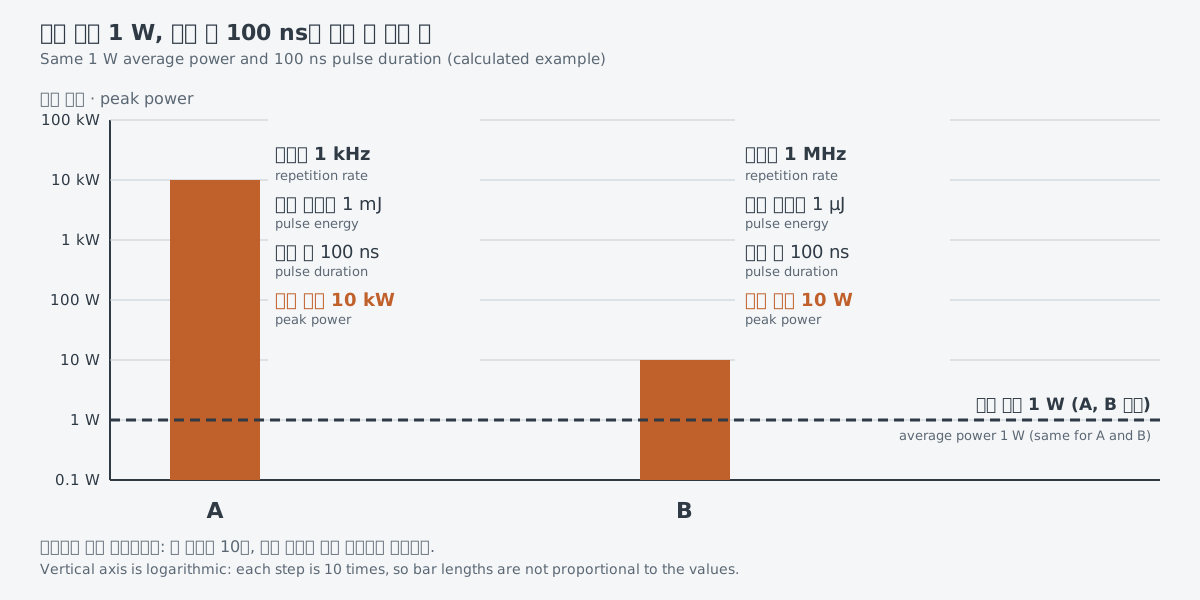
The average power is the same 1 W, yet the peak powers differ by a factor of 1,000. That is because average power is taken over all the time, while peak power is the value at the moment of a pulse. In tap terms, the amount of water over one minute divided by that minute is the average, and the rate while a scoop pours out is the peak. This is why the "1 W" on the spec sheet needs one check first: is it an average or a peak?
A short pulse can have high peak power even when its energy is not large. The Nobel committee's scientific background document says this of the lasers that came from chirped pulse amplification (CPA). Their peak power is high because the pulse duration is short, their pulse energy is modest, and that allowed high repetition rates.
Which is used where
Which type does which job? The table collects examples that Keyence and the Nobel committee give directly in their documents. They are examples from those two sources, not a rule that a given job always uses one type.
| Type | Use | Who said it |
|---|---|---|
| CW | Laser cutting and welding of thick materials | Keyence: an example of work needing steady energy |
| CW | Optical tweezers | Nobel committee: a 2018 prize achievement that uses continuous, monochromatic lasers |
| Ultrashort-pulse technology | Cutting or drilling holes in various materials extremely precisely | Nobel committee: presented as an achievement of ultrashort-pulse technology |
| Ultrashort-pulse technology | Eye surgery (millions of operations per year) | Nobel committee: presented as an achievement of ultrashort-pulse technology |
| Pulses | Laser surgery, spectroscopy | Keyence: an example of uses where the precise length of the pulse matters |
| Femtosecond pulses | Seeing events that once looked instantaneous | Nobel committee (femtosecond pulses) |
Pulse duration can also change the result. One figure in the Nobel committee's popular-science article compares two kinds of pulses. The short pulses from a femtosecond laser cause less damage in the material than pulses from a nanosecond laser that are a million times longer.
What to read next
The next article is "Laser safety: class ratings and how to read eyewear labels". Handling high-power light requires knowing the safety classes.