A pilot in a control room watches live pictures of the seafloor and moves a robot arm with a joystick. That kind of real-time work usually needs a cable between the robot and the ship. What happens when the cable is gone?
Without a cable, an underwater robot has trouble talking to the ship, and it has to work out where it is on its own. This article looks at why unmanned underwater vehicles (UUVs) face these problems and why they need to act on their own. It draws on public material from the National Oceanic and Atmospheric Administration (NOAA) and the Woods Hole Oceanographic Institution (WHOI). At the end, it turns to a Congressional Research Service (CRS) report updated in March 2025 on the problems the U.S. Navy's largest UUV has run into.
Tethered robots and free-swimming robots
Unmanned underwater vehicles come in two broad kinds. The first is the remotely operated vehicle (ROV). It is an uncrewed, highly maneuverable machine steered by someone at the surface. A bundle of cables, called a tether, links the ROV to the ship and passes electrical signals in both directions between pilot and machine.
ROVs started out in industry, for jobs such as inspecting underwater pipelines and testing the structure of offshore platforms. Today science uses them widely too. They can reach places too deep for people to dive safely, and they stay down far longer than a human diver.
The second kind is the autonomous underwater vehicle (AUV). It has no tether and no physical link to its operator. Operators on a ship or even on shore tell it where to go, when, and what to measure, and it follows that plan. AUVs range from a few hundred pounds to several thousand pounds.
The two also handle data differently. An ROV sends video up its tether to a control room on the ship almost at once. An AUV keeps all its pictures and sensor data in onboard computers, and that data comes out only once the dive is over and the vehicle has been brought back.
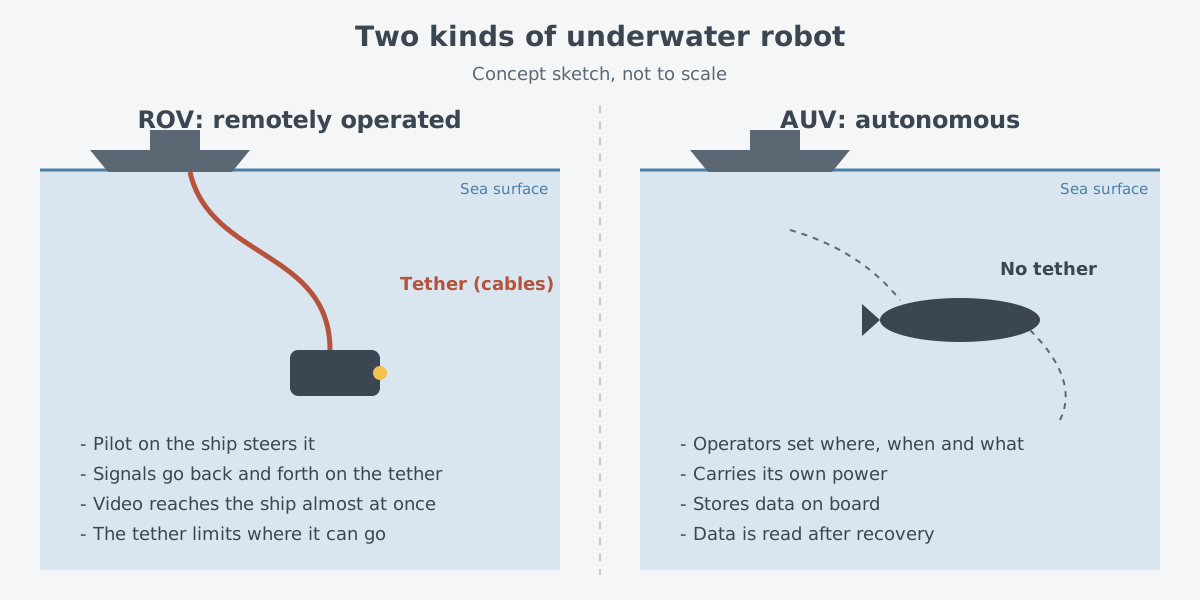
An ROV is a bit like a dog on a leash, and an AUV is like a dog let off the leash. The real difference is that an ROV's tether does not pull the vehicle; it is a cable that carries signals and video.
The reasons to use an AUV are clear. It can work in water too shallow for boats and too deep for divers or many tethered vehicles. Once under water, it is out of reach of bad weather and can remain submerged for long periods. Scientists use AUVs to map the seafloor, record environmental data, and find hazards to navigation and shipwrecks.
Militaries think the same way. The CRS report says uncrewed vehicles can suit long missions that would wear out a crew, or missions where the crew could be hurt, killed or captured. These are the so-called "three D" missions: dull, dirty, or dangerous.
Hard to talk underwater
Radio does not work well under water. The radio waves that satellites use do not get far below the ocean surface. That is why scientists use sound, not radio, to track deep-diving vehicles. The sonar article explains how sound is used under water.
So why not do everything with sound? Acoustic links turn digital data into sound and push it through seawater. The method is much like an old dial-up modem, and it works over long distances.
In seawater, sound covers about 1,500 m per second on average. Even so, WHOI engineers explain that how fast sound moves in water keeps these links to small amounts of information. That makes it hard to steer an ROV through complex work in real time.
Light is the opposite. It carries a lot of data fast enough for real-time control, but WHOI engineers put the reach of the light signal at a 100 m radius. Farther out, seawater absorbs the light and the signal is lost.
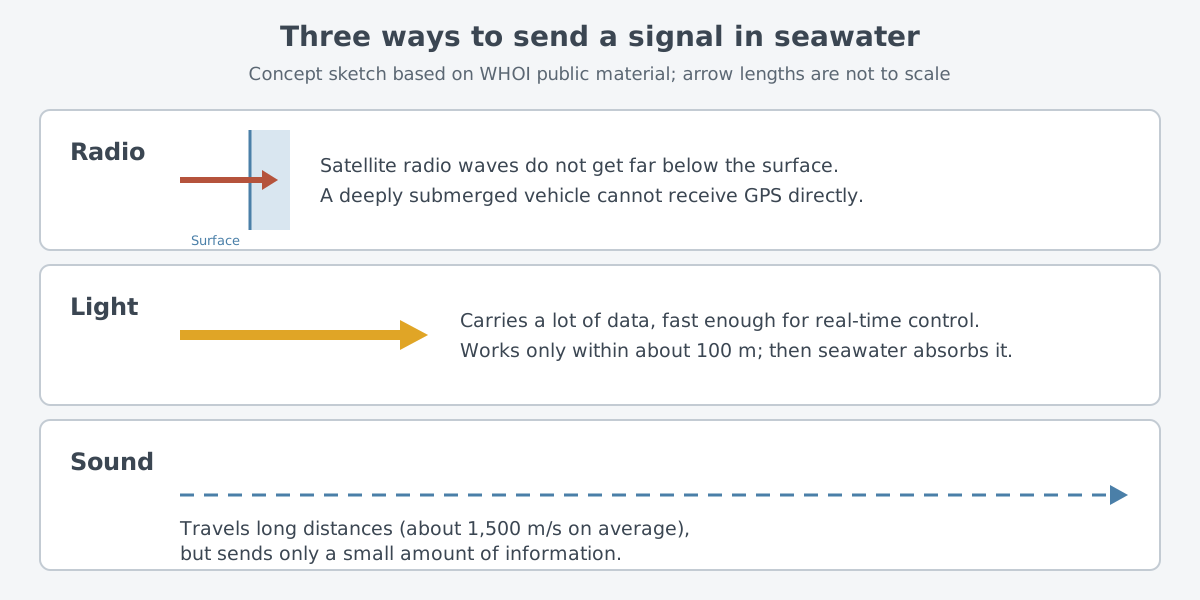
That is why real-time work has relied on a tether. A tether has costs of its own. Handling a heavy tether takes special cranes and winches on the support ship, which can raise operating costs, and the cable also limits where the vehicle can go.
In September 2012, near Guam, WHOI tested a wireless system that sends data with both sound and pulses of light. The test vehicle was Nereus, a hybrid that can work as either an ROV or an AUV, and the system reached 10 Mbps (10 megabits per second) at its peak. How quickly water weakens light sets the range of the link, much as air weakens a laser beam in the atmospheric propagation article.
Finding your place without GPS
A ship at the surface knows its position from GPS. Under water, things change. Seawater blocks the GPS radio signal, so a deeply submerged vehicle cannot receive GPS directly.
So underwater vehicles combine several sensors. They include Doppler sonars that measure speed, optical gyrocompasses that hold a heading, and inertial measurement units (IMUs). Older tools are still in use too: acoustic positioning systems, magnetic compasses, and pressure sensors that measure depth.
Working out position by adding up motion is called dead reckoning. The catch is that small errors pile up over time. So the IMU's estimate is usually corrected with speed from a Doppler sonar and with positions from GPS or an acoustic navigation system. By matching overlapping data, such as pictures or seafloor shape, a vehicle that returns to a place it has already seen can also clear the error it has built up.
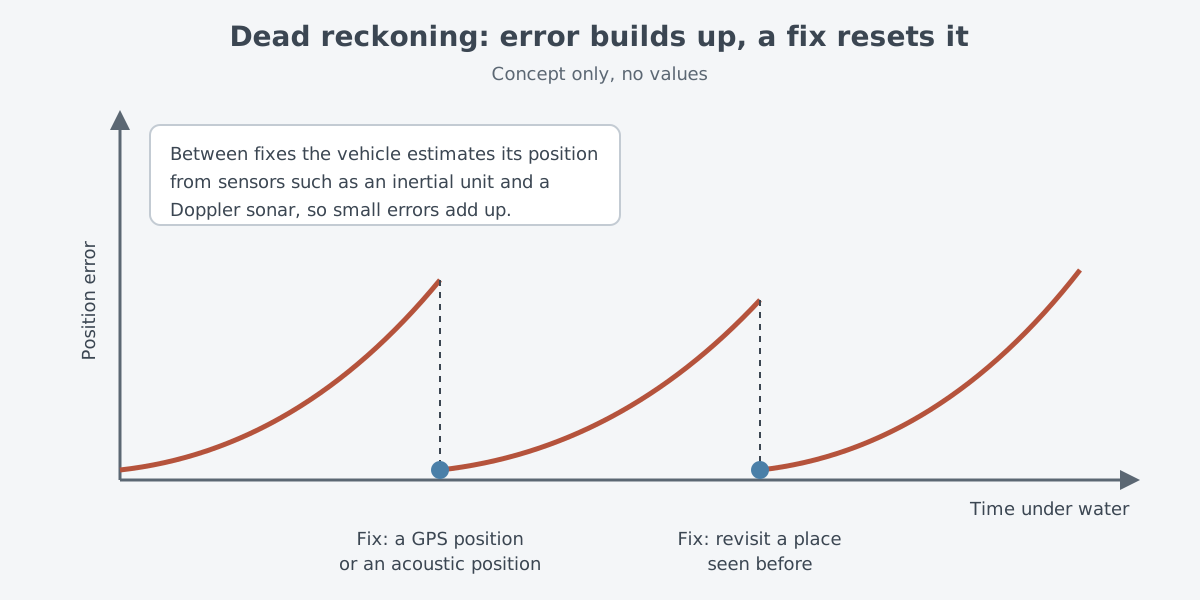
The inertial and satellite navigation article explains in more detail why inertial errors grow. In deep water, satellite signals cannot be received directly, so other methods such as Doppler sonar and acoustic positioning fill the gap.
Why the robot must decide on its own
Put these facts together and it becomes clear why an AUV has to be "autonomous." Sound is too slow for real-time control, light works only at short range, and a tether limits where the vehicle can go. A vehicle without a tether has to move on its own according to the plan its operators set, and it has to work out its own position.
Autonomy also comes in degrees. CRS notes that uncrewed vehicles may be run by remote control, with partial autonomy, or, once the technology allows, fully on their own. WHOI engineers used the term "adaptive autonomy" for the ability to switch smoothly between communication bandwidths and to change the level of automation as a mission needs.
A brain that replaces people does not come easily. The Government Accountability Office (GAO) made this point in a 2022 report. It said the Navy has to equip these vehicles with the IT systems and artificial intelligence that will stand in for a crew.
Power has to come along
With no tether, there is no power cable either. A fully autonomous AUV carries its power on board. That power turns the propellers or thrusters and runs the sensors.
Most AUVs use special batteries. A few have run on fuel cells or on solar power that recharges them. AUVs called gliders save energy by letting gravity and buoyancy move them.
Batteries also became an obstacle in the Navy's large-UUV effort. At the time of a June 2024 GAO report quoted by CRS, the Navy expected to receive five extra-large UUV prototypes in fiscal years 2024–2025. That schedule was 3 years later than first planned, and the reasons given were fabrication delays and ongoing problems with battery development. To soften the delay, the Navy bought a separate prototype for software and battery work, received it in December 2023, and planned to keep it for testing and training.
The U.S. Navy's extra-large UUV
The Navy wants UUVs of different sizes for different jobs. Smaller ones would be launched from crewed ships and submarines to extend their reach. Larger ones are more likely to leave straight from a pier and take on missions that crewed ships or submarines might otherwise do. Large uncrewed vessels on the surface are covered in the unmanned surface vessel article.
The biggest is the Extra-Large Unmanned Undersea Vehicle (XLUUV), also called Orca. The Navy defines an XLUUV as a UUV wider than 84 inches in diameter, which is too large to launch from a crewed submarine. Instead, it is shipped to a port closer to its operating area and put in the water from a pier. It is about as big as a subway car.
The program began in response to a Joint Emergent Operational Need (JEON). Five "operationally relevant prototype" vehicles were procured in fiscal year 2019. A separate test and training vehicle was also bought; it is the one delivered in December 2023, mentioned above. The 2024 GAO report put the cost growth at $242 million or more, which is 64% over the original 2016 estimate.
Autonomy software was also flagged as a problem. According to the same GAO report, the XLUUV contract was signed before the Navy began applying its standards of the time for autonomy architecture. As a result, the vehicles were to come with the contractor's own autonomy software, and any changes the Navy wanted after delivery would be paid work for the contractor. Who can change an underwater robot's "brain" has become one of the program's problems.
What to read next
- Sonar: why sound is used to see underwater: a closer look at why sound, not light or radio, does the work under water.
- Inertial and satellite navigation: knowing where you are: why dead-reckoning errors build up and how satellite navigation corrects them.
- Unmanned surface vessels: ships without crews: the problems a ship faces when no one is aboard.