The lamp at the top of a lighthouse sends light in every direction. Yet the lighthouse sends out a beam that runs straight in one direction. What turns a source that shines everywhere into a beam with a direction is a lens. Traffic lights use the same trick.
Lasers sometimes need this too. Some lasers send out a fairly straight beam from the start, while others emit light that spreads wide as soon as it leaves. The part that straightens spreading light is a collimator, and the part that makes a straightened beam wider is a beam expander.
Both look like simple optics made of a few lenses. But following why anyone would make a beam wider on purpose, and which shape suits strong light, shows the nature of light quite clearly. This article starts at the focal point of a lens and moves on to two kinds of expanders, the history of the telescope and eye safety.
A light source at the focal point
A convex lens gathers light that enters parallel to its axis onto one point on the other side. That point is the focal point, and how far it lies from the middle of the lens is the focal length. A concave lens does the opposite and spreads parallel light apart.
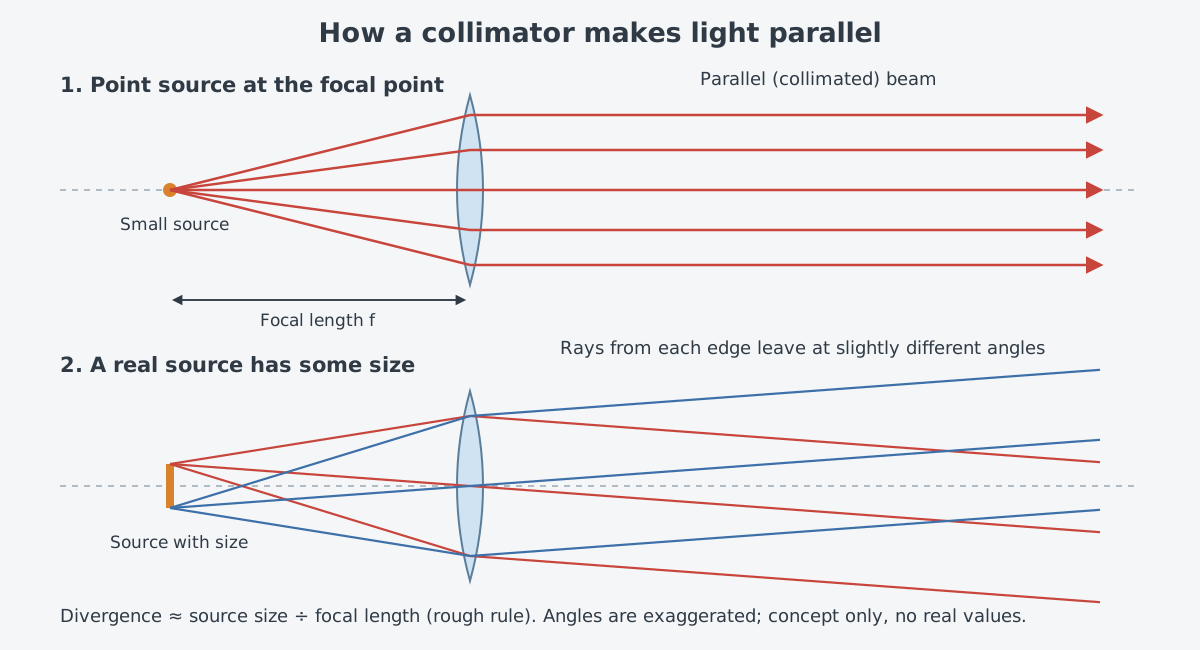
The path of light is the same when followed backwards. So if a small source sits right at a convex lens's focal point, the light that passes through the lens leaves in parallel on the other side. This is exactly what a lighthouse lens does.
Light in which every ray in the beam runs parallel to every other ray is called collimated light, or a collimated beam. A collimator is an optical system that makes this kind of light by placing the source at the focal point of a lens. Some collimators use a curved mirror instead of a lens.
Where spreading light comes from: diodes and fiber ends
A laser beam usually travels quite straight. The laser exposure guidelines of the International Commission on Non-Ionizing Radiation Protection (ICNIRP) trace this to the resonant cavity. They add that a short cavity, as in a laser diode, can give a spreading beam. Cavities that run in several modes also give a less straight beam.
Diode laser arrays, which group many emitters, are often built as a semiconductor bar 1 cm wide with a row of emitters along it. In some uses, the beams from these emitters are made parallel one by one with a matching array of microlenses and then sent far away. In effect, each emitter gets its own small collimator.
The output end of a fiber laser also gets a collimator. In a fiber laser machine that cuts metal, the fiber core leads the beam all the way to the cutting head. Inside that head sit a collimator and a lens to focus it. Laser makers' product lists include diode lasers whose output end can be a collimator or a bare fiber end, and fiber collimators with a built-in cladding light stripper.
The reverse job, gathering diode light into a single fiber, is covered in "Pump Modules: Putting Chip Light into One Fiber". The stripper that removes pump light left in a fiber is the topic of "Cladding Light Strippers: Where Leftover Pump Light Goes."
No beam is perfectly parallel
Perfectly parallel light, like the parallel lines in the figure, cannot be made in the real world. That would need a point source with no size sitting exactly at the focal point, and real sources have size. The top and bottom edges of a source sit away from the axis, and light from those spots leaves the lens at a slightly different angle to the axis.
A note from the optics maker Edmund Optics estimates the remaining beam divergence as roughly the size of the source divided by the focal length of the collimator. A smaller source or a longer focal length means a beam that opens up less. There is a cost. A longer focal length puts the lens farther from the source, so less light reaches it and the beam carries less power.
Even a source with no size would leave some spread. Every beam of light with a set diameter spreads by diffraction, and a laser beam made as parallel as possible is no exception. A textbook gives the angle with this formula.
θ = 1.22 λ / D
Here λ is the wavelength and D is the beam diameter. The larger the diameter, the smaller the angle. A flashlight is not very parallel to begin with, so this spreading goes unnoticed, but it can become large when a laser beam is sent a long way. The shape of that spreading is covered in more detail in "Why a beam spreads: divergence, focus and aperture".
Beam expanders: wider means less spread
The formula points to a clear path. To spread less, make D larger. A beam expander takes a parallel beam, makes its diameter larger and sends it out as a wider parallel beam. It is used in places such as laser scanning, interferometers and remote sensing.
The first number to know about an expander is its magnification. The magnification is how many times it enlarges the diameter, and the divergence shrinks by the same factor. Widening a beam 5 times cuts its divergence to one fifth. These are round numbers picked to show the idea.
This relation is not special to expanders. A laser beam changes shape on its way through an optical system, but the product of its diameter and its far-field divergence stays the same. An article in the MIT Lincoln Laboratory journal calls this a well-known fact. Making the diameter larger leaves the angle no choice but to shrink.
So a beam that starts out wider can end up narrower far away, because it opens up less. Run an expander backwards and the beam gets narrower, but its divergence grows. A large divergence is the price of a narrow beam.
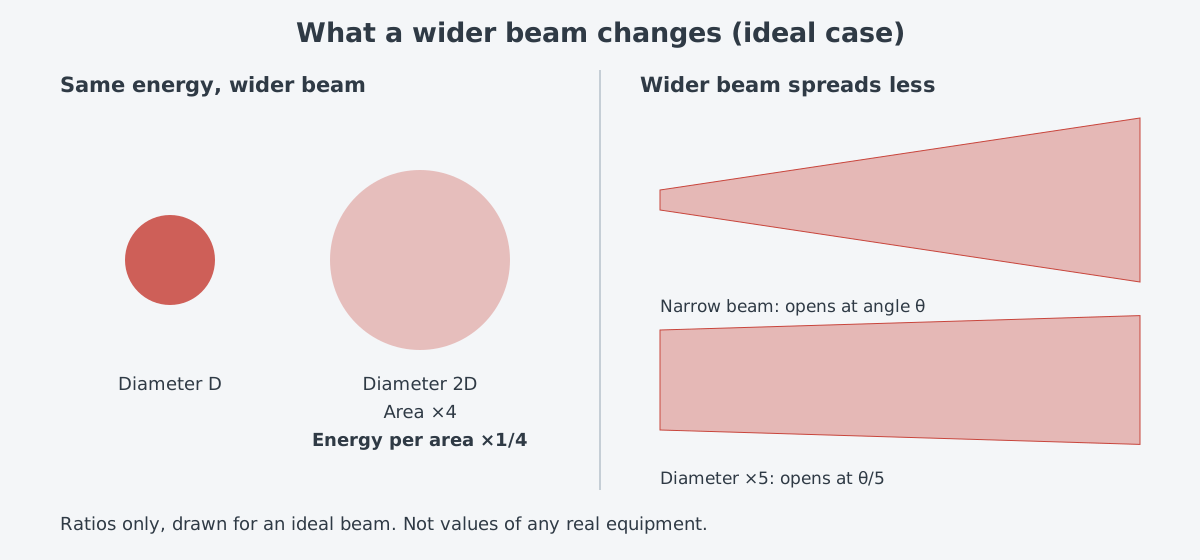
Widening changes more than that. Putting the same energy into a wider beam lowers the energy per area, called fluence. Fluence is the laser energy divided by the area of the beam's cross section, and the area of a round beam grows with the square of its diameter. Doubling the diameter makes the area 4 times larger and the fluence one quarter.
A widened beam can also be focused to a smaller spot with a lens. Counting diffraction alone, the wider the beam that enters a lens, the smaller the focus, and in the ideal case it shrinks by the magnification. But a lens's spherical aberration grows as the beam gets wider, so the real spot size comes from a trade-off between the two.
Galilean and Keplerian designs
The simplest expander is made of two lenses. Refracting telescopes come in two families, Keplerian and Galilean, and laser beam expanders use the same names. The difference from a telescope is that the objective and the image lens swap places. It is like looking through a telescope from the wrong end.
The ratio of the two focal lengths sets the magnification. Light enters parallel and leaves parallel, so the system as a whole has no focal length. Such a system is called afocal.
- Keplerian: two convex lenses set apart by the sum of their focal lengths. The first lens brings the beam to a point between the lenses, and the second turns the spreading beam into a wide parallel beam. It can give a large expansion ratio, and a spatial filter can sit at the internal focus.
- Galilean: a concave lens and a convex lens. The concave lens first spreads the narrow beam, and the convex lens makes the spreading beam parallel. Because one focal length is negative, the lenses sit much closer together than in the Keplerian design, and the design is simple and lower in cost.
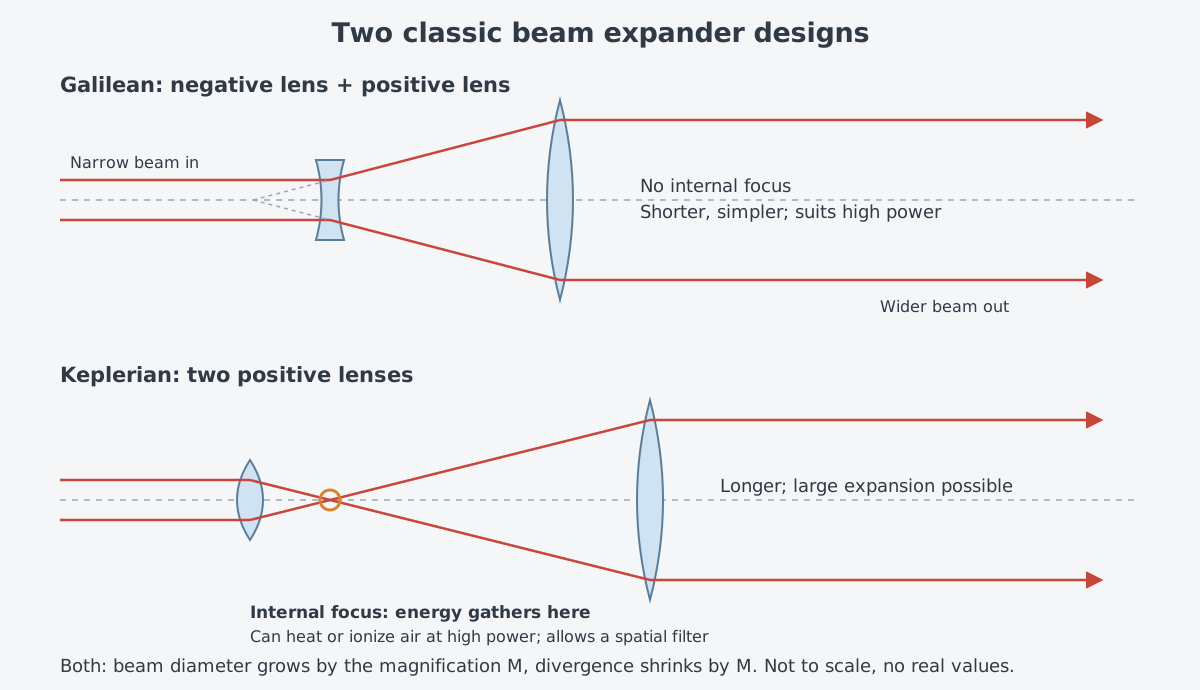
With strong light, the internal focus gets in the way. When energy piles up at the internal focus of a Keplerian expander, the air between the lenses heats up. The warm air can bend light off its path and cause wavefront errors. A very intense focus can even ionize the air.
Edmund Optics explains that the Galilean type, with no internal focus, is the better fit for high-power lasers, and that this is why most beam expanders are Galilean. Where a spatial filter is a must, only the Keplerian type, with its internal focus, will do.
Expanding with mirrors, and the limits
Some expanders widen the beam with curved mirrors instead of lenses. These reflective expanders are much rarer than lens types, but they have no chromatic aberration. In a lens type, the magnification and how parallel the output beam is both change with wavelength.
Most lasers run at a single wavelength, so in many cases this difference does not matter. But multi-laser systems, some tunable lasers and ultrafast lasers need what a reflective design offers. Ultrafast lasers have such short pulses that they naturally cover a wider band of wavelengths than other lasers.
Every approach comes with costs.
- Aberration: the wider the beam, the larger a lens's spherical aberration. Wider is not always better.
- Wobble: among the mechanisms that change focus or magnification, the kind that moves lenses by rotating them is simple and lower in cost, but the turning lenses can make the beam wander.
- Size: sending out a widened beam needs an exit as large as the beam, which means a large aperture.
The lens and mirror surfaces that strong light passes through, and the coatings on them, are covered in "Mirrors, lenses and coatings: optics for strong light".
From telescopes to lasers
The expander's roots are in the telescope. The telescope was invented around 1600, and Galileo became the first person to study the sky through one. He built his with a convex lens at the front and a concave eyepiece, a layout that gives an upright image and is used in small handheld spyglasses.
Most simple refracting telescopes use two convex lenses. The two pairings, convex with concave and convex with convex, match the lens pairs in today's Galilean and Keplerian expanders. A telescope's magnification is also set by the ratio of its two focal lengths.
After the laser arrived, this old principle was put to work widening beams. Today's laser beam expanders are afocal systems that grew out of telescope principles. Beams sent over long distances are one example. A laser used to measure the distance from Earth to the Moon is widened through a telescope, which makes its diameter much larger and its spreading angle smaller.
Ways of measuring distance with lasers, including the Moon, are covered in "Measuring with lasers: range finding and lidar basics".
Laser weapons use the same idea. FiberBridge Photonics builds high-energy fiber lasers. As an example of the optics that follow a laser and shape its beam, it names a beam expander, or telescope, that enlarges the beam diameter. Why a beam director, which sends the beam toward a target, puts out a wide beam is covered in "Beam director optics: lenses, mirrors, coatings and a large aperture".
Straight beams and the eye
At wavelengths of 400–1,400 nm and for a given power, a straightened beam is the most dangerous to the eye. According to the ICNIRP guidelines, a parallel laser beam at these wavelengths that enters the eye forms the smallest possible spot on the retina. For a given power, this case has the lowest damage threshold, so the exposure limits for thermal injury to the retina are set with this condition as the default.
A beam that has passed through an expander is still a parallel beam. How to read laser classes and eyewear is covered in "Laser safety: classes and how to read eyewear labels".
What to read next
- "Why a beam spreads: divergence, focus and aperture": follows the spread that remains after collimation through diffraction and the Rayleigh length.
- "Beam director optics: lenses, mirrors, coatings and a large aperture": looks at why a laser weapon sends out a widened beam and what a large aperture costs.
- "Mirrors, lenses and coatings: optics for strong light": looks at the parts that make up expanders and collimators.