It is the evening of 26 August 1346, on a hillside near Crécy in northern France. English soldiers stand in line on foot, their horses left behind, while French knights ride up at them again and again. When night falls, the smaller English army still holds the field.
The fight is usually remembered as the battle where the longbow beat the knight. That is not wrong, but it is not the whole story. Setting the chronicles of the time beside today's museums and historians shows what the bows did, what else decided the day, and which questions remain open.
Two kings, one crown
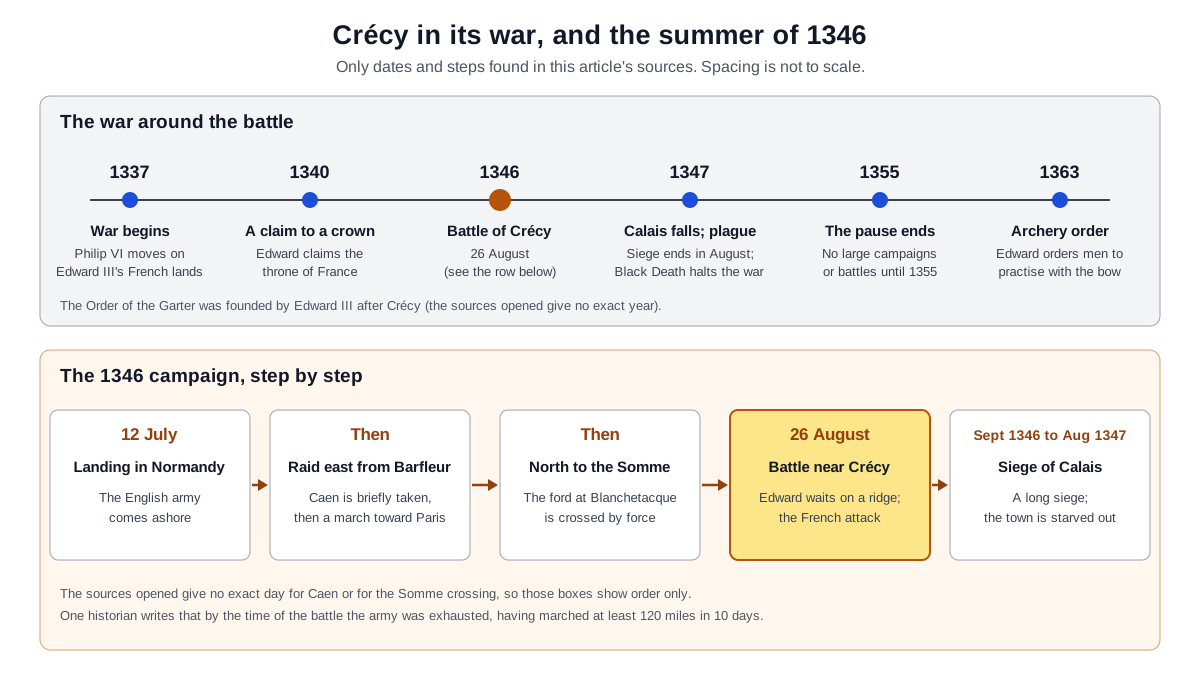
In 1337 King Philip VI of France moved against the French lands held by King Edward III of England. At first the quarrel was about land. In 1340 Edward claimed the French throne itself, and from then on the stake was the crown.
Each man had a family tie to the king who came before. Edward's mother was that king's sister, while Philip was a cousin on the male side. Philip had also been supporting the Scots against Edward.
The conflict later named the Hundred Years' War was not one long war. Sieges, raids, and fights at sea and on land followed one another, with quiet years in between. Crécy was the war's first land battle, and a decisive English victory.
A summer chase from Normandy to the Somme
Edward came ashore in Normandy on 12 July 1346. His army raided east from Barfleur across Normandy, briefly took Caen and then marched toward Paris. Philip's army aimed to pin the English against the River Somme as they headed north to cross it.
At Blanchetacque, a ford close to the river mouth, the English forced a crossing. They then pulled back to strong high ground at Crécy-en-Ponthieu, which the historian Matthew Bennett notes was country Edward knew well. Edward took up a position on a ridge and waited, and the French, when they arrived, could not get around his flank.
Was the march a plan or an escape? Clifford Rogers argued that Edward set out from the start to force a decisive battle, and that view became widely accepted. Michael Livingston sees it the other way: the English were fleeing to save themselves. In his reconstruction, Edward's gift was tactical rather than strategic, using the ground well, while Philip's pursuit was masterful.
By then, the English were worn out, having covered at least 120 miles on foot in ten days. Twice the army crossed a river only hours before the French could catch it, so luck played a part alongside cunning.
The hill on the evening of 26 August
Jean Froissart's chronicle gives the fullest account of the day. He was not an eyewitness. He says he learned most of it from the English and from knights of John of Hainault, who stayed close to Philip.
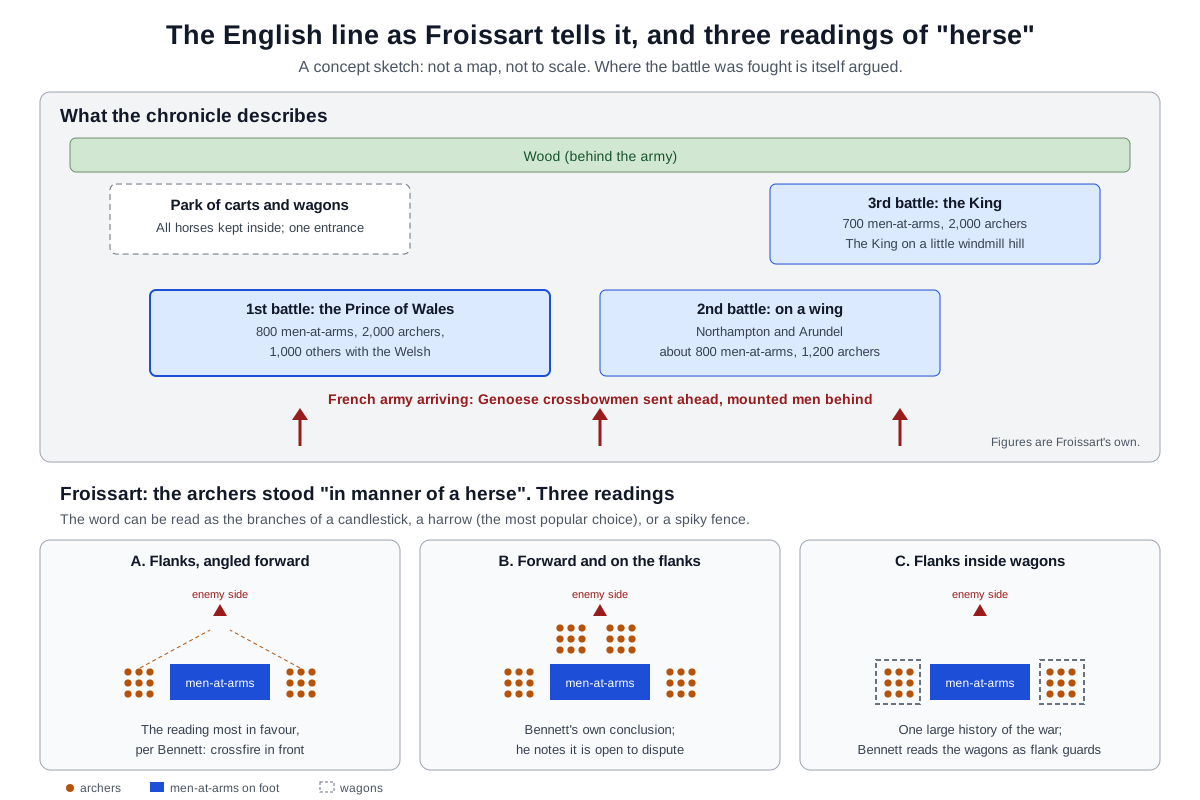
According to Froissart, Edward had a park fenced off by the wood behind his army and put all the carts, wagons and horses inside it. It had only one entrance, and every man fought on foot. The army formed three divisions, and the front one was under the Black Prince, the king's son.
The English had been resting on the ground. When they saw the French coming, they rose without haste and formed their ranks. The French side was different: lords and knights arrived in a rush, some early and some late, getting in each other's way.
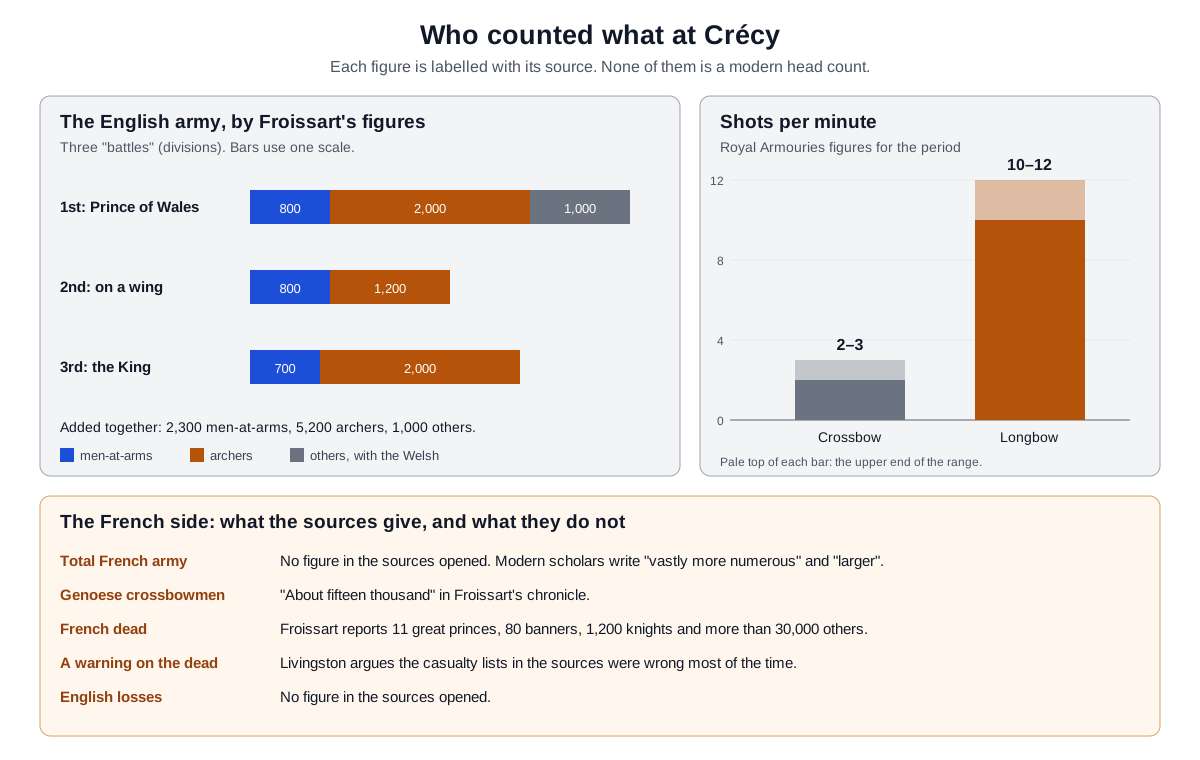
Philip sent his Genoese crossbowmen forward first. Froissart puts them at about fifteen thousand and says they were worn out after marching six leagues that day with their crossbows. Just then a heavy storm with thunder passed over, and when it cleared, the sun shone straight into French eyes.
The crossbowmen came on with three great shouts and began shooting once they were in range. The English archers stepped forward one pace and loosed their arrows all together, and the arrows came down like falling snow. Many of the wounded crossbowmen threw down their weapons and fell back.
What followed was worse. On Philip's order, mounted men rode in among the retreating crossbowmen and killed many of them, while English arrows kept falling on the packed crowd. Men and horses went down in a tangle and could not get up again.
In outline, it went like this. The crossbowmen advanced too early, were struck by arrows and pulled back, and the knights charged through them into the arrows. Repeated cavalry charges failed to break the English line.
The fight did not all go one way. Some French and German soldiers forced their way through the archers of the Black Prince's division and fought his men-at-arms hand to hand. A messenger went to ask Edward for help. The king, watching from a little windmill hill, told him not to send again while his son lived, and to let the boy win his spurs that day.
The King of Bohemia, nearly blind, asked to be led forward so he could strike one blow. His companions tied their horses' reins together and rode in with him. All of them were found dead around him the following day.
English foot soldiers with long knives killed nobles lying on the ground. Edward was displeased afterward, because he would have preferred to take them prisoner.
Longbow and crossbow: how the two bows differed
People used the longbow across Europe, but it was the favored weapon of English and Welsh infantry. It was usually around 1.8 m long and often made of yew. Arrows were stored and handed out in bundles of 24.
A crossbow holds its string drawn with a mechanism. It cost less, was simpler, and asked less of the user than the longbow, which suited conscripts and hired soldiers, and Genoese crossbowmen were especially well known. It also hit much harder, and over the course of the war its wooden bows gave way to composite and steel ones that were stronger still.
Speed ran the other way. The Royal Armouries puts a crossbowman at 2–3 shots a minute and a longbow archer at 10–12. The longbow's range is believed to have been about 229 m, and perhaps more.
That speed was not free. A crossbow was easier to load and shoot, while the longbow demanded far more training and physical strength. A longbow archer's training began in childhood and went on through his working life.
Did the bows win it alone?
Start with armor. Good armor protected both men and horses quite well against arrows. The Royal Armouries thinks only a small share of arrows got through, and only where the metal was thinnest, for example at the side of a helmet. Arrows still worked because of the sheer number that came down.
Next, the way armies fought. Battles in the Hundred Years' War were mostly fought on foot, and a man-at-arms in full armor could fight either mounted or on his feet. Archers who ran out of arrows picked up other weapons and fought beside the men-at-arms. At Crécy, the English likewise left their horses in the park and all fought on foot.
Then the ground. Bennett cites a paper suggesting the site had been prepared beforehand with supplies and arrows. Pits also seem to have been dug, at least on the flanks where the archers stood. As far as he knew, though, archaeologists had never dug at Crécy, so nobody knows what field defenses there were.
Then the French side. Bennett argues the Genoese lacked their pavises, the tall shields that covered them while they reloaded, because the shields were still in the baggage carts. In his view the Genoese have been much blamed and so misunderstood. The real disaster, he says, was French knights so impatient to reach the English that they charged head-on, again and again, without coordination.
Gunpowder was there too. Some evidence points to guns at Crécy. They may only have served to cause panic with their noise.
The English method did not appear overnight. Bennett points to two earlier fights as the key influences: Boroughbridge in 1322 and, a decade later, Dupplin Moor in 1332. A year after Dupplin Moor, Edward III used the same method at Halidon Hill.
So where did the idea that the bows won it all come from? Bennett says older historians raised tactics above every other factor, when tactics were sometimes decisive and more often not. He adds that their views were colored by an anachronistic nationalism, and that comparing archery to battlefield artillery holds only up to a point. Livingston, too, says the old picture of the longbow cutting down the best of French knighthood covers only a small part of the story.
Numbers and place: questions still argued
Froissart gives English numbers division by division. The first had 800 men-at-arms, 2,000 archers and 1,000 others with the Welsh. The second had about 800 men-at-arms and 1,200 archers, and the King's division had 700 men-at-arms and 2,000 archers. Added together, that makes 2,300 men-at-arms, 5,200 archers and 1,000 others.
None of the sources opened for this article gives a total for the French army. Froissart says only that they were "a marvellous great number", Livingston calls the French army vastly more numerous, and another reviewer calls it larger. The figure of about fifteen thousand Genoese also comes from Froissart. Bennett, on the other hand, lists the crossbowmen's smaller numbers as one reason they were outshot, which does not fit that figure.
The dead are no easier to count. Froissart reports that Edward's men searched the field and counted 11 great princes, 80 banners, 1,200 knights and more than 30,000 others dead. Livingston argues that the widely circulated casualty lists were wrong most of the time. Whatever the totals, they stand for people who fell on that field, and Edward proclaimed a three-day truce so local people could search the ground for their dead.
The location is argued as well. The first attempt to fix the site was Cassini de Thury's map of France in 1757, based largely on an old stone windmill on a hill north of Crécy. From the mid-1700s on, the battle has been placed just north of Crécy-en-Ponthieu.
Livingston argues that this site is wrong and lies more than 5 km from the most likely location. He rebuilt both armies' marches using the king's kitchen journal and proposes a rise beside the Forest of Crécy, on the road that runs from Crécy to Abbeville. There he found a wedge-shaped hill large enough to hold a wagon camp, and a man-made ditch.
Kelly DeVries, his co-editor, argues that this ground left the French horsemen surprised by the Genoese falling back toward them. In his view, that confusion wrecked their attack.
Livingston's case goes further. The story that the Genoese betrayed the French has no basis, the Black Prince was actually captured during the fighting, and the English used a fortification built of wagons. Yet he also writes that without proper archaeological work, no one can know for certain.
Where the archers stood is another old argument. Froissart says only that the archers of the Black Prince's division stood "in manner of a herse." The word can be read as candlestick branches, a harrow or a spiky fence, and the harrow is the most popular choice.
The reading most in favor puts archers on both flanks of each block of men-at-arms, angled slightly forward to cross their fire in front of the line. Bennett concludes that the archers seem to have stood forward and on the flanks, while noting that this is open to dispute. One large history shows the archers surrounded by wagons, but Bennett reads the wagons as guarding the flanks and rear against encirclement.
Calais, the Garter and an order to practise archery
After Crécy, Edward marched north and besieged the port of Calais. The siege lasted from September 1346 until August 1347. The town fell only after its people were starved into surrender and a French relief force failed.
In 1347 the Black Death brought the war to a halt. There were no large campaigns or battles until 1355.
Edward founded the Order of the Garter after Crécy. In 1363, after the victories at Crécy and Poitiers (1356), he ordered able-bodied men to keep a bow and train with it on Sundays and holidays instead of playing football. Another section of the same museum page describes this as laws that made every man aged 15 to 60 keep a bow and train with it.
Where can a bow of that era be seen today? The only precisely dated English longbows come from Henry VIII's warship the Mary Rose. The wreck yielded 172 longbows and over 2,000 complete arrows, each bow cut from one piece of yew and between 1,839 and 2,113 mm long. Those bows date from about 1545, though, roughly 200 years after Crécy, so they cannot be taken as exact copies of the bows used in 1346.
What to read next
- The Hundred Years' War at a Glance: What Happened Over 116 Years: where Crécy sits in the long war.
- The Battle of Agincourt: Arguments About Mud and Numbers: the battle that made the longbow most famous, and the argument over its numbers.
- Turning points in military technology: the idea that one weapon changed war, read through modern technology.
- A history of laser weapons: from chemical to electric lasers: where long-range weapons stand today.