Picture a large rocket with its tanks full. What makes up most of its weight? Not the engines, and not the satellite it carries, but the propellant. And that propellant burns away during the flight.
What is left, then, is mostly empty tanks. Why spend effort hauling empty tanks all the way up? That question is where rocket stages begin.
Most of a rocket is propellant
Every rocket uses the thrust from its propulsion system to overcome its own weight. For a full-size satellite launcher, the payload makes up just a sliver of the liftoff weight. Most of the weight is propellant.
There is nowhere to refuel in space, so a rocket has to leave with all of its propellant on board. Any weight savings must therefore come from somewhere else: the structure.
The number to watch is the mass fraction: the mass of the propellant divided by the total mass of the rocket. NASA's educator guide gives a mass fraction of about 0.91 for the most efficient rockets. That means propellant is 91% of the total mass, and the structure and payload make up the other 9%.
What the rocket equation says
A flying rocket keeps pushing propellant out of its nozzle. Its weight and mass change the whole time, so Newton's second law in its everyday fixed-mass version cannot give its speed. Working through that change, while leaving out the effects of the air, gives the ideal rocket equation.
Δu = V_eq × ln(m_f / m_e)
Δu is the change in the rocket's speed, and V_eq is how fast the exhaust leaves the rocket (the equivalent exhaust velocity). The term m_f is the mass at liftoff with all the propellant on board, and m_e is the empty mass left once the propellant is gone. The empty mass stays the same through the flight. Only the propellant on board goes down.
There is one thing to take from this equation. With the same engine, a bigger ratio between the starting mass and the empty mass gives a bigger change in speed. A heavy empty mass costs speed.
This ratio (m_f / m_e) is a different ratio from the mass fraction of 0.91 above. The mass fraction is propellant's share of the total, while this one says how many times heavier the rocket is at the start than when empty.
Assuming a liquid hydrogen and liquid oxygen engine like the Shuttle's main engines, NASA works an example with this equation for an orbit 200 miles high. The change in speed needed is about 17,000 mph, and propellant turns out to be 90% of the total weight for a rocket bound for that orbit. The structure, engines and payload all have to fit in the other 10%, and with today's technology the payload ends up as only about 1% of the liftoff weight.
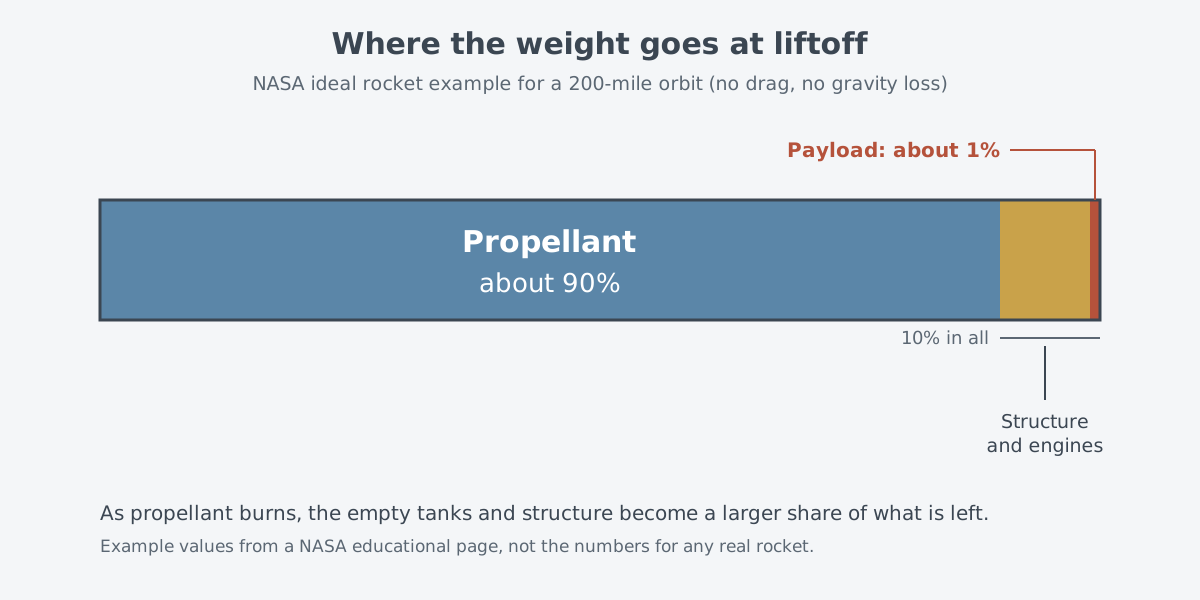
These values describe an ideal case with no drag and no gravity. Adding gravity puts an extra loss term into the equation, and that term grows with the time the engine burns.
Dropping empty tanks along the way
In the example above, propellant was 90%, and the tanks and structure sat inside the other 10%. Once the propellant burns off, that 10% is almost all the rocket is carrying. The tanks were sized for a full load, and now they would ride along empty to the end.
So most launchers throw away part of the vehicle to lighten it enough to reach orbital speed. This is called staging.
NASA's educator guide calls it "one simple but old trick." The recipe is a big rocket at the bottom, a smaller one stacked above it, an even smaller one above that, and the payload at the very top. The bottom stage lifts its own mass plus the two stages above it, then drops away once its propellant is gone.
The second stage then fires and drives itself, the third stage and the payload faster and higher. Once its tanks run dry it falls away too, and the third stage finishes delivering the payload. Because the mass shrinks during the flight, the upper stages do their work more efficiently.
Think of a truck carrying several fuel cans. It keeps its cargo all the way, but each time a can runs dry, it leaves that empty can by the road. The real thing is different in one way. A rocket does not drop a can but a complete rocket with its own engine and tanks, and the stage that remains has to start its own engine right there.
Stacking up and strapping on
There are two ways to stage a rocket: serial and parallel. Serial staging puts a small second stage on top of a large first stage. The first stage lights at launch and burns until its propellant runs out. When it shuts down, the second stage separates and starts its own engine.
The Saturn V Moon rocket used serial staging. It had three stages and staged twice on the way to Earth orbit. Its discarded stages were never recovered.
Parallel staging straps several small first stages beside a central rocket. All the engines light together at launch. When the strap-on rockets run out of propellant, only they are dropped. The central rocket keeps burning and carries the payload to orbit.
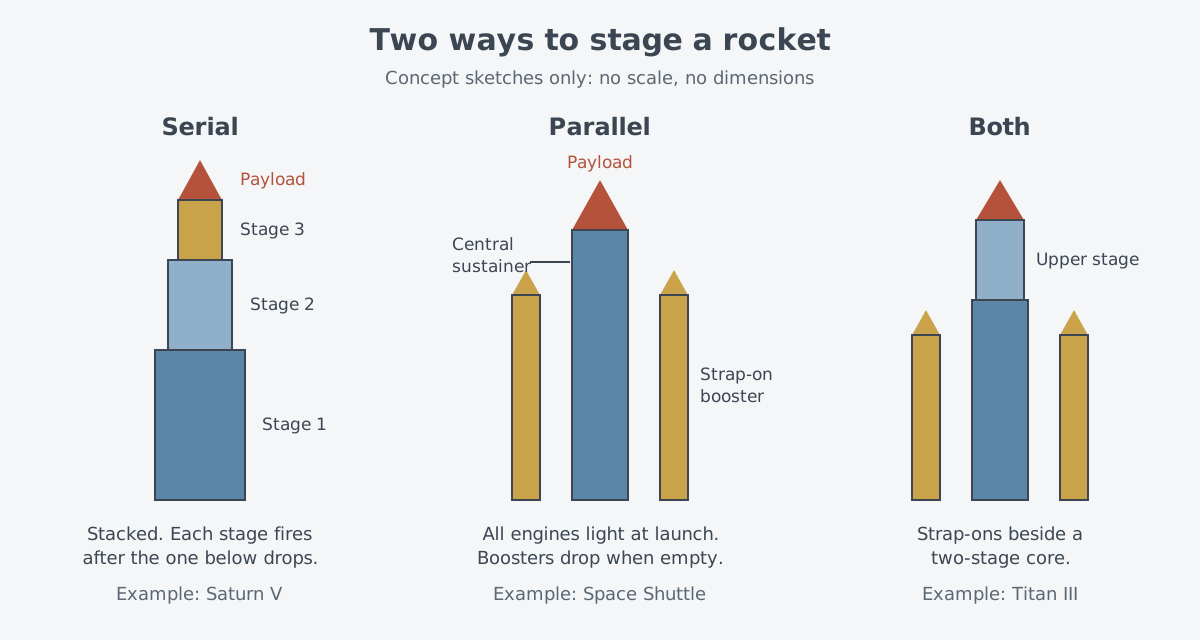
The Space Shuttle used parallel staging. Its discarded solid rocket boosters were pulled from the ocean, refilled with propellant and flown again. Some launchers combine both methods. The Titan III placed a liquid-fueled two-stage Titan II in the middle and strapped two solid rockets to its sides at launch.
How solid and liquid propellants differ is covered in Solid and liquid rockets.
From a 17th-century design to Moon rockets
The idea of splitting a rocket into stages is much older than the space age. In the 17th century, Kazimierz Siemienowicz led troops in the Polish Royal Artillery and knew both cannons and rockets well. He published a multistage rocket design in Artis Magnae Artilleriae pars prima, and NASA describes it as a design that later became a basic technology for rockets bound for space.
The rocket equation above is tied to Konstantin Tsiolkovsky. He published his best-known work, "Research into Interplanetary Space by Means of Rocket Power," in 1903. His equation, built on Newton's second law, ties how fast the exhaust leaves the engine to how much the vehicle speeds up.
After World War II, a V2 rocket brought to the United States was fitted with a WAC Corporal rocket on top. This "Bumper-WAC" first launched on May 13, 1948. Over six flights, the two-stage rocket climbed to almost 250 miles (400 km). It was the largest two-stage rocket the United States had launched up to then.
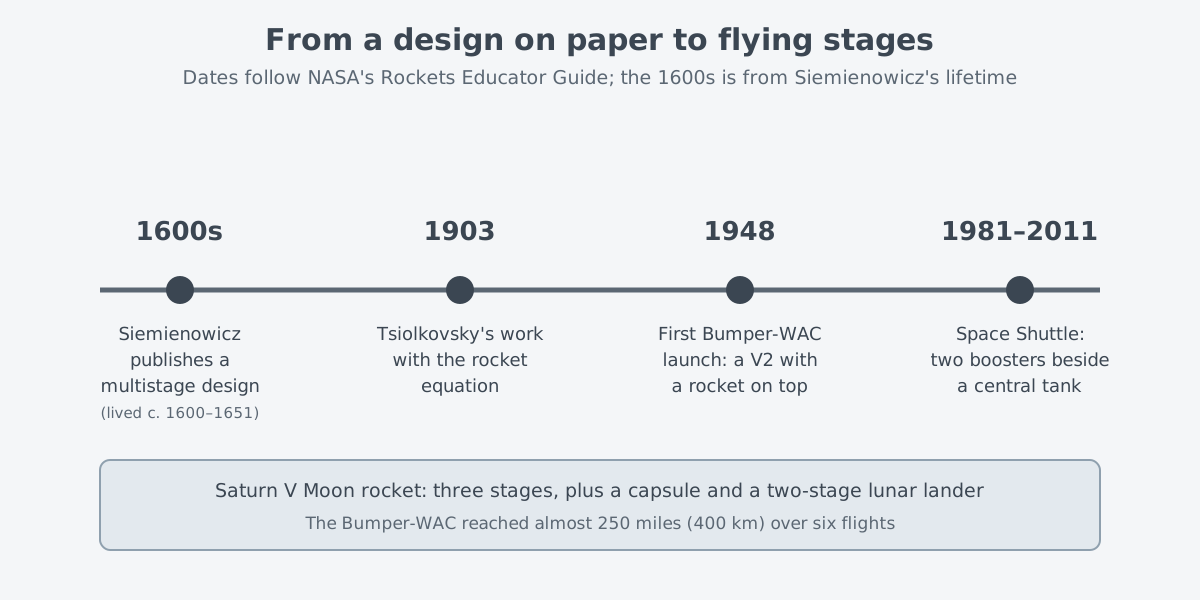
Later launchers kept using stages. The Saturn V was designed with three stages, a return capsule and a two-stage lunar lander. On Apollo 11, the lunar module was also split into a descent stage and an ascent stage.
The Space Shuttle flew 135 missions from 1981 to 2011. It was made of a central external tank, two boosters and an orbiter. Only the orbiter actually reached orbit, and each mission needed a new external tank.
Missiles and stages: what gets harder
Ballistic missiles rise on the same principle. A 2005 Congressional Research Service (CRS) report put the maximum range of a single-stage missile at about 2,000 km. Going farther, it said, takes a missile with two or three stages. The path a missile follows after its engines stop is covered in Ballistic missiles.
Adding stages is not all gain. That report also describes separating and lighting extra stages in flight as highly complex work in both science and engineering.
Staged rockets also carry intercontinental ballistic missiles (ICBMs). For where the same rocket parts ways with a space launcher, see ICBMs: what they share with space launch vehicles.
Where this meets lasers: weapons that count weight
A multistage rocket is the result of a fight with weight. Dropping weight that has done its job lets the rest go farther.
Laser weapons face a similar kind of math. A CRS primer on directed-energy weapons lists open questions about how mature they are. One of them is whether these weapons can meet the size, weight and power (SWaP) and cooling limits of the platforms that would carry them today. Some of these systems are small enough for military vehicles, it notes, but many need larger or fixed platforms.
A rocket sheds weight as it flies, while a laser weapon has to fit within the weight a platform can carry from the start. How those limits differ between vehicles, ships and aircraft continues in Weight and platforms.
What to read next
- Solid and liquid rockets: what the fuel form changes: what kind of propellant drives the engine in each stage.
- ICBMs: what they share with space launch vehicles: how staged rockets are used in the longest-range missiles.
- Weight and platforms: fitting on a vehicle, ship or aircraft: how laser weapons deal with the weight limits of their platforms.