When people shop for a car, they look at fuel economy. If you know how far a car goes on a gallon, you can compare two cars without knowing their size or engine names. Is there a number like that for rocket engines?
There is. It is called specific impulse (Isp), and its unit is, oddly, the second. In its history of the Centaur rocket, NASA calls specific impulse a measure of fuel efficiency "somewhat like miles per gallon of a car."
This article looks at what specific impulse divides by what, why a unit of time shows up, and why the same engine can have different values. It then turns to an engine with a very high specific impulse that pushes only as hard as a hand holding a sheet of paper. That engine shows what a single number can hide.
Thrust divided by propellant weight
The force that pushes a rocket is called thrust. The engine throws a mass of gas hard backward, and the reaction drives the rocket forward. When thrust lasts for a while, its effect adds up. Average thrust times firing time is called the total impulse.
Divide the total impulse by the weight of the propellant used, and you get specific impulse. Here, the word "specific" just means "divided by weight." In one line:
Isp = F ÷ (ṁ · g₀)
F is thrust, ṁ is the mass of propellant leaving each second, and g₀ is the gravitational acceleration constant. Multiplying ṁ by g₀ gives the weight of propellant used each second. So specific impulse asks a simple question: how much thrust do you get for each unit of propellant weight burned per second?
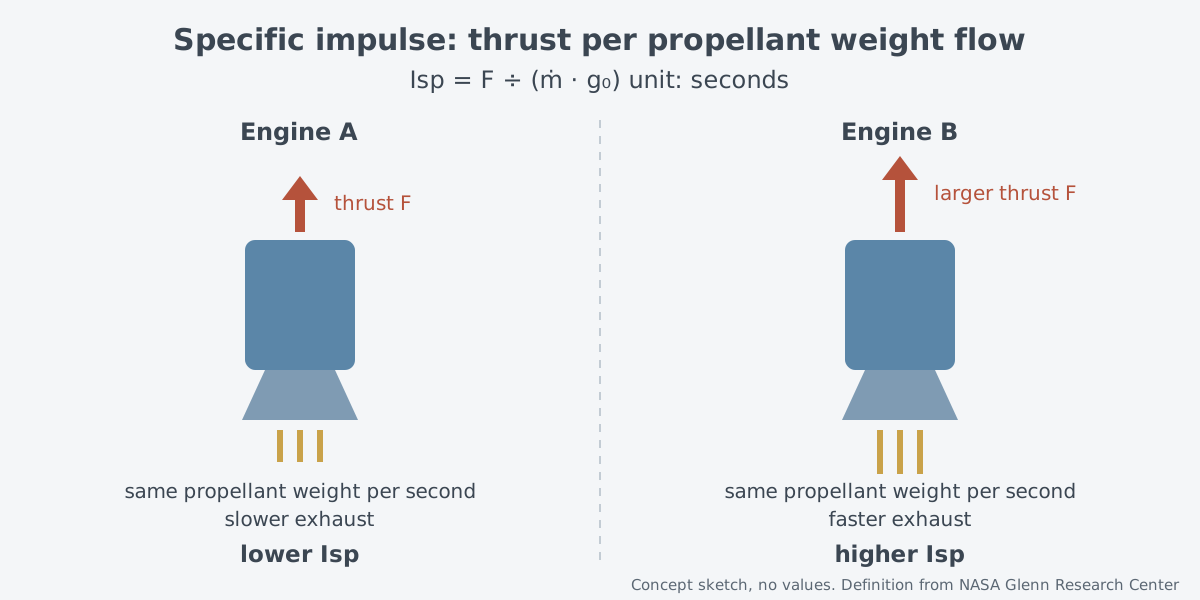
NASA Glenn Research Center's educational material explains that an engine with a higher score is more efficient, since the same amount of propellant gives it more thrust. Another use is speed: if you know the propellant weight flow through the nozzle, specific impulse gives you the thrust right away.
Why the unit is seconds
Thrust is a force, and weight flow is weight per second, which is force per second. Divide a force by "force per second" and the force cancels out, leaving seconds. The same material checks the units as m/s divided by m/s² and gets the same answer.
This has a practical side. In metric units, g₀ is 9.8 m/s²; in English units, it is 32.2 ft/s². Whichever units you use, specific impulse comes out as the same number of seconds. Engines can be compared directly even when countries use different units.
Reading the definition backward shows what the seconds mean. Specific impulse is total impulse divided by propellant weight, so it tells you for how many seconds the propellant could produce a thrust equal to its own weight. Real engines change thrust over time, so this reading only helps pin down what the unit means.
Specific impulse is exhaust speed in disguise
Rocket thrust ties the mass thrown out each second to the speed at which it leaves. NASA's material folds the pressure difference at the nozzle exit into one speed, called the equivalent velocity (V_eq), and writes thrust simply as F = ṁ · V_eq. Put that next to the definition above, and specific impulse and exhaust speed turn out to describe the same thing, differing only by g₀.
V_eq = Isp × g₀
For example, a specific impulse of 300 seconds means an equivalent exhaust speed of 300 × 9.8 = 2,940 m/s, or about 2.9 km/s. A specific impulse of 3,000 seconds means about 29 km/s. Raising specific impulse really means throwing the same mass backward faster.
This link carries over into the rocket equation. Written with the engine's specific impulse, the ideal rocket equation for a rocket's velocity change looks like this.
Δu = Isp · g₀ · ln(m_f ÷ m_e)
Here m_f is the mass with full propellant, and m_e is the empty mass left after the propellant is gone. For the same mass ratio, a higher-scoring engine gives a larger velocity change. Propellant weight is a large part of a rocket's total weight, which is why this value matters. How rockets drop empty mass by staging continues in the article "Multistage Rockets: Why Rockets Come in Stages."
Outside air changes the number
Even for one engine, specific impulse is not a single number. Thrust depends on how much mass flows through the engine, how fast the exhaust leaves, and the pressure where the nozzle ends. The exit pressure equals the outside pressure only at some design condition. When outside pressure changes, thrust changes, and so does specific impulse.
The outside air works a bit like a cork in a bottle. For the exhaust to escape through the nozzle, the pressure in the combustion chamber has to beat the outside pressure. Part of that pressure goes into pushing past the cork. The exhaust passing through the nozzle slows down by that much.
As a rocket climbs, the atmosphere thins and the outside pressure keeps dropping. The same engine's thrust then rises. That is why a specific impulse figure should come with its condition, such as sea level or vacuum.
A rocket carries its own oxidizer, so it makes thrust even in a vacuum with no oxygen around. This is where rockets part ways with engines that breathe air, and the split leaves a mark on how specific impulse is defined. The section on air-breathing engines below comes back to it.
Why liquid hydrogen: Centaur and the RL10
The idea of judging an engine by its exhaust speed is old. Konstantin Tsiolkovsky (1857–1935), a teacher and theorist, set out the rocket equation in his best-known work, published in 1903. Built on Newton's second law, it links an engine's exhaust velocity to the rocket's own change in velocity.
On March 16, 1926, the American professor Robert Goddard (1882–1945) flew the world's first liquid propellant rocket. It was a short flight that climbed only about 40 feet. NASA's educator guide treats it as an early step toward the Saturn V, the rocket that went to the Moon 43 years later.
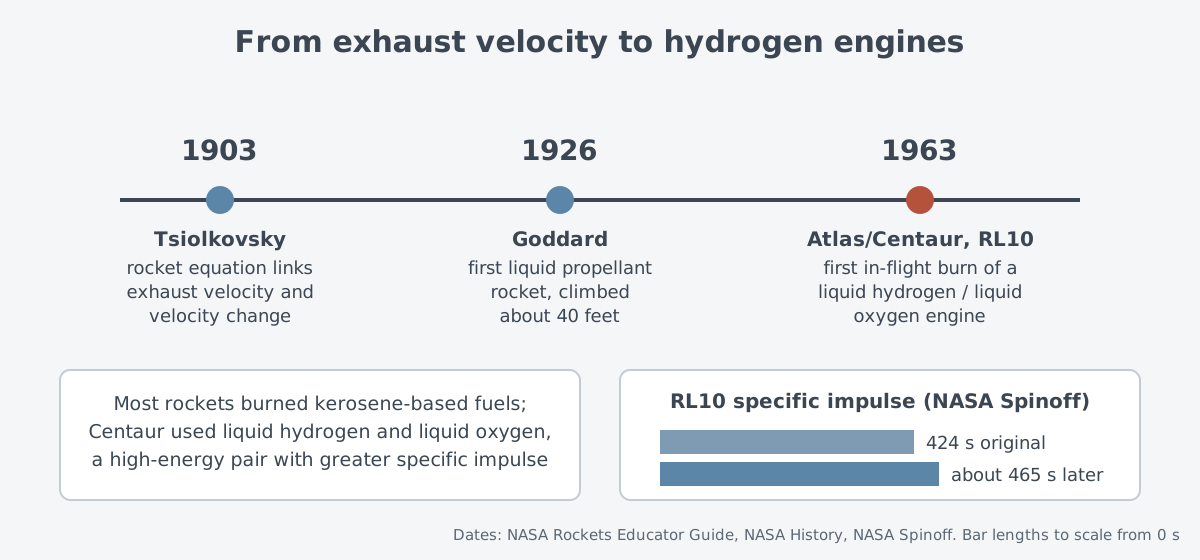
A clear case of specific impulse driving engine choice is Centaur. While most rockets burned kerosene-based fuels, Centaur, the first U.S. high-energy upper stage, used liquid hydrogen and liquid oxygen. NASA's history page explains that the high energy of this pair gives a greater specific impulse. It adds that this matters because propellant weight is a large part of a rocket's total weight.
On November 27, 1963, the first Atlas/Centaur flew without a payload. It was the first time a liquid hydrogen and liquid oxygen engine fired in flight. The RL10 engine, shaped to meet Centaur's needs, also made its first successful flight that year.
An engine's specific impulse can also rise through upgrades. NASA Spinoff reports that the RL10's specific impulse went from an original 424 seconds to about 465 seconds later on. Among the changes, it names a longer nozzle and a narrower thrust chamber throat.
High specific impulse is not high thrust
A car with good fuel economy is not always a strong car. Rockets are the same. Specific impulse tells you how well an engine saves propellant, not how hard it pushes each second.
Electric propulsion shows the gap clearly. It accelerates propellant by turning electrical energy into kinetic energy, and in space the power has mostly come from solar arrays. NASA's small spacecraft technology survey says electric propulsion can deliver total impulse an order of magnitude beyond what chemical systems give. But its thrust-to-power level is generally below 75 mN/kW, so a small spacecraft that feeds 500 W to its thrusters may get no more than 38 mN.
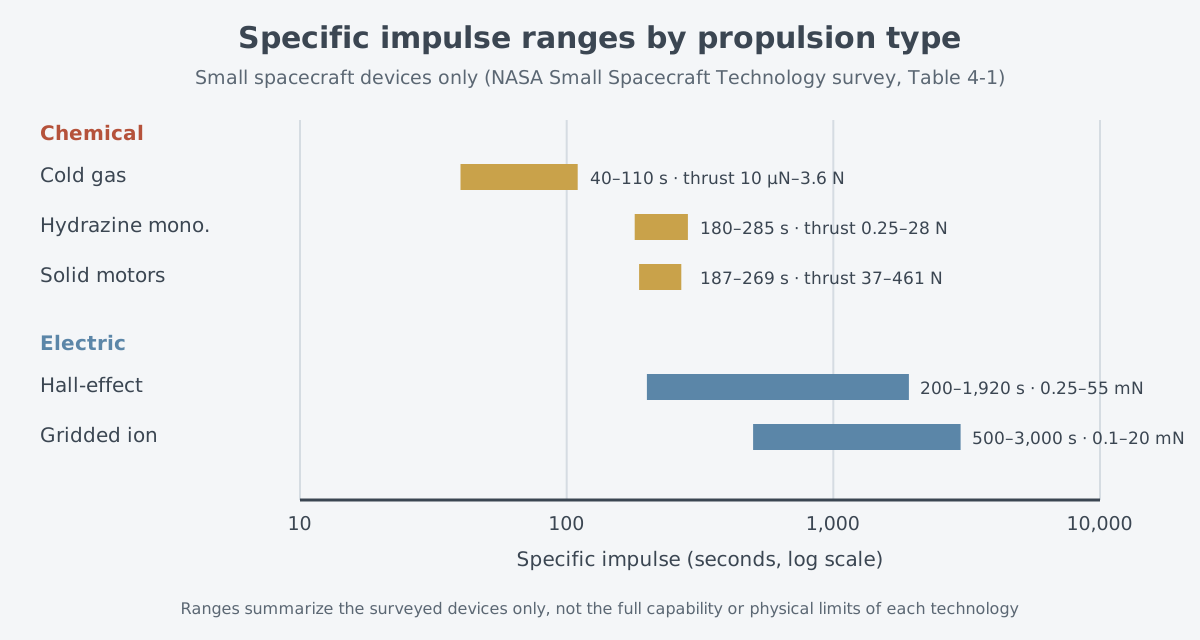
The survey's summary table makes the split sharper. Cold gas runs 40–110 seconds, hydrazine monopropellant 180–285 seconds, and solid motors 187–269 seconds. Hall-effect thrusters reach 200–1,920 seconds, and gridded ion thrusters 500–3,000 seconds.
Yet gridded ion thrusters make 0.1–20 mN of thrust, while hydrazine thrusters make 0.25–28 N. These ranges cover only the small spacecraft devices in that survey, not the full capability or physical limits of each technology.
NASA's Dawn spacecraft is a good example. Its thrusters use an electrical charge to accelerate xenon ions to 7–10 times the speed of chemical engines. Even so, at maximum thrust each engine makes 91 mN, about the force of holding one sheet of notebook paper. At full throttle, it would take four days to go from 0 to 60 mph.
So the jobs split. Chemical propulsion is used when high thrust or quick maneuvers are needed, and electric propulsion suits work that can spend hundreds or thousands of hours to reach the same impulse. Dawn's ion propulsion was planned to run for thousands of days, not minutes.
Air-breathing engines and missiles
Jet engines, ramjets, and scramjets are air-breathing engines that take every bit of oxygen they burn from the surrounding air. Their specific impulse is thrust divided by the weight of fuel consumed. A rocket carries both fuel and oxidizer, so both count; an air-breathing engine carries no oxygen, so only the fuel counts.
That means a rocket's specific impulse and an air-breathing engine's specific impulse have different denominators. Turbine engine performance also uses a separate, similar efficiency measure called specific thrust. Always check what weight a number was divided by.
A technical digest from the Johns Hopkins Applied Physics Laboratory (APL) compares how efficient turbojets, ramjets, and scramjets are at different speeds. It notes that flying faster lowers specific impulse, which means more fuel and a shorter range. Making a missile faster is tied to giving up fuel economy. The workings of air-breathing engines are in Ramjets and Scramjets, and the difference between solid and liquid rockets is in Solid and Liquid Rockets.
Reading a specific impulse number
When a specific impulse figure shows up in news or a report, look for its condition first. Whether it is a sea level or vacuum value, or a value at the nominal operating point, matters as much as the number. NASA's small spacecraft survey notes that running at off-nominal conditions may lower specific impulse or electrical efficiency.
Next, look at how the value was obtained. The same survey advises caution with specific impulse claims drawn from plume characteristics, and stresses test data from a relevant environment. Its own table lists only nominal operating values for each device, and it says some missing values were approximated from available data.
Finally, check what it was divided by. A rocket counts all of its propellant, while an air-breathing engine counts only fuel. And a high specific impulse says nothing about how much thrust there is. It is like guessing a car's power from its fuel economy alone.
Where this meets lasers: the same efficiency question
A laser weapon has no propellant, but the efficiency question remains. A rocket asks how hard a lump of propellant can push. A laser asks how much of the electricity put in becomes light. That value is called wall-plug efficiency.
The Congressional Research Service (CRS) primer on directed-energy weapons describes the Department of Defense's High Energy Laser Scaling Initiative (HELSI). Its aim is to show laser power going up while beam quality and efficiency hold steady or get better. The primer adds that many current U.S. programs use solid state lasers fueled by electrical power, so the cost per shot equals the cost of the electricity for that shot. It also points out that size, weight, and power (SWaP) and cooling needs can limit a laser's range and beam quality.
In a rocket, specific impulse sets how much propellant weight must be carried. In a laser, efficiency shapes the size of the generators, batteries, and cooling gear on board. That story continues, with a worked example, in Power and Efficiency.
What to read next
- Solid and Liquid Rockets: the two families of engines that produce specific impulse, and how each is used.
- Multistage Rockets: Why Rockets Come in Stages: how rockets shrink the empty mass in the rocket equation.
- Ramjets and Scramjets: how air-breathing engines work at high speed.
- Power and Efficiency: why efficiency sets the size of a laser weapon system.