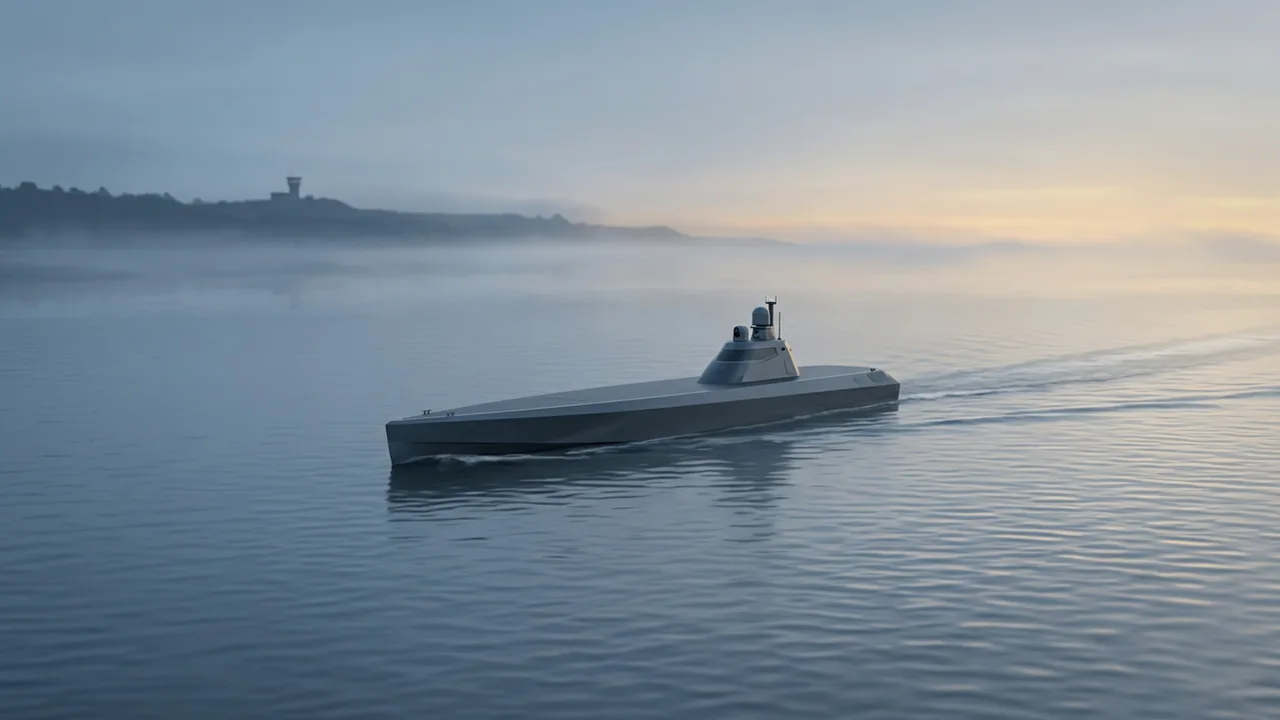
While a ship crosses the sea, someone on board is always awake. People keep watch at night, turn the wheel when another ship comes close, and go below to fix the engine when it starts to sound wrong. What happens if every one of them steps off and the ship sails alone?
That is an unmanned surface vessel (USV): a boat or ship that travels on the water with no crew aboard. This article looks at why the U.S. Navy wants such ships, and why three crew jobs in particular, keeping watch, staying in contact and making repairs, are still difficult problems.
What "uncrewed" means for a ship
An unmanned vehicle can carry sensors, weapons or other payloads. It can run in three ways. A person off the ship can steer it remotely, the ship can handle some tasks itself in a semi-autonomous mode, or, with suitable technology, it can run autonomously.
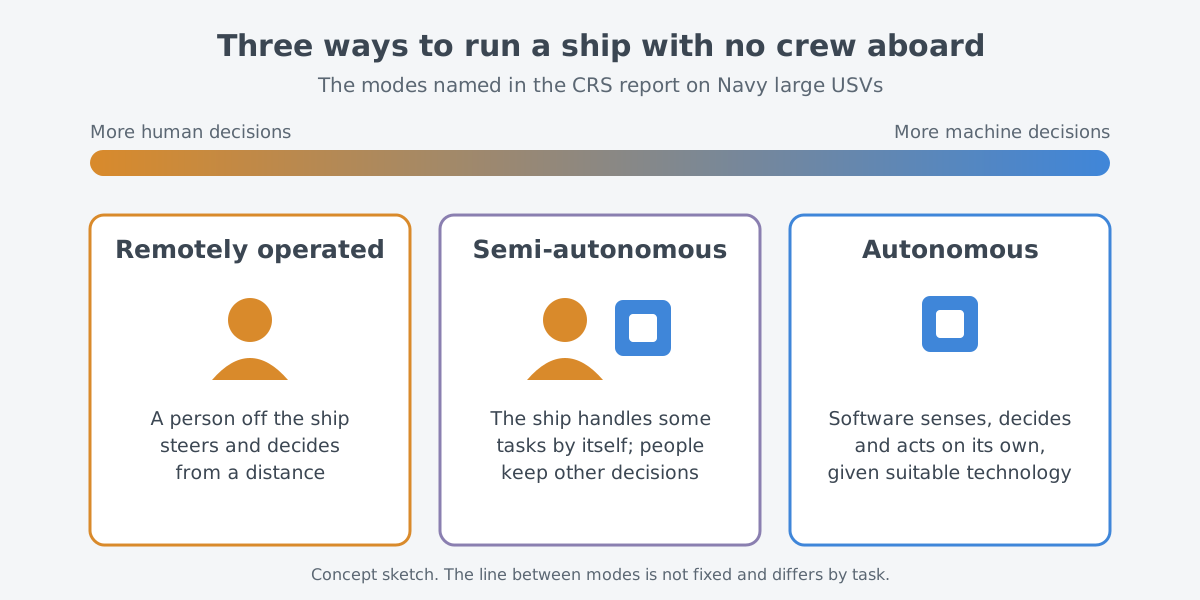
No crew does not mean no people. A Navy solicitation from July 2025 says command and control of the vessels will sit at an off-hull station, either ashore or on another ship. The people move from the bridge to a screen somewhere else.
These ships come in several sizes. Smaller USVs launch from crewed warships or submarines and extend how far those ships can reach. Large USVs leave straight from the pier and take on missions that crewed ships might otherwise get.
A large USV is roughly as big as a large patrol craft. The LUSV and MUSV programs that Congress watched for several years were for these large ships.
Why take the crew off
Cost comes first. Without living spaces and the support equipment that goes with them, each ship can be cheaper to buy than a crewed one.
The second reason is human endurance and safety. Uncrewed vehicles can suit missions long enough to wear out a crew, or missions with a high risk that people on board would be hurt, killed or captured. These are often called "three D" missions, for dull, dirty and dangerous.
The third reason has to do with how the Navy plans to fight: large USVs with weapons or sensors are to operate alongside crewed ships. In that role they act as extra weapon magazines or sensor platforms. That supports Distributed Maritime Operations (DMO), a concept of spreading weapons and sensors over more ships and aircraft. The Congressional Research Service (CRS) sums it up as avoiding "putting too many eggs into one basket."
In 2018, the director of the Tactical Technology Office at the Defense Advanced Research Projects Agency (DARPA) used chess as a comparison. The idea: on the maritime chessboard, swap the king and queen for lots of pawns. A real ocean is different: each pawn has to watch its surroundings and find its own way. The rest of this article is about that problem.
The prototypes so far
One place to start the public story of large USVs is DARPA's Sea Hunter. In September 2014, DARPA and the Office of Naval Research (ONR) agreed to share the cost of a test phase for the prototype. The ship was christened in April 2016. That October, at-sea testing of its sensing and autonomy equipment began.
From February to September 2017, the ship used that equipment to pass three tests in following the International Regulations for Preventing Collisions at Sea (COLREGs). It was also tested on swapping modular payloads to take on different missions. In January 2018, DARPA closed the program and handed Sea Hunter to ONR.
The Defense Department's Strategic Capabilities Office (SCO) also developed USVs under the name Ghost Fleet, and called its large-USV work there Overlord. The Navy's current plans build on these earlier prototypes. According to the Navy's FY2026 budget documents, Sea Hunter and Seahawk now serve as experimentation vessels homeported in San Diego.
DARPA's NOMARS program went a step further. Its demonstrator, USX-1 Defiant, was designed from the start with no allowance at all for people on board. It falls in the medium unmanned surface vessel class, and a long trial at sea is planned to test how reliable and durable it is. The Navy plans to take it over in FY2026.
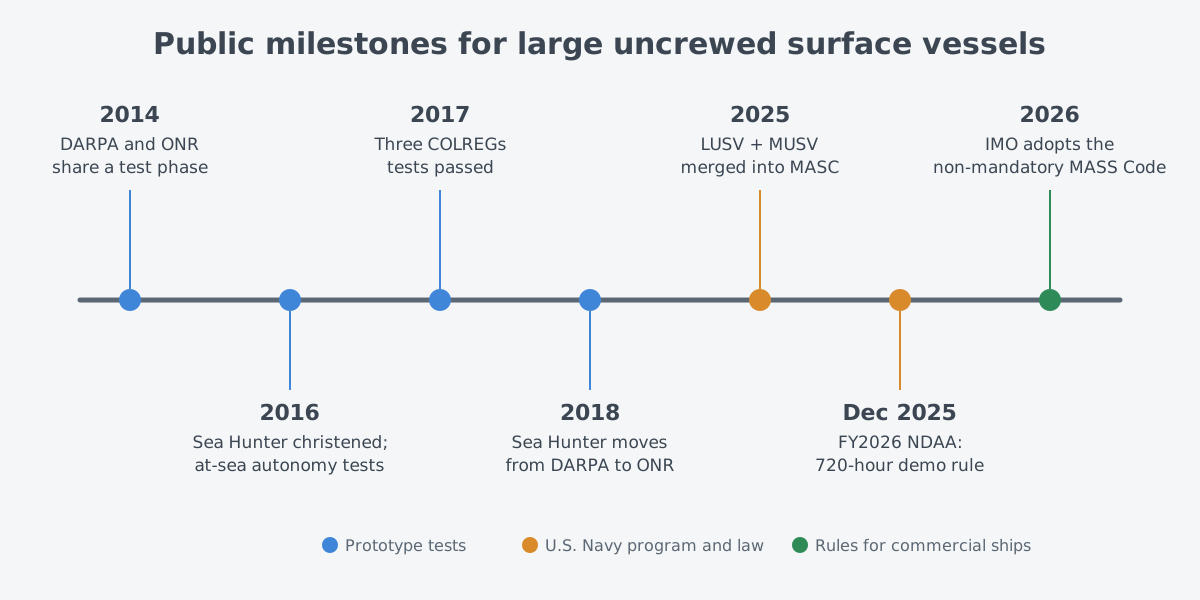
The Navy's program names have changed too. Until 2025, the Navy planned two separate types, the Large Unmanned Surface Vessel (LUSV) and the Medium Unmanned Surface Vessel (MUSV). In 2025, it merged them into the Modular Attack Surface Craft (MASC) program.
Each MASC is meant to carry weapons or sensors packed in containers. The total number and the yearly buys have not yet been announced. Based on Navy force structure plans, CRS says the Navy might want as many as several dozen.
Rules of the road for a machine
The sea has rules much like traffic law on land. The COLREGs were adopted in 1972 and entered into force in 1977, with 41 rules in six parts. In English they are also known as the "rules of the road."
Rule 5 requires every vessel to keep a proper look-out at all times, by sight and hearing and by every means available. Rule 7 warns against assuming things from scanty information. On a ship with no crew, sensors and perception software have to do that seeing and hearing.
The Navy's MASC solicitation sets a high bar. The vessel should avoid hazards and collisions on its own and safely, including in poor visibility and in situations where radio emissions are not permitted. Those maneuvers should follow the COLREGs, and the ship should be able to sort out by itself what kind of vessel it is facing under the rules. In 2018, an ONR program officer also called autonomous control "a challenging area."
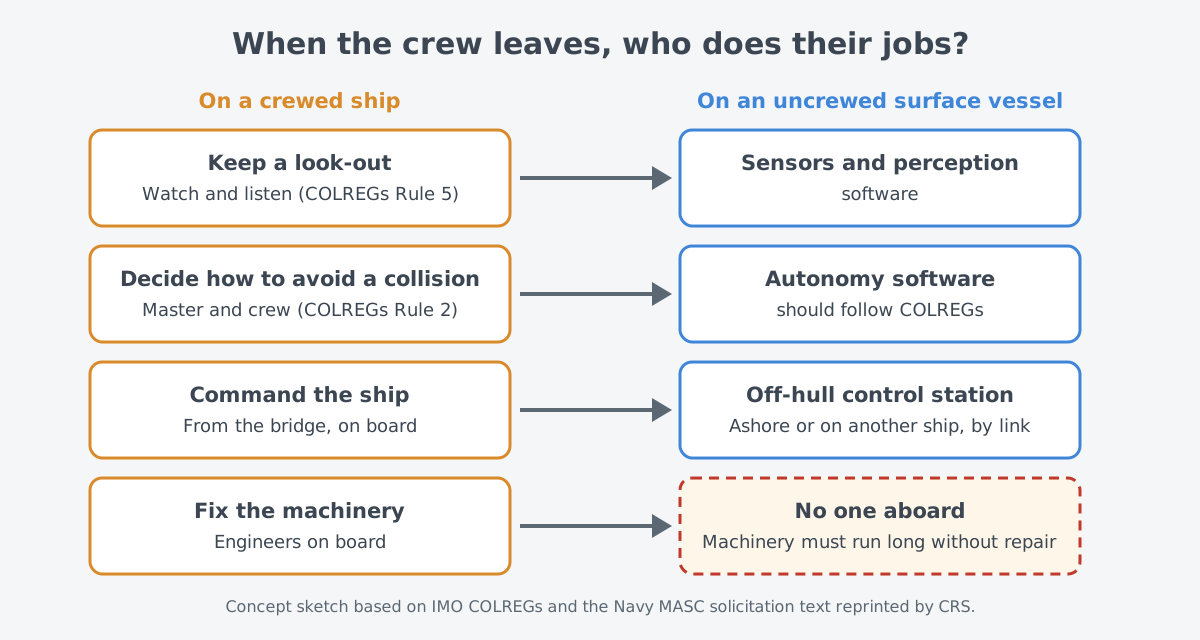
Traffic law on land differs in one way that matters here. On the road, the driver is responsible for obeying the rules. COLREGs Rule 2 likewise names the master, the owner and the crew. So where does that responsibility go when nobody is aboard?
For commercial ships, the International Maritime Organization (IMO) has started to give an answer. In May 2026, the IMO adopted the MASS Code, a non-mandatory set of rules for autonomous ships, and it took effect on July 1, 2026. Under it, the master stays responsible for the whole ship at all times, including when not on board. Trained staff at remote operations centers ashore can monitor or control the ship.
These rules are written for commercial shipping, separate from the Navy plans above. The IMO says that no SOLAS cargo ship in international commercial trade is run autonomously or by remote control today. It expects to adopt mandatory rules by July 1, 2030, with entry into force on January 1, 2032.
When the link drops, the ship is still at sea
With command off the ship, the radio link between ship and people becomes a lifeline. The Navy solicitation asks for a control screen that can run several USVs at once from a single station. That points to one station looking after more than one ship.
What if that link breaks? The same solicitation asks that the ship be able to continue its mission safely if communication with the control station is lost. As noted above, avoiding collisions where radio emissions are not permitted is also on the list of desired attributes.
In the end, the communication problem and the navigation problem merge. If there are moments when no person can be asked, the software on board has to make the call. One of the issues Congress watched was how mature the technology for autonomous USV operation really was.
No one aboard to fix things
On a crewed ship, engineers fix the machinery when it fails. A ship with no crew has nobody to do that. While watching the LUSV and MUSV programs, Congress raised the reliability of propulsion machinery for long ocean crossings to distant deployment areas.
The law now includes a reliability test as well. Section 122 of the FY2026 National Defense Authorization Act (NDAA), enacted in December 2025, requires an operational demonstration in detail design or construction contracts for medium and large USVs.
The main propulsion system or the power generation and distribution system has to run for at least 720 continuous hours. No preventive maintenance, corrective maintenance, emergency repair or other servicing is allowed during that time. At 24 hours a day, that is 30 days.
Section 130 of the same law requires the first MASC version (Block 0) to be purpose-built as an unmanned vessel, engineered to run without support systems for people. The Secretary of the Navy cannot sign a construction contract until certifying this. It points in the same direction as NOMARS, which dropped space for people altogether.
Plenty of questions remain, and CRS lists several issues for Congress. They include the Navy's concept for how to use MASCs and the risk that costs grow, schedules slip or technical problems appear. Another is the chance that large USVs could lead to miscalculation or escalation at sea.
What to read next
- Unmanned underwater vehicles: robots beneath the sea: what changes when the same kind of uncrewed system goes below the surface instead of on top of it.
- Manned-unmanned teaming: when a pilot's wingman is a drone: the idea of crewed and uncrewed platforms working together, seen through examples in the air.
- Drone swarms: is every group of drones a swarm?: how the idea of using many simple machines together has been tested with drones.